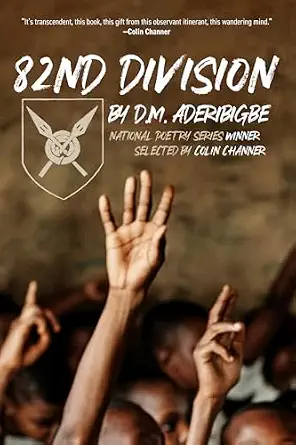
The best Nigerian poetry of the past couple decades is anything but short. More than a decade ago, the duo of Tade Ipadeola and Dami Ajayi enchanted us, and they continue to enchant with their sweeping ruminations in The Sahara Testament and Clinical Blues, respectively. More recent works like Gboyega Odubanjo’s Adam, Nnadi Samuel’s Nature Knows A Little About Slave Trade, and Theresa Lola’s beautiful Ceremony for the Nameless, earn the outstretched length of most lines and poems in their respective collections through a certain sense of creative alertness. In the Nigerian poet D. M. Aderibigbe’s second full-length collection of poems, titled 82nd Division, length is used as a strategy for both thematic and formal contrast. Each equally important and central to the overall articulation of the book’s intentions, the poems showing the poet’s formal project are shorter while the ones that serve as its thematic heart run on for pages, albeit structured in a way that gives the opposite sense. This is one of the reasons why 82nd Division is, at least on the surface, fascinating.
The first time I read a D. M. Aderibigbe poem was around the time I was doing research for a short and polemical defense of the Jericho Brown-invented poetic form called “duplex” in 2023. Aderibigbe, too, had written a duplex. His duplex, titled as such and about love and aging, was the singular poem among the cluster of duplexes I read, with alarming disappointment, that was not only passable but also can be described as decent. Reading a full-length collection of his poems is therefore a welcome prospect, if only taken as a chance to see how Aderibigbe, in his formal endeavours in poetry, scales past the limitations of those earlier embarrassing examples. 82nd Division is convincing enough evidence that he has what it takes to make the poetic forms work in the service of the proper articulation of his observations and ideas.
When it comes to the formal aspects of the book, Aderibigbe is nothing less than studious and solemn: he is industrious with and obedient to the most painstaking aspects of each poetic form. In the traditional sense, he is a true formal poet because he understands a form is a form because of the rules within which the poet must prove his craftsmanship and competence. And so he does across an impressive range of traditions: he tackles the finical strictures of the duplex in “Duplex (An Elegy Is)”; the synthesis of prose and poetry of the haibun in “Annual Manual Labor Day”; the historical curation of the found poem in “Gathered During a School Trip…”; and the alphabetic—and lexical—constraints of the abecedarian in “Christening.” In each instance, his formal poems hew as closely to their constraints as locks to their jambs. In “Duplex (An Elegy Is)” Aderibigbe follows each rule carefully—the poem is written in couplet; each line is between nine and eleven syllables; the second line of each couplet is repeated, if in a slight variation, in the first line of the next couplet; and it is exactly fourteen lines to reflect its sonnetic origin:
An elegy is a love poem.
Says my uncle—who smiles into a mirror.

My uncle smiles into a mirror:
the face he worships is a palace.

The face he worships is a palace
of wrinkles—though, nothing new to see.

Lo ti to, wrinkles are nothing new to see:
time is a bus, always on the road.

I am a bus, always on the road:
old lovers now mistake me for a stranger.

My lover warns: don’t make me a stranger,
love, if what we have were ever over.

Love, if what we have were ever over,
would we be an elegy or a love poem?

Since the form is the smart concatenation of the sonnet, the ghazal, and the blues, the poem also turns out thematically and rhythmically obedient to the form. The decency, as opposed to the outright accomplishment, of the poem is attained half by Aderibigbe’s regard to the basic constraints of the form and the other half through the subject, language, and movement of the poem itself. Under Aderibigbe’s handling, it is easy to feel the precise impression the form seeks to evoke in the reader because it holds multiple mediations simultaneously. The poem moves from the self-perceptive image of the aging uncle finding dignity—even majesty, as symbolised by “palace”—in his own reflection, to the speaker’s anxiety over becoming unrecognizable to his lovers. Then these seemingly disparate meditations converge on a profound question about the nature of love poems. Are elegies fundamentally love poems? Or are love poems always tinged with elegy, knowing they contain their own ending? Aderibigbe puts the question to us by the virtue of the form he’s working with, which saves him from making the mistake of belaboring its point.
Since some of the most wonderful poems in the collection are written in received forms from across different literary traditions—English, African American, Japanese, and Arabic—it’s easier to recognize Aderibigbe’s recognition of formal discipline as both aesthetic choice and interpretive framework. Take, for instance, his haibun titled “Annual Manual Labor Day”, where the form’s traditional pairing of prose and haiku becomes a vehicle for something more unsettling than the contemplative serenity the form is typically employed to evoke. The prose section sets a scene of apparent pastoral calm:
There’s a green field inside the matron’s steely gaze. Instead of sweeping through it with a machete like your peers, you sit on the other end of the school compound, among a constellation of short shadows, and pick out peanuts from your protruding pocket. Around you, a stretch of tall grass bends to the tunes of the afternoon breeze, chickens bathe in warm sand, and lizards of all stripes seek crickets to crush.
However, the cool and calm ambience of this particular moment will soon be attended by an ominous prediction of a violent past. The subject of the poem has been in that calm moment of rest before and knows it to be anything but permanent, even if he wishes differently. In the following mediation, Aderibigbe criticizes forgetting the past in the comfort of the present, which can be deceiving, as well as make complacent: “You know too well that, soon enough, you will hear the footsteps of the past year at your doorstep. You know too well that, soon enough, the night will birth another blood-soaked memory.” The interesting thing about form that this poem further validates is that when a poet is serious enough to give form its due, the form carries the heavier loads off of the poet’s shoulder. In this particular case, the haibun uses the tension between the characteristic meditation of prose and the compression of the haiku to show the dichotomy of the tension between peaceful present and violent past. The essence of the haiku, obvious wishful thinking in the ambience of the poem, is paradoxical:
Night returns early
in December—that cool warmth,
those sonorous snores.

How can warmth be cool? How can rest be possible when memory is always “blood-soaked”? Aderibigbe’s achievement in this haibun is a formal demonstration of historical consciousness: the way the past does not stay past. Rather, it returns annually, ritualistically, like Labor Day. The prose circles back to the same realization as the haiku reflects a descent further into the comfort of forgetting. This is how the formal poems in 82nd Division prepare us for the historical work the longer poems will undertake: they show us that form can be a kind of historical memory, that repetition and constraint can replicate the cycles of violence and amnesia that structure collective remembering.
Beyond its various formal displays, the equally primary purpose of 82nd Division is historical. Its main subject is a history no longer present in our current consciousness due to our characteristic selective amnesia in Nigeria. Until my engagement with the book, I hardly knew anything about the personal sacrifices and vast contributions of our Nigerian military to the Allied victory during the Second World War. During the war, a division of the Nigerian army called the “82nd Division” was instrumental in the Allied victory against imperial Japanese forces during the grueling Burma Campaign, and Aderibigbe writes the longer poems in the book illuminating their experience and other contributions now absent from our collective memory.
Another one of Aderibigbe’s most excellent poetic reconstructions of history is his found poem, “Gathered During a School Trip to the Old Colonial Secretariat, Lagos,” in which he talks about the colonialists’ initial gift-giving strategy to buy African traditional monarchies, the importance of understanding the contexts surrounding one’s history, and, in one of the shortest, clearest, and simplest summarisation of its nature, the Scramble for Africa of the late nineteenth century:
In Berlin
between 1884-85, tension

about how to share Africa
was examined and settled

among warring European nations.
And it was determined:

each nation hoisted its flag
on any African land

in their line of sight.
That way, a territory was drawn.

The point of the poem is that the mechanics of our colonial history is not as complicated as the imperialists might want us to believe, if only we bothered to investigate it. Though the colonial history isn’t necessarily morally complicated, Aderibigbe is not as straightforward in his retelling of other pieces of history as he is about the Scramble for Africa. In “Christening: An Abecedarian,” a poem about the naming of African countries, especially Nigeria, he starts with the reasons the imperialist Europe was interested in Africa in the first place, borrowing Jericho Brown’s expressive strategy in “The Tradition” to name the specific items of their greed:
Aframomum. Black-eyed bean.
Cocoa bean. Buried—in sacks—in the cargo hold.
Columbite. Gold. Pegmatite. Tantalite.
Dragged onto the lower decks.
Every single day, a crowded ship sailed
from the coast of Lagos to Bristol.

The poem then moves through the alphabet of colonial violence, their instruments of oppression—“Grenade. Gun. Gun. Gun. Gun. Gunpowder. Gut.”—before arriving at the casual administrative decision that gave the country its name. What makes this poem particularly devastating is how the abecedarian form, often used for children’s learning, becomes a primer in imperial brutality. The constraint forces Aderibigbe to find the precise vocabulary of extraction and exploitation at each letter. By the virtue of those constraints, he creates an inventory of colonial trauma that reads like a ledger of theft.
However, it is in the collection’s eponymous sequence poem, “82nd Division,” that Aderibigbe’s historical recovery achieves its most sustained power. Written as a series of dated diary entries from September 1943 to April 1945, the poem gives voice to a forcibly conscripted Nigerian soldier fighting for the British in Burma. The formal choice here is crucial because, by adopting the diary form and fragmenting the narrative across time, Aderibigbe reflects the fractured consciousness of men torn from their lives and thrust into a war that was never theirs. The speaker remembers:
At every turn of thought, I see
that sunny day: while whistling my way
through the garden I tended—
each of my palms a bed of blisters—
three men, British, barged into my view,
two grabbed me by my underpants. The third—
the man who owned the garden—stood beside them.


The violence of conscription is rendered in the humiliating specificity of being grabbed “by my underpants,” a detail that captures both the physical violation and the deliberate dehumanization of the act. As the poem progresses through its dated sections, we witness the soldier’s growing awareness that he and his fellow Africans are expendable: “…our dead necessary bait,” as Commander Bruce calls them. The poem’s most gutting moment comes in the final entry, April 1945, when the British commander gives his victory speech and extends his gratitude “to the Queen and the prime minister,” “to all the British soldiers,” “to British people everywhere,” but offers “no further gratitude” to the African soldiers who died to secure that victory. The anaphoric repetition of “In his speech, he extends his gratitude” becomes a drumbeat of erasure, each iteration emphasizing the important unsaid.
In 82nd Division, D. M. Aderibigbe harnesses his expressive commitment to craft as the vehicle of his historical retelling. The formal poems teach us how to read the historical ones, and the historical poems give a certain weight to the formal exercises. Refusing to let selective historical amnesia continue its work of erasure of moments and individuals like the speaker of the eponymous poem, the collection is accomplished in its dual conditions of aesthetic and moral obligations. In addition, it reminds us what we have been conditioned to forget, as well as teaches us some of the things we never learned in the first place.