She could have taken it to court, but the mediocre lawyer billed $175 for half an hour of “reading and processing correspondence,” which really encouraged her desire to minimize legal action. Maybe that was just her being lazy. Maybe, on some level, she enjoyed being forced to do this, dragging other people into her bizarre pain.
Otherwise she was sure she’d dance around it, feeling immense guilt while knowing logically that she didn’t owe the store clerk at Sephora or her random coworker the news of her father’s death.
Besides, the stipulation was only for a year. Who even knew that requiring your child to tell every person they interact with that you recently died and are missed was something you could incorporate into your will, a pre-condition to accessing the trust? The lawyer made a kind of hybrid laugh exhale noise when he first read it. “I know how you feel, I lost my father too,” he offered weakly.
Her dad wasn’t even some eccentric billionaire with an army of lawyers—half the money she would’ve inherited was frittered away on obscure cryptocurrencies and perplexing amounts of wild-caught salmon. But it is still a sizable sum of money, so here she is, gearing up to recite her spiel to the flight attendant at the gate scanning boarding passes.
She thought about going away to some remote island or foreign country to avoid the whole year. The problem with “away” is that she herself never gets to go there. She’s always stuck with herself and her dead dad. Not talking about it wouldn’t free her.
It’s almost over though, with today being the anniversary of his death. She thought about booking an earlier or more roundabout flight to spend less time interacting with people, but that felt like an admission of what this year had done to her. She considered throwing a party to celebrate this big obstacle being officially over. There wouldn’t be another clearly defined endpoint in the grieving process, after all. But the thought of someone’s plus one jovially asking what they were all celebrating made her want to lay facedown on the floor, so she never worked out the logistics of the party.
Over many, many practice opportunities, she’s gradually optimized the best way to say, “I’m alright, my dad recently passed away. He is missed.” Luckily, she doesn’t have to specify who exactly misses him. She experimented with including “estranged,” though she wasn’t sure most people registered it, or sometimes she went with “died” or “was found dead” to make it a bit more brutal and mysterious. She suspected that all keywords under the umbrella of discussing death in banal public life set off the same high-pitched alarms in people’s heads. She said it fast, she said it slow. She emphasized different words, shifted the cadence, looked away, made extreme eye contact. She attempted to breadcrumb by using past tense to describe him before she broke the news. Maybe a hundred more times and she’d get it right, stick the landing. She’d become an expert in telling people her dad died.
At one point, she contemplated handing out an FAQ, but people love to avoid reading and her apartment was already overrun with loose papers. She wondered if wearing a button would have counted? Custom printing a 1 of 1 “MY DAD DIED. HE IS MISSED.” button had a certain blitheness to it. Too late now.
“How are you?” didn’t even genuinely ask how you are in a normal situation, something she’s always been baffled by. An international student once told her that was one of the first tidbits of American social etiquette they were taught—that Americans love to ask about you with no desire to hear the real answer. It’s ritualistic with a script to follow: say “Good” and they say “Good.” Maybe “Okay” if you want to allude to some distress, but nothing further than that.
So what came next was predictable, the agreed upon clip of the chat inevitably lurched to a stutter. “I’m so sorry for your loss!” they would exclaim, the register of their voice suddenly leaping upward, like the vocal version of sitting up straight. Sometimes she could see the other person’s thoughts of mortality or their parents’ mortality pooling, unwanted, on the floor of their brains, a leak that no plumber nor therapist could fully plug. She could see the bank representative furiously trying to estimate her age; he was trying to figure out whether he was older than her dad.
Her brain skittered too, trying to figure out how to smooth everything over. She felt irrationally responsible and would attempt to salvage the vibe she’d just ruined. Unfortunately, she’d made more strangers and acquaintances cry with this information than she herself had cried.
Sometimes people had the gall to ask more invasive questions, even as they must have known nothing she said would make them feel better. They must know the chances of “What happened to him?” being answered with, “Well, he lived a good, full life, and passed gently in his sleep, surrounded by everyone he cared about and having said all he needed to say,” were low. She’d considered telling some outrageous lies just to mess with nosy people (maybe “he died in a freak cheese shredding incident”), but that felt mean. It’s no one’s specific fault that everyone is so bad with this kind of thing.
Boarding a flight is not the ideal time to be complaining about how people talk about death and dying. She locates her seat and maneuvers her carry-on suitcase into the overhead compartment, turning it “like a book on a bookshelf,” as instructed by the middle-aged flight attendant with the winsome smile greeting passengers at the front of the airplane, who she had to inform about her father’s death in a painful drive-by. The flight attendant’s face fell, and then she quickly plastered the smile back on, but it seemed like a bit of the joy vacated her green eyes.
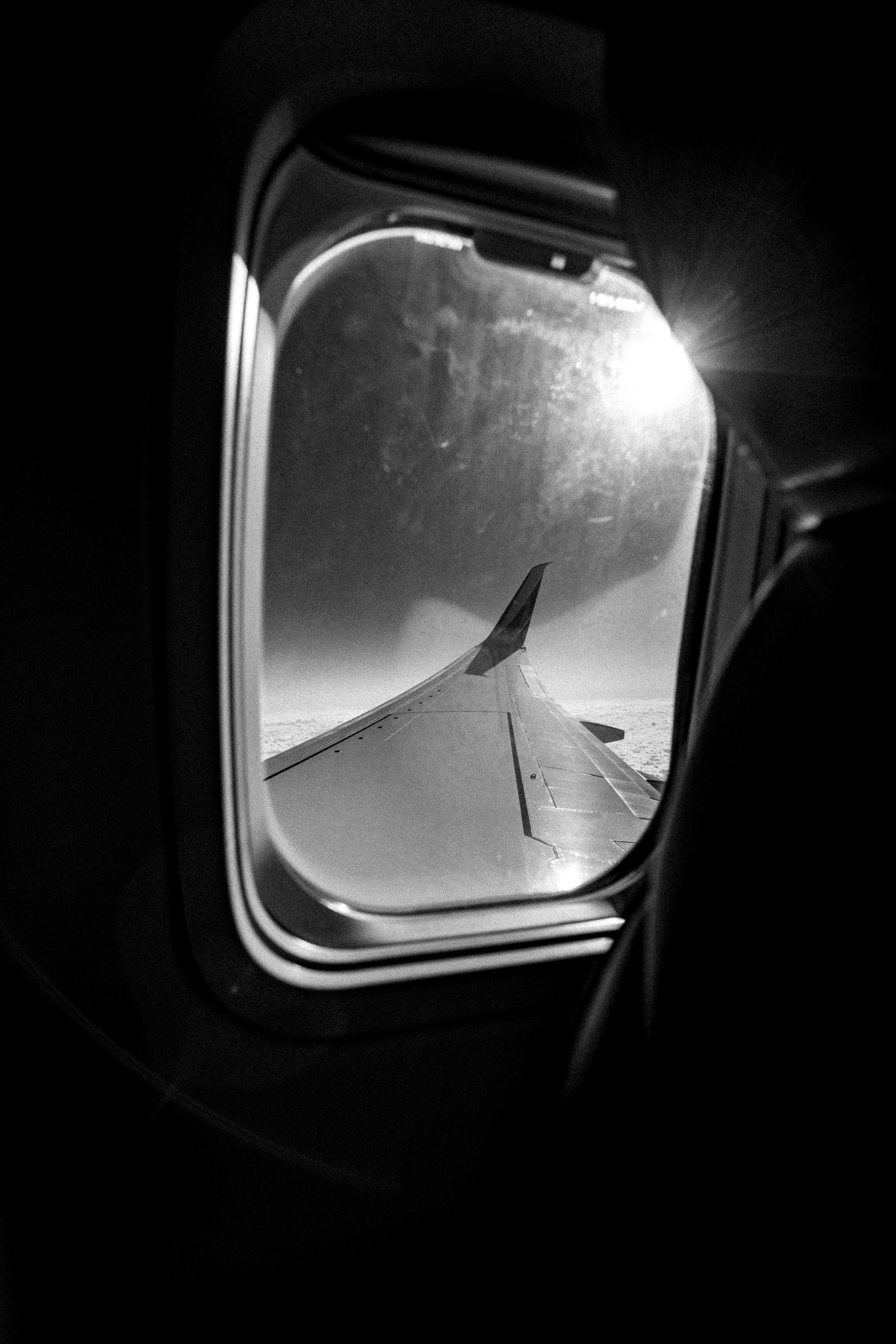
She sidles ungracefully into the aisle seat of her row, silently hoping that the modern antisociality crisis applies to her seatmates. In the window seat sits an older woman with short grey hair and earbuds plugged into the screen in front of her. The woman is scrolling through the movie selections, pausing almost exclusively on films that sound like they were made up to be the butt of a sitcom joke. The two of them will not need to interact.
Nobody is sitting in the middle seat yet, which means the poor soul will have to ask her to get up to let them in. It’ll be down to the wire.
A kindly middle-aged man is making his way towards her row. She tugs on her sleeves and wonders if this man has his will updated. She wishes it were socially acceptable to throw in that public service announcement after talking about her dad dying. The man passes her by.
When did her father call up his lawyer and insert that fifth item under Article III in his will? Was it during the last few years, when she’d stopped talking to him completely? Had he found the wording on some kind of weird Internet forum? Had the idea sprung fully-formed from his warped mind? Was it meant as a twisted punishment? Had he thought that her saying it over and over would magically make it true?
On the plane, a father ushers his son to their seats while the son sputters nonstop questions about air travel and pilots and the father tries to answer to the best of his ability. She bites her lip. A friend will say, “I’ll just ask my dad,” and she questions who she would reach for in the same circumstances, who she’d be if she’d had someone to turn to there. Once, in a group conversation, someone mentioned the apparently universal-to-everyone-else experience of faking sleep on the couch or in the car as a kid so their dad would pick them up and carry them to bed. She stared past everyone at the wall and wondered who she would be today if her childhood was associated with tenderness.
He didn’t push very hard when she cut off contact with him. There was no massive fight, no inciting incident. It was anticlimactic.
On the rare occasions that she’d tried to explain it to other people, she found herself emphasizing the more blatant—the alcoholism, the controlling behavior towards her mother, how he forgot to pick her up from school, from the airport, from the dentist. She felt obligated to preemptively defend herself from accusations of overreaction. Everything would spill out like a cartoonish overstuffed suitcase being unzipped.
But if she is honest, what had been the hardest to process was all that she’d missed because he never tried to be a father. It’s hard to identify what was missing when it’s a cumulative lifetime of paternal involvement that is lacking. At best, she could gesture at the gaping hole, a different kind than the one he left in the drywall.
She absentmindedly pulls the drinks menu and the safety information out of the seat pocket like they’ll have changed since the last time she took a flight.
She’d been keeping her mouth shut more than she liked because of the will. She didn’t want to order at the restaurant, and winced when someone stopped her to ask about her dog’s age or name.
Even if she didn’t have to tell everyone, it would still be on her mind. But the weird part was that it was often a thought that didn’t lead to any others. She had always struggled with meditation because she’d get distracted, mentally leaping from one thought to another until she’d be revising her to-do list or trying to recall the name of a fourth-grade classmate. But where did, “My dad died,” go? She just sat with it in her hands, a hand-me-down she couldn’t throw away but also didn’t want to keep.
The middle seat passenger is finally here, one of the last people to board the plane. It’s only twenty-two minutes from departure time and only six minutes from her freedom. There always has to be a last person to go through anything.
The middle seat passenger is a girl roughly the same age as her, hair piled messily atop her head, wearing a college sweatshirt, leggings, and a maroon backpack. Bulky headphones sit around her neck. She’s still four or five rows away, blocked by a flight attendant asking exit row passengers for verbal confirmation that they can complete the duties asked of them in an emergency situation. Life really is full of things you have to just say, regardless of whether you mean them or not.
Her heart rate is up. They’re racing against the clock. She’s almost excited to potentially make the girl’s flight experience a little offputting. Her jaw aches—she realizes she’s been clenching her mouth shut since sitting down. She unlocks her phone to supervise the rounds of the red second hand on the Clock app icon. The expiry for the mandate isn’t the actual time of death because nobody knows it; he died alone. Instead, it’s 5:00pm, end of the business day.
She politely smiles and shifts out of her way. It’s 5:01pm. The girl is texting heart emojis to a family group chat. Her seatmate doesn’t know it, but she’s lucky. The flight attendants are closing the overhead bins and making their safety announcements. By the time she sits back down and buckles her seatbelt, stray tears dot her pants.