Horror protagonists these days are self-aware and snarky about the tropes they’re living through (or failing to live through). Gen Z knows more about movies from YouTube Shorts, parodies, and fan commentaries than from watching the movies themselves. For Barnaby Jones, the teen protagonist of Dom&Ink’s campy horror-comedy graphic novel Queens of the Crypt, Vol. 1, discovering a secret lair of high-femme movie monsters within their closet is NBD compared to the mundane pain of being misgendered by their parents and harassed at school.
Then again, Widow’s Creek is no ordinary town. Like Salem, Massachusetts, where a history of Puritan persecution has been rebranded as a tourist attraction, “Witch City,” Barnaby’s fictitious home base, has leaned into the legend of the Faceless Frightener. This man-killer, who was so extra that she ripped off her own face in a fit of pique, is memorialized in the kitschy museum where Barnaby works after school, as well as in gift shops and coffee bars and my personal favorite, “Widow-nuts” pastries.
Underneath these fun frights, real dangers press in on the young residents. Other teens have recently disappeared. Barnaby’s best friend, Fiona, starts to hear weird voices in her room at night. And in the background, mostly unspoken but adding tension to the microaggressions Barnaby faces, is our real-life political climate that tells queer and trans teens that their pain doesn’t matter. I’d rather put my fate in the hands of five undead ballroom house mothers than nine Supreme Court Justices.
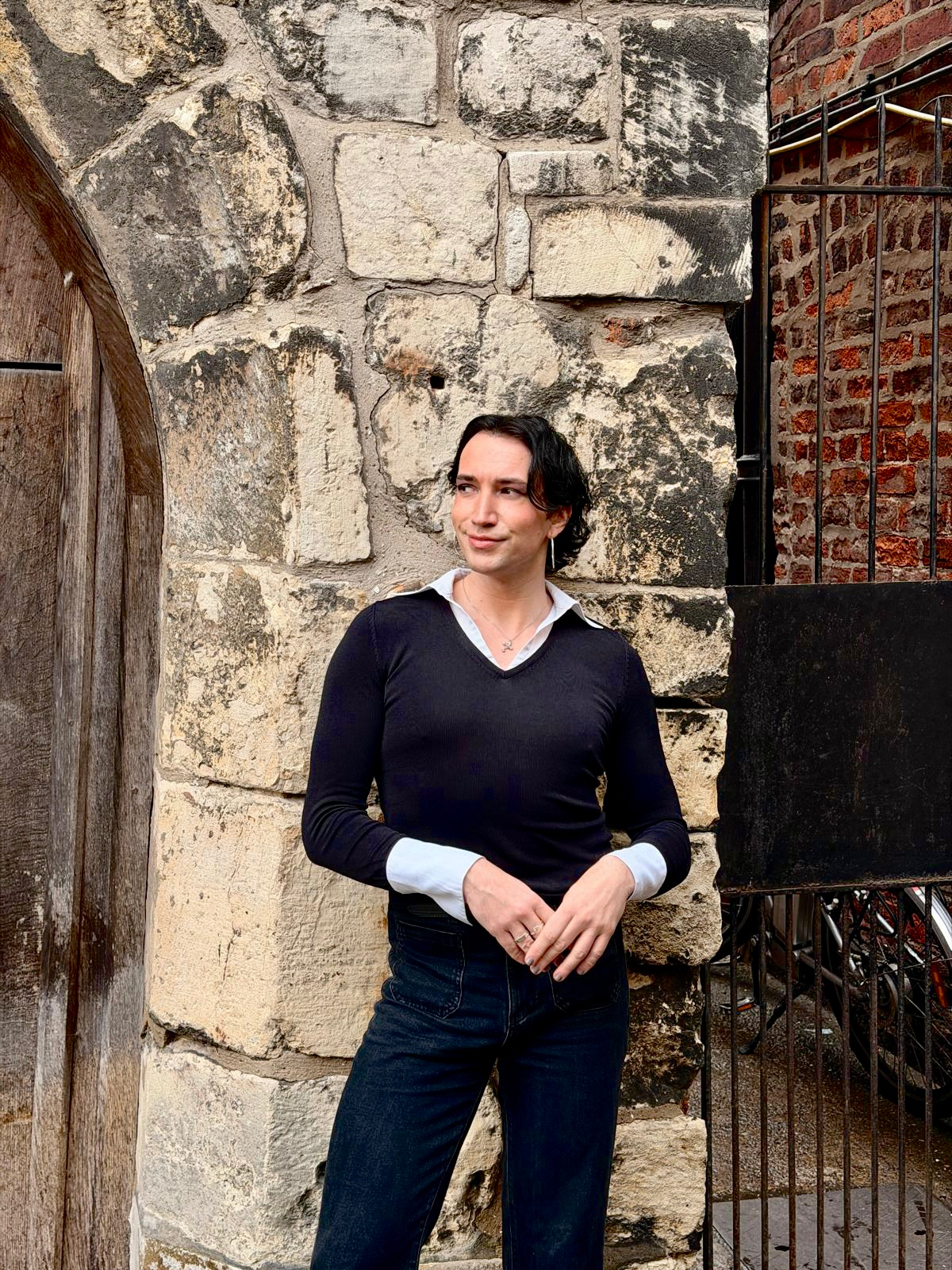
Queens of the Crypt is the debut graphic novel of British freelance illustrator Dominic Evans, pen name Dom&Ink. With a background in fashion illustration and a passion for reality-TV divas and comic books, Dom&Ink wrote and illustrated this story to provide affirming representation for all of us who’ve identified a little bit too much with The Phantom of the Opera.
We spoke over Zoom in July: they in York, England and I in Northampton, MA. We talked about queer monsters, respectability politics, librarians as action heroes, aesthetic influences from film noir to Real Housewives.
This interview has been edited for length and clarity.

The Rumpus: Tell me about your art style. The style reminded me of Nightmare Before Christmas a lot—the scratchy long lines, exaggerated angles and noir shadows.
Dom&Ink: When I was younger, I taught myself to draw from comic books. I would buy comic books from this tiny comic shop in Bolton, which was really rare, to get a comic shop where I live, called Dominion Comics. And it was the size of a shoebox, and I’d go and buy a comic, and I would copy the drawings.
I got a bit too good at it, because this was the 2000s, so everyone had huge boobs and tiny waists, and at school, when I was asked to draw Mary for the Nativity, let’s just say that drawing didn’t end up being used. She was like Pamela Anderson.
I was obsessed with drawing comic books. I bought a book called How to Draw Comics the Marvel Way that’s still available. I remember the most important part in it was where Stan Lee says something like, “if you want a woman to look evil, give her high eyebrows and high cheekbones.” Every woman I’d draw, no matter how good or evil they were, was always like that. I could draw Mother Teresa, same thing.
I loved fashion illustration as well. So I love drawing people and figures. And over time my style developed through that. And working in illustration, I did work on lots of different things, I did a book called Free To Be Me (Penguin Workshop, 2020) that was like an interactive LGBTQIA+ journal that had different figures in it.
I also did illustrated content for Drag Race UK, for the BBC, for their official channels, so I’d draw the queens in their winning outfits, or eliminated outfits, and iconic viral moments from the show. That helped craft getting into Queens of the Crypt and really telling the story of it. Drawing loads of drag queens and women with high cheekbones and high eyebrows got me ready to draw the Queens.
For ages, we really thought about whether to make the graphic novel full color. I was so adamant that I wanted it grayscale and black and white, because it gives a nod to all those classic horror films, and Hitchcock films, and the Cabinet of Dr. Caligari kind of vibe. And I love that on the paper it’s printed on, it has that crackle to it, almost like a TV when you’re reading it.
With all the heavy blacks that are in it and the shadows, I wanted those to represent the crypt creeping more and more into Barnaby’s life. So at the beginning of the book, it’s quite light. And then as you read further, it gets darker and darker and darker ’til it’s almost fully black towards the end when we have some of the darker moments.
Rumpus: With black and white, you have to pay more attention, when you’re illustrating it, to the gradients and the shadows, since you can’t rely on color to do that. I’m trying to picture how the book would have been in color, and I think it would’ve been more like a horror movie and less like a ghost story. The current vibe is a little more playful and friendlier for the young adult readers.
Dom&Ink: Yeah, totally. When I did the color experiments, with a lot of purples, yellows, and navy blues, the one word I could use to describe it is, it looked a bit “pulpy.” It took away the edge. Having purple accents only on the cover was the right balance. The American version will have a sprayed edge, too, with purple all round it.
Rumpus: How did you get the publishing deal in the first place?
Dom&Ink: I’d been pitching the book with my literary agent since 2020, and we kept getting rejections. A lot of the time, it was that horror wasn’t trendy. What changed? Wednesday came out on Netflix, and everyone’s doing the TikTok dance. Everyone’s banging about Wednesday. And slowly there was this uprising, the horror trend. So then the UK was still deciding what they thought of it, but straight away Penguin America were interested. I’ve always been told that America’s five years ahead in terms of graphic novel publishing. I’m constantly told this all the time because I feel like in America there’s more of a recognition for graphic novels.
Penguin was really passionate about it, and I genuinely was quite gagged. When I got on the call with my literary agent in January 2023, they were like, “We love this,” and it was really validating, because I was like, “I knew I was right about this,” because it had been years and years and years. I even shared it on Instagram so that I could get comments that I could screenshot to send to publishers, saying, “Look at all these people who want it,” because sometimes they need to see that there’s an audience there for it.
Obviously now horror’s massive. Obsession’s done amazing at the box office. Horror’s winning Oscars. Horror fiction is really taking off. There’s so much out there. So hopefully this is the right time for the Queens.
Rumpus: We’re living in such horrifying and surreal times, I think there’s a demand for stories that are a little bit extra, that are bigger and bolder and more unusual than the kind of bourgeois narrative realism that feels so 1990s “End of History” to me right now.
There’s a lot of politically infused horror right now that I think is really great literature. A lot of Black history horror, like Lovecraft Country (the book and the TV show), Tananarive Due’s The Reformatory, anything by Victor LaValle, Sinners, the movie.
We want something as horrible as real life and as ridiculous as real life, but that’s going to have a resolution that is upbeat, with justice in our lifetime.
Dom&Ink: It’s true. Everyone needs a bit of anxiety escapism, where it’s something that you watch that might be horrific, but it soothes your anxiety, because you know it can’t happen to you, because it’s so outlandish. I read online that there’s been a 23 percent uptick every year in horror in fiction every year for the past 5, 10 years. In the booksellers, horror’s smashing it in fiction, and the main genres that are doing really well are femme gore, like feminist gore, like Lucy Rose’s The Lamb, queer horror, and spore horror, or “sporror,” which is like spores and plants growing out of your skin, botanical horror. I was like, “That’s called having no money living in London, babes. That’s the council flat I lived in for five years.”
Rumpus: It wasn’t mold in the shower, it was your muse.
Dom&Ink: Maybe that’s what it is. Maybe horror is the leader of the revolution.
Rumpus: So about Barnaby Jones, I knew the name sounded familiar and I Googled it, and it was a 1970s detective show starring Buddy Ebsen. As far as I could tell, there was nothing queer or supernatural about it. Is there a reason you refer to it, or is it a complete coincidence?
Dom&Ink: I really like the name Barnaby. And I kept hearing it. There was a day when I was thinking of names for the main character. At one point, I think it was Theodore. I remember hearing this woman in London go, “Barnaby, Barnaby!” And I thought, “That’s the sign. That is the sign, some random woman’s screaming at a child at a bus stop, Barnaby!” And I thought… “That’s Barnaby Jones. The universe is calling to me.”
Rumpus: Tell me more about what representation you felt was missing, that you wanted to portray with Barnaby.
Dom&Ink: I was really excited developing them, because I feel like they’re a character you don’t get a lot of, as a main character in stories.
Growing up, I was always very effeminate. In playgroup, which is like nursery school, I’d always want to wear the princess dresses. I remember being personally offended that I was asked to be the clock in Cinderella as a school play. I was like, “I’m Cinderella!”
I never related to big, muscular kind of Wolverines, action man style characters. I always related to Catwoman and Poison Ivy. I think a lot of gays did. And then as I got older, and processed more of me being non-binary, I was looking around and realizing that there’s a lot of different queer representations missing, and one of them is that non-binary, trans femme person.
When I was younger, I’d have loved to see someone like me running around fighting monsters, because normally a character like Barnaby is the sassy best friend, or in the ensemble of the story. They never really get a love interest. They don’t move the plot forward.
The most representation you can find is the contestants of [RuPaul’s] Drag Race, where they’re all very dynamic and interesting and fun. And something like the British film Everybody’s Talking About Jamie, about the young drag queen who performs. But there’s still not tons of it in books, TV, film, comics. You might have these characters, but they’re never the focal point of a story.
I really wanted Barnaby to have that moment. And whilst navigating the queer trauma of it, also being able to kick the shit out of a DM. I was like, “How badass is that, that they could just, like, go beat someone up?” Yeah, violence does solve problems. Let’s go.
Rumpus: I really like the way that identity was something that just happened in the story rather than being labeled. I’ve just described Barnaby as a non-binary trans femme, but somebody else might read them and say, oh, this is a proto-trans woman figuring herself out, and somebody else might read it differently, and it isn’t as important as them being themselves.
And to me, that felt like you were giving people who read this book the freedom just to try on things without having to affix a label to it. But I’d love to hear your thoughts about identities and how you imagine these people and what parts of the LGBTQ spectrum you saw them fitting into in your mind.
Dom&Ink: For me, the Queens always fit into so many different categories. I wanted the Queens and Barnaby to be quite malleable to readers, so that wherever they are on the queer spectrum, or the trans spectrum, or non-binary, they could see a little bit of themselves in Barnaby, but they might also see themselves a bit in the Phantom, or the Countess, or someone. So the Queens are quite queer/trans-coded in that way.
The starting point of it was: “Wouldn’t it be great to have female versions of horror male characters,” because horror is very male centric. We’ve got a lot of final girls, but I mean, some of the big horror characters, they’re all men. Women can be serial killers too!
If you look at all the classics in black and white, and all those huge films that had a massive thing between the 60s and 80s, a lot of them are male, and I just thought, it’d be great to have some female ones, wouldn’t it? And then I thought, “What would a female Phantom of the Opera be like?” Iconic bitch!
And it’s a really weird analogy, but I’m always fascinated by the relationship between big female pop stars or the Real Housewives—these icons that the queer community put on pedestals—and their relationship with the gays.
I always find it really interesting when a Real Housewife who’s never mentioned the queer community before on TV is so active offline for queer rights, like Bronwyn on Salt Lake City is very pro-trans and everything, but it’s hardly mentioned on the show. And I find it very interesting that they have these personal connections with these queer people in their life. So I saw the Queens as a set of Real Housewives of the Crypt.
When I was drawing it, I thought, “As a film, who could play these characters?” The Countess could be played by someone like Michaela Coel, or Angelica [Ross] from Pose, or someone like that. They’re all very queer-coded in their own way. I was conscious about labelling them, but then I thought, I don’t want to, because I want readers to be able to build that. And also, there’s bits coming up in further books where there will be more hints dropped about this.
Rumpus: Definitely room for more backstory, and hopefully the romance between the Countess and the sexy librarian, Miss Kwan! That was so cute. And I loved seeing a librarian also being a sword-wielding ninja because libraries have been at the center of the attacks on queer stories and access to books like yours for young people.
Dom&Ink: I love librarians. Recently I did the UK press day for Bonnier Books, which is releasing it [Queens of the Crypt, vol. 1] in the UK under the Hot Key imprint, and the librarians in the audience came up to me afterwards saying, “It’s so nice to see a librarian in a story. We rarely get a moment to shine.”
I love the character of Miss Kwan and her being someone who’s gone through a separation, and she’s had to move back to Widow’s Creek with her mum, and she’s befriended Barnaby, and then she gets caught up in this whole adventure and having a bit of a flirtation with the Countess. That was really fun to do. I just loved having a big action set piece in a library.
Rumpus: Widow’s Creek reminded me of Salem, Massachusetts, the way it leans into the witchcraft thing and makes it very touristy. A middle ground between touristy and actually witchy people who take it seriously. And you always have that plausible deniability on either side of the line…
How did you come up with the town of Widow’s Creek? Is it based on any place or composite of any place, real or fictitious?
Dom&Ink: I’ve always been inspired by York. This is where I live now. My sister’s lived here for a very long time, and I only moved here about two years ago from London, but York is a very Gothic city. I think, if I’m right, it’s the second most haunted place in the UK. I actually live just near the castle walls, so it’s got a castle wall that runs all the way around it. It’s got a place called The Shambles, which has loads of cobbled streets and old thatch houses.
There’s ghost hunters here all the time. There’s a ghost tour that goes outside my flat, twice a day. And I’ll be watching the Real Housewives scream at each other, and then I’ll hear, “In 1800, fifty people were killed on these battlements.” I’m like, “Oh!” And it’s all about beheadings, executions, treason. It’s a good time.
Even the cafe down the road when I first moved here, the lady that owns it was telling me about how they got an exorcist in to get rid of the ghosts in the cafe and apparently there’s a demonic presence downstairs, an old lady upstairs, so they got rid of those, but there were two Roman soldiers that apparently were very harmless and just liked to chat with people and watch people have conversations.
So I loved that everywhere in York’s got a ghost story. Coming here more and more to see my sister, it definitely inspired the idea of Widow’s Creek, which was also inspired by that kind of Salem town as well, where they filmed Hocus Pocus. That was my blueprint for it: a town that really leant into the horror, supernatural, commercialized on it as well. And I loved the idea of giving it a made-up figure, “the Faceless Frightener,” a Headless Horseman kind of figure that some people completely believed. And it had a ludicrous backstory—she rips off her own face.
Rumpus: In Widow’s Creek, you have a mix of people who are accepting or queer- or trans-looking themselves, and people who have some issues with it, including Barnaby’s parents and the security guard at Barnaby’s job in the tourist museum. How do you envision the culture of the town?
Dom&Ink: In terms of the culture and the people, I think wherever you go, there’s always going to be those voices that maybe aren’t as accepting and aren’t as understanding or empathetic to other people’s experiences and minorities. So I wanted to make sure that that was in the book, especially in the UK at the moment, and obviously in the US, with the state of the world.
I wanted to have those voices in there and those viewpoints to give a real clash against Barnaby’s character who is carefree, optimistic, and kind of kooky, versus the opposing thoughts of the parents, and the weird, vague homophobia of the security guard, Brian. Because I’ve experienced that myself, from many a straight man I’ve had to work with who’s been like, “Why are you wearing that?” And I’m like, “Oh, whatever, Fred.” You know, it’s just one of those things.
Rumpus: I loved the character sketches at the back. It looked like Barnaby, in the initial sketches, had a little bit more of a masculine jaw, a little bit of five o’clock shadow or something. It was interesting that they ended up having a much more feminine presentation in the comic. If I just looked at the art and didn’t know the story, I would think this is just a teenage girl character. They didn’t look like a pre-medical trans person, because I assume their parents would not have signed off on estrogen if Barnaby even wanted to at this point. Tell me your thought processes about representing Barnaby the way they feel inside, perhaps, versus representing them the way they might look externally as a person in that body, in that presentation.
Dom&Ink: Very early on, with one of the first editors on this book, called Gaby, who was amazing, we had this whole discussion about how would Barnaby behave? Gabi was like, “Why is Barnaby reacting in certain ways to the Queens? They’ve just found this whole crypt in the bedroom, and they’re like, ‘Oh, okay.’ They’re pretty chill.”
I said that my justification was that Barnaby is someone who’s been through a lot of very dark points in their life already that we aren’t privy to, but are alluded to. So if there’s a crisis or there’s something going on around them, they’re actually quite collected with it. Later they will crash out in a different way.
The story begins as they’ve just come out as non-binary, so in my head, they’ve shaved that face the day before—just mentally gone “Fuck it,” like, “I’ve been through all this. I’m going to say this, and I’m going forward like this.”
My idea was that they’ve had that transformation a bit already, which I alluded to in older photos of them and their friend Fiona, in an early spread, where they’ve got shorter hair.
I did go through loads of versions. I knew that I wanted them to have some sort of skirt, very Buffy-coded kind of outfit. Non-binary Buffy. I think they know who they are, but they’re still working out how they present who they are, if that makes sense.
Barnaby was really difficult, but Barnaby has great outfits, and I can say Barnaby gets great outfits in the second book, too. Everyone does. I’m determined to give them amazing costumes in each book. I want them to look iconic at all times.
Rumpus: It felt very spacious, like the book gave people room who are reading it—younger people or older people—to figure out “how do I want to be” without slotting myself into a box right away. And monsters are so queer because monsters exceed those kinds of categories and threaten our categories. Tell me about the queer resonances that you see in some of those movie monsters.
Dom&Ink: All of them were very much inspired by femme fatales that inspired me when I was younger. Phantom of the Opera definitely; if I was going to say anyone, Uma Thurman as Poison Ivy. That performance is so brilliant. It’s so calm. It’s pure drag. It’s such a great performance that she does. Also Diana Rigg as Emma Peel from The Avengers in the ’60s, because Diana Rigg was just so incredible, and she just had that presence to her that I thought was amazing, and I love the idea that the Phantom would just be so dramatic and obnoxious and rude and annoyed all the time. I thought it would be great to have her like that.
The Countess was a mix. The Countess was definitely Storm from X-Men, which was my favorite superhero growing up, and very queer-coded in itself, like the relationship between Storm and Jean Grey in the cartoon. Also for the Countess, I loved Halle Berry’s Catwoman. A terrible film, but also iconic.
What I like about the Countess is that she’s probably the most unpredictable of all of them, because she can be quite serious and grounded, but then she’s got some quite chaotic moments, or she’s quite impulsive and will just start flirting with the librarian out of nowhere for no reason while they’re fighting monsters. She’s got three ex-wives that hate her, so I like that she has this weird dynamic and backstory. I think that’s really fun to deal with.
Grace Jones is such a great reference, because that definitely inspired her, and also people like Skin, the lead singer of a band called Skunk Anansie in the UK. She had a shaved head and all this amazing eye makeup. I feel like the Countess in the ’80s was a punk rocker, and then in the 2000s, she was probably a club DJ or something—she did everything.
Lady Invisible was very much, I don’t know why, but very Tipping the Velvet-esque in my head. I had this image of a number of different characters from those Edwardian mysteries, but also, I loved Rosie O’Donnell, growing up, in Another Stakeout. I would watch that film every day. I was obsessed with Rosie O’Donnell. So in my head, Lady Invisible’s got that kind of New York accent and the brashness of those Rosie O’Donnell-style characters.
Rumpus: I don’t want to spoil the plot twist for people who read the interview, but I want to talk about the Queen who tries to sell out, shall we say.
The in-group betrayal was a real surprise to me when I saw it. That was a real twist. But then thinking about it, it made perfect sense, but it was a great plot twist. You didn’t see it coming, but in retrospect, it makes sense because respectability, politics, and just being tired of being an outcast is such a real fatigue that you have. It’s very lonely.
There’s an editorial that came out this week in The New York Times by a gay Christian writer, Matthew Vines, who was talking about, “I’m Gay, Not Queer It matters.” I don’t know if that discourse has made it all the way over to you, but everybody’s dragging him on social media about selling out us freaks just to be an assimilated queer. It’s still a really hot issue. What are your thoughts about what inspired that plot twist, what you’re hoping people take away from it?
Dom&Ink: There’s so many times in my life where I thought a person was a safe space, and then they’ve not been. And this reaffirmed it when I came out as non-binary, and certain people distanced themselves from me, which was interesting, because they accepted me as gay, but they didn’t accept me as non-binary.
These are people that I’ve been there for through huge life events, and loss, and tons of things. I thought, “How can you not see the humanity of me as a person over these thoughts? I’ve known you for years.” It was a weird grieving process of realizing, “Okay, that’s actually how that friendship’s been viewed by that person.”
And I thought, “How would that translate to Queens of the Crypt,” where you have [a character] who has stalked the nightmare realm [and given people all these terrors and sucked the life out of all these people’s minds and terrified children.] But actually, she’s sick of being a Queen of the Crypt. She just wants to live this normal life. And then I thought, “Well, if she lived normally, what would she be? She’d be a Karen.” She would have a Karen haircut and she would be an awful Karen because she’d still need to get that kick—that injection of conflict or causing problems. She’d want to speak to a manager or she’d have a phone out filming someone. And of course she’d throw it all away for a below-average man.
I just thought that could be a really good way to show that the people that you think are safe are the ones that aren’t safe, and also, from their point of view, they’re so “in it,” and they feel so othered, that they just don’t want to do this anymore.
It’s such ironic timing that the NY Times article has come out alongside us doing this chat, but it was also something I was thinking of at the time, where, I think I’d seen something similar online about someone was a huge queer influencer, and then had gone fully right-wing MAGA within two weeks, and it was one of those situations where you just think, “Is it a psychosis? Is it something else that’s happened? What’s going on behind the scenes?”
Rumpus: The plot twist had larger resonance, like everything in the story. It’s a fun action story, and it’s got snarky humor and romance and great costumes, but it’s also saying something about how do we live as a marginalized person? There really is no perfect way to do that.
Rumpus: So what’s next? Since this is Volume One… and there’s a cliffhanger. We don’t know yet who opened the crypt to let the villain out.
Dom&Ink: Oh, it’s getting spookier!
I’m currently working on Books Two and Three at the same time. When we did Book One, I thought this was it. After I handed in my last draft, we then got offered another two by Penguin Workshop, which was incredible. I’m already so blessed to be able to work on something like one book. So three is incredible. We went back into book one before it went to print, and added in Easter eggs and visual clues so that when we have twists in book two, and especially three, there’s a really good payoff for the reader. So the reader can go back and go, “Oh wait, this was on page whatever of book one already, and I didn’t spot that, and it was right there.”
The reader experience is my priority for all of it. I want you to have fun, and be shocked, and love it, and learn things, and relate to the characters, and I don’t want what you expect to happen, to happen. So, yeah, but Book Two, I will say, if you like Phantom of the Opera, Book Two is very Phantom-related.
Rumpus: Cannot wait! That’s so exciting. When’s it coming out?
Dom&Ink: Book Two, we’re looking at Spring 2028. And then I think Book Three is 2029. They could be brought forward. They could be. I’m currently on the pencils of Book Two. So we’re moving quite quickly. But doing two books at the same time and promoting one, I don’t know how George Lucas did those Star Wars films.
The next one is going to be even more gowns, and more fabulous, and more death, and gore, and gross stuff. And I’ve got some other books and stuff that haven’t been announced yet, but we’re working on pitching to editors. I think a lot honestly sits on how Queens does, because I’ve never done a graphic novel before. It’s my first fiction, my first graphic novel. It’s got a queer non-binary main character and a female ensemble. There’s a lot against it. It’s very niche, niche, niche. Hopefully, if it does well, there will be other stories to come.