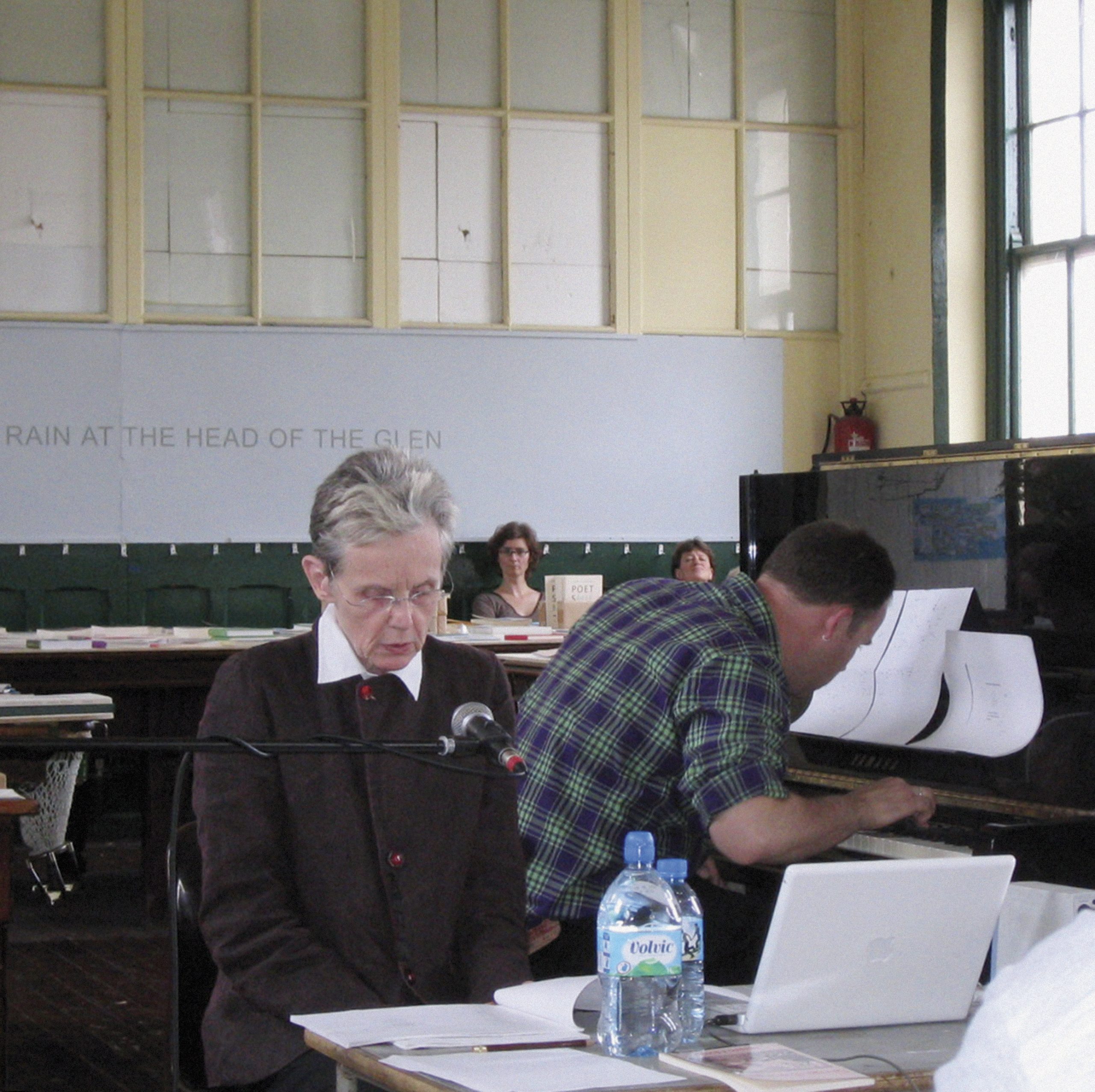
When embarking upon a collaboration with Susan Howe, I begin by familiarizing myself with her poem, but once I’ve recorded her reading it I set aside the written text and for my purposes the recorded version becomes definitive. That’s how the process has started for each of the five performance pieces we’ve made together over the last two decades. After I’ve said goodbye to the poem on the page, it might be years before I return to the published version, and when I do, invariably I discover my relation to the text altered. When revisiting the work, I have Susan’s voice with all its precision of diction and intentionality of delivery in my head, anticipating the printed version, pulling me through the text at the tempo of her reading. Although I’ve yet to make a mark in my copies of “Thorow” or “Melville’s Marginalia”—the two poems that comprise Thiefth (2005), our first collaboration—every time Susan and I rehearse or perform one of these pieces, she adds another layer of marks in colored pencil to her performance scripts. Over the years, these have become fascinatingly detailed, very beautiful documents with underscores and marginal notes in a sheaf of colors. (Don’t forget that Susan’s first work of criticism, the landmark My Emily Dickinson, is a model of careful attention to manuscripts.) I’m frequently peering over her shoulder, curious to see the changes her scripts have undergone.
Stepping away from the printed text is freeing. It allows me to listen with greater focus, to encounter the poem differently, and to attend more fully to the sonic dimensions of the work. Susan’s performance in all of its nuance becomes the spine of the sound composition. I learn the rhythms of her reading. I learn the emphases that shade her vocalizing, details in her handling of the poem that wouldn’t be evident to a reader, and I map the range of intensities in her transformation of print into acoustic events.
Susan and I first met in 2003, when we were invited to create a performance for the Fondation Cartier in Paris. Before we concluded our first meeting, I proposed that I record her reading. Minutes later I was holding a Shure VP88 stereo microphone with my elbows propped on a wobbly table. She selected “Thorow” and “Melville’s Marginalia,” as they had been published in French translation, which would facilitate the proposed bilingual performance with poet Dominique Fourcade reading from the French.
“Thorow” begins with a prose introduction that describes the circumstances of the 1987 writer’s residency that brought her to Lake George, New York:
The town, or what is left of a town, is a travesty. Scores of two-star motels have been arbitrarily scrambled between gas stations and gift shops selling Indian trinkets, china jugs shaped like breasts with nipples for spouts, American flags in all shapes and sizes, and pornographic bumper-stickers. There are two Laundromats, the inevitable McDonald’s, a Howard Johnson, assorted discount leather outlets, video arcades, a miniature golf course, two run-down amusement parks, a fake fort where a real fort once stood, a Dairy-Mart, a Donut-land, and a four-star Ramada Inn built over an ancient Indian burial ground. Everything graft, everything grafted. And what is left when spirits have fled from holy places? 1
Prose plays a crucial role in Susan’s books of poetry. Not only do they provide welcome entrees into poems in which it can be hard to establish one’s bearings, but they also introduce the possibility of those rapid qualitative changes between prose and verse—solid to liquid, liquid to gas—that lend a productive instability to her presentations, keeping the listener in a state of anticipation. As she began reading “Thorow,” I found myself thinking about the transformation of its printed version to performance or audio recording. I wondered how the prose introduction might function in our live performance. I came into the project with a bias toward musicality, however unfamiliar a form that might take; I was eager to work with writing of hers in which the sonic patterning was at its freest and most unpredictable. As regards what I might bring to the collaboration in terms of instrumentation or arrangement, my impulse was to begin by listening closely to Susan’s voice. This led me to contemplate whether her voice could be the only source material for the piece, and I was especially interested to hear how she would handle the third and final section of the poem, in which lines have been severed and scattered, with individual words and even individual letters strewn as fragments.
This was my introduction to understanding the facing pages in Susan’s books, their tendency to function as a composite image. On the poem’s penultimate spread, the verso and recto are identical but with the recto page flipped 180 degrees; each page contains text that is right side up, upside down, and skewed at a variety of angles. Having been familiar with “Thorow” before working with Susan on the piece, I assumed that a salient feature of these and similar pages was that one finds a different path through the tangle of lines with each reading. I still think that’s true for the individual reader—one is unlikely to settle upon a single, determinate method for how to read these pages, and how one encounters its component parts remains in flux. That’s part of its appeal. I was fascinated, however, to realize upon hearing Susan read “Thorow” on numerous occasions that she has a clear path through these pages, and that what I had presumed to be a species of indeterminate performance functions otherwise in her own reading.
As a listener—sitting at the table with headphones on, doing my best to keep the microphone as steady as possible—I found Susan’s reading enthralling. As a reader, I found it enlightening. In her handling of “Thorow,” she cuts words in a manner redolent of taking a razor blade to audio tape, and indeed she explained to me that one of the tasks she loved most when hosting the WBAI New York radio show “Poetry” from 1971 to 1980 was editing tape.2
Once I had the recording of Susan reading “Thorow,” I started with the third and final section. I cut the recording into a collection of lines and then individual words. I kept cutting until I was working with syllables and stray consonants, sometimes shaping fragments into smooth, isolable objects and sometimes reveling in the harshness of the cut. Just as the penultimate spread of “Thorow” features textual superimpositions, I overlaid Susan’s performance of that final section with dozens of fragments from the gamut I had assembled.
I scattered. First, I scattered by ear—what sounded best with what, which clusters had the greatest aural impact—and then I scattered by eye. In the edit window of the digital audio workstation, I learned to trust my visual apprehension, placing audio clips by sight and periodically listening to the results. Rather than using the computer as a real-time musical instrument, I approached the software as a tool for collage. It was a slow, involved, repetitive, often meditative process of placing minuscule sonic elements, of scattering with deliberation and deliberateness. To give an example, I might create a fleeting event in which eight different syllables are lined up to sound simultaneously; I would experiment with pushing and pulling them in time, listening, muting, or downplaying some and emphasizing others through equalization or placement within the mix. In the final version of the piece, it’s difficult to tell which pops and snaps and violent interruptions were created in my editing and recomposing and which occurred in that first performance in my living room.
I typically have a method in mind and an end in sight when I begin work on a piece, and this was one of the rare, cherished instances—one of those instructive instances—in which I truly did not. The poem’s final spat-out utterance is the word “Thiefth,” part of a densely compacted envoi: “thou sculling me / Thiefth.” I experienced this unfamiliar word as suggestive of our method in that initially I apprehended it as having been spliced together.3
After a period of working exclusively with Susan’s voice, it struck me that this might work for one section, but that I needed additional sonic material with which to compose. I had arrived at the moment of essaying an answer to the question, “Why add anything to Susan’s poetry?” My initial impulse that everything be generated from her voice had started to seem showy, as if my purpose were to demonstrate how much could be done with how little source material, and so I decided to limit the scatter effect to the poem’s final section.
Once again I needed a place to begin. Susan and I had talked about Charles Ives, especially the final movement of his Piano Sonata No. 2, Concord, Mass., 1840–60, “Thoreau.” Near the end of the movement, there is a brief, unanticipated flute part that’s meant to represent Thoreau playing his instrument by the edge of Walden Pond. As Ives wrote, “Thoreau was a great musician, not because he played the flute, but because he did not have to go to Boston to hear ‘the Symphony.’”4 This prompted me to ask the Swedish reed player Mats Gustafsson to record variations on the flute theme from Ives’s “Thoreau” on the fluteophone, an instrument that Mats created by jamming a saxophone mouthpiece into the body of a flute. In “Bartleby the Scrivener,” Melville describes Bartleby’s voice as quick and flute-like—that’s the quality I desired.
Mats provided me with several improvisations based on the “Thoreau” flute part and tossed in a couple of baritone saxophone variations for good measure. In the end, I found the baritone versions particularly satisfying, especially when lowered in pitch so they betray even greater physical exertion, like heavy furniture being dragged across a wooden floor. The pitch-altered baritone sax has the uniquely striated texture of someone—a large someone—gaspingly short of breath, which further distinguishes the instrument from the airy and comparatively colorless fluteophone.
In lieu of the prose introduction that appears in the published version of “Thorow,” we settled on a nearly wordless first section to precede the poem. This introduction begins with two- and three-note phrases from the pitched-down baritone saxophone, beginning and beginning again, gathering and regathering to repeatedly start anew. Short rhythmic fragments of the fluteophone recording are placed atop one another in loops of differing lengths. Discrete, decontextualized samples of Susan’s voice from later in the poem occasionally break through to punctuate the end of a musical phrase or shatter the increasingly long silences: “strict distant day,” “anthens,” “blue wov,” a deep inhale of breath, the click of a tongue. In the second and third sections of the piece, corresponding to the first two numbered sections of the poem, Susan’s reading is paired with sustained tones on the baritone sax and fluteophone—this time with a calmer, more measured breathing—and brittle, bitcrushed electronic salvos as well as a droning cello played with a curved, slack-haired bow that permits one to play the instrument’s four strings simultaneously. Listening now, I’m struck by the sudden overlappings of Susan’s voice in these sections—decisions not strictly motivated by the text, but which now strike me as propitious with regard to our working together.
Even at that early stage in our collaboration, I must have felt a degree of freedom such that not every compositional choice needed to be justified with reference to the text. I wasn’t as cautious and timidly respectful as I recalled. I can’t reconstruct the logic of these choices and that suits me well. Susan’s delivery at its fiercest propels us into the final section, the effect heightened by stacking and slightly offsetting recordings of individual lines; every word remains comprehensible while the time manipulation results in echoing delays of varying lengths. The sonic space resists coherent mapping. This outburst ideally approximates the wild scatter of text on the page. When the irruptive squall of language abates, when storm clouds separate, Susan intones, “You are of me & I of you, I cannot tell / Where you leave off and I begin.”
Let’s pause there: “I cannot tell / Where you leave off and I begin.” The disorienting quality of not being able to identify the source of a voice is something that Susan and I were eager to explore in live performance. During soundcheck, a standard litmus test was whether, with eyes closed, I could tell whether I was hearing Susan’s live reading or recordings of her voice, this seamless blending of the two (or three or four). I wanted to hear multiple Susans and not a duet between human Susan and digital Susan. My attraction to this confusion of voices originates in the cuts of her own poetry, those fascinating self-interruptions that operate on a continuum between language and sonic abstraction. She continues to surprise me with how detailed these fragments of vocalized text can be. That smallest jab of sound—some of my favorite music.
For “Melville’s Marginalia,” the second piece in this first collaboration, I composed piano music. I wanted us to perform together without me being stuck behind a computer—the ignominy of scrutinizing a monitor in the presence of an audience. My goal was real-time musicality, fingertip subtlety I could enjoy. I’m no virtuoso on the piano, but even less of one when using the computer as an instrument in performance. Listening now to the recording of “Melville’s Marginalia,” the piano part is much as I remember it, but what draws me particularly close are the sounds of dripping and cracking from recordings made in my Brooklyn apartment during an especially cold winter. The back window had frozen over—it became a sheet of ice—but the heavy snowfall that was beginning to melt caused the roof to leak in multiple spots, delivering an unpredictable percussive patter of water dripping into buckets and pans. I’d like to think that I can hear gusts of wind against the poorly fitting sash—I may be relying on my memory—but I can unambiguously make out the distant, intermittent sounds of airplanes overhead, located as we were in the flight path of LaGuardia Airport. After several years in that apartment I had learned to tune out the rumble of aircraft, but there it is on the recording of “Melville’s Marginalia.” Odd things happen when you point a microphone at a window. Microphones hear extraordinary things, by which I mean extraordinarily ordinary things.
Photo credit: R.H. Quaytman
- Susan Howe, “Thorow,” Singularities (Middletown, Conn. and Hanover, N.H.: Wesleyan University Press and University Press of New England, 1990), 40. ↩︎
- The collection “Susan Howe Radio Program Sound Recordings” is housed at the Archive for New Poetry at the University of California, San Diego. A selection of these recordings is available to stream on the online archive PennSound: https://writing.upenn.edu/pennsound/x/Howe-Pacifica.php. ↩︎
- “Thiefth” resembles the Middle English word “thiefthe” and the Old English “thīefth,” meaning “theft.” ↩︎
- The passage continues, “The rhythm of his prose, were there nothing else, would determine his value as a composer.” (Charles Ives, Essays Before a Sonata, The Majority, and Other Writings [New York: W.W. Norton, 1962], 51). ↩︎