
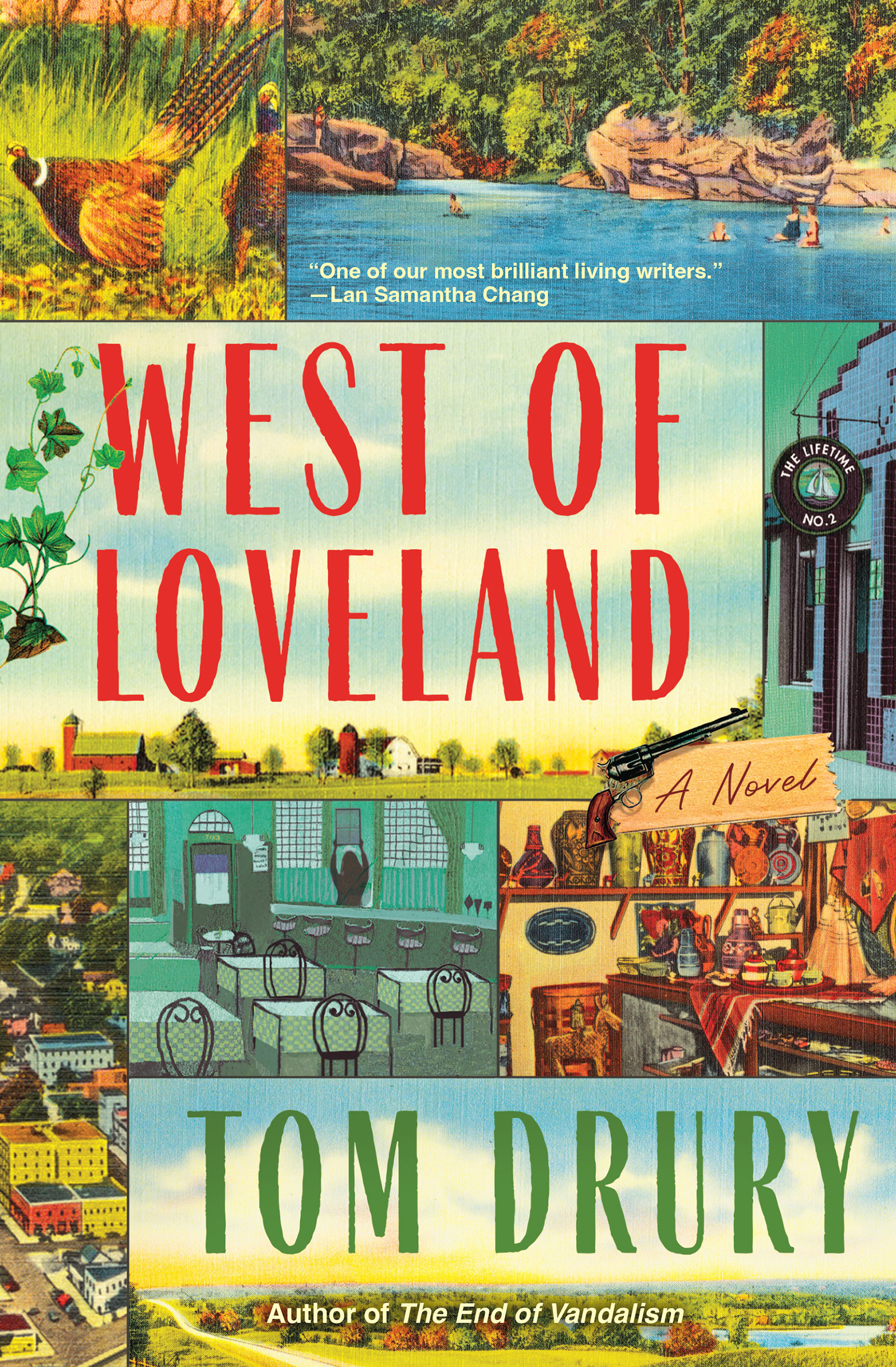
There is a scene about halfway through Tom Drury’s new novel, West of Loveland, in which one deputy sheriff, Rick Luna, tells another deputy sheriff, Sheila Geer, about the night he went to see his new girlfriend, Kimi, dance on stage at a small-town nightclub. “One thing I noticed,” Rick Luna says, “she pays a great deal of attention to her arms.”
Rick and Sheila have taken a pit-stop at an orchard on their way back to Grouse County, the constellation of middle-American towns in which three of Drury’s previous novels take place: Pacific, which was longlisted for the 2013 National Book Award, Hunts and Dreams (2000), and his critically acclaimed debut, The End of Vandalism (1994). The pair has just recorded a statement—and, in doing so, garnered crucial leads—from metal detectorist Billy Follard, a prime suspect in a labyrinthine investigation that all began when two civilians, Helen Slater and her nephew Rocky, discovered a Smith & Wesson handgun in a ditch on the side of the road. “The only thing she took off during the whole performance,” Rick continues, “was the black headband—during a song I think is called ‘Tell Me’ she slipped it off and bowed her head with her arms out like wings and shook her hair like silver dust would fall from it.”
For about another page, Rick continues to describe all the different ways Kimi danced. The chapter ends with the following paragraph:
Sheila set the basket of apples down in the grass and brought her hands to her face, and Rick asked what was wrong, and she looked up at him through gaps in her fingers and said oh, nothing, and he asked if she was crying, and she said not really, maybe a little, and she laughed—it was just that she could tell by the way he described Kimi and the way she danced that he was far gone over her.
I have always found it difficult to articulate exactly why I’m so drawn to Drury’s Grouse County novels, or why, whenever I return to them, I’m so often brought to the verge of both laughter and tears. But here, in the final installment of what is now the Grouse County quartet, I’ve found, in Deputy Sheriff Sheila Geer, someone similarly overcome by the same emotion, and, I think, for the same reason. The fondness and longing I feel for Grouse County and its characters stems, ultimately, from the love Drury himself has shown for them—now for nearly three decades. It’s just that I can tell by the way he describes Kimi and the way she dances that he’s far gone over her.
***
West of Loveland’s starting gun, literal and figurative, appears in the opening pages. Helen and Rocky Slater take the Smith & Wesson home and try to figure out what to do with it. Eventually, the law gets involved. Enter Dan Norman, the good-mannered sheriff of Grouse County and the closest thing the tetralogy of novels has to a protagonist.
This jumpstart quest is classic Drury: in The End of Vandalism, the same Dan Norman gets a mysterious tip and finds an abandoned baby in front of a Hy-Vee grocery store; in Hunts in Dreams, the plumber-turned-thief Tiny Darling becomes obsessed with recovering an old family heirloom; in Pacific, a mysterious woman named Sandra Zulma shows up in Grouse County, searching for a valuable ancient artifact. Yet to call these quests the central “plots” of Drury’s novels would be to grossly misunderstand their function. They are not throughlines; they are more like clotheslines. Because when you look at a clothesline, you’re not looking at the clothesline—you’re looking at the clothes.
In West of Loveland, there are a lot of clothes: Fifteen-year-old Rocky Slater’s parents have abandoned him and moved to Europe; they “were so obsessed with each other they had to go someplace they’d be the only ones they knew.” (Abandoned and neglected children appear in all four Grouse County novels, but, impressively, each is abandoned or neglected in a completely different way.) Tiny Darling has retired from both plumbing and thievery; his adult son, Micah, returns to Grouse County after a long stint in California, putting Tiny back in the role of father, which has never exactly come naturally to him (“You seem more like a brother than a father to me,” a younger Micah says in Pacific, “and I don’t mean that bad.” “I don’t take it bad,” Tiny replies). Tiny’s stepdaughter, Lyris, who spent most of her childhood in foster care, now has two kids of her own, Astra and Fen, and must confront the strangeness of giving them the kind of life she never had. Louise Montrose Darling Norman (yes: Dan Norman’s wife, and Tiny Darling’s ex-wife, the result of a superbly clumsy love triangle in The End of Vandalism) is happily married but realizing, in breathless spurts, that there are many other kinds of happiness.
Someone who has not read Tom Drury might think that attending to such a multiplicity of characters makes for a chaotic reading experience. The truth is that Drury’s patient, unpretentious third-person voice, sprightly, audible dialogue, and empathetic portraits of ordinary life make for a reading experience that does not feel burdensome, but ambling and smooth and full of pleasures. Drury’s range is impressive; he describes children (“[Astra] patrolled the midfield, glaring, leaping, laughing, hammering the ball across the net at her admiring mother and Uncle Micah and the scornful Fen, who tended to take his older sister’s accomplishments as offenses aimed solely at him”) and the elderly (“He came to the door at a meditative pace that made him seem wise and thoughtful, though it was simply how fast he could move”) with the same casual sharpness. In this way, reading West of Loveland is less like watching ten-way tennis and more like watching one of those nature documentaries featuring the voice of Morgan Freeman or David Attenborough. Drury’s voice is just as distinct and trustworthy; through it, every life seems full of whimsy, mystery, and struggle, and every home can be a kind of paradise.
***
Must readers begin with the first three Grouse County books, or does West of Loveland stand alone? Drury seems intent on providing the context uninitiated readers would need. When a character has an affair, the audience is clued into the fact that, years ago, their spouse had an affair first. When a character’s maternal instincts kick in, Drury reminds readers that, decades earlier, she lost a child of her own. When a character is given a tour of another character’s front yard, all readers understand that the old train tracks in the grass have always been there, and that, at least in these characters’ lifetimes, there has never been a train.
And yet: Some of the most satisfying moments in West of Loveland are those in which Grouse County’s recurring characters are subtly revealed to have been shaped and changed by time.
There are twists that, to a first-time reader, will read merely as turns. Reading about Astra and Fen, for instance, I felt like a proud grandparent; reading about Dan and Louise’s marriage, I felt like their longstanding third wheel. Billy Follard, the metal detectorist, is the closest thing to a true villain in Hunts in Dreams, but in West of Loveland he plays a different and surprisingly vital role. A first-time reader might consider his character at least partially redeemed; Drury completists may never forgive him.
“It’s my belief as a detectorist,” Follard says in his deposition with the deputy sheriffs, “that things not only get dropped from above but work their way up from below.” Maybe that’s the joy of reading West of Loveland after the first three Grouse County novels: Things not only get dropped from above, but work their way up from below.
***
In the early 1990s, when excerpts of The End of Vandalism were first getting serialized in The New Yorker, Drury’s vision of small, rural, midwestern towns—isolated but resilient, closely knit, relatively peaceful, striving nobly against (and not yet completely bowled over by) industrial and agricultural change—might have seemed only slightly antiquated. Of course, towns like that existed back then, and maybe some still do; but by the turn of the century, Drury’s succinct, sweetened novels about everyday small-town life might have been overshadowed by the more maximalist tomes of his white-male contemporaries: Infinite Jest, The Virgin Suicides, The Corrections. And yet, with Pacific in 2014, and now with West of Loveland, Drury has quadrupled down on his literary ethic. The Grouse County novels are not meant to mirror our current reality, but to portray the kind of reality we might wish to live in.
In 2026, the contrast between our current reality and the world of Grouse County has never been starker. This does not make Drury’s work less relevant; if anything, this widening divergence serves to clarify his career-long project: writing toward an aspirational vision of a hyperlocal community, and thus, by default, writing away from a fractured and broken global system. At a time when so many contemporary novelists seem interested in blurring the line between fact and fiction, West of Loveland is defiantly the stuff of storytelling, and Grouse County is not meant to stand in for anywhere specific. Occasionally, a popular song title or brand name will roll across the page like a tumbleweed. The year, in West of Loveland, is 2019, but there is no real mention of America’s current President, and little to no commentary on global politics or current events, with one exception that feels more like Drury himself stepping out from behind the curtain to say his piece.
The richness of Grouse County has led some critics to compare it to William Faulkner’s Yoknapatawpha County, or Sherwood Anderson’s Winesburg, Ohio: a small-town stage on which the inner lives, shifting ties, and entrenched conflicts of local characters can play out with all their tragicomic trappings. But a better comparison might be J.R.R. Tolkien’s Middle Earth. On the first page of The End of Vandalism and West of Loveland, as with The Hobbit, there is a detailed map of the region in which the entire epic will take place. At the end of Drury’s novels, as with Return of the King, there’s a helpful index of characters. And while Drury’s invented realm may not have elves, spells, or dragons, every Grouse County book contains a few pinches of mystical activity, and West of Loveland is no exception (I’m still wrapping my head around the “ghost fire”). And yet the most supernatural element of all remains Grouse County’s relative insulation from contemporary American challenges. These are twenty-first century Midwestern towns, after all; what of extremist politics, white supremacy, climate change, social media, fentanyl, AI data centers? “Aspirational” may not be the right word. Grouse County is, and has always been, a magical place.
***
If West of Loveland really is the end of the Grouse County books, it is a fitting one. In the novel’s final chapters, the mystery of the Smith & Wesson handgun becomes a kind of extra-strength magnet, gathering crucial storylines and narrative junk with frenzying force. Grief, betrayal, marriage, parenthood, loneliness, violence, friendship, community, acceptance—Drury’s usual themes are all there. Near the novel’s climactic peak, for which nearly every character is present and every major tension is on the precipice of rupture or resolution, one can almost hear Drury packing up his time-worn tools and closing the garage door for good.
And yet, from the very beginning of West of Loveland, it’s clear that Drury didn’t wait for the final curtain before exploring an updated stable of themes. Character identities and relationships, for instance, are more complex in this novel than in the previous three: Loveland features a polyamorous relationship, multiple affairs, some of the longest and best sex scenes Drury has ever written, a platonic reunion of former lovers, a non-platonic reunion of former lovers, teenagers coming to terms with gender fluidity, and a progressive pastor, Nell Fischer, who encourages her parishioners to dissolve their culturally prescribed binaries. “Listen instead to the still small voice that spoke to Elijah after the tornado and the landslide and the fire said nothing,” Nell Fischer says. “That voice is you and that is God and that is true.” Is Drury trying to get with the times? Maybe—but he gets the times right. It is the new, young crop of characters who steal the show in West of Loveland, and who end up teaching the older crowd a thing or two about love.
There is a passage in the End of Vandalism, Drury’s first book, that I return to often. Louise’s mother, Mary Montrose, walks into her kitchen and finds a full-grown deer standing by the refrigerator, munching on the vines of her ivy plant:
Mary turned and left the way she had come. She raised the garage door, got into her car, locked the door. She did not know what to do. She had been a schoolteacher early on in her career and had always taught the children that the answers were near at hand for those who would look. But at this moment she didn’t know where to look or what she would find.
Despite all of Mary’s accumulated wisdom, she has encountered something completely bizarre and unexpected; she is at a loss for what to do, or what lessons she’s supposed to learn; she is uncertain; she is once again a wide-eyed student of the world. It feels appropriate that a small detail from this scene reappears in West of Loveland, because what pervades Drury’s new novel more than any other is its sense of uncertainty. After all the investigations, journeys, affairs, attacks, transitions, and tattoos, the citizens of Grouse County are still in flux. Their relationships and bodies are fragile; their pasts continue to haunt them; their questions about the future remain unanswered. After a frenzied, action-packed finale, the book ends peacefully, as all Grouse County novels do, but there is no promise of an ending to struggle, yearning, or fear. In this way, Drury has honored his characters—not by finishing their stories, but by allowing their stories to fan out beyond his vision.
“I’m sorry I have not been more helpful,” says another suspect in the gun investigation. “But as I say I will soon be gone.”


Click here to subscribe today and leave your comment, or log in if you’re already a paid subscriber.