The exhibit Voices in the Mirror, on display at Jack Shainman Gallery in New York City, features some of Gordon Parks’s best-known photographs from the nearly seven decades of his creative career. Taking its name from Parks’s 1990 memoir, one of four he published in his lifetime, Voices in the Mirror is framed not just by the photographer’s vision but by the reflections of the photographic subjects, their descendants, as well as artists and activists, each of whom shared how their encounter with Parks’s camera shaped their lives afterward. Black Panther Party Communications Secretary Kathleen Neal Cleaver, featured in the exhibit, revels in Parks’s ability to capture the “joy in photography—you isolate what’s important.” When Parks traveled to Algiers in 1970 to photograph Cleaver and her husband Eldridge for Parks’s last major assignment for Life magazine, the photographer found both a movement and a family in chaos. He described “the cluttered, temporary shelter of a black man in exile—where bags stay packed and all precious things are portable.”1 Despite the turmoil of the movement and a home life in disarray, Parks managed to produce a glamorous image that has since become iconic: a sexy, unencumbered young Black couple, bolstered by their love for each other, their love for Huey P. Newton, and their love of the revolution. Voices in the Mirror celebrates Parks’s exquisite eye, his ability to train his camera to find what was most important to convey about the lives of his subjects—dignity under often oppressive and dehumanizing conditions.
Yet not all of Parks’s photographic encounters resulted in triumphant transformation. Whether by nature of the conditions in which Parks found his subjects or the enormity of the structures that bound them, sometimes Parks’s photographs did damage.
Take, for example, his 1961 photographs of twelve-year-old Flávio da Silva and his family, residents of a Rio de Janeiro favela, which appeared in a Life magazine issue devoted to fighting communism in Latin America (“Freedom’s Fearful Foe: Poverty,” June 16, 1961). Flooded with sympathetic responses and numerous donations from readers, Parks and Life personnel helped Flávio get medical treatment for life-threatening illnesses, helped relocate the boy and his family to better housing, and even helped institute infrastructural improvement in the favela (“The Compassion of Americans Brings a New Life for Flávio,” Life, July 21, 1961). Flávio spent two years in Denver, Colorado, receiving medical treatment and attending school. All of this attention and the attempts at acculturation “greatly complicated his [Flávio’s] return to Brazil, and forever colored his life.”2 For his part, Parks felt “confusion and guilt” about the disruption he brought to Flávio’s life. “As a photojournalist I have on occasion done stories that have seriously altered human lives. In hindsight, I sometimes wonder if it might not have been wiser to have left those lives untouched, to have let them grind out their time as fate intended.”3
Parks struggled with his involvement in Flávio’s life for years to come and became increasingly mindful of the unpredictable power of his camera. Parks expressed similar concern following his essay, “A Harlem Family,” featuring the Fontanelles, an impoverished Black family barely surviving in a Harlem tenement in the years when the civil rights movement gave way to Black Power. Parks made the images in the cold, damp late autumn of 1967, “A Harlem Family” was published in the March 8, 1968, issue of Life magazine, in a section titled “The Cycle of Despair: The Negro and the City,” a special section devoted to understanding the spate of urban uprisings through sympathetic portraits. Parks connected with the Fontanelles through Neighborhood Board #4, a local agency for one of the Great Society antipoverty programs.4 Given a list of families who might allow the photographer to chronicle the intimate details of their struggles, Parks began by interviewing Black families on Neighborhood Board #4’s welfare rolls. He found that most were “too embarrassed” about the abject conditions in which they lived. Or perhaps they declined his invitation out of a desire to maintain some semblance of privacy these programs had already eroded in the name of “order” and “integration.” In the end, only the Fontenelles agreed to participate, urged on by wife and mother Bessie Fontenelle.
Parks described Bessie, age thirty-nine, as “strong, personable, and caring” and, more than that, “she understood the importance of exposing the misfortunes of the impoverished.”5 Not only would their material misfortunes be exposed, but so too would the intimate details of their family: Bessie’s strained relationship with her husband, Norman Fontenelle Sr. (age thirty-eight), who had been out of work for eight months and drank heavily; the frustrations and waywardness of their eight children (Phillip, fifteen; Roseanna, fourteen; Norman Jr., thirteen; Riel, twelve; Lette, nine; Kenneth, eight; Ellen, five; and Richard, three); the disappointments of Bessie’s children from a previous marriage, twenty-year-old Harry, incarcerated in a state psychiatric hospital for drug addiction, and Bessie’s oldest, Diana, living on her own in Massachusetts. To invite Parks into their fourth-floor walk-up apartment on Eighth Avenue (now Frederick Douglass Boulevard) and allow him to observe their lives for a month, for an article to be published in an internationally recognized magazine with a predominantly white middle-class readership, was a risky prospect with an uncertain outcome. Yet Bessie Fontenelle bravely gambled and smiled as she said, “Okay, Mr. Parks, looks like you’re going to be part of our home for a while.”6
In November 1967, when he began working with the Fontenelle family, Parks had been making images for Life magazine for almost twenty years, starting in 1948 as a freelancer and then, after 1949, as the magazine’s first Black staff photographer. Parks had traveled the world training his camera on the most beautiful and the most terrible of the human experience. His assignments often “proved to be as different as silk and iron. Once, crime and fashion were served to me on the same day. The color of a Dior gown I photographed one afternoon turned out to be the same color as the blood of a murdered gang member I had photographed earlier that morning up in Harlem.”7
Even across the vast and sometimes jarring range of genres, Parks developed artistic techniques and visual grammars that produced photographs full of drama and emotion. For the sociological assignments for which Life relied on his sensitivity and expertise, Parks found modes of address that attempted to treat subjects and viewers with equal respect. But facing the extreme situation of the Fontenelles, which he would have to make legible for Life’s twenty million readers, Parks questioned his ability to do justice to this story. “Was I about to exploit their despair?”8 How did Parks navigate the winds of these multiple demands?
The world-famous photographer began this assignment without his camera, “something that would have been questionable to my colleagues.” More than a gesture to gain the Fontenelles’ trust, it let Parks examine his own ethical choices because, as he reflected later, “I questioned my motives for the assignment.”9 Parks recognized the historically extractive and exploitative work of sociological photography, and from his own experience with Flávio in Brazil earlier in the decade, he knew all too well that the camera can present crises but is limited in its ability to prevent or eradicate them. Thus, Parks first left his cameras at home. Then, when he did bring them, along with a turkey for the Fontenelles’ Sunday dinner, the cameras mostly stayed in his jacket pocket; occasionally he would bring one out to show the children. He approached the assignment offering his presence—his listening ear, sometimes food, but “not much. I don’t want to start something I can’t keep up”—before he lifted the viewfinder to his eye.
Building rapport helped Parks understand how he would make the Fontenelles the protagonists of the story. As became his practice, he organized his reports around individuals, grounding “the interlocking problems of race and poverty in America” in the lived experiences of everyday people.10 Parks first developed this strategy as a Rosenwald Fund Fellow, working in the Farm Security Administration’s (FSA) famed photography bureau under the mentorship of Roy Stryker. With his first photo essay, later named “American Gothic” (1942), Parks found in Ella Watson, a Black cleaning woman who worked the night shift in the FSA offices, a striking symbol of Black women’s labor as the foundation of American wealth and power. Through conversation and collaboration with Watson, Parks was able to elaborate on the fullness of her life as a mother, grandmother, and pillar of her spiritual community. “American Gothic” demonstrates a life shaped but not wholly confined by the workings of American racial capitalism. Like Ella Watson, Red Jackson (in “Harlem Gang Leader,” 1948), Mr. and Mrs. Albert Thornton Sr. (in “The Restraints: Open and Hidden,” 1956), and Flávio da Silva (in “Freedom’s Fearful Foe: Poverty: A Beaten Family in Rio Slum,” 1961) would emerge as flesh-and-blood protagonists in Parks’s reports, revealing the force of structural violence on everyday lives.
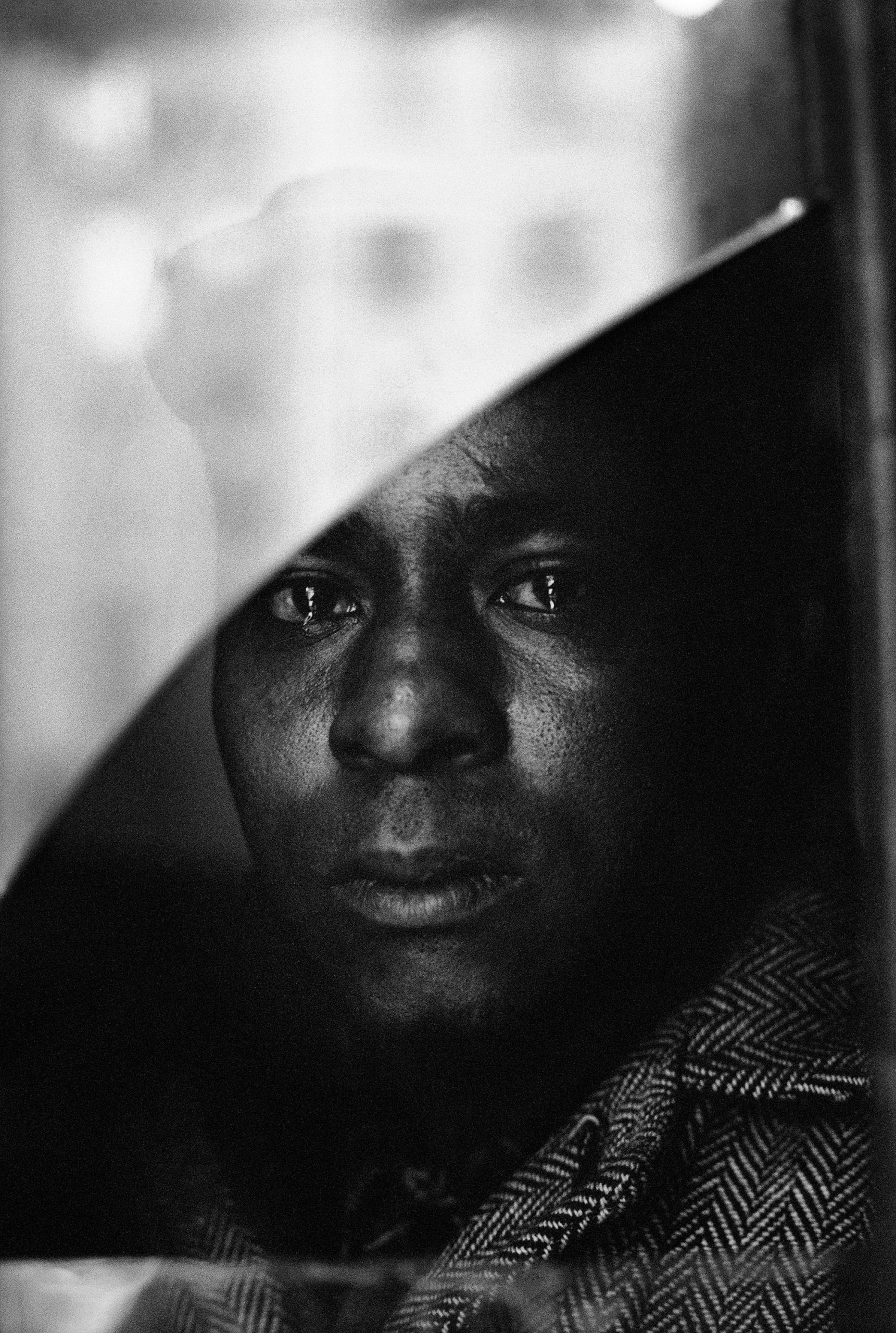
Once he began photographing, Parks pursued a similar strategy with “A Harlem Family.” His goal was to present the story through the eyes of his subjects. Parks announces this intention immediately with the opening image of the photo essay: a close, tight portrait of Norman Sr., who looks directly at the camera through a broken window, his eyes wet as if on the verge of tears. The photograph covers a half page and reaches across the fold, so that readers must meet Norman’s eyes as soon as they open to the spread. A poetic plea directly to the Life audience, penned by Parks, echoes the direct gaze of the photograph and quickens the message that Norman and the reader are bound to each other as humans but confront one another across the fracturing conditions of race and class. “For I am you,” the poem declares, “staring back from a mirror of poverty and despair, of revolt and freedom.”11
“A Harlem Family” was unsparing in its documentation of urban poverty and unflinching in its portrayal of the Fontenelles. In twenty-six photographs and some 2,600 words across sixteen pages, Parks brings Life’s readers uncomfortably but necessarily close to the Fontenelles’ daily struggles. He documents both the tender and the cruel intimacies of their lives and offers them up for public consumption, attempting to afford the family dignity while driving home the loathsomeness of their situation. The story ends on an even darker note than how the essay began. A photograph that occupies most of one page and protrudes into the next shows Norman Sr. in a hospital bed, covered in burns after Bessie threw a pot of boiling sugar-and-honey water on him to ward off his alcohol-fueled attacks the night before. Parks positioned his camera over Norman Jr.’s shoulder so that viewers could take in the disturbing view of the father’s painfully blistered face and hands right alongside his shocked thirteen-year-old son.
Despite his various visual practices and ethical strategies, Parks never stopped worrying that he was exploiting the Fontenelles. He found the intensity of their situation almost unbearable. “Terrifying,” “sorrowful,” “gloom,” “misery” often appear in Parks’s diary notes for the month he spent on this assignment. His position as a Black man in America who had experienced poverty himself made him ideal for such an assignment, but caught “between life in Black ghettos, and life in Henry Luce’s privileged [publishing] empire,” Parks found it increasingly difficult to move between these two worlds. “It’s like going from hell to heaven. The family faces a world of gloom, hunger and a thousand little violences every day.”12 The “Harlem Family” assignment made Parks acutely aware of how far he had come from his own experiences of abject poverty, just as it made him profoundly unhopeful that he could change the Fontenelles’ lives for the better.
If Parks felt anguish during the assignment, he was bolstered by the response from Life readers. Letters soon poured in from all over the country, as they had after the article about Flávio da Silva and his family in the first half of the decade. They praised Parks’s poignant profile of the Fontenelles and lamented that one family had experienced so much tragedy. Overwhelmingly, they asked, “What, in the name of God, can I do to help?”13 Readers offered the Fontenelles food to fill their cupboards, sheets for their naked beds, jobs to get Norman Sr. back on track, better accommodations to make a real home, and cash to ease their deprivation. Some readers even offered to adopt the younger children to provide more stable lives with greater opportunity. “Life’s readers had gotten the message” that Parks had carefully assembled, and support for the Fontenelles included numerous donations. At his request, the magazine matched reader donations and bought a house for the family on Long Island. Parks and Life readers hoped that the purchase of a suburban home for the destitute Fontenelles would help them forget the immediate horrors of their Harlem tenement—the broken windows, the peeling paint, the toxic asbestos, the neglectful landlord who kept his distance, the vermin that stayed all too close, the lack of space, the lack of heat.
Parks no doubt felt some semblance of relief that this family would enjoy the comforts a middle-class life in the suburbs offered: “New clothes, new furniture, a front porch, and fresh air.” The children would have access to better-funded schools. Life even helped secure a job for the long-unemployed Norman Sr.
“What happened then,” Parks would write and recount many many times for the remainder of his life, “hangs brutally in my memory.”
Norman Sr. had come home late from a night of heavy drinking with a friend to celebrate his new job, and fell asleep on the couch with a lit cigarette that quickly set the house on fire. Bessie got most of the family to safety besides Norman Sr. and eight-year-old Kenneth. Bessie was bereft. Even though she owned the house in Long Island and could probably have received financial support to rebuild, her dream was finished. Wearily, Bessie told Parks, “Take us back to Harlem.”
Two years after the tragedy in Long Island, Parks visited Bessie on Christmas Eve at her new apartment back in Harlem. She updated him on the state of her family: Norman Jr. and Harry were both in prison; Roseanna, Riel, and Lette were “on the streets” and out of communication with their mother. Parks maintained contact with members of the family for the next few decades through correspondence, visits, and attendance at funerals. He mourned as they variously succumbed to chronic illness, addiction, incarceration, and death. Finding it “impossibl[e] to detach” himself from the family, Parks understood himself as permanently “part of the Fontanelles.”14 The misfortunes of their lives were not his doing, yet Parks remained haunted by his collaboration with them. Since their first meeting, he was uncertain about the ethics of taking on this assignment. Once he began, Parks harbored a sense of guilt for all that had befallen the Fontenelles, especially for urging the purchase of a home that took even more from a family that had little to begin with. “As I fled that place,” Parks wrote of the Christmas Eve visit, “I sensed that perhaps I had played God and dug too deeply into their lives.”15
Parks often referred to his camera as a weapon, which he wielded “against all the things I disliked about America—poverty, racism, discrimination.”16 But in the context of “A Harlem Family,” we must ask: If the camera is a weapon against, what is the camera for? What, or more urgently, who are the casualties of such a disposition? “A Harlem Family” presented to white audiences an urgent statement about the damages of racialized poverty, but the story nearly devoured the Fontenelles whole. What if the camera does not always need to be ammunition but can act as a shield or provide safe harbor? Can the camera function as an object of care?
Voices in the Mirror showcases the many forms care took in Parks’s ethical and aesthetic approach to his work: listening, collaboration, respect, camaraderie if not comradeship, and in many cases direct financial support; he even paid for Roseanna’s, Ellen’s, and Bessie Fontanelle’s funeral services. Yet in the case of the Fontanelles, Parks’s camera made promises it could not keep, a breach the artist would mourn the rest of his life.
Lead Image Credit: Gordon Parks; “Norman Fontenelle, Sr., Harlem, New York, 1967” (gelatin silver print, 20 x 16 inches); (GP67.007) © The Gordon Parks Foundation. Courtesy of The Gordon Parks Foundation and Jack Shainman Gallery, New York.
- Gordon Parks, “Eldridge Cleaver in Algiers, a visit with Papa Rage,” LIFE, February 6, 1970, Vol. 68, No. 4, 20; and Gordon Parks Foundation, “Tribute to Kathleen Cleaver,” May 2016, https://www.gordonparksfoundation.org/education/features/tribute-to-kathleen-cleaver. ↩︎
- See Paul Roth, “Weapon of Choice,” in Ariella Aïsha Azoulay, Wendy Ewald, Susan Meiselas, Leigh Raiford, and Laura Wexler, Collaboration: A Potential History of Photography (New York: Thames & Hudson, 2024), 85. ↩︎
- See Paul Roth and Amanda Maddox, Gordon Parks: The Flávio Story (Göttingen, Germany: Steidl; Toronto: Ryerson Image Centre; Los Angeles: J. Paul Getty Museum; Pleasantville, NY: The Gordon Parks Foundation, 2017), 100–101, 124 (quoting from Parks’s 1978 book Flavio, 7). ↩︎
- See Robert L. Haggins, Director, Neighborhood Board #4, to Gordon Parks, March 11, 1968. Gordon Parks Papers, Wichita State University Libraries, Special Collections and University Archives, MS 2013-01, Box 1, Folder 29. ↩︎
- Gordon Parks, A Hungry Heart: A Memoir (New York: Washington Square Press, 2005), 258
↩︎ - Bessie Fontenelle quoted in Parks, A Hungry Heart, 258. ↩︎
- Parks, A Hungry Heart, 341. ↩︎
- Parks, A Hungry Heart, 259. On Life readership, see Wendy Kozol, “Gazing at Race in the Pages of Life: Picturing Segregation through Theory and History,” in Looking at Life Magazine, ed. Erika Doss (Washington, DC: Smithsonian Institution Press, 2001).
↩︎ - Parks, A Hungry Heart, 259. ↩︎
- “The Cycle of Despair,” introduction, 47. ↩︎
- Gordon Parks, “A Harlem Family,” Life, March 8, 1968, 48. ↩︎
- Parks, A Hungry Heart, 216, 262. ↩︎
- Letters to the Editor, Life, March 29, 1968, 23, quoted in Doss, “Visualizing Black America,” 236. ↩︎
- Parks quoted in Michael Torosian, Harlem: Gordon Parks The Artist’s Annotations on a City Revisited in Two Classic Photographic Essays (Toronto: Lumiere, 1997), 45. ↩︎
- Parks, A Hungry Heart, 268. ↩︎
- Gordon Parks, A Choice of Weapons, (1966; Minneapolis: Minneapolis Historical Society Press, 2010). ↩︎