
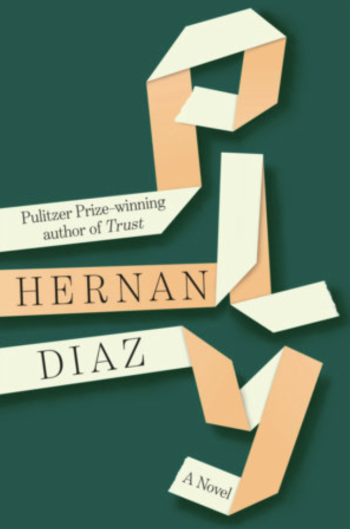
Hernan Diaz’s Ply (Riverhead Books, 2026) is a work of unapologetic maximalism. It is a Dickensian story of an orphan mastering an illicit trade; a plot-driven noir; a pointed exploration of our current political moment; and a meditation on reality and humanity’s relationship to time. It is at the same time a tender story of friendship and motherhood. Also, the punk-rock music scene. And, of course, Quantum mechanics and advanced particle physics. It is impressive enough that all of these elements coexist in a single work but what really astounds is the fact that the novel needs these elements. Remove any of them and Ply would be a lesser work.
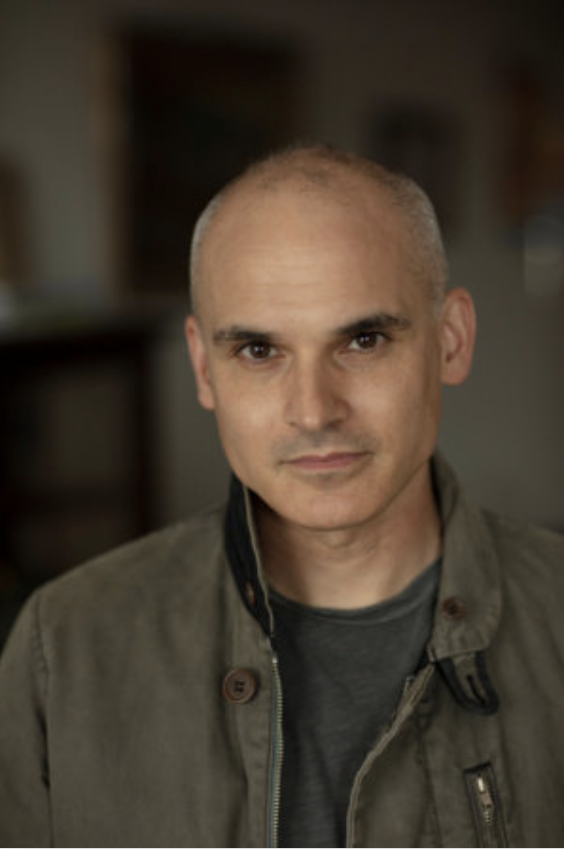
After speaking with Diaz, this approach made even more sense. We talked over Zoom, Diaz in front of the kind of mammoth bookshelf that populates my dreams. He would pause, often, to point to a book —aware of its exact location on the shelf—and use it to illustrate an idea. His knowledge of literature seemed encyclopedic: he gives the impression of having read nearly everything that has ever been printed and, judging by the bookshelf, owning all of it too. While that kind of intellectual rigor can often be distancing, Diaz is anything but. He was funny, candid and remarkably generous. When the interview ended, he stayed on the call and turned the questions back on me, asking about my own novel in progress and offering genuine encouragement and guidance.
We spoke over zoom for nearly two hours about following up the titanic success of Trust (Riverhead Books, 2022), punk rock, physics, and what a novel can ask of its reader.
This conversation has been edited for length and clarity.
The Rumpus: The book drops us in medias res, directly into the pincher’s world with very little explanation. Was that immersive approach something you planned from the beginning?
Hernan Diaz: To create a sense of verisimilitude, a believable reality within the text, what works for me is to take that reality a little bit for granted, without relying on explanatory scaffoldings. I’ve done this when writing about the 1850s and the 1920s, for example. If you read a Charles Dickens novel or a Raymond Chandler novel—two entirely different periods on different continents—they don’t describe their societies in great detail unless it’s part of the plot. There’s no need to explain how the British Postal Service worked in the 19th century or what a rotary dial is. Letters are simply mailed; phone calls are just made. I’ve taken this approach to the past, and part of the formal experiment in Ply was to take a similar approach to the future—to make this future feel as present as possible.
The Rumpus: Did that require you to build this whole world out for yourself—even if it didn’t make it into the novel?
Diaz: Yes. Especially when it came to the political context, of which very little is given, and that was a tough decision. There are a couple of dialogues and a character who speaks briefly to the political situation, but it’s fleeting. I wrote it all out—I know how this world got to where it is. I just thought it was wiser not to include it.
The Rumpus: Music is also—a little surprisingly, given the way the novel has been marketed—a major part of Ply. What role does music—specifically the punk rock scene the pincher is adjacent to—play to the novel?
Diaz: From the very beginning, I always thought of Ply as a punk novel—thematically, formally, emotionally, and, if this makes any sense, gesturally. I’m mostly interested in post-punk rather than the first wave of punk, particularly the scenes in New York, Manchester, and London. I read a lot of memoirs and first-person accounts by musicians from the mid ’70s through the early ’80s. The city described in Ply actually existed here in New York not that long ago: nature reclaiming buildings, squatters, sub-economies functioning outside institutionally regulated financial systems, and an almost limitless sense of freedom. That’s part of why I don’t see the novel as dystopian. Yes, some of those forms of decay have brought and will bring real suffering, and I’m not romanticizing that, but they can also create space for new collective configurations, radical art, and ways of living that are less commodified. I’m also very interested in constraints. These bands made incredibly intense, moving music with very limited means—little formal training, bad instruments, no money. Putting those precarious material conditions alongside the extremely high-tech machine in the second part of the book created a dissonance—I’m using this word quite deliberately—that I found very appealing.
The Rumpus: Writing about music seems like a particular narrative challenge, especially because you’re actually describing the experience of listening to music, and because these are songs that don’t exist. Did you have a clear sense of what those songs sounded like as you were writing them?
Diaz: That was one of the scariest things, because you don’t want to sound like a Brooklyn dad writing about rock and roll. I could absolutely hear the music in my head—I used to be a musician and have written about music in the past. But I wanted the descriptions to be physical rather than psychological, because the novel is so concerned with the material world and with physics. This kind of music is something you experience with your ears, but also on your skin. Volume, repetition, sound waves moving through the atmosphere and affecting their surroundings—that material experience was what I tried to focus on. But it was hard. I can think of rather embarrassing rock-related novels by writers I otherwise really admire that I held up as terrifying counterexamples—like, “not this.” I think intensity is hard to write about. It’s why sex is hard to write about, and violence too.
The Rumpus: That is something I wanted to touch on. There are actually a lot of memorably, disturbingly violent moments in the novel—several of which stayed with me for weeks afterward—but the pincher having her pinky deliberately broken as a child was especially haunting.
Diaz: I was drawn to the contrast between the sheer brutality of the act and the smallness of the limb. There’s this almost delicate violence to it. Now, I’m a very linear writer. I don’t draft in the usual sense—I write the book in the order you read it, and when I’m done, I’m more or less … done. But the pinky was different. I went back and introduced these moments where the pincher’s little finger bothers her before the reader knows why. It becomes a minor motif that, to a limited extent, articulates the narrative: First you wonder what’s going on with the pinky, then you learn what happened, and afterward the pain keeps returning in very specific situations. It plays an important role—to avoid spoilers, I’ll speak discreetly—by becoming a marker of the pincher’s identity.
The Rumpus: So you don’t draft? I’m a little in awe of that, especially given the complexity and interconnectivity of Ply. Can you walk me through your process?
Diaz: It’s very simple, utterly uneconomic, and most likely unsuitable for anybody else. I put enormous pressure on each sentence as I go. I don’t typically allow myself to move to the next sentence if the one I’m finishing doesn’t work. That doesn’t mean it’s done, but it does mean it isn’t a placeholder. I don’t have those. I tend to write longhand, and then I transcribe the day’s work into a Word document. That transcription is already a very, very big editorial pass. Things change: lexical choices, punctuation, syntax. But it is, in essence, kind of the same sentence. Then, the following morning, I go back to my pen and repeat. It’s a very slow process.
The Rumpus: I find that fascinating, especially from a plotting perspective. Both Trust and Ply are so intricately plotted. How do you keep track of the larger plot? Do you have a master document, or is it all in your head?
Diaz: I’m almost philosophically against plotting.
The Rumpus: Why?
Diaz: Because plotting assumes there is some kind of Platonic idea of the novel—disembodied, ethereal, existing outside of language. For me, literature is a linguistic event. There is no plot. There are no characters. There are no places. The only thing there is in a novel is sentences. This means that so much will be dictated by the texture of language, by syntax, by the pacing imposed by punctuation.
There’s also the exhilaration of discovering what is going to happen through the act of writing. Plotting feels too tidy to me. It takes away the mystery of the trajectory. Sometimes I don’t know where it’s going, and that can be painful and anxiety-inducing, but I prefer it that way.
That said, it’s not as though I’m a goldfish living in a perpetual present. I have an idea of where the book is going. I’ll make little side notes about what’s going to happen in the next paragraph or a couple of chapters ahead—something as simple as, “These two characters should meet.”
The Rumpus: What happens if, while writing a scene, you realize there is a gap or the narrative requires something that needs to be set up earlier? Do you go back and revise immediately, or keep moving forward and return to it later?
Diaz: Two answers. The first is that, as they’re being written, my books are very slow-moving ships. Think of a big oil tanker: It doesn’t turn on a dime. So there’s a lot of time for me to look at the consequences of a turn and what is needed to make it more effective. The second is that, of course, sometimes I do need to go back and write inserts—little bits, maybe a paragraph—in order to make the causal cogs turn smoothly. I don’t think I’ve ever gone back and written a full chapter. If I have (and I can’t recall doing so), it’s an exception.
The Rumpus: Related to plot is the question of exposition. There are two moments in the novel where the pincher sort of recedes, and we’re caught up on the larger events unfolding around her. I used to write screenplays, and I always found those scenes incredibly difficult to write well, but you handle them very effectively. How do you approach exposition?
Diaz: Oh, I love this question. Thank you for your exceedingly kind words. It’s essential to understand and embrace that “exposition” has always been central in the modern novel, at least since the 17th century, and not a cumbersome supplement of sorts. This “catching up” you refer to is very important, since it plays both with scope and time. In addition, the novel has always been drawn to ideas and to presenting them within a narrative frame. These two urges often become one single gesture in exposition.
The curious thing is that, at some point we’ve been told, I’m not sure by what higher literary authority, that exposition and plot are at odds with each other. But you can see so many of these expositional moments in hyper-classic plot-driven “adventure” novels by, say, Defoe, Scott, Dumas, Verne, Stevenson, and so on.
The Rumpus: Formally, you do something very interesting by shifting tense in the middle of the novel. As the book progresses, the reason for that becomes clearer, but I wondered why you chose to make the shift at that particular moment when its function is far less clear narratively.
Diaz: Time is important to me. This is a book about time as a physical entity, and the most immediate way we experience time in language is through tense.
In all of my books, including Ply, I have paragraphs where time is suspended because there are no conjugated verbs—only infinitives and participles. I try to do it unobtrusively. If you don’t notice, that’s mission accomplished. You don’t have to know grammar to experience it, just as you don’t have to know meteorology to experience weather.
Suspending conjugation creates a kind of lifting of time—to quote the novel, we are “stepping out of the river of time.” There are still actions, but they exist outside of tense.
In Ply, I took that further because the novel is also concerned with identity: how “I” relates to “you,” and what really separates those categories. Rather than simply talking about those ideas, I wanted the shifts in tense and grammatical person to embody them in the language and form of the book. The placement of the shift was something I deliberated over and experimented with on the page. I considered making it happen after a more obvious causal event, but it felt too tidy. I wanted the shift to happen earlier. It is intentionally a bit disjointed because time is out of joint.
The Rumpus: And that brings me to Pola, the scientist in Ply who is exploring the manipulation of time. She enters the book with a fairly long and dense monologue. I actually studied chemistry at university and have a very basic familiarity with quantum mechanics, so I was able to follow her, and I enjoyed it. I don’t mean to suggest that the section is flawed in any way, but it does feel like readers may respond to it very differently. I can see it becoming a talking point among both those who loved it and those who found it more difficult to engage with.
Diaz: With Pola, it was paramount to present her as the embodiment of scientific thought precisely so I could play with the border between the apex and the nadir of reason. Is she truly that brilliant, or is she insane?
But you can’t create that tension without first establishing her expertise. That’s why her little lecture is there.
The Rumpus: When you’re making a choice like that, how much are you thinking about what you can reasonably ask of the reader?
Diaz: I care immensely about the reader, but it’s twelve pages in a 450-page book which seems to me like a very reasonable thing to ask of the reader. I try not to shape things around those readerly expectations though, because they would ultimately be made up by me, wouldn’t they? And that would be vainer than not caring at all, because it would presume that I know what a vast swath of readers want. Who the fuck am I to know that?
The Rumpus: Trust feels like a good example. Its middle section asks a lot of the reader and I can imagine editors suggesting toning it down or removing it. Yet, that was as popular as a book could be.
Diaz: Trust was exactly the book that I wanted to write. I got representation very late in life and was published very late, and Trust went to auction, which was a completely new process to me. During COVID, I had all these meetings over Zoom, and there were editors who said, “Love the book, would love to move forward—but maybe we should cut that second section.” And it was like, “Okay, this has been a good meeting.” It was a deal breaker.
We live in a world where everything tends to follow the line of least resistance. I happen to be interested in literature, music, films, and art in general that pushes back a bit, that makes you think about the medium you’re experiencing. In this case, language: the materiality of it, the sentence, how meaning is constructed, how conceptual horizons can be stretched.
But I’m also interested in the flipside of that, where you forget that you’re reading entirely. That’s beautiful too—when you forget you’re holding a book and are instead held by it.
Because I’m greedy, I want both experiences. I want moments where you disappear into the text, and other moments where you become intensely aware of a certain semantic density, syntax, punctuation, the sentence as an event. Why not aim for both?
So if physics is not your thing—and I understand that for most people it probably isn’t—the concepts are presented quite gently and concisely. There are metaphors. There are plenty of comparisons for scale. There’s no algebra or equations. If you have a modicum of patience, I think it’s pretty lucid. But if not, if it sounds a little like gibberish, I think that’s great, because it enhances the “mad” part of the mad scientist. If your reaction is, “I don’t know what she’s saying; this sounds crazy,” that works too.
The Rumpus: There’s an interesting parallel I noticed in the novel. And if this is way off base, just let me know.
Diaz: I have no problem saying no. I’m very good at saying no.
The Rumpus: I noticed that both the pincher and Pola could, in a way, be viewed as artists. They’re working without much concern for money, driven instead by a particular goal.
Diaz: Right. I can see where this is heading.
The Rumpus: And that passion becomes complicated once success arrives and the various money-men begin to swarm around them. I talk to a lot of writers about what it’s like to follow a transformational success like Trust—the kind we all hope to have at some point in a career. I wondered whether any of that was consciously or unconsciously connected to your own experience after Trust.
Diaz: Yeah, no, I mean, look, I’m not going to lie to you. It’s a mix. On the one hand, I started thinking about Ply before I started writing Trust, so it’s not that. That’s normally the way I work: Something is stewing in the background, and I start vaguely reading toward it. It’s a very long process.
So in that sense, it lives in the void that is me. I’m interested in technology. I’m interested in mad scientists. When I was a university professor, I taught a semester-long class on mad scientists. This is something I’ve been thinking about seriously for a long time, independent of any “success” I may have been lucky enough to experience.
The second part is, for sure, that I’m not going to pretend I’m so pure that I just write my own thing without thinking about expectations. By sheer coincidence, not design, I had written two—please put this in quotes—“historical novels” in succession, In the Distance (Riverhead Books, 2024) and Trust.
So I thought the expectation might be that, if I kept moving forward chronologically, I’d write something about the Cold War or whatever comes next. And I knew it couldn’t be that. I knew I had to go against both myself and expectations.
That part was deliberate, like a self-imposed cliff that I built for myself and then jumped off. I think risk and honesty are two very important things. I would rather stop writing than have a formula for emitting novels. I’d rather quit and open a cheese shop. It is in this additional sense that I spoke of Ply as a punk novel. I never want to have a formula or simply build on the thing I wrote before.
Of course I’m building in the sense that I’m learning how to write better for myself—not objectively better, but for myself. But I don’t want anything that could be perceived as a formulaic continuity.
Every project, to me, should be completely ad hoc. There shouldn’t be a preexisting set of rules you apply to it—only rules that are valid for that particular case. So I could see an emerging pattern because of the nature of those two novels, and I felt very, very strongly the urge to break with it.
I don’t believe in manifestos. I don’t believe in rules or dogmas for art. I think that’s noxious and destructive. I only believe in freedom and feeling and extreme discipline.


Click here to subscribe today and leave your comment, or log in if you’re already a paid subscriber.