
I underwent, in the spring I turned twelve, a certain crisis of bodily matters. I use the word “crisis” in the sense of a sudden revelation of the wants and needs of the body. In the rural landscape where wheat fields and church spires stretch upwards, where revivalist traditions and inherited restraint permeate the culture, that is where I learned that God was everywhere and nowhere at once. He existed, I was told, in the moral architecture of everyday life. It was there, in the backdrop of a heat-wave summer in the 2000s, that the body became more than just a tangle of limbs and hair: down by the lake-bed, the wet stretch of sinewy muscles coming up from the rippling water. Backwards bent with the hands gripped on the curve of the spine. I felt myself grab heaps of sand, crushing them to particles; felt the repulsive hotness of the sand burn the palms of my hands, as this stranger dove back into the murkiness of the lake water. It was a matter of an unidentifiable surge of sensation which I identified in the following years as curiosity, pleasure, ecstasy, but most of all shame. Though I could not verbalize this particular notion at the time, I knew, in one way or another, that I was threading into forbidden territory.
To discover that my desires were frowned upon was to confront, in a sense, the structure in which I found myself. It presupposes a choice between submission and subversion, though no child should have to understand the cost of either. It was in the sermons, it was in the education system, it was in the vernacular of everyday conversations. It had not yet occurred to me, before that spring, that it could happen to me, too. In the refracted light from the stained-glass windows of our church, I clasped my hands and listened to the priest recite Psalm 23: “The Lord is My Shepherd.” The priest’s voice beckoned from the pulpit, echoing across the nave of the church: “And He restoreth my soul: He leadeth me in the path of righteousness for His name’s sake.” I had been dealt cards in this hour of revelation, cards which I was unsure how to play.
***
Children contain a certain innocence, which can, paradoxically, be quite monstrous. They sniff out faults and idiosyncrasies effortlessly, like bloodhounds. What they choose to do with this newfound information is up to pure chance, either resulting in casual curiosity or a cruel punishment. With this in mind, I deterred myself from allowing any mishaps: with awareness came caution, and from that, performance. The schoolyard became an arena for social performance, as well as longing. It was the one true social exception for physical interaction without repercussions. It became a game of trial and error. I had to learn, through physical altercations and ripped clothes, which glances were too long, which jokes to laugh at, and what manners were acceptable within the framework of schoolyard politics. After one in the seemingly endless array of altercations, my blood on the hot concrete, I felt a hand help me up. This was him: honey-blond hair. Scrawny. Mottled, hazel eyes. I swept the dust off from my knees and wiped the blood from my mouth. Neither of us said a word. He smiled.
As with most friendships forged during adolescence, there existed an unspoken understanding between the two of us. An invisible force which made us gravitate toward one another. I wanted recognition. He wanted escape. Both of us, it would seem, depended on the other to fulfill a need.
His father’s farm sat at our town’s outer edge far from the bronze-coloured dust of the trackfields, even further from the church. Out there, land rolled over and roads diverged, broke apart, and dissolved into a dirt-nothingness. Stagnant tractors and rusted machinery, the rubber wheels caressed by the overgrowth of grass. The creaking wood of a red-and-white barn, in which they remodeled the second floor so it became his bedroom. It became, in the years that followed, a space in which we could live out different lives. We could spend the days imagining the lives we had envisioned for ourselves. Above his doorframe, Jesus Christ looked down, arms outstretched.
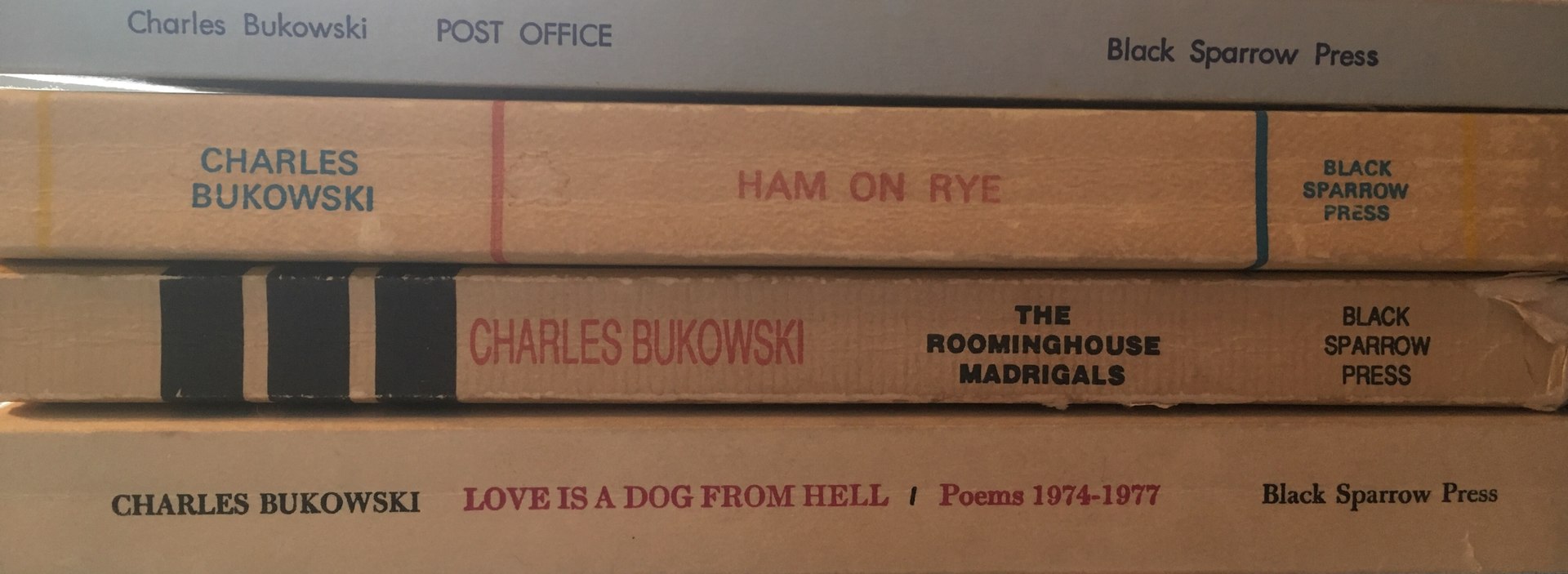
He wanted to become a writer. Some mornings, after a night of playing video games, we would discuss poetry and meter. Not with a particular finesse, I will admit, but we attempted to understand something greater than ourselves. He was fond of Bukowski and Hemingway. On summer days we biked to the lake and sank into the hot sand. A copy of Ham on Rye tucked inside of his backpack on the beach while we raced each other to the island northwest of the lake: panting, perspiring, pushing away the thoughts of what the future might hold.
In the disarray of his room, the stack of Bukowski’s novels rested on top of sprawled-out papers containing his short story drafts. Forgotten pencils behind the counter, a film of dust resting on the lining. When he let me read his writing I was overcome with a secret pleasure. I tried to find pieces of myself in his work. Perhaps, I thought, there would be a secret message that only I could decipher. Things that only I would understand, and then I would know, and a mutual understanding would be drawn between us. Each story became an oblique confession. Each adjective became a clue. I suppose what I had really wanted was for him to contain a part of me.
In his stories, the urge to leave seemed to me a central motif. There were characters who were misunderstood, characters ridden with shame. In one of these stories, I recall, a young man felt so ashamed of descending from a long line of farmers that when he arrived at college he imagined a persistent odor of a pigsty following his every step. This odor separated him from his classmates, and became a tangible manifestation of his otherness. In the end, the young man retreated from university life and diligently, if not in a defeated spirit, returned to his parents’ farm.
I recall him chuckling, and calling it stupid before ripping it out of my hands.
“Yeah,” I said. “It is.”
As it goes, and as it does in many cases, all things end. Time pervades the foundation of all organic matter: It makes for growth and rot and allows for new beginnings. He went north; I went south. Then the years passed and the unanswered longing became forgotten. Through a chance encounter of hearsay from a mutual childhood friend, I found out much later in my twenties that he had, despite our talks and fantasies, returned to his father’s farm to work in the family business. I pictured him in the same barn where we had discussed McCammon and King on bales of hay. The same bales of hay where he had once asked me if I believed that God loves all his creatures.
“I hope so,” I replied.
It became at once a poignant irony, that this allegorical story should have become a fulfilled prophecy: a collapse between the fictionalized version of him and the real self.
***
I had vivid, recurring dreams as a child: black soot; teeth falling out of grimy mouths, tooth after tooth; God in the shape of various animals. It all seemed to be the currents of a subconscious sea, washing over me as I slept. The dreams seemed frightfully symbolic. There had, as the years passed, amassed a palpable anxiety which accumulated interest the longer it went undisclosed. To discuss it with God seemed an impossibility, since the thing I feared most was the condemning nature of God’s devout followers. A mob, James Baldwin once wrote, is not an autonomous entity: There is a correlation between the hand and the nerves which fire off the synapses, ordering it to strike. If the mob was terrifying, then God must be even worse, I told myself.
I began to observe the possible outcomes of my life by facing the roster of those whose desires aligned in the way mine did: There was the revert, spending his life repenting through the act of abstaining; there was the discrete husband, whose desires could only be actualized with other like-minded strangers in the dark; there was the shunned man who became a subject of ridicule within his own community, having worn his heart on his sleeve and paid the price.
My point of view on my desires was certainly formed by my religion, and it is probable, highly likely even, that a young man despised by the very same religion finds his faith faltering. It is therefore an awful thing that follows after this fact: People believe they deserve their punishment, and when they operate on this belief, an internal collapse ensues. I have seen men and women alike who repress and absolve themselves of any wrongdoing. Men and women who carried a seed of destruction within their souls. Men and women who have melted into the night, dissolved by daytime. I wanted none of it. I wanted more than that.
***
I know things now that I did not know back then. I know now that the first lesson of desire is that it survives despite the condemnation. It became apparent to me, in the years following our divergence, that the boy had written the ending to his own story. He had written the ending, watched it unfold, and then slipped into the role from which he had wanted to escape. I imagined for quite some time that he had done so reluctantly, but truthfully, I could not tell. I did not know if it made things easier for me if he had or not.
I wrote a poem on the midnight train not too long ago. I remember the blue light reflected in the window from the water beneath the bridge as I jotted it down on a crumpled receipt. The final stanza went along the lines of “ELECTRIC BLUE BLONDE / STRUCK ME DOWN WITH A / SOFTENED PUNCH / BLOOD-STAINED TOUCH / I WILL LOVE YOU / TO THE FLOOR AND BACK.” I folded the poem and slid it back into my pocket.
It was true that violence and tenderness have always been intertwined. I know this because I have felt both. To me, this unrequited love had been a source of comfort, as well as injury. I had learned that God loved all his children, but that he loved some less than others. I had loved this boy and God alike, but neither could reciprocate it in the way I had needed, much less wanted. To be valued is one thing, sure: It is an easy enough transaction which stems from observation and a bit of willpower, nothing more. But to love is another matter; love makes a mockery of the will, and is, to some degree, a sacrifice.
The real tragedy of this adolescent want was not its unfulfillment, nor was it the lack of physical reciprocation. The life I inherited would require a different version of the self. The strength of my desire and the failure of my devotion had become my deepest wound. It had taught me that this opposition was, effectively, possible: I had to invent a new set of cards with which to play.
I know some things now that I did not know then. I wonder too, sometimes, if he does as well.

Click here to subscribe today and leave your comment, or log in if you’re already a paid subscriber.