
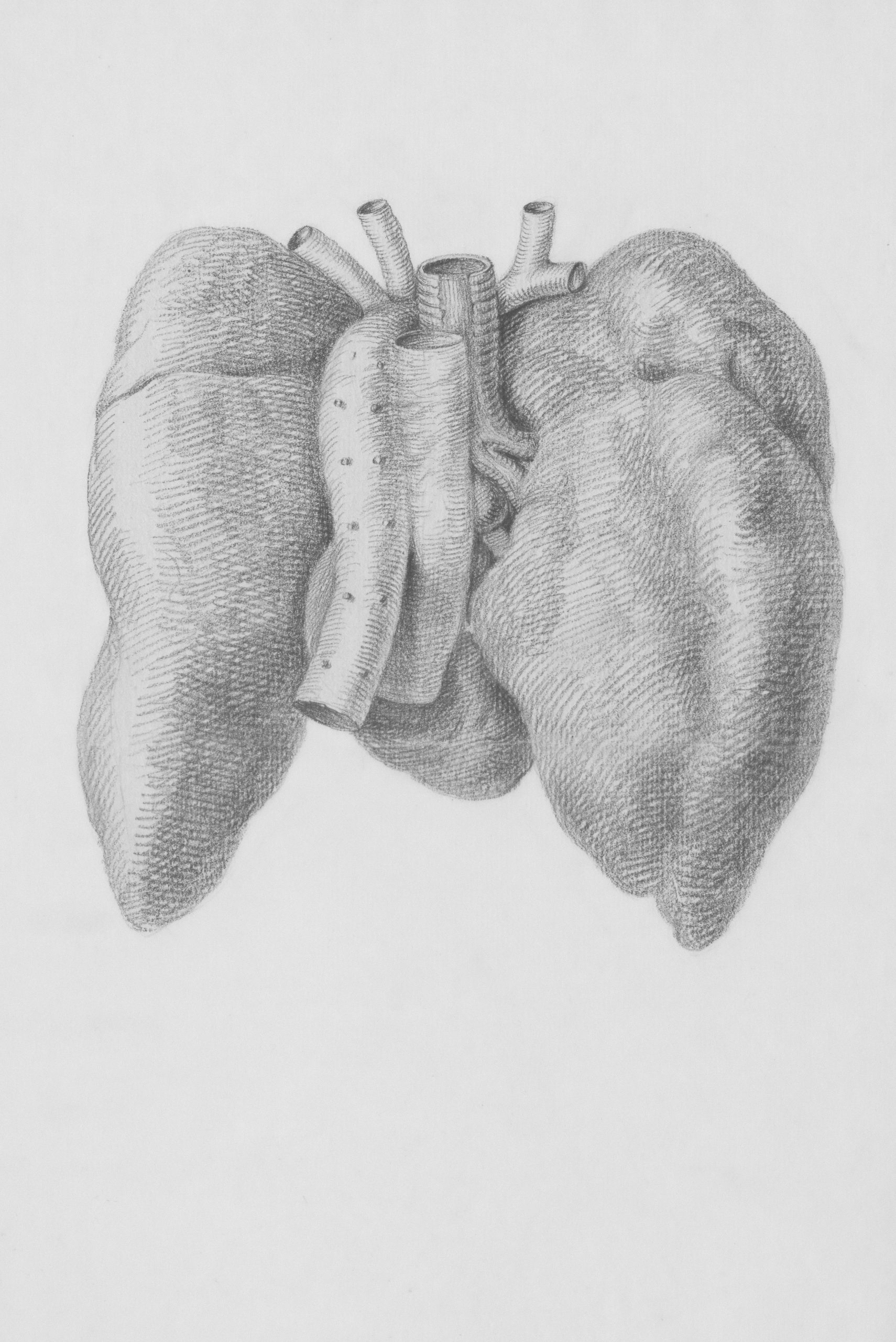
I miss smoking. I’ve never been a regular, I just miss the taste. I’m no longer allowed to enjoy the occasional cigarette after my pneumothorax.
I was walking along the streets of Brooklyn around two in the afternoon, as I often did, unemployed and aimless, struggling to envision what was next even as the world slowly blinked back into being. The only thing I remember from that walk was that my friend Rachika drove by on a motorcycle. I waved as she passed. Before I got back to my apartment, I felt like I was having heart palpitations. A few hours later, I told my roommate Calpurnia and we called her mom, a nurse back in New Mexico. Calpurnia’s mom told me to stop eating so many bananas but that I should probably go to urgent care just to check it out. After an hour or so more, I acquiesced. This is how the first of my multiple hospital stays in just three years started. I had no idea this would only be my first, and in some ways easiest, time interacting with the medical industrial complex.
Calpurnia and I walked the entire way, a twenty minute walk or so, all the while Calpurnia trying to comfort me. It was probably nothing. In retrospect, we should not have walked.
We didn’t have to wait long at the small, bleak urgent care City MD close to Maria Hernandez Park in Bushwick. Apparently my palpitations didn’t bode well. A small dark-haired nurse performed an EKG.
“Well it’s not heart palpitations,” she said. “You have a collapsed lung.”
I was devastated. I never got the chance to smoke a Capri. She told me I had to go to the hospital immediately. In a flurry, I dashed out to the waiting room and Calpurnia called us a car, not wanting to pay for an ambulance. Our driver was not amused. I was on Medicaid but terrified of going into more debt. Who knew what was and wasn’t covered?
At Woodhull, we were quickly ushered into the emergency room. Another short dark-haired woman set me down on a stretcher and gave me an oxygen mask.
“It’s a good thing you came in when you did,” she said. I nodded, smiled, taking her chastising in stride.
A doctor eventually came in to grill me on the real questions. Over and over, doctors would ask me if I smoked.
“No,” Calpurnia said. “She doesn’t.”
Eventually, they told us they would be right back.
The doctors wanted so badly to blame my broken lung on something I’d done. A sin. I wanted to admit I had the occasional cigarette, spaced years apart and often when I was very drunk or trying to impress a boy at a party. Instead, they eventually told me it was because I was tall and skinny. The part of me recovering from an eating disorder relished this diagnosis. Someone had said it. That I had punished myself enough to cause corporeal damage.
Meanwhile, the nurse left to take a smoke break as a gun-shot victim came in and started screaming just outside the curtain.
“Take it out!” she howled, deep and guttural. The doctors could not seem to comfort her. Not that they tried.
Eventually, the doctor returned. Despite their urgent warnings when I arrived, they were oddly slow in treating me.
“We’re going to have to stick a tube in your side, to make sure your lung gets enough air,” a doctor told me.
“Okay,” I said, not entirely comprehending, staring at Calpurnia and wishing she could stay when the tube went in. I was single and she was my confidant, the closest thing to immediate family I had. We met on a dating app years and years ago, before becoming friends who talked about pop music and experimental art.
“Unfortunately, your friend can’t stay,” the doctor said, returning with three interns. Maybe they were assistants, or fellow medical professionals, but to me they looked like children, holding scalpels and a long clear tube that I now knew would be inserted into my side like the wound of Christ.
Calpurnia ducked behind the curtain and waited. Despite strict Covid protocols, the nurse who smoked let her stay. I silently thanked her for that small courtesy.
Without any anesthetic, my side was cut open and the doctor began to feel around for my lung. Calpurnia later said she had never heard anyone scream in so much pain. I can hardly remember the pain now, not after the dull hum that followed for the next two weeks. But that was only the beginning of the real test. The waiting. Once they were in, they attached the chest tube to bypass the small hole in my lung to make sure I could keep breathing. The pain meds came much too late. The scream gave way to silent crying. Physical agony like that eventually degrades, exhausts itself.
Slowly, we tried to piece together what would come next. I was given a color contrast that felt like an ache blooming across my body, like a UTI spread throughout my limbs. A few hours later I was wheeled up to my own room where I would stay, locked in and locked up, for the next two weeks, with friends dropping by in between their first post-vaccine summer of freedom activities. Drugs, raves, parties, dates. I stewed. Waited. Apparently, we were going to wait and see if the chest tube helped the pneumothorax repair itself. Sometimes, apparently, miraculously, that was enough. Every day I waited to be told if I was going to get surgery. Every day I waited for a solution.
I couldn’t leave, and couldn’t walk around in the hospital because of my lung. So I read. Mainly short stories. Alice Munro, Brandon Taylor, Lorrie Moore, Casey Plett. Domestic realism. The life I would be having if I were out in the world. The janitor kept telling me to relax, to watch some TV.
I asked friends for pictures of beautiful women on motorcycles. I needed a distraction from the pain and I was trying to find out if I was a latent lesbian. My friend Mary sent a great one of Kathy Acker. I joked I wanted her to drive over me. That’s almost what it felt like—as if I’d seen a beautiful woman on a motorcycle and been run over, my lung, my heart, like popcorn.
I watched Wendy Williams too. Nothing else was on. Nothing else would do. The janitor shook her head coming in. “I don’t know how you watch that shit,” she said. I didn’t either.
After a few days of limbo, my mom flew in. I was glad to have someone bring me real coffee in the mornings, someone who could relieve my friends, who was a nurse herself. She wanted me to transfer hospitals at first, but after a while we could admit that this was a more common physical problem than we thought. The days stretched in front of me, the tube still in my side until the doctors could decide whether I needed surgery or not.
Dilaudid saved my life. Before my lung collapsed I always thought of myself as something of a masochistic, inured to the shock of pain. Being in a hospital for two weeks lowered my pain tolerance. Having a broken lung is not, for example, like getting a tattoo. Staying with such agony, with the vicious timeline of surgery, is a practice. Like meditation. Like prayer.
Old acquaintances came out of social isolation to wish me well, and, in one case, illness disguised as wellness. An ex-girlfriend called not long before my mom was supposed to come back from a food run.
“Are you okay?”
“I don’t know,” I said. Every surgery has risks. There was always a chance something could go wrong. How likely was actual death? Perhaps not very. But being that close to the precipice was new for me.
Not long beforehand, she had sent me a letter, telling me she wanted to be back in touch. That she listened to Joni Mitchell’s Blue while thinking about me. But now that we were on the phone, I discovered she had a new partner. That was who encouraged her to reach out to me.
“We don’t have to talk about this though,” she said.
“It’s okay,” I replied.
“Do you think—were you afraid of the long distance?”
“Of course,” I said. “But I would’ve done anything for you.”
“Yeah,” she said.
I excused myself and hung up. My mom had come into the room. I was bawling. She did not even know I had an ex-girlfriend; I had—and still do—primarily date men. I am a model fake bisexual. But my mom took it in stride, hating her for both of us. I cried for four hours and then decided I did not want to potentially die loving someone who did not love me, however melodramatic that was.
***
The doctors tried to wait out my condition. They thought with special oxygen, my lungs might heal on their own. Of course, they didn’t. I was desperate. I kept whining to the doctors who eventually told me they would perform a thoracotomy. I was both terrified and overjoyed.
After a few days of stops and starts, fearful fits of observation, I was released into the real world, good as new. My bill was zero dollars. I don’t know what I would have done if I had private insurance or the shitty insurance I had when briefly gainfully employed. I had been freed with only minimal damage and minimal rules; no smoking, ever, even when drunk, even when trying to impress a boy at a party.
Despite the fact that I am no longer allowed to even be near smoke, my relationship to the act is still one of admiration. Smoking, despite its respiratory consequences, remains an aphrodisiac to me.
If smoking was so uncool, it wouldn’t have become so sexy. Every detective, every femme fatale, every chanteuse smokes—even in contemporary cinema. I still believe in the crushing beauty of an oral fixation. And I’m not alone. During a TedTalk, the founder of Juul said nearly the exact same thing—hoping to remind us of the link between cigarettes and sex. Is Audrey Hepburn really Holly Golightly without her long cigarette from Breakfast at Tiffany’s? One of the strangest erotic scenes I’ve seen in my life (yet no less thrilling) is Misato’s cigarette burning in an ashtray as we hear her moan in the anime Neon Genesis Evangelion. In high school, before I had any sense, all the women I fell for smoked Yellow American Spirits and all the guys I fell for hid Marlboro Reds in their lumberjackets.
After my lung collapsed, I didn’t feel like myself. A friend of mine told me that many of the phases I experienced afterward—excessive partying, for instance—were very normal after a near-death experience. She was speaking firsthand. I’m still trying to understand What It Meant even as I understand it meant nothing. I’m not convinced death or illness have any meaning other than what we need them to, to complicate this is to moralize or spiritualize the body in ways that lead to bizarre if not fatal political implications. I’m only writing this because I write things. I’m writing because it’s relevant copy.
***
I did everything I could in the meantime to not think about the hospital. The drip. The sterile stench. The loss of time. The clinical bedside chitchat. The brutality. Instead, I went to raves. I tried all of the drugs I had never done because I was too busy being a good girl. Before, I thought, “I can be gay or trans but I must be the right kind.” Respectable, diligent, quiet, small. There is no place for the meek in a rave. You have to move, to feel both in and out of your body under the blue light, to pretend there is a new world revolution coming, even if there is most certainly not.
***
The revolution that came was not peaceful. Business was not returning to usual—if it ever had been. Not long after Russia began to invade Ukraine, my entire nuclear family contracted Covid. Sibling, father, mother. The messages were fine at first, small updates on how they were weathering the fever. Then my mom bought an oximeter. I remained optimistic at first, determined not to ask if they had gotten their vaccines or not.
I had a new boyfriend. D was in law school. We met online and I got us lost in Prospect Park while drinking the last of some gin my roommate had left in the back of the freezer. Slowly at first, we danced around each other. We spent Christmas Eve at his apartment baking gingerbread and watching A Charlie Brown Christmas, my only real tradition.
My father called me.
“I just wanted to give you the safe code,” he said. “In case something happens.”
“Okay,” I said nervously. I should have said nothing is going to happen or it’s going to be okay, but somehow, in that moment, I knew that was not the right thing to say. I took down all the information he gave me. D walked up behind me and rubbed my shoulders.
On Christmas morning, D flew to Seattle to help his friend during top surgery and my father slipped into a coma. The two guys in my life coming and going like sliding doors. I walked outside and immediately realized I had forgotten sixty dollars worth of Chinese food back inside D’s apartment. It was still too early to ask for a key. I walked home with my headphones in, listening to Michael Barbaro talk about the invasion of Ukraine. It was oddly soothing.
I spent most of Christmas alone. The day felt thin. I sat on the fire escape and ate congee before downing a bottle of bourbon and calling home to check in.
“This could be it,” my mom said.
***
Airports compress large, incoherent groups of people under one cramped, masochistic dome. There is no headache like the headache of being too early for a flight. I was reminded of this when I returned to LaGuardia after a long hiatus from air travel. Joan Didion, the queen of blue moods, had died not long before my trip. She was once dubbed [by Elizabeth Hardwick] “the poet, if you like, of the airplane and the airport.” I was revisiting her essays, waiting to board as the boy across from me read Dune. Behind me a woman complained loudly about the delay. I wanted to turn and yell at her, to tell her I was visiting my father who had slipped into a coma after contracting Covid. I was on what felt like a time limit. My mother wasn’t sure how much longer my father had and I was supposed to get facial feminization surgery through Medicaid in just a few weeks. For every action there is an equal and opposite reaction.
Being a transsexual traveler is not as glamorous as Jan Morris would have you believe. Dodging looks with my nice but affordable purse, being asked what gender of TSA agent I would like, waiting for the family restroom to open up.
Drugs could help, or so I’m told, with the dissociation and dysphoria. Often, I feel a little shimmer and persistent nausea when taking something. I get intense motion sickness when I’m a passenger in a car. My mother taught me to carry dramamine—though I’ve come to learn it’s inevitable I will forget to take it until the symptoms are nearly unbearable. Travel dislodges our rhythms, the ones we create to be semi-functional machines. Without our rhythms we turn unrecognizable.
By the time I reached Indiana, I had steeled myself. Dissociated almost completely. This was a test of mental fortitude, and I was determined to pass.
The first night we didn’t do much. We gathered reserves and ate sushi. I had never seen the family in such a distraught, anything-goes state. Flowers and casseroles littered the kitchen. Dirty dishes piled high in the sink. I immediately got to work, got the latest update, and started cleaning.
I called D a few times while I was back in Indiana, desperate to remember there was life outside the cul-de-sac I walked every night to get some space to myself. Suburban houses are not built for alone time. The carnage of Christmas lights illuminated the gray slush.
When we went to visit my dad, a nurse came out of his room in a panic.
“What’s wrong?”
“Betty White just died,” she said.
I went into his room, watching the ventilator jerk him up and down. I was told to say my goodbyes. They didn’t expect him to survive. After telling him I loved him, I ran into an empty waiting room and stared at an empty fish tank.
The rest of my week at home I spent digging through my father’s finances. Nothing was in order. I read emails that misgendered me trying to figure out bank passwords and make sure all bills were paid and up to date. I convinced my mother to drink some whiskey. I, meanwhile, reverted to my middle school alcohol of choice. Blackberry Merlot.
A few weeks after I left, my father mysteriously woke up. They moved him into a physical rehab facility. He was a miracle. Few survived being in a coma for a few months. Not from Covid.
***
I crash landed at home, waking up in a daze, eager to prepare for facial feminization surgery. I made a Google Doc and called friends, made sure D would be back from their travels in time to help take care of me. I asked my roommate to come with me to the hospital. Less than a year ago I had been camped out at Woodhull for a very different kind of surgery. Northwell was a very different experience.
When I woke up a few hours later, drenched in pain, D was the first person to walk in the room. Later he would tell me it looked like I’d been a domestic violence victim or a praying mantis, my face was battered and bruised, my eyes mostly swollen shut. It felt like it was hard to breathe. D barked for more pain meds. I tried to talk but struggled, wincing at D to read to me.
The book I had brought to speed read while nervously waiting to go under was Ursula K. Le Guin’s The Left Hand of Darkness. D struggled and laughed over the nonsensical words and proper nouns: “kemmer,” “Genly Ai,” “Gethen,” “Estraven”. After a few pages, I fell asleep. Or something resembling it anyway. Real rest would elude me until the pain subsided. I struggled to eat or keep anything down—could not even focus on the Nintendo Switch I’d bought for bed rest. All things in time. Some have a remarkably easier time getting back up and around. But I took the pain to heart. Needed people more than ever before. Becoming dependent on others was hardly my default—I always needed friends, sure, but this was different, this was bodily care. Help getting up and down, showering, removing stitches that got stuck, preparing food.
Somehow, smoothie after smoothie, sleepless night after sitcom rewatch, I gathered my strength. It wore me thin. After the three weeks of friends visiting wore off, I broke down crying, the drugs flushing from my body as I came down.
The worst part of surgery, the one they don’t tell you, is not the pain, but the moment three or four weeks in when the anesthesia works its way out of your system and a mysterious emotional drop occurs. It feels like your heart is falling through the floor. A malaise almost physical in intensity.
Then, of course, there’s still a few more weeks to go before something like normal is even in reach.
***
Many trans women argue over which surgery is the “hardest.” By this they mean which has the longest, most physically arduous recovery. I voted face for its sheer terror, the difficulty one feels in seeing, tasting, being. But vaginoplasty is hardly simple. Not long after getting FFS, I met with a few possible surgeons. I made a selection and got onto the waiting list. For my preferred doctor, I would be waiting around two years.
After getting breast augmentation, I started waiting patiently for the next—and “last” step in my transition. The sex change, the operation.
It was an election year—-the year I was scheduled to “get” a vagina. There seems no artful way to describe this, only crude attempts at explaining what ended up becoming a very mundane part of my life. The surgery that has become so politicized is in fact quite safe, coherent, and easy to understand. Bodies are fungible. Mine, yours, and everyone else’s.
Despite having become familiar with hospitals, at this point through multiple surgeries and mental health visits, I was still nervous. Not in a way that would give conservatives any ammunition. Just in the way we can never be certain of anything. We make choices. Doors open and doors close. Certainty is a blunt instrument, a moral vicissitude that visits us very rarely. Yet I have no regrets.
In August, D and I went to Japan. We had just moved in together, a beautiful second floor apartment bigger than anywhere I’d ever lived in the city. It was a perfect place to recover from surgery. I asked a pack of former admirers to help me lug all of my books from one side of Queens to the other. When we left for Tokyo, half of my stuff was still in boxes, dresses spilling out of my closet.
I was not able to visit Mifune, the opalescent cerulean-encrusted restaurant that Patti Smith praises in her memoir M Train, when I traveled to Japan. Like Smith, I’m haunted by the talismans and graves of the great artists I admire. If I couldn’t visit the restaurant that laundered Akira Kurosawa ephemera and Toshiro Mifune posters, I would have to make a further pilgrimage. We were staying in Japan for two weeks, just enough time for numerous side excursions in the late August heatwave. I wanted at least one focused trip: Kurosawa’s grave in Kamakura. My boyfriend was lured by the warm beach town and I wanted to pour out some konbini sake to my beloved director. For a long time, I thought I was going to be a filmmaker. I loved the late films of Kurosawa. Old men and women struggling to make peace after living in the long shadow of war. There were, of course, many other stops I wanted to make, but this was the most serious pursuit. Something approaching holy.
We had to take three transfers and almost had to catch a bus, but instead, we walked through the suburban town. Crossed train tracks until we found a vicious fence. My boyfriend was the one who found a way in. We weren’t the first, though it seemed we were the first in a while. It took us about thirty minutes to identify the grave. DuoLingo hadn’t been much help the previous months. Decaying flowers lined a few of the heavy onyx stones. We set out the sake in front of Kurosawa’s grave and bowed, silently reflecting. So this is what it all comes down to. This is how it goes, for the tall and tiny alike. The master and the student waiting, an unmade haiku frozen in time.
By the time we got back, I was convinced I could handle sheltering in place for the months ahead. Vaginoplasty is immobilizing, requiring a lot of rest and daily dilation. Four times a day for the first few months.
I felt something akin to gratitude. Not to the doctors, who were merely doing their job and had their own ideas of what gender should or should not be in mind, but to myself. I had outlasted something. I could breathe. This was not a cure all, I was not broken and suddenly fixed, I was merely more open to the world. Receptive.
At six in the morning, D and I took a car to the hospital in Midtown. I donned a gown and waited. Every surgery I wait, terrified, not of any real complication, but of the anticipation itself. D held my hand until the last moment.
“Are you nervous?” The nurse asks, leading me to the little surgical cross.
“No,” I say. Meaning it, perhaps for the first time.
Click here to subscribe today and leave your comment, or log in if you’re already a paid subscriber.