
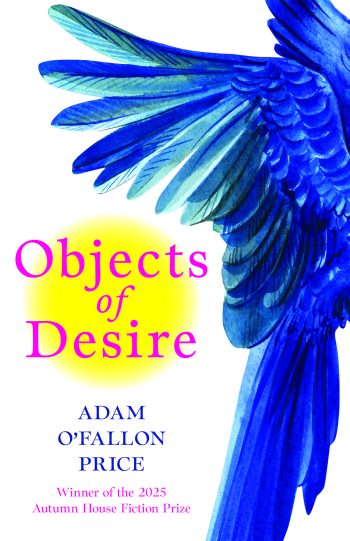
I feel both the passion and protective snobbery of a true fan when it comes to short stories. Like any devotee, I take pleasure in my sense of ownership, grumbling when I see a flub, giving a metaphorical pump of my fist when I’m dazzled by a triumph. Objects of Desire (Autumn House Press, 2026), Adam O’Fallon Price’s debut collection, is a book full of dazzlers—a real fist-pumping triumph—and readers will immediately recognize Price as a true fan of the form.
Filled with little nods to some of the greats (O’Connor, Carver, Borges, Chekhov, W.W. Jacobs), Price’s stories operate first and foremost as ingeniously conceived explorations of yearning and dread. Desire, as his title suggests, drives characters into all sorts of extremes. Wonderfully tense, these stories entertain; on the line level, Price writes sentences laser-cut in their precision. Panning out, I’d also argue that many of these stories operate with an ingenious meta-awareness of their own machinery, working as mini-explorations of story craft itself.
What a joy to talk with Price, friend and fellow denizen of Carrboro, NC, about his new book, certainly one of the best I’ve read this year—and in fact one of the strongest I’ve read in a good while.
This interview has been edited for length and clarity.
The Rumpus: Objects of Desire is such an accomplished, polished book. Tell me–over what span of time did you compose these stories? I saw “fifteen years” in the acknowledgements. What’s the oldest story? The newest? How long does it take generally for you to finish a story?
Adam O’Fallon Price: The oldest story in the collection is “Sandstorm,” which was the second story I ever published (at The Paris Review, right after I got to grad school). The newest is “Stone Lions,” which was unpublished at the time the collection sold, although it was recently placed at Writer’s Chronicle. All the rest are somewhere in between, 2010-2025, roughly.
The “how long does it take” question is really interesting—increasingly, my process has become more or less as follows: I write a rough draft fairly quickly, over the course of a couple weeks, maybe less. I write the shitty first ending, and I save it to my “Stories” file, and I basically forget about it. Then, after a certain amount of time has elapsed—not usually less than three months, and sometimes as long as a couple of years—I comb my story file, rediscover the story, and start working on it again, and the right ending usually comes pretty easily. There are exceptions to this, but it’s how I wrote the majority of the stories in the collection, especially the later ones. “Schenectady,” for example, was drafted first in probably 2014 or 2015, and then I completely forgot about it, came back to it in 2017, and realized how to end it.
When I was younger, I sort of beat my head against the wall and polished and polished and forced it, but I increasingly really trust my subconscious and this process. I would honestly recommend it to anyone reading—try putting a draft away for a while, your subconscious keeps working on it in the interim. It’s like magic!
Rumpus: One of my favorite stories (I had lots of favorites) was “Sandstorm,” which is kind of a standoff between a student and his professor who are opposites in many respects. The student has absolute conviction about his own abilities as a writer; his professor does not. I know you’re injecting parts of yourself into both of these guys, but I’m curious as to your take on the argument about the student’s workshop piece: is “guys sit in a tent” enough to constitute a story?
Price: Yeah, given the right writer, it’s plenty. I mean okay, I’m a plot guy—I’m the basis for the Plot Nazi character in Ling Ma’s masterpiece “Peking Duck,” from when we were at Cornell together, because I was always the voice in the room wanting more to happen, asking what the character was going to do. I like things to happen in stories.
So I would probably not personally write “guys sit in a tent,” but I totally think the right writer could make a meal of it, if they really understood the guys and what the emotional stakes are. The professor, in “Sandstorm,” is not giving that critique in good faith—the story clearly works, and he’s finding something wrong with it, as we often do in workshops. All of that said, I do think the average literary writer could stand to do a bit less “people sitting in rooms” storytelling (I say this to you, a writer who really knows her way around plot and dramatic action).
Rumpus: In this same story, there’s such a funny, wonderful scene in class in which the student refers to Raymond Carver’s “Cathedral” as “clichéd bullshit.” I’d love to hear about your relationship to this story and/or the relationship between the teaching of creative writing (for the readers, I’ll note that you teach creative writing at UNC-Chapel Hill) and your own work.
Price: Oh, I usually teach “Cathedral” in my intro fiction classes—I just taught it this week, in fact. It’s a wonderful piece for showing students a couple of important things they need to learn about storytelling: 1) that the narrator/main character can, and sometimes should, be an asshole, and related 2) that unreliability is not just a matter of something like Gone Girl or The Silent Patient—in other words plot twists and deceiving the reader. That unreliability is baked into all first person narratives. The narrator of “Cathedral” is not meaning to deceive the reader, but he’s a miserable jerk who is incapable of emotional intimacy with his wife, and his account of things cannot be fully trusted.
As far as teaching goes, I know this is kind of the standard response, but writing and teaching really do feed each other so much. I read so much more, and more broadly, because of my teaching than I otherwise would. And I have to figure out how to explain things to them in ways that help me articulate what I’m doing in my own writing. It almost feels like two parts of the same thing to me.
Rumpus: I caught at least two references to one of my favorite stories of all time, “A Good Man is Hard to Find.” The entire collection is studded with little nods and references to the GOATs of short story writing. Can you talk to me about influences? Favorites? Most hated?
Price: Oh yeah, I do love Flannery. She was where I learned how to write stories, really. She is so funny and so cruel—I learned from her that you have to torture your characters. Her stories are these exquisite little torture boxes designed exactly to the dimensions of the main character, and for the main character’s weaknesses. Whatever the tragic flaw of the character, FO creates a situation that ensnares and punishes them for it. Honestly, I reread her a few years ago and found the degree and intensity of cruelty toward her characters—without any mitigating lightness or kindness—breathtaking. It’s harder for me to read now than it used to be, I guess I’m getting soft in my old age. But nonetheless, it’s a great education about how to trap a character, how to put them under pressure, and how to keep turning the pressure up and up until… something snaps.
Favorite short story writers: Yates, (early) Updike, O’Connor, Malamud, Porter, Cheever—all the mid-century masters. I do think American middle-twentieth century short story writing was basically like Florentine art in the 16th century: incomparably great stuff, from an era when you could make a living in the short form. Trevor and Munro a bit later. In the last twenty years, I’ve really enjoyed work by Miranda July, Lauren Groff, Ted Chiang, Curtis Sittenfeld, Greg Jackson, and Danielle Evans, to somewhat randomly name a few.
I don’t hate anyone per se, just hate the kind of typical litfic story where nothing really happens, where it’s just a cultivation of sad, wistful, melancholy moodiness, and where at the end there’s not really an end, just a gesture of finality. I don’t hate any individual writers, but I really hate this kind of story, and there are always a lot of versions of it out there.
Rumpus: Two other stories I loved were “A Last Chance in Whitefish” and “A Natural Man.” These stories were so cleverly constructed, with so much mounting tension and—as everyone wants to see in a story—surprising inevitability. Can you talk about how you approach story structure?
Price: “A Natural Man” began as a sort of prompt to myself: Try to write a story where the narrative logic is governed by pure consequentiality. The main character’s van breaks down in the middle of nowhere, which causes his dog to run off, which causes him to chase the dog, which causes him to encounter the farmer, and so on all the way to the end. And this is true—stories are chains of consequence. I do think that’s one way I approach story structure: thinking about causality, how this scene is set up by the scene before and how it sets up the next.
I also think a lot in terms of desire, I guess (partly) hence the title. All the stories in this collection are about people who want something, usually something ruinous. You really need desire for a story to work, usually on a material level and simultaneously on an emotional level. Tracking character desire is one way to think about structure. That is to say that if all you did was have a handle on what a character wants and how that desire evolves, you would be in good shape dramatic structure-wise.
I should say, I began writing as a screenwriter—in my late twenties I lived in LA and spent several years writing scripts. So I think, for better or worse, I have a more concrete sense of story structure than most literary fiction writers, for whom this stuff is maybe a little more nebulous. I do believe that, while there is magic in storytelling, stories really *work* in certain ways.
Rumpus: Relatedly, you have this knack for pulling off what I might call the turn in a story. I see it throughout many of these, but the two aforementioned stories also seem like particularly good examples. Is this something you think about? Or is there a different way you think about that motion?
Price: Well, I don’t think I consciously say “I want to have a turn here,” but I am conscious of wanting to surprise the reader with character action. And I think that’s what you mostly mean by turn: The place in the story where the character (or sometimes a secondary character) does or chooses something that surprises the reader and sets the story on a different trajectory. I think it’s something I’ve developed as almost a reflex, because when I’m writing something, I want to surprise myself—you put the character in a situation and it puts pressure on them to act, and you give them a menu of possible actions, and when they do act, you want it to be something unexpected, maybe even off-menu. You want the story to wind up in a place that is not simply a straight line from A to B, in which the angle of dramatic action changes radically at (a) certain inflection point(s).
Rumpus: Beyond the obvious difference in size and scope, I’m curious how different story-writing versus novel-writing feels to you.
Price: Oh they feel like completely different things to me. Novels are big and messy and the ultimate pleasure a reader gets from them, whatever might happen in the story space, is this sense of spending time with the author, being in the company of this person’s intellect.
Stories are perfectible in a way that novels aren’t, and when you read a story it’s not as much about the force of the author’s personality, it’s about the way the thing is crafted. Like, I have a good sense of William Trevor’s William Trevorness from reading The Collected and doing The William Trevor Reader (I read all 85 stories in the Collected and wrote an essay about each one, from 2021-2023), but I think that personality is always to some extent subordinated to the structure and craft of the individual stories.
Rumpus: This is cheating because I’m friends with your wonderful wife (Elizabeth Watkins Price, a fantastic writer herself) and know about her work in mindfulness. I’m curious about this practice amongst artists and writers. Do you have a meditation practice?
Price: I have a relatively minor but consistent meditation practice—for many years, Elizabeth and I have started the day by meditating, anywhere from 5 to 20 minutes depending on how much time we have. It’s a bedrock part of my day-to-day life—I also meditate during the course of the day as needed, sometimes taking 5 minutes in my office, if I feel overwhelmed, et cetera. I’m not sure I think of it as being part of the writing, although it probably is, at least in the sense that everything is sort of part of the writing. And certainly, being calm and centered is a better state to write in than the alternative. Some people seem to thrive in chaos, or think they do, but I’ve always found the fewer distractions—internal and external—the better.
Rumpus: Talk to me about the state of short stories and the belief (which seems to be self-reinforcing) that no one wants to read story collections and they don’t sell. What’s up with these fools not giving love to short stories, and why?
Price: I’ve been hearing this since I went to grad school in 2011—I thought I would just be a short story writer and was immediately informed that I had to write a novel. When I wrote a novel-in-stories for my second novel, my agent, and then editors who rejected it, pretty forcefully argued that I needed to turn it into more of a novel and less of an “in-stories.” So, yeah, this is and has been, as they say, “a thing.”
I think there’s some truth to it—like I do think the average reader does not read short stories very much, if ever, and automatically thinks of novels as the coin of the literary realm. But like so much publishing stuff, it’s also a self-fulfilling prophecy, as you say, because if they decided to really get behind a great collection of stories, they could probably sell it as well as a novel. I think the reason for that has something to do with what I mentioned earlier—we are in this moment where author identity is paramount, and novels are kind of this conduit to communing with an author’s personality and vibe. Novels do this in a way that stories sort of don’t—stories are more about the thing itself, and publishing is still in this place where it very much wants more of the author and less of what the author creates.
Rumpus: What have you read recently that’s blown you away?
Price: I reread Mrs. Dalloway out loud with my wife recently and was blown away by it. I’d read it before, but doing it out loud forces you to slow down and sit with Woolf’s incomparable language. She really was just the greatest.
Rumpus: Are there books you see your collection as being in conversation with? (I mean beyond the writers you name-check in the stories themselves!)
Price: Well, I definitely feel like I’m in conversation with those older writers I mentioned earlier. I’m not at all saying I’m as good as Yates or Malamud or Katherine Ann Porter or whoever, but those are the people whose work I’m aiming at. This is going to sound supremely fogeyish, but I think there’s a tendency for writers these days, if they read at all, to mostly read stuff by their contemporaries. And I think the result is a “Literature of Now” that’s pretty flat and superficial and among other things obsessed with the internet. And while I do think we should be writing about our era, we also should be drawing on the best of the past—it’s all available to us, why wouldn’t you read the stuff that has held up for fifty to a hundred years?

Click here to subscribe today and leave your comment, or log in if you’re already a paid subscriber.