
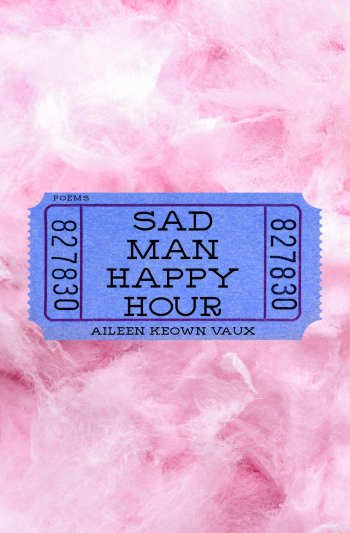
Aileen Keown Vaux and I share an obsession with what it means to be from the West—the particular gothic weirdness of the region, the grandeur and threat of its landscapes and the histories of extraction, labor, displacement, and reinvention that haunt them. Those questions run throughout Keown Vaux’s debut full-length poetry collection, Sad Man Happy Hour (Unsolicited Press, 2026), a book deeply rooted in the places that have shaped them.
Keown Vaux and I first met over a decade ago. They grew up in Yakima, Washington, living throughout the Pacific and Inland Northwest over the years. Their 2018 chapbook, Consolation Prize (Scablands Books), became the first of four sections that eventually formed Sad Man Happy Hour.
These are sorrowful poems, but they are also bright, full of the pleasures of language and the small miracles of being human. Keown Vaux’s eye for the beauty of passed-over places like Yakima and Spokane aligns with an equal affection for the strange, funny, tacky, and ordinary things people use to make a life. This keen attention extends to people and creating community, connecting writers, friends, neighbors, and people who might otherwise not share a circle. Their work feels just as expansive.
County fairs, orchards, dance floors, and pandemic-era walks all become vehicles in this collection, for considering where we come from, what we inherit from those places, and what we owe them in return. While interested in kitsch and pleasure, they also speak to grief, family, mortality and the pressures of living through a changing climate.
From their home in Portland, Keown Vaux joined me in a shared Google doc to chat about regional inheritance, space-time sandwiches, and the interminable work of figuring out where—and with whom—we belong.
This interview has been edited for length and clarity.
The Rumpus: I know we have spoken a lot over the years about what it means to be from the West—the way that the landscapes here can feel uncanny, haunted by histories of dispossession and extraction, beautiful, and dangerous. Do you think of this as a Western book?
Aileen Keown Vaux: It is 100 percent a Western book. I’ve bopped around the region quite a bit—I’ve lived all over Washington and Oregon and spent significant time in Idaho and Montana and my experiences here are an engine-driver for the book. I’m evolving my own personal definition of what it means to be from the West. I think what I know so far is that a true Westerner is emotionally and spiritually moved by the landscape and its ghosts—that sometimes standing at the edge of the forest is an eerie feeling. And the stories we tell each other about where we come from are also unsettling and unsettled, on par with the ones we typically associate with the Gothic South.
An award-winning author came through Portland a few years ago and said that he “found the Western, as a genre, in shambles” and felt compelled to write his own version. In the same breath he said that he felt like it wasn’t necessary to visit the region to write a Western. And I nearly fell out of my chair. I’m not a gatekeeper for the Western. In fact I think a lot of people belong here because they resonate with the place, even if they weren’t born here. But to write with truth about this place means to write about the alchemic relationship between nature and people.
Every time I catch the mountains framed against the Portland skyline, I am shocked anew by the beauty and smallness of living in a volcano’s shadow. The awareness that landscape is intended to speak to us on a deep human-animal level is, for me, a quintessential component of Western writing. I’m going to always try my hardest to represent that feeling in my writing.
Rumpus: Reading these poems made me think a lot about place as an inheritance. The opening section frames the State Fair as a consolation prize. How do the stories of the places we are from become part of our understanding of who we are and what we deserve? Can writing about a place change it, or our relationship to it?
Keown Vaux: The opening to Sad Man Happy Hour and the section “Consolation Prize” briefly summarizes what happened to the three cities in Washington State vying to become the state capitol. Olympia won the title; Ellensburg got a university; and I joke that Yakima was awarded a state fair as a “consolation prize.” There’s a cheekiness to that statement—but I do believe that those decisions gave each place a type of cultural inheritance—to be perceived as the place of state power versus the spot that has really awesome corn. It trickles down into the fabric of the city and its inhabitants.
As a younger person I saw the world in clearer dualities—legislators versus farmers—and wanted to be from elsewhere. But in writing this book I tried to collapse those dualities a bit more, complicate them, and poke at any assumptions I’ve made about rurality and what we can learn from places that are dependent upon weather, seasonal changes, and wild nature. I don’t think I would be as sensitive to how this country treats migrants, or immigrant labor, if I hadn’t grown up in a community full of people who travel to where fruit needs to be harvested in order to keep their families afloat.
The Pacific Northwest, and where I am from specifically, is globally significant, but somewhere along the way the origin of that significance is severed from the general public. It’s a lot like eating an apple grown from the Yakima Valley—people enjoy it 1,000 miles away, but the place that grew it matters, needs support, and influences how good it tastes.
Rumpus: The book is divided into four parts, Consolation Prize, Unsolved Mysteries, Animal Collective, and Sad Man Happy Hour. Did putting the larger book together change your understanding of the earlier poems? How do you see these parts relating to each other?
Keown Vaux: I’ll be honest—I approached these poems as if I was writing discreet chapbooks first, and I still think of them as four small books bound by a larger sensibility—which I suppose is just my brain’s vibes and how I think about the subjects I’m drawn to, recurring to the point of personal disgust, where I’m like, “Sheesh! Get a new obsession!” Rural places, human-animal relationships, queer experience, mortality, and what it means to experience spiritual injury and repair all show up throughout each section.
The themes also started out as personal inside jokes. [The section],“Consolation Prize,” I’ve talked about. “Unsolved Mysteries” has sly references to all of the categories of mysteries on the show I watched (but probably shouldn’t have) as a kid. “Animal Collective” is a shout-out to the band and a personal constraint to include an animal in every poem in that section. And “Sad Man Happy Hour” is how I felt during the pandemic. So the through-thread is also attempting to entertain myself in my own way.
Rumpus: I want to go back to what you were saying about what it means to come from a place—the terroir or our lives, what is indelible and where disconnection happens. A lot of these poems seem to reckon with the speaker’s disconnection from their mother, and I can see a way of reading them where the speaker is circling a similar question of origin and severance. Do those feel related to you?
Keown Vaux: I think it is important to say that poems are not machines of the literal. I think there is a different litmus test for narrative veracity in poems than in nonfiction. But what I am trying to accomplish in the poems is a very human impulse—to consider our origins, retrace where we are from to figure out where we are going. There is a tremendous, perhaps unfair, amount of cultural pressure to trace that origin back to “mother” or to “hometown.”
I have a line in “Aristotle Says” where I say “what did birth do to me and my mother / who emerged from the same swamp / both claiming to have invented the other.” Is this about me and my mother? Or about you and yours? Or anyone’s relationship to their lineage? I don’t need people to take these lines literally to consider it meaningful to their own story.
I am really fascinated by the dynamic when one person is born and creates an immediate identity for two people. We so often want family to be people they were never born to be. The older I get the less black and white that dynamic feels to me—perhaps I’m allowing it to be more human and complex. And that definitely parallels how I am in relationship to the geography that feels like home to me.
Rumpus: There’s a lot of examination of duality here—of the tension between seemingly opposing forces. “Sad Man” versus “Happy Hour”, public versus private, inheritance versus refusal, usefulness versus pleasure. What interests you about those tensions?
Keown Vaux: The tension for me is that they don’t live in opposition with one another, so much as they feel inextricably linked. The phrase “Sad Man Happy Hour” comes from the walks I would take along the Spokane River in the early days of the pandemic, during the golden hour, when a bunch of random dudes and I were just on our evening stroll together, alone. It was an hour when families were having their dinners or winding down for little kid bedtime—so this unique Centennial Trail demographic was really noticeable to me. At the same time we were enjoying our nature walks and kind of going feral together. And I started calling it “Sad Man Happy Hour” in my mind—probably as a coping mechanism for all of the uncertainty I was experiencing at the time.
Over a decade ago I was in a workshop with the wonderful poet Erin Belieu and I remember her saying that she could skate across the surface of my poems like ice. They were too contained, too tight. And she was right. I was trying to make something perfect and perfection simply doesn’t move people emotionally. So I’m trying to let people into the experience below the surface of my poems. And it turns out the subterranean is murky and full of opposing forces.
Rumpus: I’m thinking about the role of humor in the book, moments when I would laugh and then immediately consider what I had just laughed at. What role does humor play in your work?
Keown Vaux: A huge turning point in my writing life occurred when I realized I could write humor into my poetry and get consistent laughs during readings. If you can surprise an audience, you can get people to pay closer attention and be more open to metabolizing a difficult truth.
If you’re talking about something intense AND you’re dour about it—I don’t think of that as a gift to an audience. I want people to feel uplifted even when talking about something unpleasant; gallows humor is how many people survive traumatic events. I am heavily influenced by poets and writers whose poetry also hinges on humor—Sommer Browning, Jennifer L. Knox, and Natalie Shapero come to mind.
Rumpus: In many of these poems, you’re investigating the idea of needing others and of survival, questioning whether survival is a “Save Yourself Plan™” (“The Old Fashioned Way”) or a project of interdependence (“Three Sisters”). What are you asking or discovering about what it means to save oneself? Does that question feel different on the scale of a person, a community, or a society?
Keown Vaux: I’ve talked about sociologist Robert Putman’s work since I saw Join or Die, a documentary about how Putman’s work correlates the relationship between the democratic health of a nation and its community ties. I’m grossly summarizing—but basically, if a lot of townspeople join a choir they are connected in ways that make it more challenging to screw each other over when it comes to decisions made at city hall, because it’s harder to be cruel to your neighbor Bob when you have to sing next to Bob at choir the next day. So I’ve started to see surviving the big stuff—unjust politics, natural disasters, a worsening economy—as dependent on whether or not my community has hobbyists who are making hyper-local connections with one another. Of course we also need jobs that pay enough to allow for free time to cultivate hobbies or community connections. I think one of the markers of late-stage capitalism is the commodification of hobbies—because then you’re in a relationship with money, not your fellow neighbors. I think survival, genuinely, is based on whether or not you know your neighbor and have some kind of common activity with them.
Rumpus: That feels very aligned with the idea of localism as key to sustainability—shrinking our scope in order to invest in our communities. There’s something inherently queer about that as well—found family, mutual aid, third places. In “Sci-Med,” the speaker is out at a dance club and falling to the floor to help someone find their missing pills, and that gesture, of immediately giving oneself over to help someone (even at 4:00 am, high on molly!) feels queer and generous and joyful.
Keown Vaux: I’ve been thinking a lot about parts of subculture that get celebrated but rarely addressed as an absolute failure of systems that more privileged humans get to claim as givens. When we talk about “found family” in queer community, it is joyous; it is wonderful to find people who we can count on in meaningful ways, but the shadow side of that is that there are absences in our lives because we’ve lost family for being who we are.
When we have to depend on mutual aid because typical institutions of commerce exclude us because of our differences, is that a happy condition? When we laud someone for being the first to achieve a benchmark typically reserved for another class of person—amid the applause what I hear is the overwhelming silence of why that person had to be the first at all. Sometimes I’d rather talk about institutional exclusion than celebrate the ways in which undersupported people have persevered despite it all. So yes, it is joyful to be in a club at 4:00 am, but I also feel the undercurrent of sadness that moves people into that space to seek a type of mollifying joy.
Rumpus: The specters of climate change—displaced animal attacks, thousand year floods, wildfire, haunt your poems. What demands does climate change make on your imagination?
Keown Vaux: I can’t un-observe the ways in which my communities are impacted by catastrophic weather events. If I am hiking in the forest, I am seeking the transcendent joy of standing next to a 200-foot waterfall, as well as noting that in order to get to that waterfall I had to walk a half-mile through trees blackened by wildfire. My pattern-seeking self tells me that climate change is a self-evident part of storytelling, if I am going to be truthful about nature in the Pacific Northwest. I can’t filter out physical realities just because they seem ugly or scary next to the beautiful elements of this landscape.
Rumpus: Do you think of this as a hopeful book?
Keown Vaux: In maybe the biggest show-don’t-tell, I want this book to show the ways in which I’m actively trying to interrogate the world and celebrate it, to show how I am actively seeking out ways to stay light when levity is in short supply. So is the book hopeful? I’m not sure I can be the one to decide that. But I know that this is my method for not getting mired in doom-erism.
Rumpus: I’m obsessed with this image in the last poem of the collection, “Return to the Cities”:
What matters is that time
spears space like a toothpick
through a club sandwich:
each strata held together by filaments
thin enough to be mistaken for choice
Tell me about that image, and about choice versus inevitability.
Keown Vaux: I love watching documentaries about space/time and I think this line came out of one I saw about black holes. I like to think of all of these different possibilities of life stacked on top of one another—like a club sandwich or a millefeuille—but time as we experience it is linear and that moves us straight through all of these life-scenario layers.
I suppose it is my way of coming to peace with the nagging feeling that life is simultaneously limitless and fairly contained. Once our time-toothpick pierces a layer it’s okay to release any path we didn’t take—on to the next part of the sandwich!


Click here to subscribe today and leave your comment, or log in if you’re already a paid subscriber.