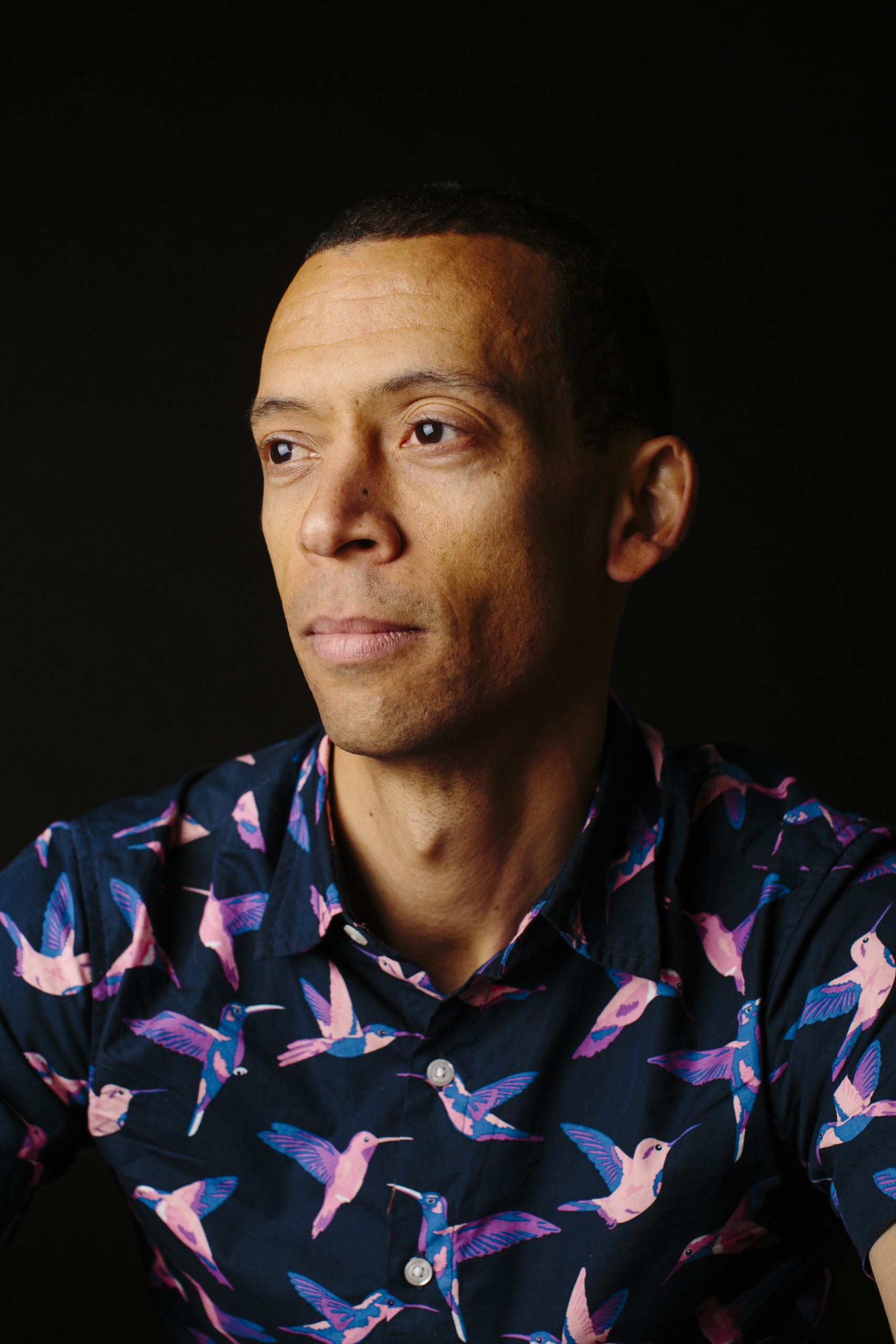
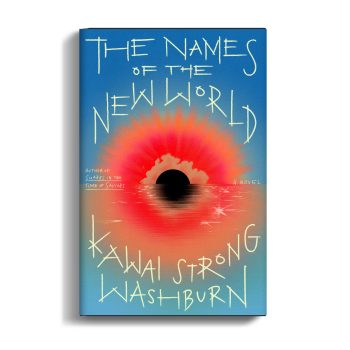
Dystopian survival amidst environmental breakdown. Violent conflicts over fresh water and arable land. Total societal collapse. Most of today’s climate fiction focuses on impending doom, but Kawai Strong Washburn isn’t interested in a future where doom is the only assumption. “What does the world that I would want to live in look like? That’s where this book started,” he says about his second novel, The Names of the New World (FSG, 2026).
Washburn’s highly-anticipated saga follows three strangers who are thrown together after a devastating superstorm obliterates parts of present-day Minneapolis. Naomi, Amaré and Raheem’s lives intersect across decades, bringing them from the American Midwest to the nation’s halls of power to islands across the Pacific. Theirs is an unlikely bond forged by love, ambition, resilience and—for better or worse—each fights to protect a future threatened by overwhelming change.
Admittedly, it’s challenging these days to not fall into existential doom and gloom. Climate catastrophe is all around us, happening in real time: glacial collapse in Nepal, wildfires in Canada and Spain, severe monsoon flooding in East Asia, the Colorado River drying up, tornado outbreaks across the Midwest, deadly heat waves suffocating swaths of North America and Western Europe. What’s a human to do? Washburn responds in an original, energetic, and beautifully-written work that ventures audaciously into our near future. “When you think of your [home], do you ever think of it ceasing to exist?” wonders Naomi, the unforgettable lawyer-MMA fighter-mother-warrior-heroine at the center of Washburn’s story. She continues, musing about what’s possible: “Think of power that survives summer heat waves and winter cold snaps without poisoning the air or the water. No more smog, no more asthma. No more oil spills turning the Gulf of Mexico into a permanent toxic waste dump.”
Washburn thought often about the connection between person and planet while writing The Names of the New World: his transcendent experiences with the natural world while growing up in Honoka’a, a small agricultural town on the windward coast of the Big Island of Hawai’i near the dramatic cliffs, waterfalls, and black sand beaches of the famous Waipi’o Valley; his decade-plus work in climate advocacy; and the kind of world he wants to hand down to his two daughters.
We recently shared conversations over Zoom and email where we discussed the interconnectedness of all things, imagining a climate future that isn’t apocalyptic, writing badass female characters, and what he’s writing next (a Polynesian retelling of Lord of the Flies).
This conversation has been edited for length and clarity.
The Rumpus: I really enjoyed this book and I have a million questions. Where do we start? Oh, I know! Let’s begin with this idea of interconnectedness.
Kawai Strong Washburn: Yes!
Rumpus: It’s a theme in this novel and something you explored in your first book, Sharks in the Time of Saviors (Picador, 2021). I’ve been meditating about this concept of connectivity, how we are all linked together in this world—human to human, human to the natural world—and I loved how you threaded this theme throughout this book. Maybe we could start by talking about the prologue because it so clearly points to that interconnectedness, how different people or events can relate to each other and how what happens to one part can change or affect another part—in this case, the horrors humans can inflict upon each other and the legacy of those horrors.
Washburn: For Naomi, the book’s main character, her body has been changed by the nuclear bombs that were detonated in her homeland, the Marshall Islands.
Rumpus: You’re talking about Castle Bravo, the largest nuclear device ever tested by the United States, which is mentioned in the prologue.
Washburn: Yes, exactly. And you see this again with Amaré’s mother, Skye, whose asthma was caused by the toxicity of the redlined Milwaukee neighborhood she grew up in. So they both grapple with the physical manifestations of systemic abuse.
The interconnectedness of all things is one of my writerly obsessions. Every novel I write I’m trying to express that feeling of, not only the people around us that we’re connected to, but the connection between us and the trees, us and the animals. I think about those things when I go about my daily life. Like when I’m getting ready to eat a meal, I think about who and what touched it before it came to me: The bugs that helped build the soil that allowed the plants to flourish, the farmers and truck drivers that brought it to the grocery store, the grocery store workers, getting up at five in the morning in dark, cold Minneapolis. It’s all around us, this incredible miracle.
Interconnectedness is antithetical to the American story, which embraces extreme individualism. Pushing back against that narrative emerged for me in the first draft of Sharks in the Time of Saviors, and it’s continued with The Names of the New World. And the prologue is where it started. I’m really glad you saw that.
Rumpus: Let’s talk about your characters because they are so richly drawn. We have these three characters—Naomi, Amaré, and Raheem—who come together when a climate-induced superstorm called the Ultra nearly destroys Minneapolis. Naomi is an attorney by day and an amateur MMA fighter by night. Investment banker Amaré grew up in an upwardly mobile Black family and navigates his way through the predominantly white and privileged world of finance. Raheem is a diesel trucking mechanic and small business owner. Can we start with Naomi? Because she’s such a badass.
Washburn: (laughs)
Rumpus: Where did the inspiration come from? What went into creating her?
Washburn: I’m interested in characters that transcend stereotypes. With Naomi, I thought it was important to allow for female rage. It’s something that’s always allowed for men, but never for women. For Amaré—and Raheem, as well—I wanted to write a Black man that has a deep, intimate relationship with his child. I wanted the reader to see him changing his kid’s diapers and loving carrying his kid around. Not something you often see in popular culture and in literature.
Rumpus: There’s that scene with Raheem!
Washburn: Yeah, where he’s braiding his daughter’s hair and his wife’s hair.
Rumpus: I loved that scene so much—the tenderness.
Washburn: I love writing Black male tenderness. But back to Naomi, I also wanted her to be a woman who’s not detached from her body. She’s aware of the ways in which it might not be an accepted body—she’s muscular and wide and powerful—but she doesn’t hate her body. I also wanted her to have a justified rage. She’s from this place, the Marshall Islands, that’s been devastated by the country she now lives in.
Rumpus: There was something cathartic about reading a character like Naomi, how she carries this justified rage and how it physically manifests for her inside the MMA ring. She’s a fighter, literally, but she’s also fighting to save the world through her climate work as an attorney and later as a congresswoman. She is comfortable in her body, she has agency, she kicks ass. But she also has this vulnerability about her. Naomi’s confident but she’s also scared. She’s ambitious and also unsure. She’s got issues around her identity, her sense of belonging. There’s this ethnic ambiguity she’s gotten all her life, the “What are you? Where are you from?” In the book she’s described as white with a Portuguese-Nigerian-Marshallese father and Brown with a Japanese-French-Tahitian mother.
Washburn: I ultimately try to write the things I’m interested in and all those things you described were important for me to have in Naomi’s character. I also used some of my own experiences. I’m half Black, half white. I grew up in Hawai’i. I have a Hawaiian name. The number of times people have bluntly asked me, “What are you?” I wanted to build those things into her character.
Rumpus: The three main characters form this unlikely bond, unlikely because they are from such different worlds where their interests don’t always overlap but often come into conflict. Naomi crusades to save the planet from climate oblivion. Amaré’s ambition to make as much money as he can guides him, but closing a big agribusiness deal risks jeopardizing his budding relationship with Naomi. Raheem struggles to keep his diesel trucking business afloat after the Ultra nearly destroyed it and depends on Naomi and Amaré’s growing power as a duo.
Washburn: All these dynamics—race and class and money and privilege—are playing out among the characters. Early on in the story they share this incredibly intimate moment, working together to save each other’s lives in a superstorm… but then their lives get more complicated.
We like to think that when people come from racial groups that have been historically oppressed in the United States, that there will be some sense of unquestioned solidarity. But it doesn’t always work that way, unfortunately. I wanted that to be something that emerged in this story.
With Amaré, his parents made it out of the ghetto but they’re still chased by the demons of that ghetto and they’ve transferred that fear to Amaré. He’s like: “I’m going to protect my parents from everything that hurt them when they were younger, I’m going to make as much money as I possibly can and hell yeah, I’m gonna break my way into the Good Ol’ Boys Club and be a part of the country club, goddammit.” Raheem is on the other side. He’s like, “Man, you’re part of the problem”—but he’s also like, “Help me get some of that money!” And Naomi, she has the power to make change in the world but she needs Raheem. She uses him for her agenda and she knows it.
All those things get tied up in a way that makes the characters push against each other. They do what they do, they make decisions that aren’t always justified, but they are understandable.
Rumpus: People’s motivations are complicated, aren’t they? On the outside it might seem like a matter of right or wrong or good versus bad, but often it’s a complex internal tug-of-war. You want to do the right thing. You also need to pay your bills.
Washburn: It’s one of the things that is particularly brutal about America. It’s so much harder to hold on to your humanity when it feels like there’s this guillotine over your head. People who live in places with better social safety nets, I get a sense there isn’t that same level of impending doom.
Rumpus: Like you’re one small disaster away—an accident, a health condition, a job loss—from complete ruin.
Washburn: Exactly. It’s one of the things I explored in my first book and continued to explore in this one. The things that make it hard for people to work across gender and class and race, where it’s like, “I have to take care of me, and I want to take care of you, too, but I’m scared to take care of you because I might not be able to take care of me.”
Rumpus: And that’s the irony, right? This illusion that we are safe, which brings me to the climate aspect of the book. The thing that was unsettling while reading this novel was the feeling of inevitability. The climate-related disasters described in the book feel like where we are headed: the loss of reefs in Hawai’i, a Mississippi so low it becomes unnavigable, parts of the Gulf coast entirely under water, giant swaths of the South too hot to inhabit. It made me wonder, is anywhere safe?
Washburn: So much of what I read in the climate fiction space was focused on doom and gloom. The assumption is everything is going to get worse. The climate is going to get unlivable. Governments are going to get more oppressive. The stories start from that place and then try to find their way out of it somehow.
But, as a climate activist, that’s not the future I believe in. So when I wrote this book, the question I asked was “What does a realistic but livable future look like?”
Rumpus: The way you structured the book—First Year, Second Year, Third Year, then we jump to the Twentieth Year and Twenty-Fifth Year—if I did the math right, that puts us around the 2050s or 2060s. You painted a very hopeful, resilient future. It’s a US with high-speed rail networks, hydrogen airplanes, organic skyscrapers, fully electrified homes, and decarbonized neighborhoods. I was like, “Wow, the things we could do!”
Washburn: Dr. Ayana Elizabeth Johnson, who is a huge climate activist and co-founder of the Urban Ocean Lab, said this great thing on her podcast, that the apocalypse basically has better PR.
Rumpus: Ha! That’s kind of true.
Washburn: I love that quote. She also had a conversation with Franklin Leonard, the founder of The Black List, and they were talking about Back to the Future Part II and how Marty McFly had these self-lacing Nikes and autofitting jacket and Franklin was like, “Yo, everybody remembers that! Where’s the climate future that looks that way?” So I wanted to have some things in the book where people could imagine a future and say, “We can have nice things!”
Rumpus: Migration goes hand-in-hand with the climate crisis. Sudden disasters and gradual environmental damage will continue to impact human movement. In the book, Naomi goes after companies responsible for the Ultra, then flexes her political power in the halls of Congress, and eventually leads the new Office of Migration and Adaptation, which helps relocate people displaced by climate-related natural disasters. How did you come up with this concept?
Washburn: One of the things I kept thinking about when it comes to climate was mass human migration. How do we make that work? The consensus seems to be, it’s impossible, it’s going to be a nightmare, total chaos. But what if it wasn’t? What would it look like if we were a country, or even a world, that helped move people from places that are precarious to places that are safer? We could build a more resilient and culturally rich society.
Rumpus: It reminds me of a part in the book that describes Minneapolis in the Twentieth Year: Puerto Ricans built microgrids in neighborhoods from salvaged batteries and solar panels, the way they learned to do in hurricane after hurricane back home. The Sudanese brought with them knowledge of drought-resistant plants. Bengali engineers helped construct irrigation systems from what they learned managing water on the Delta. It’s like a beautiful utopia of people coming together, this interconnectedness coming full circle.
Washburn: There was a time when migration was a very natural thing. Animals do it. Humans did it freely, because there was no sense of nations. Water moves around the world. I love the idea of water as the original migrant. It’s natural to move and that got me thinking about these hard boundaries we have drawn and who lives inside these boundaries and who’s on the outside.
Rumpus: Let’s talk about names. I mean, your novel is called The Names of the New World. Can you tell me about “blissonance,” “solastalgia,” and “revivance”?
Washburn: Blissonance is a word created by a public art project called the Bureau of Linguistical Reality, and it describes that uneasy feeling you get when you’re having a blissful experience in nature but it gets ruined by worrying about how your actions may be complicit in its destruction.
Solastalgia, which was coined by philosopher Glenn Albrecht, is in that same vein, almost a homesickness you feel for a place that’s changing for the worse while you’re still there. I have deep solastalgia for Hawai’i. Having grown up there, there are so many places where I’ve had transcendent experiences, and yet there’s this feeling—like, I don’t think the reefs are going to exist in fifty years.
With revivance, a combination of the words revival and resilience, I wanted to come up with a name describing the action of building something new in response to this harrowing world that we’re being pushed into.
Rumpus: There is also a name, though not new, that is at the heart of this novel: empathy.
It’s beautifully depicted at the end of the book, when Raheem converses with Naomi and Amaré’s grown up son, Rio. They both work in the Climate Corps, going house to house to zero-emission them, and Rio wants to know how Raheem was able to get through to an intimidating old man who warned them to get off his property. Then Raheem tells Rio about the night he almost died, the night of the Ultra—how, even after the ambulance and weeks in the hospital and PT and trying to keep his business from going under, there was still a feeling he couldn’t shake. It wasn’t until he named it—fear—that he could release it. “When a thing is unknown, it becomes a monster,” is what he tells Rio. And Raheem continues to explain that when they were at the house of the old man, he understands why the man holds his door closed and gets his gun out. He is scared. But Raheem finds common ground, an old Ford F-150 in the man’s backyard, and they talk shop, trucks and engines, how things used to be and how hard change is at first. “Me and him, we’re just two people, in the end,” Raheem says.
This desire to understand and share another person’s feelings is such an optimistic vision of the future.
Washburn: I wanted to write a story where people want to do the right thing, even amidst threatening systems that are bigger than them. How do we figure out how to navigate these systems without harming each other? You could choose the scarcity mentality and see people in need as a threat and think, “Well, I can help you as long as it doesn’t require anything of me because I’m really scared and I need everything I have and I can’t give any of that up for you because then I don’t know what will happen to me.” Or, what if the other choice is, “We’re going through this together, like us. We have to get through this together…”
My wife and I spent significant time in Palestine, working for a non-profit. We were with some Palestinian friends at the Qalandiya border crossing to Jerusalem, and the Israeli soldiers locked down the gates and went on lunch break, leaving us stuck in these barred up pens, like cattle. And my Palestinian friend said, “When they do this to us, we just sit down and break bread. We will pass bread through the bars to each other.” (Starts to cry). I want to live in that world. That’s the spirit I wrote this novel with. Sorry, I didn’t know I was going to cry this much.
Rumpus: It’s okay.
Washburn: I thought about that a lot when I was writing.
Rumpus: It makes me think about—and maybe this is where we will end—the last line in the novel. “Alive alive alive, living among the names of the new world, everything that was underneath and beginning again to rise.” I think about a hopeful future we can all build together.
Washburn: I think about that when I spend time with people, doing something in community. It’s always better afterwards, isn’t it? There’s this sort of bridging that happens. We’re going through this together. Isn’t it nice to have somebody there with you? There’s nothing better. That’s it. That’s life at its best.