
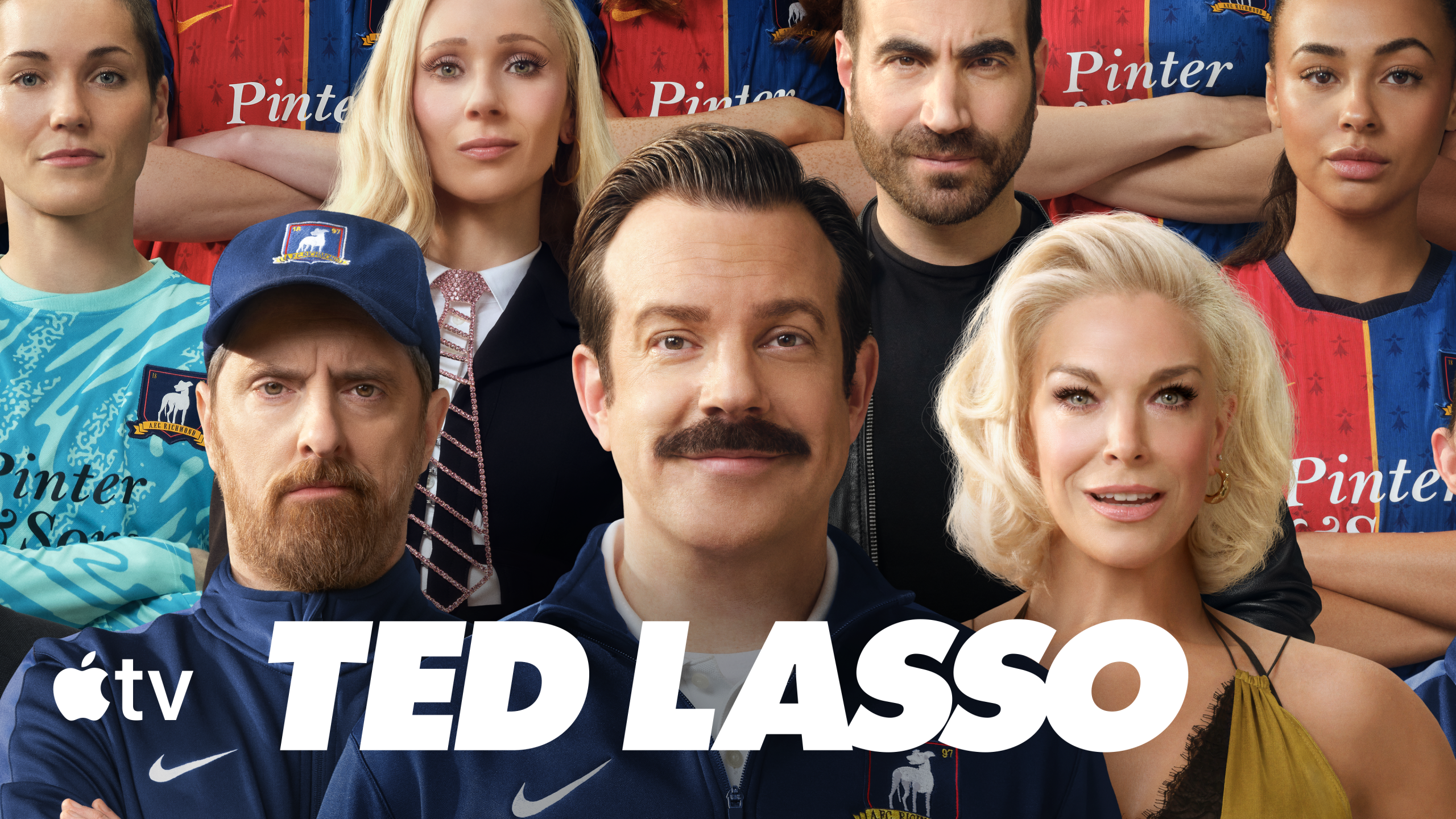
“Be curious, not judgmental.” So says Ted Lasso (Jason Sudeikis) in a beloved moment of the hit Apple TV series. In the scene, the excessively American Ted gallantly accepts a bet from the Richmond Football Club’s former team owner, Rupert Mannion (Anthony Head), involving the much-more-British game of darts.
Rupert is very good; for Ted to win, he will need to accrue a highly unlikely 170 points—two darts in the triple-20 slot (with its .3-inch width), followed by a 50-point inner bullseye, a half-inch space. As fans of the series know, that’s about when Ted shows he’s just been messing with Rupert, that he’s actually a ringer with those whizzing shafts, nonchalantly tossing two quick triple-20s. And after talking about how people have underestimated him his whole life, he astonishingly sinks the final bull to win the game, and the bet.
It was a beautiful, ridiculous scene. Not because Ted got the score he needed. But because, if Ted Lasso really threw a 170, under intense pressure, with a smile on his face, while teaching a bully a lesson, it’s very clear he’s involved in the wrong sport.
Ted Lasso should be playing darts. On the pro tour. For money.
Next year marks the 100th anniversary of the professional game of darts; its now-annual Madison Square Garden tournament has become a popular fixture stateside; and the sport’s nineteen-year-old megastar, Luke Littler, is prepping to take on all comers in a live Netflix event on October 30. Granted, the biggest tournaments—which rate highly across Europe—don’t have a US TV home yet, but that’s just a matter of time. In fact, the only thing “fringe” about darts is the feathers ridged to the shaft, keeping those throws landing true to the board. And that makes me very happy. Because if you can fall in love with darts, you can fall in love with any sport.
* * *
Why darts? Why would anyone this side of the pond be obsessed with a game more associated with pints than points?
When Ted says, “Be curious, not judgmental,” he may just be giving us a Walt Whitman quote about life, but it’s actually a pretty good motto for embracing the game. And watching it obsessively on YouTube has taught me a powerful little axiom that applies to pretty much every sport on the planet:
A) They all have rules.
B) They all have strategies.
C) They all have star players with different personalities.
Once you understand the A and B of a sport, you get to choose and root for your favorites in C, and observe how they react to the agonizing pressure of competition. And after you dive in, darts becomes so blissful a watch you’ll welcome the slo-mo replay of those sailing projectiles heading toward a winner.
My love for this game dates back to 1998, during a trip to London to cover the making of the NBC miniseries Merlin. Sitting in my hotel room in the UK’s pre-cable era with only BBC1, 2, and 3 for company, I stumbled on the BDO World Darts Championship and became fixated on a gawky Dutch thrower named Roland Scholten. For two days, I watched Scholten, a part-time pro with a pair of colorful nicknames—The Flying Dutchman and, because of his odd stance at the board, the Tripod—mow down three competitors before being stopped by top player Richie “The Prince of Wales” Burnett, who at thirty-one still looked like he’d won the high school science fair. Sadly, I flew home before witnessing Burnett’s tie-break loss in the finals to one of the best ever, the then-baby-faced Dutch master Raymond Van Barneveld.
I picked up the rules and strategies very easily. Dart boards come numbered 1 to 20, with a small outer ring on each number for doubles and a tiny inner ring for triple scores. In the middle, the green, outer-ring bulls get you 25 points; the inner bullseye is worth 50. To win a game, you must score exactly 501 points, and the winning throw must be for a double; meaning, your last dart has to land either in the bullseye or in the outer ring. So, if you need 10 points for victory, hitting a double-5 is the way to go.
Strategies? Some players are better at hitting certain triples or doubles, and finding a way to leave, say, a double-8 or a double-12 at the end might be preferable. Most players try to excel at throwing the “double tops,” the double ring’s No. 20 spot right at the top of the board.
A perfect game is called a nine-darter, where you accrue 501 points in only three sets of three throws. Your highest score with any trio of darts is three triple-20s for 180 points… Or, as the pro announcers yell, to the utter delight of the crowd, “WAAAAAAAN HUUUUNDRED AND EEEIIIIGGHHHTTTYYYYY!!!!”
That’s the other thrill of the game—it’s become quite the show. The years passed, prize money rose, and fans filled arenas. Attending events is like going to that one neighbor on Halloween who gives out shots to the parents. Fans dress like hot dogs or kegs or their favorite players and cheer the best throws. Players now wear colorful shirts with sponsors sharing space with their nicknames, and while darts seems to share little with heavyweight boxing, competitors also enter to the sound of exaggerated name calls and loud walk-on music. In time, the television coverage improved, and the play-by-play commentators learned to shout when the going got tense. In one beautifully iconic—and ironic—moment, Wayne Mardle, the British pro-turned-announcer, suggesting that a particular game left him speechless, kept yelling, “I CAN’T SPAKE! I CAN’T SPAKE!”
* * *
Choosing whom to root for offers a fascinating look at some of the best pro personalities. Who do you cheer for when Peter “Snakebite” Wright—whose wife spends two hours before every match painting the snake on the side of his mohawked head—takes on Simon “The Wizard” Whitlock, with his Gandalfian beard? Do you favor Gian Van Veen, who overcame dartitis, or the fiery Mighty Michael Van Gerwen, whose game-time intensity and peerless success suffered during a high-profile 2025 divorce? Or maybe Wales’s Gerwyn “The Iceman” Price, who plays with the aggression of a contract killer?
Right now, some of the best matches are between the Two Lukes, Luke “the Nuke” Littler and “Cool Hand” Luke Humphries. They’ve traded No. 1 with McEnroe vs. Borg–like passion, and yet, when the matches end, there are relieved smiles, long hugs, kisses on the cheek, and supportive words. And while Humphries is a thirty-one-year-old crowd favorite, Littler is a phenom who has earned the strangest backhanded compliment in sports—a bit of fan hate. There’s also discussion, in our superlative-worship society, on whether or not he’s already the GOAT at the age of nineteen.
Fortunately for Littler, that spot is already reserved for the man the announcers called, “PHIL! The Powwwwweeerrrrrrr Taaaaaaayyyyloooorrrrrr!” Phil Taylor won sixteen world championships before his 2018 retirement due to constant hip pain. Word is he may return for some doubles events. He’s spent time in the senior darts circuit. At sixty-six, does he have the stamina to take on “the Nuke,” who throws with machine-like precision? That’s the other thrill of sports—watching a veteran who can’t stay away try to make a magical comeback. Darts is an equal opportunity sport—anyone can come in and, from that spot 7 feet, 9 ¼ inches away, win the day. How many times have fans seen champion-level players miss winning double after winning double, opening the door for a competitor to sneak in for victory? Let’s add “D” to the axiom: In darts, anything can happen.
Just ask Ted Lasso.




Click here to subscribe today and leave your comment, or log in if you’re already a paid subscriber.