

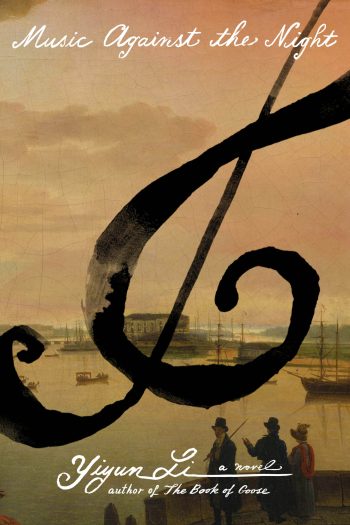
Yiyun Li writes love stories. In her latest novel, Music Against the Night (Farrar, Straus, Giroux, 2026) —as in past novels, the author’s short fiction, and memoir writing—she explores several kinds of love: first love, friendship, and the love of a parent who must let a prodigy go. Li, like several of the characters portrayed in her new novel, seems to be able to “hear music” in the world, and translate what only she can hear, for us, her readers.
I first encountered Yiyun Li through her fiction, in 2003, when I read her short story “Immortality” in The Paris Review. I’d just returned to my adopted hometown of San Francisco after my life as an ex-pat in Italy came to an abrupt end. It was a difficult time, but I’d been hired to teach in the Creative Writing Department at my alma mater, which, along with a return to reading fiction, anchored me.
Immediately I knew I wanted to hear “Immortality” discussed and assigned it in The Craft of Fiction class, which I’d go on to teach for the next twenty years. I taught Li’s story alongside Tobias Wolff’s “Bullet in the Brain,” pairing the stories to illuminate how writers artistically manipulate the passage of time to move readers, and, hopefully, get us to reflect on the large, unanswerable questions about what it means to be human. “Immortality” still astonishes me because of its epic scale. Centuries pass in the first paragraph, and the narrator’s collective “we” then carries the reader through some fifty years of a nation’s history.
In 2009, I met Li in person when she visited my class and did a campus-wide lecture on occasion of receiving SFSU’s Gina Berriault Award, an honor conceived by Peter Orner that he and I co-produced for many years. What I remember most about that visit? Li had recently had dental work. Serious dental work! And still she answered all of our questions with the same generosity and humility that she brought to this interview, which we conducted over Zoom, in which I asked about following her obsessions, including love but also immortality and posterity, across genres.
This interview has been edited for length and clarity.
The Rumpus: You’ve said that you “first met” John Field while reading Tolstoy’s memoir with Edmund White. Can you talk to me about Edmund’s influence on this project, and how John Field turned from a name in a Tolstoy memoir into a novel?
Yiyun Li: It was entirely serendipitous, because Edmund thought we could read Tolstoy’s memoir or autobiography together. A few chapters in, Tolstoy mentioned John Field as his mother’s piano teacher. He was recollecting the memory of his mother playing on the pianoforte.
I asked Edmund, “Now, who’s John Field?” He said, “He’s an Englishman, isn’t he? Wasn’t he a composer of sorts?” That’s a mistake all the Russians made, because they called John Field the Englishman. I did a little research and found out he wasn’t English; he was Irish. As I was researching, I thought, this could be a novel.
I have to say, I miss Edmund dearly almost every day, because he didn’t see this book. He knew I was working on it and the assumption was that at some point he would read it. But, of course, he didn’t. That’s the sad part. I miss him.
Rumpus: Edmund was one of our greats. Was there something in your research that hooked you? In my research of your characters, I read that Adelaide Victoria Percheron, wife of John Field, would flirt with anything, even a hat on a walking stick. I was glad you used it.
Li: It was entirely that. John Field’s biography is very skinny. There was a little bit about his wife Percherette—no more than five mentions. And then there was that particular quote: “If you put a head on a walking stick, she would do the trick.”
I think Percherette interested me partly because she was born in 1782, around the same time as Jane Austen’s characters. Jane Austen’s characters were all in the same family village; the furthest they would travel was to London or Bath. Percherette circled around the world, from Pondicherry to Russia.
John Field also made an epic journey, from Dublin to Moscow. I’m always curious about this period of history, overlapping with the French Revolution and the Napoleonic Wars. I’ve read War and Peace so many times. All these things pointed to this being a project that would interest me.
Rumpus: “Immortality,” your short story, was my first encounter with your work, in 2003. I sense connections between that story and Music Against the Night: a fascination with group consciousness, organizational systems, the costs and rewards of fame, and the gap between what history and geography have offered men versus women. Do you think of your different forms as a musician might move their obsessions through different compositions?
Li: I am interested in posterity and immortality, what to remember, what to forget, and what’s left. John Field was more than a footnote to Chopin. He was an important figure in his time. How people are remembered or forgotten as time passes can be entirely different from who they were in history or in their lives. I notice that I’ve explored all these things in various ways in my novels and possibly in short stories.
I like what you said about there being something musical about it. Maybe it’s my key, or one of my keys. I was just talking to my piano teacher. I think she was trying to have me learn a John Field nocturne. It’s B-flat major, I think, and she said it’s a very awkward key that most people wouldn’t write in. Chopin had his own keys that were very natural for pianists, so maybe you’re right: each writer is like a musician. We all have our carved-out movements, interests, obsessions, or curiosities.
Rumpus: John Field came from a multigenerational musical family. His grandfather, Old Mr. Field, believed that nature was the supreme model for music: a musician should be inventive, but create such an exquisite imitation of nature that a piece sounds both new and familiar. I’d assume that he felt it his obligation to style his music to reflect others’ compositions in similar styles. In writing Music Against the Night, did you feel beholden as a writer to how historical novels are expected to take shape?
Li: I’ve probably read a lot of historical novels, but I don’t think of them as historical novels. For instance, War and Peace: even when Tolstoy was writing it, it was the generation of his grandfather. It would be like us writing a World War II novel about our grandfathers’ generation. When I read these novels—Tolstoy’s novels, or Rebecca West’s novels set in the early twentieth century—I think of them as my peers. Because of their characters, I tend to think of myself as the peer of the characters.
When I was writing the book, I wasn’t using a model of a historical novel. I tend to write with other works as conversational partners, not historical novels as a genre. I remember citing Tolstoy and Dickens in the book proposal as two conversational partners for writing a big novel about a big canvas of historical events.
Rumpus: I relate to what you say about feeling close to the characters and not worrying about genre labels. My interest in history is always its people.
Li: When you read a really good story, you feel very close to the characters.
Rumpus: In your novel, John Field as a boy stutters, sees crosses talking, refuses to memorize the order of numbers, and learns music extraordinarily quickly. What did writing him within his own historical context allow you to explore, rather than, say, writing a biography and interpreting his life through today’s ideas of brain science?
Li: We’ve had different understandings of human intelligence and human brains. The easiest answer is that when I write, I tend to write from within the character, rather than from an overview.
I try to live in John’s world and body, or Percherette’s world and body as a child. I try to live in their children’s world and minds. They are both extraordinary children. They’re prodigies: One is a musical prodigy, and the other is a prodigy at living and doing things.
The key to me is not to write from the outside. If you write a character from the outside, you tend to draw the outline of the character. You reach the limit very soon. You can have definitions and descriptions, but I don’t think characters, especially children, understand their own limits or where their world ends.
Especially in the earlier part, when they’re children, I’m writing from within. I wouldn’t know what troubles them from a twentieth- or twenty-first-century point of view. You could only experience along with them how frustrating, mysterious, complex, and perplexing the world is. I didn’t write with contemporary knowledge in mind. I wrote with my knowledge of being a child and having brought up children. I rely more on that firsthand experience than on a comprehensive view of human brains.
It’s very hard to explain prodigies to people who don’t know them. My piano teacher has a student who’s quite a prodigy. I would go into his lesson just to observe him. It’s beyond me. I couldn’t understand how such a small child could sit down and start playing Bach as though he’d played it all his life. There’s no way to understand from the outside. I think the only way is to write from the inside.
Rumpus: Bringing contemporary ideas into historical work can pull us away from inhabiting the character.
Li: I agree. Sometimes contemporary notions can be noise, or they can be a trend. I separate myself from that kind of thinking. Brain science is in its utter infancy now. Human beings are far more mysterious than scientists seem to think.
Rumpus: I loved another of your characters that you seemed to fully inhabit: Grace Field, John Field’s mom. You wrote, “Grace had lived for him. How else do mothers live?” Grace also “hears music.” They each seem to have a private soundtrack going at all times. John may have inherited his gift from her. Can you talk about Grace?
Li: Grace is certainly of her time. I’m glad you’re saying John got music from his mother’s side, too, because they were also musicians. Grace interested me for different reasons. One is motherhood. The novel started with her: how to mother a prodigy. People could think of her as cold-hearted. She said, “When you’re a prodigy’s mother, you have to wean him from you. You better orphan him.”
She loved John dearly, but she had to separate herself from him for his sake. That was an astonishing thing for a woman to face. And yet she also had a dreamy side. She was musical and liked to imagine things. All these talents happened to be born at a time when they weren’t useful to her, and she couldn’t make use of them.
She was one of those buried names. I’m sure in every generation there are many talented people who never get access to anything that would develop their talent. Along with Grace, there’s Grace Ann, the daughter. She was hilarious, a sharp little girl with a very funny sense of humor. And then she ended up as an Irish maid. It’s women’s sacrifice that puts men ahead of their time, I think.
Rumpus: Grace must mother John, a prodigy, differently than her other children. People, both then and now, might think of John and George as eccentric. You write, “How could anyone expect George to be that musical genius without what other men called his dissipation, which was simply George’s love, too abundant, too forbidden.” What drew you to George, especially his connection with John?
Li: In this Louis F. Hill biography, they were each other’s music teachers. They were teenagers, and George was three years younger than John. George taught John how to play the violin, and John taught George how to play the piano.
John was pretty decent as a violinist. He could play in any amateur or semiprofessional chamber-music group. They were both geniuses, so I imagine it wasn’t hard for them. George, despite being the prodigy on the violin, also played piano very well. John was his teacher.
Then you have two teenage boys. George was known to be a very beautiful young boy. Clearly, his contemporaries thought he was terrible and assigned all these vices to gay men. George dedicated his first opus, number one, to John. You knew there was a story, but the biographer completely glossed over that part.
Rumpus: Even though his connection to George—in my reading—is one of the most exciting connections in John’s life.
Li: Exactly. The biographer didn’t say anything about their relationship, just that they taught each other and that George dedicated the piece. Anyone reading that would know there was a story.
Young love, first love—these are important themes for anyone, but especially for geniuses and prodigies. George Pinto is important to the novel. He died very young. There wasn’t even a gravestone for him. He was buried next to his step-grandmother in a churchyard, and only her name was there. He was erased by history.
As a writer, I wanted to look at who he was and what he was doing. He loved animals. You can clearly see he was a very pure boy. He would buy things for horses and birds. Even his teachers said very harsh things at his funeral. They demonized him.
Rumpus: Yes. I appreciated that you gave him dimension, a fuller life. By the end of the novel, Percherette is a piano teacher who sees music as a gift for everyone, not just prodigies. Her changing relationship to achievement and fame made me wonder how you think about ambition and recognition. Earlier in the interview you indicated that Percherette is a prodigy of making a life. I see Percherette—perhaps less famous—as having gotten the best deal of them all.
Li: Yes, I agree.
When you write about geniuses, it’s largely about their ambition, their progression in the world, whether they achieve or fall short or succeed.
John is an ambitious man, but he didn’t start as an ambitious man. He started as a prodigy, so in tune with music and the world. He could walk around hearing music. His ambition came from his grandfather and his father: this inherited ambition and repeated teaching that he would go out to make a name for himself, become famous and rich, and become the next Mozart.
Ambition is quite a worldly measure, and they expect him to succeed by that measure. John is all about ambition, and in the end, ambition falls short.
Percherette is a more complex figure. She is ambitious, but if she were truly ambitious, she wouldn’t have left Pondicherry. She grew up in a powerful local family and was clearly more intelligent than anyone else around her. Her grandmother wanted her to become a matriarch, an important and powerful figure in Pondicherry. If Percherette were only ambitious, she would have stayed and become a powerful local figure. She could have had worldly success, politically and economically.
But she’s ambitious in another way. I like to use the word “aspiration” rather than “ambition” for her. Aspiration is similar to ambition but different. Ambition is often about worldly success, but aspiration is more about striving against yourself. Her aspiration isn’t to achieve what other people thought possible for her; it’s to achieve something that seemed impossible, something beyond her reach. Her aspiration was to go to Europe. It was a striving to transcend her situation and become someone else.
Everybody in the novel ends up living a life meant for them, except Percherette. She lives a life not meant for her, and makes it for herself. I like that you said she got the best deal, because I relate to her. I can’t believe what my life is today. I can’t even believe I’m alive.
Rumpus: I feel the same way about my life. You’ve also received recognition as a writer. What does that recognition mean to you, and how does it relate to your own aspirations?
Li: I would be disingenuous to say, “Oh, I don’t mind winning” or “I don’t care.” I do care. It’s a confirming experience to receive awards or be recognized by other people. It’s important.
But I don’t think that’s my aspiration. That’s different from my aspiration. This is difficult to put into words. My life has been very difficult, but it has also been strange, because I’ve been lucky to be recognized.
There will be Grace in the world. There will be George Pinto, Grace Ann, or Fortunée. They’re all extraordinary and talented people, but they haven’t found the opportunity—or things happen to them that prevent them from doing what they want to do—and they get buried by history.
Rumpus: When Percherette makes it to France, she’s there during the revolution, when the government reinvents the week and even the clock. Monsieur Rual tells her everything is an invention, so everything can be reinvented. How do you think about reinvention as a theme?
Li: I like when Monsieur Rual says everything can be reinvented. In a way, the whole novel is Percherette reinventing herself—her history and her past, her story, and her obsession.
Not only her. Clementi started as a prodigy but reinvented himself as a successful businessman.
Robert Field, John’s father, also represents this time when men were no longer bound to the home. They could travel and move around more than before. It’s an age of the self-made man.
The novel looks at music, but beyond music, a lot of people were reinventing themselves. Clementi was also reinventing the pianoforte. They were improving the instrument. Beethoven was writing beyond what any existing pianoforte could play, so musicians were ahead of the instrument, and manufacturers had to catch up. It was an exciting time.
Music was no longer the sole right of the church and the royal court; the public had access to it.
Music publishing, touring, masterclasses—the musicians were their own agents. It’s like today’s writers: Everyone is playing and teaching and making money—or not making money, just getting by. Artistic pursuit is a timeless topic.
Rumpus: It’s always been a hustle.
Li: It’s a hustle. Exactly.
Rumpus: Percherette hopes the music could last, that she could live in it for an hour or forever. You write that love is never a means to an end, but the end itself. When Fortunée offers her hand near the book’s close, it spooks Percherette. I love that moment.
The book explores different kinds of love: maternal love, friendship, romantic love, and the love of music or art. Earlier you mentioned Fortunée. I’m especially interested in Percherette and Fortunée’s connection and John and George’s brief time together. How did these relationships and kinds of love fuel the novel?
Li: I feel that nobody calls me a writer of love stories, but I do think all my life I’ve been writing love stories.
Rumpus: I think you write love stories! I tell my students and friends that you write about love.
Li: Exactly. I do. Yes. Even going back to my first book [A Thousand Years of Good Prayers (Random House, 2005)], after I wrote those stories, my agent said, “Why don’t you write a little summary and present this as a collection?” I presented it as a collection of love stories—different kinds of love. As you said, there are different kinds of love.
I think all my books are love stories. Here, particularly, it’s the love between John and George Pinto, and between Percherette and Fortunée. I think it’s young love: the first time two people’s essence meets essence. They’re so pure. They’re young, and they live in music and live for music. That was their entire life, and they were both extraordinary in that.
That’s a monumental relationship that John Field’s biographer clearly wouldn’t dwell upon, and I must dwell upon it because it’s a monumental young love. I said the novel is a counterpoint: Percherette and John’s lives work as two contrapuntal themes. The young love for John is Pinto, and the young love for Percherette is Fortunée.
The two girls are orphans with similar backgrounds, but their meeting wasn’t predestined. They just randomly met in the French countryside. I think it was very fortunate that they met, because we can imagine them not meeting—and what a loss that would have been for both of them.
There are a lot of deaths in the novel, but there are a lot of other things, too. One of the most important things to me is the love story between these people. I think both love stories transcend the deaths of George Pinto and Fortunée because the love story lives on in music. Thank you for calling me a writer of love stories.
Rumpus: The particular kind of love I see explored in your writing, in addition to romantic, is friendship.
Li: Yes.
Rumpus: We could have a thousand more books about the depth of platonic friendship love. I want to teach a class called “Friendship in Literature.” In it, I want to hear people discuss The Book of Goose (Picador, 2023) and Music Against the Night.
I loved the tone, rhythm, and voice of Percherette in the opening chapter after she learns she’s officially John Field’s widow. Between her imagining her husband’s mistress and choosing mourning clothes, it all felt so operatic. I mean this as the highest compliment I can give: It felt very gay. I immediately decided I’d follow her anywhere. In my humble gay opinion, this opening chapter along with your portrayal of the young same-sex prodigy-love we talked about earlier, earns you the status of “gay” or “queer” writer if you’d like it.
Li: I’m going to wear this as an honor badge. It’s the highest of the highest! I’m a queer, gay writer.


Click here to subscribe today and leave your comment, or log in if you’re already a paid subscriber.