
A decade ago, in my first year of teaching high school English, I was required to teach The Odyssey to ninth-graders. My only other interaction with the epic poem was when I read it in high school, which means that I didn’t really read it. Like many teens, I read quickly and fitfully, focusing only on what I needed to know for the next day’s class. Besides, what could this dusty, centuries-old text possibly have to do with cool things I was actually interested in, such as the collected works of Billy Joel and choosing the best reeds for my tenor saxophone? (The irony was entirely lost on me then, and painfully clear to me now.)
This time around, I was intimidated by the book’s physical heft and daunting reputation among students as being a “hard” book (and among fellow teachers as being a months-long curricular endeavor), and I was more than a little bitter that I had to teach this ancient text instead of, say, a novel by an author from a culturally unrepresented background. It was the fall of 2016—Trump’s victory had yet to put a depressing damper on the rest of the school year in liberal Massachusetts, and adolescents had more exciting things than Homer to focus on, like the punchy anti-tyranny of Hamilton and the pre-fascist stylings of Kanye West. These kids were academically game and charmingly dorky, but ancient Greece seemed to be a line they weren’t willing to cross.
We read the 1996 translation by Robert Fagles, who introduces hero Odysseus as “the man of twists and turns.” These opening words, which promised mystery, danger, adventure, and a flawed character, were something of a relief. Like me, the students dreaded reading a poem from thousands of years ago that spanned hundreds of pages. Also like me, they were surprised at themselves for actually enjoying it. The final assessment involved student-made trailers for their imagined movie versions of the play, one of which begins with on-screen text reading “Meet the man of twists and turns” and ends with a fourteen-year-old Telemachus gleefully stabbing Penelope’s potential suitors with a broom handle. I was relieved and delighted to find that The Odyssey was not only a work of satisfying complexity, but that it was so dang fun.
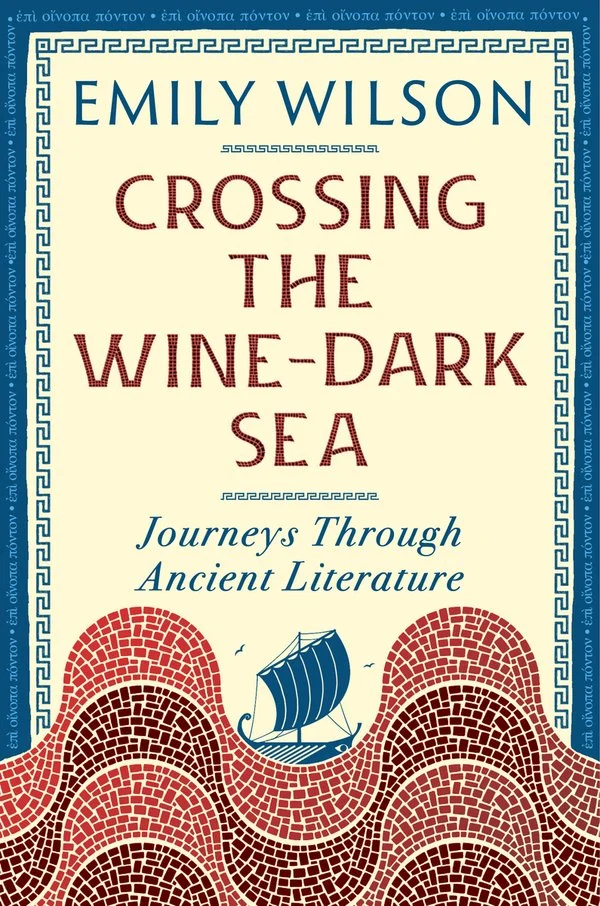
Emily Wilson, whose 2017 translation of The Odyssey has become the modern standard, conveys similar enthusiasm in her new book of essays, Crossing the Wine-Dark Sea: Journeys Through Ancient Literature. In her introduction to the collection, Wilson writes that texts from ancient Greece aren’t as far from contemporary storytelling as we might think. “A turn back to ancient Greek and Roman cultures,” she writes, “reminds us that the crooks and adventurers have always been with us… I aim to provide an engaging and accessible introduction to some central themes within the interpretation and translation of ancient literature and its relationship to modernity.”
This engagement and accessibility is infectious. In a piece about translating The Odyssey, she deftly steers us through Homer interpretations ranging from Fagles to Alexander Pope, the latter of whom Wilson admires for his love of the satirical and absurd, despite his tendency to stray from the original poem’s themes and tone. Wilson’s own tone is also playful, but she takes her craft seriously. She devotes twelve pages to different interpretations of that opening Odysseus description—in her own version, she settled on “a complicated man”—not to criticize other translators, but to express awe at the worlds of meaning that a few different words can evoke. In describing her reasoning for translating those opening lines as “a complicated man,” she writes, “I tried to think hard about how similar effects might be achieved by different linguistic means: it’s impossible, for instance, to start an English sentence with the object (‘man,’ andra) unless you repeat it (as Fagles does), but I wanted to avoid extra repetitions so I put ‘man’ in the emphatic position at the end of the line, rather than at the beginning, to try to create a similar effect.” In Wilsonian fashion, she also admires less meticulous approaches. She writes that the translation by Fagles included images and phrases that don’t “correspond to anything in the original,” but is “loud, lively, and chatty, so it is not surprising that it has remained a bestseller in the US.” Touché.
Since 2002, Wilson has been teaching at the University of Pennsylvania, where she is currently the Department Chair and Professor of Classical Studies. This experience—along with her time at Yale and Oxford Universities and as recipient of MacArthur and Guggenheim fellowships—is evident; the book’s tone is that of a virtuoso leading a masterclass.
However, Wilson is no stuffy, out-of-touch academic. Across these fifteen essays, she references Spike Lee and The Good Place alongside Peter and the Wolf, Ezra Pound, and Romeo and Juliet, but the seemingly incongruous parallels never feel forced. (She makes a strong case for Helen of Troy’s lost sandal as an antecedent for Cinderella, “the irresistibly pretty young girl for whom it is always midnight, as she dashes, half-shod, from one prince to the next, a trope that is very much still present in contemporary teen dramas and the endless reruns and revivals of shows like Sex and the City.”) Her insights about historical and cultural throughlines are enlightening, and they remind the reader that while we associate these texts with musty libraries, many of them were shocking works of art in their day. (One hopes that Wilson’s comparisons between Sappho’s poetry and “WAP” by Megan Thee Stallion and Cardi B will one day be studied like The Oresteia.)
Wilson was the first woman to publish a complete English-language translation of The Odyssey. She doesn’t address this milestone directly in her collection; it’s a fact that she often underplays in interviews. (“I don’t think my actual work as a translator—either of Homer, or of Seneca, Sophocles or Euripides—has anything to do with my gender as such,” she recently told LitHub. “My goals were about poetic form, pacing, and narrative perspective. And yet the labelling of me as ‘the woman translator’ or ‘the feminist translator’ persists even unto this day.”) She does make clear, however, that some of her translation choices were a conscious effort to correct misogynist readings of the text, especially ones that had no textual basis. “Once one translation has a sexualised term of abuse,” she writes, “others follow—regardless of whether it parallels or makes sense of the Greek.”
Past translations, for example, depicted Telemachus’ slaughter of Penelope’s enslaved women, whom his father Odysseus was disgusted to discover had slept with Penelope’s suitors, in monstrously sexist terms—Fagles has Telemachus call them “the suitors’ whores,” and three (!) translations use the term “sluts.” There is no basis in the Greek, she notes, for such terms, grammatically or emotionally: “There is no noun, and Telemachus does not level any term of abuse at them, beyond describing them as bringing shame.” Accordingly, Wilson’s translation calls them “girls” who “lay beside the suitors,” and in his command to Telemachus, Odysseus says, “They will forget the things the suitors made them do,” emphasizing the women’s lack of consent. (Fagles wrote this as a command to “blot out of their minds the joys of love they relished under the suitors’ bodies, rutting on the sly.”) In a 2017 essay for The New Yorker, she wrote, “I read Homer’s great poem as a complex and truthful articulation of gender dynamics that continue to haunt us. The Odyssey traces deep male fears about female power, and it shows the terrible damage done to women, and perhaps also to men, by the androcentric social structures that keep us silent and constrained.” Several essays in Wine-Dark Sea likewise focus on gender and take her critical forebears, and the Greeks themselves to task; in the essay “Slut-Shaming Helen of Troy,” she writes, “These myths can teach us a great deal about the complex attitudes of ancient Greek men, mostly ancient Athenian men, towards women, female beauty and male desire.” Helen’s presence is one of objective beauty but criminal complicity. “Menelaus,” she writes, “is made unmasculine by marrying a woman who is so powerfully feminine that she comes close to achieving masculine kinds of authority.” The Chorus in Agamemnon, she adds, deems Helen’s adultery as more offensive than Clytemnestra’s slaughter of her husband. Predictably, these choices and comments have activated swarms of trolls who continue to harass her online. In an interview on NPR’s Fresh Air, she said the trolls are “people who want to construct some kind of narrative to justify prejudices that they are very much attached to. I wish that some of them would like to just have a face-to-face conversation with me rather than spamming me with emails.” (She added that she also receives kind, academically engaged messages, a dichotomy that resulted in the tongue-in-cheek but pointed inclusion of separate contact forms for “Kind Words and Praise” and “Misogynistic Trolling.”)
To those who only know Wilson from her recent viral criticism of Christopher Nolan’s film version of The Odyssey, it may come as a surprise that she has an affinity for balance—between ancient and contemporary, serious and funny, adhering to and boldly straying from a text’s implications. But as her Wine-Dark essay on Christopher Logue’s controversial Iliad reimagining War Music makes clear, Wilson loves a hot take, if it’s done well. War Music, she writes, “has, at times, a jazzy rhythm, an improvisatory feel, a cinematic sensibility, awkwardness, an ambiguous, perhaps incoherent attitude towards war, a fetishistic love of detail, some idiosyncratic silliness, and a willingness to pause at odd moments and notice the unexpected.”
That willingness seems to be Wilson’s literary priority; she appreciates the boldness to find humanity in stories we often dismiss as being too old to matter. The general internet criticism of her London Review of Books essay on Nolan’s adaptation—which, having been published two weeks after Wine-Dark Sea, doesn’t appear in this book—is that she’s too much of a persnickety, chiding scholar. But that essay is far more nuanced than its critics would admit. She doesn’t criticize Nolan’s blockbuster for being too unserious; she actually seems to think it could use more of the “jazzy rhythm” that made War Music so interesting: “Adaptations needn’t and shouldn’t follow the original with anything like the exactitude of a translation,” she writes in the LRB essay. “Some of the best radically transform or resist the source material.” If anything, she writes, Nolan’s film lacks the complex emotion and humanity of Homer’s poem.
Sexist trolls aside, Wilson seems to love a good argument. What Crossing the Wine-Dark Sea makes clear is that Wilson believes that disagreements, perceived misreadings, and literary scrums—within appropriate bounds—are what make classical scholarship so enjoyable. And while I don’t believe she’d appreciate the inaccuracy of my student as Telemachus stabbing Penelope’s suitors with a broomhandle, I do think she’d admire the passion behind it.




Click here to subscribe today and leave your comment, or log in if you’re already a paid subscriber.