
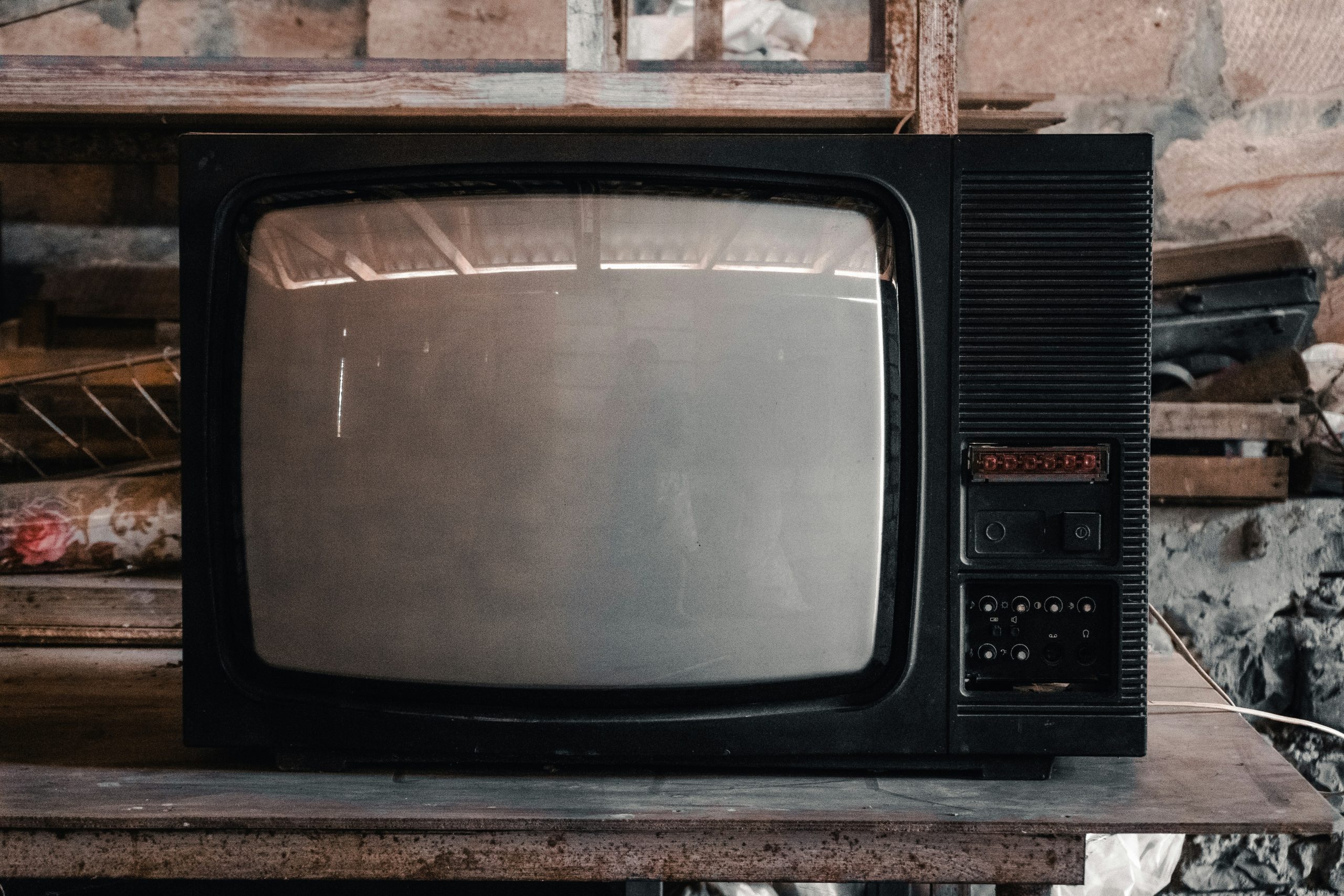
“Just wait till you see it,” Jimmy Vale says in a conspiratorial whisper that isn’t quite low enough to avoid attracting attention.
“See what, egghead?” Paulie chimes in, leaning over us menacingly. He’s older and taller than the rest of us, with a mean squint and a meaner temper.
I shrink inwardly as I do every time Paulie’s near, hoping to be ignored. He loves taking other people’s lunches. Sometimes he eats the food, sometimes he just throws it away.
I reach out my hand to cover my half-finished, school-provided peanut butter and jelly sandwich, wishing Paulie away. And it works. Like magic.
He is summoned to the principal’s office.
I cram the rest of my lunch into my mouth, just in case.
Jimmy adjusts his glasses as he picks at his food. It looks good; it always does. His family has their own cook, and she is very good, but he never has much of an appetite. Not for food, anyway.
Jimmy’s passion is television.
His father works for RCA. I’m not sure what he does there exactly, but to hear Jimmy tell it, his dad is single-handedly responsible for every innovation when it comes to modern TVs.
I believe him, too. While my family’s hand-me-down set is so old that I get dizzy watching it, Jimmy’s got a brand-new TV in his house. With a remote control.
His father—Mr. Vale, a tall, thin man with stooped shoulders and coke-bottle glasses—likes to talk about the future. He tells us that down the road, the TVs will have pictures clear enough to touch, presented on screens thin enough to hang on walls like art. It’s difficult to imagine but exciting too.
He talks about other things also, like computers. But that seems too far-fetched. TVs are here now.
Jimmy doesn’t look anything like his dad. He’s short and what my mother generously calls “hefty.” But he does wear the same coke-bottle glasses that get him teased by the likes of Paulie.
I don’t care what Jimmy looks like. He is my best friend and has been for three years, ever since his family moved here for Jimmy’s dad’s RCA job.
We like watching a lot of the same things, but our favorites are The Twilight Zone and The Outer Limits. I think between the two of us we know every episode that’s ever aired by heart.
And now Jimmy swears he’s found a new show, one that blows TZ and OL straight out of the water.
“Bull,” I say, drinking my milk then crumpling the small carton back into its tray compartment. I stole the word from my father and like the way it sits on my tongue.
“I’m serious.” Jimmy’s got a bit of a lisp, and his “esses” slither out like snakes. “You’ve got to come over and check it out.”
I’d like that, of course, plus I already spend most of my time at Jimmy’s, but he tells me the show only comes on at midnight, and my parents are strictly against sleepovers.
“So why can’t I watch it on my TV?” I ask him on our way home. Against all odds, we live in the same neighborhood—a wealthy area of well-kept, stately homes that my parents sneeringly call “mansions.” Only Jimmy’s family owns one, and mine rents the caretaker’s cottage at the back of someone else’s property.
My dad hates being a caretaker as much as Jimmy’s dad loves working for RCA.
I hope when I grow up, I’ll have a job I love. I just don’t know what it might be yet.
Jimmy, of course, wants to be an engineer and an inventor just like his father.
“I don’t know how you can watch anything at all on that relic of yours,” Jimmy says, huffing lightly from the walk. “Maybe this show only comes on the newer models.”
“Maybe. Did you ask your dad?”
“Heck no. I don’t want to get in trouble for being up that late.”
“Right, right.”
For all his faults, Jimmy’s never lied to me. If he says he’s watching a show on his TV at midnight, a show I have never seen or heard of, then, unlikely as it is, my gut reaction is to believe him. But, as my dad likes to say, “Words are cheap. Seeing is believing.” And I very much want to see this with my own eyes. I just have to figure out a way.
In the end, I sneak out of my house. Sometimes the simplest plan is the best. I leave a pillow-made body of roughly similar shape to mine swaddled in a blanket on my bed and crawl out of my room’s only window.
The night is warm and quiet. I can’t recall if I’ve ever been outside at this hour. The world is asleep; the windows are dark, and the skies are darker still.
On TV, nighttime is when the monsters come out and scary things happen, but up close and personal, it seems much too peaceful for any of that.
I look up and see stars. So many stars. Like fireflies trapped in a dark web. The moon is full, or nearly so. I think about the old werewolf movies as I walk.
Jimmy’s house is on the corner of Arch Street. Large and imposing, it has small tower-looking things sticking out on the sides—turrets, I remember. It makes me think of castles and knights and all the rest.
True to his word, my friend has left the side gate open. I enter, lock it, and round the house, coming to the large double doors leading into the backyard.
Jimmy’s waiting for me there with a flashlight. His cheeks are bright red with excitement. Or heat.
“You made it,” he says.
He grabs my hand and shakes it with exaggerated enthusiasm. His palm is sweaty.
“I made it. Are your parents sleeping?”
“Probably. Unless Dad’s still up reading. But don’t worry, he won’t hear us.”
We go through the doors and into the house. No matter how many times I come here, I can’t get used to the smell—so different from the soupy, mildewy, stale nicotine rank perpetually lingering around our cottage. Jimmy’s house smells so… clean.
We make our way to the basement. Here, they call it “the den.”
It isn’t anything like our basement: an unfinished, packed-earth-floored space that houses old boxes and tools. This place—this den—is nicer than most people’s living rooms and is furnished accordingly, all polished wood and soft upholstery. And right across from the comfortably broken-in green sofa sits a futuristic-looking, gleaming machine.
“What is that?” I’m not even trying to keep the awe out of my voice.
Jimmy grins a proud grin. “It’s the new TV my dad’s been working on. Well, it’s a prototype. Supposedly, we’re testing it.”
“And no one else has it?”
His grin widens. “Nope.”
No wonder the thing is transmitting shows I’ve never heard of. Look at it. It’s like a robot, or a robot’s head anyway. Like something out of science fiction. So slick and chrome and shiny, with the most incredible remote control. No unwieldy knobs or buttons at the front either, just a curiously flat screen.
“Where’s everything? Where’s the antenna?”
“It’s integrated,” Jimmy tells me. His grin is now threatening to split his round face in two. It’s almost as if he was the one to design and build this beauty.
“Wow.”
“Exactly.”
“And it works?”
“Just you wait.”
Jimmy points the remote at the screen and pushes the top button. The screen fizzes into life, going from a pinpoint dot to the full picture mode in about five seconds flat.
“So fast.”
“I know.” Jimmy gestures to the couch. “Sit. It’s about to begin.”
Ever since I climbed out of my bedroom window to come here, I’ve been feeling kind of like a trespasser. But now I’m too excited to care.
I’ve been to this house so many times. I’ve sat on this couch. I’ve marveled at all the amazing things Jimmy’s family has, some brought from the old country, most acquired here.
The Vales came to America just after World War II, but they seldom talk about their life before. Jimmy was born here. English is the only language he knows, but I’ve heard his parents speak another one, only to each other and quietly.
They are older than my parents, older than any of our classmates’ parents.
I once asked Mr. Vale if he’d always been a scientist.
“Yes, yes,” he said in that funny accent of his. “It is how I’ve come to live here, in this wonderful country.”
But he’s never said anything else about it, and I don’t want to pry.
Jimmy hits some more buttons on the remote.
“There it is,” he says, leaning back on the couch.
“There is what?” I’m looking at the screen of nothingness. “That’s just static, man.”
Jimmy points to the wall clock. “Not midnight yet.”
We sit there and watch the clock’s long hand drag itself to line up with its short one. It’s strangely hypnotic in a way. The moment the two of them become one, the TV screen bursts into life.
It startles me so much I nearly jump. Jimmy laughs at my reaction.
“Calm down,” he says. “Watch.”
And so I do.
Words appear onscreen: the title of something I’ve never seen before.
The Midnight Show.
It’s in color, which is striking enough. But then there’s the image’s clarity, unlike anything I’ve ever seen. The font is sharp and prominent, but as we watch, it begins to… melt. Like the letters were carved out of blocks of butter and someone turned on the fire below them.
“Welcome to the Midnight Show,” a voice says. “We dare you to look away.”
The voice is sinister enough to make you shudder. It makes all the horror movie icons sound like loving grandfathers. But as much as it unsettles me, it entices me too. They are right—I couldn’t look away if I tried. I wouldn’t want to.
Once the title letters melt away completely, we are presented with a seemingly normal scene of a family eating their supper. The silverware is clinking on the plates; glasses of water are raised and lowered. The food is plain, and the conversation is all small talk.
The only notable thing about the image is the crystal clarity with which the lamb chops, mashed potatoes, and peas are rendered. The faces, too, every wrinkle, every freckle.
“How’d they do that?” I wonder out loud.
“Shhh,” Jimmy whispers. “Just watch.”
“I told you we didn’t need to worry about going hungry,” says the father of the family, and everyone nods at him with gratitude in their eyes.
“Has anyone seen Grandma?” the youngest child asks. His lips and fingers are glistening with meat fat.
That’s when the entire family but the kid who just spoke turns and looks directly at us, Jimmy and me, and winks. And we know, we know, without anyone telling us in so many words, that their supper is no lamb chops at all.
The screen abruptly fades to black.
I exhale. It feels amazing. I hadn’t realized I was holding my breath.
“What. The Hell. Was That?” I ask Jimmy.
“Keep watching,” he says, like that’s an answer.
I’m here now. What else am I going to do?
The next story is about a girl, older than us, maybe a high school senior, trapped in someone’s basement. We never see her keeper, only hear him humming a creepy, atonal tune as he goes about his business.
His business is brutal.
When the screen fades to black again, I tell Jimmy I don’t think I want to watch anymore.
He shakes his head at me and points to the screen.
A face materializes there, its features too vague, as if blurred deliberately. Looks like a man. Sounds like one anyway.
“What comes to your mind when you think of darkness? Is it the night outside? The monsters you see on the movie screen? Or is it something much, much worse?”
A long-fingered hand reaches up and taps the screen from the inside. It sounds so real, like someone’s just on the other side of it.
“I’m asking you. Yes, you.” I get the distinct feeling the man is addressing me directly, though, of course, that’s not possible.
“What haunts you? What scares you? What squeezes your mind like a python when you can’t fall asleep at night? What do you believe lurks in the shadows? At midnight, what monsters are after you?”
Now I am convinced the man is speaking to me directly and, more than anything, I want him to stop.
“You were brought up to believe in a world that is nice, kind, mostly just. You were sold on a lie. I am here to show you the truth. This is what really goes on behind locked doors and lowered blinds. This is what people around you really think and do and long for. Stay tuned and learn.”
We are shown two more short stories, each more unsettling than the last.
Then the blurred man comes on again.
“You don’t have to believe me yet,” he says evenly. “I know you don’t want to. You’d rather go back to your cozy world of make-believe. I get it. No one wants to look behind the curtain. The wizard inevitably disappoints. It is why you never question the extracurricular activities of your fathers or the put-upon happiness of your mothers. But sooner or later, the wool will be torn from your eyes. That you can believe. So why not start now?”
There is a pause where all I can hear is my own breath, and it sounds much too loud.
“Tune in next time. And until then, watch out for monsters.”
The blurred man starts laughing, sounding like the Devil himself. The blurring increases until he vanishes off the screen completely, dissolving into static. Then, there is nothing but a dark screen.
Jimmy uses the remote to switch the TV off. We sit in silence. I can hear the ticking of the wall clock, a reminder that this is the witching hour: too late to be awake and best suited for nightmares.
“What was that?” I say finally. “What was that?”
“The Midnight Show,” Jimmy replies, like it explains anything.
“It was horrible.”
He shrugs. “Made you look, though.”
“Yeah, like a car crash would.”
“It is kind of like a car crash.” Jimmy nods thoughtfully. “Are you going to come over and watch it again?”
“Yes.” The answer is out of my mouth before I can even consider it. Like saying no would be impossible.
“Good.” Jimmy smiles. “Because it’s been kind of getting to me when I watch it alone.”
On the way home, I notice my palms are stinging. I rub them, not giving it a second thought. My mind is full of The Midnight Show. And the night no longer feels warm and safe.
It is only when I sneak into the bathroom to wash up before going to bed that I notice the bloody half-moon cuts on my palms. I must have been balling my fists hard enough for my fingernails to leave marks. Weird.
Sneaking out at night becomes a pattern. It leaves me stumbling through my days disturbed and exhausted. But I can’t stop.
There is something so magnetic about the blurred man, so morbidly sincere. I think he may be right: He may be the only one telling me the truth.
My parents lie. I know that. I’ve caught them lying before.
“My father does, too,” Jimmy tells me one day when I share this with him. His expression is grave, and there are dark circles under his eyes.
“What do you mean?”
My friend hero-worships his dad, but at the suggestion of the blurred man, he’s been doing some snooping.
“He was in the war,” Jimmy says, not making eye contact.
“So what? Lots of people were.”
“No.” Jimmy looks up. His eyes are brimming with tears. “He was… on the wrong side of things.”
“No way,” I protest. “If he was, he would have been caught and put on trial, like all those people in that war movie we saw. And there’s no way anyone would just let him come to America.”
“That’s just it.” Jimmy sighs heavily. “There was a way. There was a program that accepted scientists into the US, despite their past. That’s what saved my father. But I have done my research, played the detective and all, and it turns out…”
He waves his hand, looking sadder and older than someone our age ought to.
“My dad was a Nazi,” he finally says in a small voice.
The blurred man was right. We are surrounded by monsters.
***
Henry Vale never meant to reinvent television. Only the TV set itself. Conceptually, he is a huge fan of reinvention. After all, he didn’t start out as Henry Vale.
But he had to leave Heinrich Voss behind, in a different country, in a different era. He is no longer that man. He seldom thinks about that man. These days, it is difficult to square the image of himself with young Heinrich Voss. Henry Vale no longer cares about politics or ideologies.
These days, he is only interested in science and technology. And his family, too.
He believes he’s good at this new life, all of it. Although it may have gotten off to a rocky start, now he has finally mastered it.
Henry believes it so firmly that his latest discovery throws him for a loop. Sure, he’s heard the theories of parallel universes and other dimensions, but it was always too speculative to take seriously. More along the lines of a science fiction novel plot.
Never in a million years had he imagined coming up with a TV set advanced enough to not only tune into another dimension but transmit shows from there.
He’s tried watching a few and found them unbearable. Much too grim. He didn’t come here, to this relentlessly, vigorously happy new country to be depressed.
He prefers lightweight, amusing, hopeful shows, either the sitcom comedies with his wife or crime thrillers like The Untouchables and The Fugitive on his own.
The dimension his technology has inadvertently tapped into appears to be all doom and gloom. It would have suited the ruined Berlin he fled perfectly.
Henry never talks about his life before with his colleagues or his American friends or his son. Only occasionally with his wife. He believes in second chances. And the US government has given him the best one of all. Though Henry isn’t easily given to sentiment, if he had to put a name on it, he’d say he’s happy.
He isn’t quite sure what to do about the new TV set. He only knows he doesn’t want to be responsible for bringing any more darkness into this world. He’s been a good man for a long time now. He hopes his son will become an even better one, though he doesn’t quite understand the boy and wonders if perhaps he might be growing up too soft, too impressionable, too easily led. He used to be like that once. It did him no favors.
From a purely scientific perspective, the new TV is a marvel. But Henry can’t see anything good coming from it. It has taken him a long time, but he has become a man of sound judgement. And he has judged his invention to have nightmarish potential. It’ll need to go.
For now, he has stuck it in the basement. Eventually, he supposes he’ll have to take it back to RCA for scraps, admit defeat, and start over.
All they asked of him was to improve upon the previous model. What he came up with is above and beyond, and not in a good way.
Oh well, he tells himself, trial and error. Trial and error. Henry’s getting tired of TV technology, anyway. Computers, now that’s exciting. He can only imagine the reach those beasts might have once properly realized.
***
When the blurred man on TV stops explaining and starts making demands, it seems logical. Like the next step.
The man speaks of justice. Of slaying the monsters around us to make a better world—or at least a more honest one.
It makes sense to me. It makes sense to Jimmy.
Lately, things only make sense at midnight. The rest of the time is a dreadful slog through endless hours of meaningless interactions.
School lies. The teachers serve us up rewritten histories and empty promises.
None of this will matter in the future, according to the blurred man.
In the future, the world will be on fire. In the future, the world will be underwater.
People will go to space and come back empty-handed. Wars will be waged over greed and false ideologies. The lies will multiply and be given new platforms to spout from.
Every invention will only serve to alienate people and potentially endanger them.
Humankind will get poorer, angrier, meaner.
It isn’t a world worth waiting for, Jimmy and I agree.
But we can make this one better, if only marginally. We know we can. The blurred man has told us as much.
Sometimes, he comes into focus. When he does, he looks strangely—terrifyingly—familiar, but my mind refuses to connect the dots.
Jimmy says it’s the same for him, but I am convinced we are seeing two different things.
These days, wherever I walk to and from the Vales at night, I know the darkness is full of monsters.
I wonder what they make of me.
***
It’s difficult to imagine Mr. Vale as a Nazi. He’s such a mild, soft-featured man. His accent isn’t as strong and harsh as heard in war movies. Did he ever wear the ugly uniform and goose-step? Did he ever throw out his arm in a salute to a monster? Did he lie then as he is lying now?
I agree to go along with the blurred man’s plan, but then, it’s easier for me. Jimmy loves his father. The decision to proceed breaks him. But the blurred man insists, and it’s just about impossible to say no at midnight.
We opt for poison, easy enough to find at the local hardware store. It’s hard to tell how much to use. There are no chart comparisons between rats and men. We use a lot.
It’s Jimmy’s first baking effort, and his father, genuinely touched by his son’s gesture of a birthday cupcake—oversized and ungainly as it is—eats it all, despite the flavor. He blows out the candle stuck into the crumbling top, takes it out, then gobbles up the entire cupcake, and smiles at Jimmy, frosting on his upper lip.
Mr. Vale dies horribly later that evening, throwing up violently and foaming at the mouth. Help arrives too late.
The body gets taken away, and the house assumes a quiet, somber air, like a mausoleum.
Mrs. Vale, stunned by grief, wanders the empty rooms and corridors. Every so often, the full weight of her loss hits her like a freight train, stealing her breath away.
She has known Henry—Heinrich—for most of her life. She has loved him for nearly as long. At first, there was nothing but hate. He was the enemy. His people killed her people. It was all so very simple back then, no grey zone on the map of her morality.
But then, unexpectedly, he saved her. And setting her initial reluctance aside, she agreed to go with him.
“It is only you,” he said. “I can only save you. I am so sorry. I know it isn’t enough.”
She told him that the Talmud teaches, “He who saves a single life, saves the world entire.”
And she thinks he loved her then. She saw it in his eyes.
She came to love him later. In a strange new country, so far away from all she knew that it could have been a different planet.
They became a new couple with new names. The Vales. And now, uncoupled at last, brutally and suddenly, she is lost.
She finally remembers to check on the boys late at night.
It is always the two of them these days. Inseparable.
She finds them in the basement, awake and staring at the screen of Henry’s failed experimental TV set. There is nothing onscreen but static, but the boys appear rapt. Tears are trailing down their cheeks. Or maybe it is just the reflection from the screen.
“Boys,” she says. “What are you doing here?”
They ignore her.
“Boys,” she says louder and more firmly. “It’s time for bed.”
Being ignored again grates on her. She walks over and unplugs the TV. The static hisses at her, then disappears into the ether.
In the sudden darkness broken up only by the illumination drifting from the hallway, she sees the boys turn their heads to her. Their expressions are pure evil.
In the sudden darkness, broken up by the faint illumination drifting in from the hallway, she sees the boys turn their heads toward her. Their eyes shine in the dark, catching drifting motes like the beam of a reel projector. Mrs. Vale remembers the dead-alive eyes of the soldiers glistening hungrily in the camp searchlights. The same look—pure evil burning lanterns inside bodies emptied out of all humanity.
It can’t be. The memories of suffocating terror have found her across the ocean, dragging their dirty, broken fingernails across her mind. She’s seeing things; surely she’s seeing things.
They are grieving, she tells herself, they are in shock. They are good boys.
With arms outstretched and fingers curled, they lunge at her.
They look like monsters.
Somewhere upstairs, the clock strikes midnight.


Click here to subscribe today and leave your comment, or log in if you’re already a paid subscriber.