
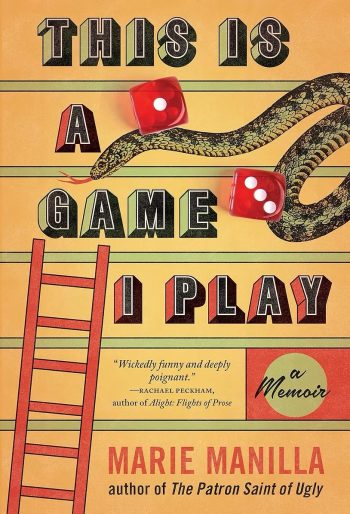
When I initially sat down to read Marie Manilla’s new book, This Is a Game I Play (University Press of Kentucky), I intended to savor it. Notebook in hand, pen behind my ear, I played the part of the diligent student for about fifteen minutes before realizing that, at least on a first read, I would have to submit to the tide and tear into the work the way it demanded. In fewer than two hundred pages, This Is a Game I Play treads decades of ground with alacrity, and Manilla’s well-honed voice had me by the collar from start to finish.
This Is a Game I Play, Manilla’s first full-length foray into nonfiction, is a memoir in micro-essays that digs into Manilla’s Appalachian roots and mines them for answers. From tricking her father into paying attention to her as a toddler to entering a doomed first marriage and beyond, the book holds manipulations to the light and wonders at their origins.
While Manilla is more than willing to hold her own feet to the fire in these pages, she also looks at the misbehaviors of others and the societal-level contortions that enable them. The book zooms in and out, examining games at all levels, and delights in juxtaposing unlike memories against one another.
In one essay, the pound’s sweetest, most pitiable yellow lab takes on additional meaning as a metaphor for Manilla’s persistent anxiety and panic disorder. In another, a young Manilla invents sightings of a local flasher, flipping through plausible encounters like the dizzying spin of a View-Master. In yet another, while examining the overlapping commodification of race and gender during her time in Houston, she recalls a school auction wherein she and her fellow classmates were “sold” to the highest bidder based exclusively on the perceived attractiveness of their legs.
I had the pleasure of speaking to Marie Manilla over the phone about the memoir, her past as a fiction writer, her proud representation of urban Appalachia, and what plumbing the depths of her own life taught her about being human.
This interview has been edited for length and clarity.
The Rumpus: This is your first foray into memoir. What prompted your transition from fiction to nonfiction?
Marie Manilla: For the first probably twenty-five years of my writing career, I strictly wrote fiction, but I’m in a lovely writer’s group here in Huntington [West Virginia] and one of the members is a fantastic nonfiction writer. I just loved what she was up to and learned so much from reading her work. Most writers have more than one genre. I would write fiction in short stories and novels, but I don’t write poetry—or I should say, I write bad poetry—so I thought maybe nonfiction could be my other genre.
I started writing essays in 2016 when the #MeToo movement really went viral. All those women coming forward with their stories reminded me of the many, many times I had been preyed upon by nefarious boys and men starting when I was thirteen or so. Sadly, I am not unique. Once I uncorked that bottle, the essays just started flowing and expanding to include my place as a girl in a patriarchal society. This was also when the second Feminist Wave was taking off, so I began planting myself inside all the history I was living through: the Vietnam War, the psychedelic era of the sixties and seventies, and later Black Lives Matter and other movements. Even in my fiction, I was always drawn to explore issues of race and class and gender, and once I started writing nonfiction, that really allowed me to explore those topics in my history and in our country’s history, so I got to swim in those waters in a unique way.
Rumpus: As you were writing these essays, did you have a sense early on that they would become a memoir? At what point did they turn into a book?
Manilla: When I started writing them, I did not think I would put them together as a book. I felt like an outsider, and I should say I kind of felt the same way about fiction. I didn’t start writing until I was about thirty. I’m kind of a late bloomer, and so I always felt like I was behind people. I didn’t start writing nonfiction until my fifties, so I really felt like an outsider there. So I just started writing, and it wasn’t until my writer’s group said, “You need to pull this together into something,” that I thought I should give it a try. I started organizing it by going back to my childhood, and the organizing principle was “The games that I play.”
In the first essay, I was about four years old, and I played a cruel trick on my father in order to get him to see and value me, and then I started looking at other games that I played throughout my life for attention, or to wound, or just to cope and survive. That expanded into games that folks played on me, like my ex-husband, or societal games, the games that the dominant culture is playing or has played on marginalized groups in our country. It was a little dark, but it was fun.
Rumpus: I loved the portrayals of anxious and depressive impulses as dogs in the book. Would you expand on that motif?
Manilla: Yes, so decades ago in the nineties I was a founding member of a writers group and we named ourselves “the Black Dogs,” which is a euphemism for depression, because almost everyone in the group suffered from depression. My bouts of depression began in high school, and “Black Dog” still occasionally rears her head, so she’s still with me. When I started compiling the memoir, I knew I needed to include my struggles with panic attacks, which started in my mid-twenties and have dogged me ever since. I’ve already written a few pieces about how the panic attacks started and manifested, which was when I was in that bad first relationship, but it wasn’t until I started writing about my college years that “Yellow Dog” as a euphemism for anxiety came into being.
I wrote about this in the book, but I still vividly remember the rainy day my brother and I went to the pound to get a dog and he did pick out a yellow pup cowering in the rear of the cage. Her back was to us, and I often feel as if I’m cowering in a corner, my back to the world. It wasn’t until the writing of that essay that I understood that I’m very much like that dog, a fear living inside me. And I’m a dog lover, so having a yellow dog embody my anxiety enabled me to offer myself some grace. I’ve often tried to hide my panic disorder, something I once viewed as weakness or vulnerability, which is why I’ve never written about it until now. But I can have compassion for “Yellow Dog” because I know she’s just trying to keep me safe. And I wish I could say that I conquered my anxiety, but our country and our world is on fire right now on many fronts, and “Yellow Dog” is on high alert, not only in me but in many, many people.
Rumpus: It’s so interesting that you said you were trying to hide it for so long, because that vulnerability is the opposite of hiding. You really put her out to the whole world.
Manilla: I really did. I think that’s part of our goal as humans, that as we age we need to be wise and self-reflective and honest. When you hide things like “Yellow Dog” and turn them inward, that’s when you get into trouble. So it’s better to expose your soft underbelly at times to the right people in the right settings.
Rumpus: Did writing the memoir change your relationships with “Yellow Dog” or “Black Dog?”
Manilla: It gave me a place to put my grace toward myself. I grew up in a family that was pretty critical, but that’s not uncommon for families in the sixties and seventies. I always felt like my father had a critical eye on us, and there’s a streak of perfectionism that runs through me that can make life tricky. But when I can embrace that soft fuzzy “Yellow Dog” and just tell her, “It’s okay; you’re gonna be okay; you’re doing okay,” it takes the pressure off. It helps ease some of that perfectionism and the angst. You see in the book that I’ve been to therapy various times for grief and for anxiety disorder, so I learned a lot about relaxation techniques and visualization, and often they say, “Picture somebody who you have an easy relationship with.” I always pick an animal as that comfortable entity.
Rumpus: Maybe especially as a writer, it would be so hard to follow that directive. Think of a person with whom you have an uncomplicated relationship. Like, who is that?
Manilla: Is there such a thing? Even people that I love and are very very dear to me, we’re human. So we all have our wicked little ways that rear their heads from time to time.
Rumpus: There’s another character in the book that’s not a person. I don’t know if we want to call it West Virginia, or Huntington, or urban Appalachia. There’s something in the way you write about your home that made it feel like a character to me.
Manilla: Absolutely. Huntington is definitely a character here, and I tried to include the locations that were important to me, where pivotal things happened, where I learned lessons. Like that tiny little essay called “Little Houses” about a time from early childhood. There were five of us, and we must have done something wrong because my dad put us in the car and drove us past these little shotgun shacks and said, “If you kids don’t behave I’m gonna leave you here.” And I’ve never forgotten that. I believed him. And when I drive by that place, the shacks are gone but the field where they were is still there. I wanted to include those locations because they made me who I am, for better or worse.
Huntington was the biggest city in the state when I grew up, with a population of seventy to eighty thousand. That’s pretty big for West Virginia’s standards. I don’t really have those rural Appalachian roots. My father’s parents were from Italy, and my mother grew up in Northern Kentucky right across the river from Cincinnati. So I always felt like a city girl. I went to Catholic school, and Catholics are in the minority. We didn’t refer to ourselves as Appalachians when I grew up, even the rural kids, and it really wasn’t until I moved to Houston that I got picked on for being a red bull, not a Yankee. I was a Northerner, as if the Civil War was still going on. I’d get asked if my dad was a coal miner—and my dad was not, he had a degree in metallurgical engineering—so I didn’t have the experience, but I still got all of the stereotypes. “Did you have plumbing? Did you wear shoes?” There’s one essay in there called “Mother Tongue” where I didn’t know I had a West Virginian drawl until I moved to Texas and they made fun of it.
For the longest time, I think Appalachian journals mostly just wanted the rural story. I get it, they’re trying to protect their culture and that way of life, and they don’t want to see it erased, and I absolutely respect that, but when I started trying to get stories published I would send pieces set in Huntington and they would send back a rejection with something like “I like the story but could you send us something more Appalachian?” But this was my Appalachia.
But that is changing. More and more urban writers from the region are getting their work acknowledged and published. We’re trying to show people outside the region that there’s more than one story to tell, and they’re all valid stories.
Rumpus: One function of the memoir seemed to be to grant yourself and your community complexity. Why was it so important to prioritize that while writing?
Manilla: I figure if I’m going to be honest about my parents, I have got to be honest about myself. One of the trickiest threads for me is the friendship. or whatever you want to call it, with a gay woman in high school who I allowed to buy me drinks. When I came out of that first marriage, I needed help and had these panic attacks and I didn’t know what to do with them, and I wondered if God could help me. I had left the Catholic faith and I had a brother who was Protestant, so I attended some services. I heard a lot of language and rhetoric that I ultimately didn’t agree with, and that time actually taught me what I really believe in. My heart told me that what I was being told in that specific setting was wrong. But I did damage to my friend. I did damage and I had to be honest about that. If I’m gonna be vulnerable, I gotta put that out there too. And maybe ask for some forgiveness.
Rumpus: You used the strategy of holding your memories up to one another in many of the essays, maybe even the majority. What was it like to take your history and nonchronologically juxtapose it against itself?
Manilla: I used to give a seminar with the highfalutin title of “The Thing and the Other Thing.” In it I suggested one way to add layers and texture to writing is by pairing often seemingly disparate things together. The hope is that the two things will resonate with each other and add depth and richness and metaphor—braiding, nonfiction writers call it. While writing this memoir, the pairings often came quite naturally to me, since I was mining my own life.
For example, instead of just writing about the day I came across a wounded seagull on a beach, I paired it with my unhealthy first marriage a decade before and my realization that I was drawn to wounded people I thought I could fix. Thankfully, as that essay indicates, I no longer have that inclination. Or the essay about the time I was walking my dog in an alley and came across a bird of prey eating a smaller bird. I paired that with the U.S. drone strike not long before, that had killed an Iranian general, as well as a toy drone I found on my driveway one Christmas morning. The drones juxtaposed war and childhood innocence mixed up together, and linked it back to that bird of prey and the violence inherent in the natural world, too.
About chronology, though the memoir is roughly presented from childhood to present-ish day, I do dart into the future in certain pieces so readers get a foretaste of what’s to come. It’s a reminder that the point of view is from my older self who has scrutinized my past cringy behaviors, beliefs, and mistakes so that I’ve hopefully become a better human.
Rumpus: You noted in your acknowledgements that you had siblings read over those early chapters about your family.
Manilla: A brother and a sister, yes.
Rumpus: What was that like?
Manilla: I admit to being anxious about how relatives would react to my presentation of our family. Even before I sent the manuscript out, I had two siblings read select chapters to ensure I was presenting us honestly, not sugar-coated, but not vilified either. It was never my intention to unduly wound anyone. I told my siblings that I wasn’t trying to write their stories. I was writing my experiences of our family as seen through my eyes. Lucky for me they loved the chapters, and even helped with certain names and details for accuracy. I did the same with a dear childhood friend whose troubled early years were so commingled with mine that I needed to include them. I had her read those relevant chapters and she also gave me her blessing. So far no one has grumbled about not being in the memoir, but I guess we’ll see!
Rumpus: And I imagine the title of the memoir really plays into that note you were making about subjectivity.
Manilla: Exactly, that’s why this final version is the one I could live with and feel good about.
Rumpus: What changed over the course of revising and editing to eventually get to this final version?
Manilla: An earlier version of the memoir was longer and included chapters that truly might have caused pain or embarrassment to friends and family. Often those chapters weren’t directly about me, but were about people close to me who suffered in various ways. I ultimately had to ask myself if I could live with revealing certain secrets and scars, especially if those scars weren’t mine. Ultimately, I decided to err on the side of respect and removed those chapters. It was also in the final drafts that I changed names of certain individuals to protect their privacy.
This final version is the book and I can live with and feel good about. I have no regrets about that. The person most judged and exposed in these pages is me.
Click here to subscribe today and leave your comment, or log in if you’re already a paid subscriber.