
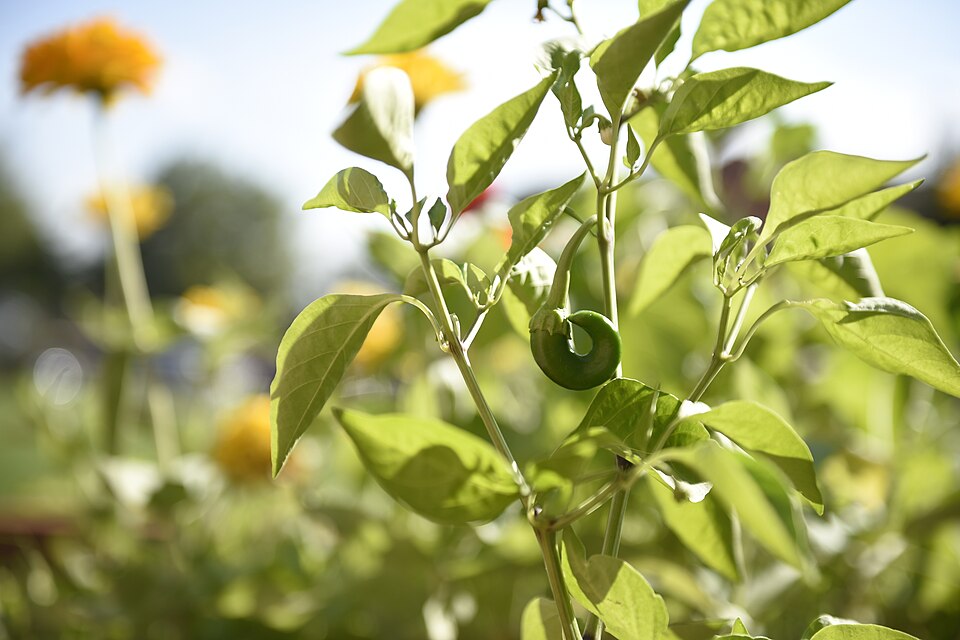
Seven spouts of fire roast a cage full of peppers, thirty pounds of chiles blistering and spinning in tantric motion. Out the back of the roaster, green sludge and bits of blackened skin pour onto the asphalt. The sign in front—DiTomaso Farms—is singed and ashen, and once in a while, there is respite from the flames: A vendor hoses the peppers down and envelops them in a cloud of smoke. This smoke, however, wafts into the nearby booths, where families turn into choruses of coughs and complaints. A child cried, maybe two.
At the Pueblo Chile & Frijoles Festival, beans are sidelined. Despite the name, it’s undeniably a chile-centered event. But what shocked me was that no stands focus exclusively on the humble pinto, as the bean cannot be adapted into inventions. It refuses fusion (besides an earthy pinto-chocolate ice cream), while the green chile finds itself in increasingly absurd situations. Starting with common pairings—chiles and burritos, chiles and burgers, chiles and tortilla chips—it slowly attaches itself to kettle corn, apple pie, jelly, wine, peanut brittle, and beer. Most of these combinations are not combinations at all, operating at two distinct registers of flavor, with the chile never fully assimilated. The flavors pass the baton to one another: with Walter’s Pueblo Chile Beer, first grassiness, then wheat, and finally a lingering smoke and spice.
I overhear a Nebraskan in shock by the sheer presence of the chile, how the smoke nestles into your hair, the smell seeping into it like a long night of smoking cigs. But in Pueblo, Colorado, the pepper is no laughing matter. It’s as ridiculous as suggesting corn is just a silly fixation on the plains of Nebraska.
* * *
I headed to Pueblo representing Burrito Bear, a Colorado-style breakfast burrito spot in New York, as part of a loose marketing push before their grand opening. I arrived late. The ride began with a prayer over the loudspeaker, and still there was a spat on the Greyhound. A man was escorted off at a rest stop outside Colorado Springs, so when we got to Pueblo, the sun had already crested the Rockies.
Walking down to the festival, past the stands of Himalayan pants and competing scams, I obsessively ran through the script: “Did you know our green chili burrito was developed through a competition? Imagine Top Chef, where judges are not just food critics but potential clients: stoners, yuppies, construction workers. And our winner, who trained in Michelin-starred restaurants, that same weekend discovered he had a brain tumor. After brain surgery, chemotherapy, and many seizures, he still hit the ground running. We’re opening soon. Green chili is headed to New York City. Haven’t you heard? Bears love burritos.”
But really, that felt like too much. Whenever I was pressed about my backpack and ballet flats, I just said the opaque “I’m a journalist.” Self-indulgent essayist doesn’t quite roll off the tongue.
Everyone wanted to tell me the real story of the Pueblo chile, and I quickly learned Puebloans have a chip on their shoulder, their namesake pepper overlooked in favor of their foes from Hatch, New Mexico. This rivalry began in Las Cruces at what later became the Chile Pepper Institute. In 1913, horticulturist Fabián García improved upon the mirasol pepper (a fresh guajillo, for the uninitiated), creating the old reliable New Mexico No. 9. Every commercial chile grown in Hatch (from the Big Jim to the Barker to the Joe E. Parker) and the Pueblo pepper are descendants of this crossbreed and, throughout the 20th century, there was a space race of pepper exploration.
This race ended in ’94, when the contemporary Pueblo pepper was born, with its sweeter flavor and meatier texture. To farmers, even the Pueblo pepper has more pride than its counterparts down South: “The mirasol lifts its head toward the sun. Hatch chile hangs its head down to the earth.” More than just a lack of humility, there’s something oddly phallic in their defense of the chile, their mighty pepper.
There’s a culture of excess based around the Pueblo chile. Throughout the festival, the pepper finds itself in emotional extremes. Mustached and doting with an arm around their lover (salsa); bloodied and belligerent, toting a knife; screaming, tongue on fire. But Pueblo’s thick chile sauce epitomizes that excess, with defenders, such as nuclear scientist Daniel Archuleta, framing it as glorious in its extravagance: “Colorado chili… is like taking the best scotch you can buy and mixing it with cocaine.” Its most famous application is the slopper at Gray’s Coors Tavern, the American retort to poutine. Where French-Canadian indulgence stops, and where Québécois excess meets the rightful voice of God, the tavern begins: Beneath a bed of fries (or on the side, for the health-conscious), insert two burger patties, drench it in a thick chile sauce, and top it with onions and cheese. Despite the tavern’s social realist mural—depicting children of the Depression in slacks and dusty shoes—the slopper was actually invented in the ’50s when Herb Casebeer (his real name) thought his burger was a bit dry. He needed more than extra sauce, so he asked the bartender, old Johnnie Greco, to pour a bowl of chili atop his burger, until the dish became sauce with bits of entreé.
At the well-lit tavern, college football onscreen, one of the patrons struck up a conversation: “When’s the last time you left jail?”
I tried to play it cool, as if that were a normal opener in these parts, “Let me get a schooner of Banquet first. Then I’ll open up.”
I never did. Or rather, he never let me. That grizzled man in Wranglers quickly brought me back to the glory days of Pueblo, not the halcyon days before the Great Flood, but a more recent past. This was his childhood, the late ’80s, when the city was still depressed, the steel mills long closed, but his city was importantly void of Texans, transplants blown up from Dallas.
“You know, the only thing left to do these days is sell chiles,” he said, all resigned.
“So why’d you stay?”
“Where else can guys like us go?” His voice trailed off.
A sip from the squat, awkward glass. The air settled. I nodded and agreed long enough for him to say, “I’ve never met somebody so homegrown.” We shared a laugh.
Little did he know I was a slopper virgin, and once that last spoonful of chili entered my mouth, a bell would ring and it would be announced to the whole bar that my slopper virginity had finally been taken, that I’d only been in Pueblo for the past five hours, that the sun-faded button-up was thrifted, the result of another man’s labor. It was only a matter of time until he’d discover I wasn’t like the barback, traveling the state playing cornhole, but was a mere city slicker, and worse, a man of letters. To delay the inevitable, to fit right in, I savored that slopper. It was a slow affair, one fry at a time, a half-hearted prod of the fork. Each bite was indulgent and monotonous, warm and smoky. By the end, what once was a bun had dissolved entirely into the sauce.
That messiness defines the food of Southeastern Colorado: Burritos are smothered, handheld foods are inevitably drenched in thick sauces, and all that is solid turns into green chili. Under that veil of chili, it’s difficult to tell exactly what you’re eating. Each bite becomes homogeneous, each spoonful another helping of this comforting, warming slop. All differences—the range of flavors you’d expect from drenched burgers to pork chops to breakfast burritos—become null under the spell of the pepper. And perhaps we, all those devoted to the green chile, have become one.
Although the festival nets 150,000 visitors, it’s ultimately a local affair. There are some out-of-staters, certainly, but when people heard I flew in from New York and took the bus down from Denver, the main reaction was confusion. The festival is an event you should only ever drive to, while a flight signals some deeper, perhaps worrying, pepper fanaticism.
Every time I tried to break into the community, my conversations were blunted. The Mussos, the Mauros, the DiTomasos, the whole gamut of Sicilian farmers would only venture so far as small talk. Work’s good and work’s busy, but ain’t that what it’s all about. I wanted all the stories, the myths, the underbelly, but was met with stilted laughs and well-timed coughs. I already knew those stories from back in the ’30s—tough miners bootlegging and ironworkers blowing up their homes as insurance scams—I just wanted them to tell me theirs. But those curt men kept spinning and burning the peppers. Another round of fire and another spray of the hose. No talk of the family, no talk of the great Carl Musso, the farmer honored with a county-wide holiday.
Instead, I could only watch from afar. I saw parents wheel their strollers and listen to bands play corridos, whole families pile in for old-timey magic shows. When the sun set, I passed grandmothers and aunts and cousins along the riverwalk, as they stretched out on its open lawns to watch a trio of branded hot air balloons—glowing orbs of Pepsi, Xfinity, and Re/Max—stay floorbound but inflate and sag like overgrown lungs. The night was still. I was walking alone. The burner roared, then went silent. And someone asked me, “So are you headed to the Tarantula Fest out in La Junta?”



Click here to subscribe today and leave your comment, or log in if you’re already a paid subscriber.