
Emily Dickinson has had a death grip on my imagination since I first encountered her by way of a lisping, born-again, junior-high English teacher in Easley, South Carolina.
Miss Crosswell was a proselytizing stickler, a Quasimodette. She had a zeal for pointless authoritative rubric, stuck sermons into her literature lessons, and was empathetically trollish. A proud graduate of Oral Roberts University, Miss Crosswell heard in Dickinson’s poetry what Miss Crosswell purported to hear in everything: the music of unshakeable faith.
My own household was under the spell of Oral Roberts and his ilk. In the anxious womb of my bun-haired, makeup-free mother, I attended revivals of every televangelist who came near town, from Ernest Angley to Jimmy Swaggart. As I was growing up I noted a pendulous quality in my zealous father: every fit of fanaticism complemented one of deviance. This dynamic prompted my early suspicions that religious faith was infinitely more complicated than the airtight version the adults around me were so desperately marketing. To her credit, Miss Crosswell felt a need to allude to a ribald past she was not proud of, but these obstacles didn’t stop her from seeing Dickinson as her kindred. They both lived alone, in houses with enviable views, saving themselves for some Great Approaching Thing. My inner reactionary accused Miss Crosswell of selective perception, of preferential listening; she seemed to overlook Dickinson’s doubt and wildness and was using her, like Noah used pitch on the ark, to make things stick together, to fill holes.
On the other hand, I’ve done my share of selective perception and preferential listening, too. For the longest time I assumed Dickinson was from the South. (Coming of age in upstate South Carolina can be like growing up in a cauldron that you can’t see out of: Oral Roberts was an authority figure everywhere, right? They watched The Dukes of Hazzard in Denmark, didn’t they? I mean, President Jimmy Carter—pre-empting The Waltons or Hee-Haw—didn’t sound that different from our mayor.) Maybe the Southern associations were forever sealed by my first hearing Dickinson’s poems in Miss Crosswell’s falsetto drawl (was “I never saw a Moor” not about cows?). The poems’ lilting trees, garden snakes, tight-knit communities, horses, farmers, noisy birds, barns, cemeteries, and expanses of darkness sounded just a few power lines, Fords, and crawdads short of an exact description of where I lived. And Dickinson talked like everyone around me who was either doomsaying about death or throwing around crucial conceits from the King James Bible. And that white dress she wore seemed straight out of Gone with the Wind, which my sister and mother watched on holidays. Surely, Emily Dickinson was from some haunted Southern city where they’d witnessed Civil War battles from their rooftops; surely, her tone of bereavement was rooted in commiseration with a town of War widows. She was gothic, right? And didn’t the South have dibs on that?
*
Despite her rarely leaving her (okay, New England) house, there is a spiritual homelessness in Dickinson that I loved even as a youth. She writes of an imaginary spider that is “so much more at Home than I / …I felt myself a visitor.” She refers to countless things, inanimate and animate, as “Souvenirs,” as if she were just passing through this world on her way to somewhere else, which is ironic when one considers how much of her life she spent at home. Much is made of her sense of place, which seems like a no-brainer for such a stationary individual, but I don’t think she’d disagree with Samuel Beckett’s idea that the true artist comes from nowhere.
I had coped with many of the events in my childhood by pretending that my home wasn’t my home and that its people weren’t my people. One practices this for a while, and before one knows it, one suffers from a perpetual disassociation, or Chronic Tourism. One becomes an unscientific anthropologist, absent-mindedly cataloging the ways of the natives. An unfortunate side effect of this syndrome is that one occasionally fails to consider the feelings of one’s subjects. Once, I used the answer blanks of a test—for which I was unprepared—to write a malicious analysis of Miss Crosswell (her fears, her righteousness, her lonely motivation). The assistant principal threatened me with expulsion, saying that my attack had made Miss Crosswell cry, that it had hurt her more than any other blustery teen cruelty she’d weathered. She informed me that Miss Crosswell was one of the few teachers who honestly loved her job, who wasn’t here by some career default. It was decided that I would have to “attend” Miss Crosswell’s class sitting out in the hall until she could accept my apology and allow me to return. Which she never did. Suited me fine; I could be even more of an impartial observer from my desk in the hall. But there was a long-term punishment brewing, one as ironic and tragicomic as that of Tantalus or Sisyphus. I would grow up to be an English teacher freighted with spiritual complications and personal investment in my work, standing in front of an adolescent powder keg, teaching, among other things, the work of Emily frigging Dickinson.
*
Dickinson’s poems accompanied me to school in Charleston and Florida—two ideal places for sufferers of Chronic Tourism. I dragged her Complete Poems to jobs and beaches and hammocks and restaurants; I inflicted her on girlfriends, roommates, fishermen, and, once, a meter maid (“Floss won’t save you from an Abyss,” was my early-morning response to her parking ticket.) I got to study Dickinson with two wise old profs nearly blacklisted for their insistence on offering legit, old-school literature courses in a climate of pop and gender and post-colonial fervor. One of them read her aloud with a swashbuckling, proclamatory heft, like a Sermon on the Mount delivered by Teddy Roosevelt. This fanfare approach was shocking, because by then I had a theory that the reason many readers feel so strangely close to Dickinson is that, like an intimate, she whispers to us. For one thing, she uses those hushing—pausing—disarming—dashes. Then, in her drafts, she underlines all those words, which, in their current italics format, only adds to the Sshh! Someone’s coming! mood. And these in poems that are mostly about adumbrated desire.
Readers personalize Dickinson because they can. She’s a prism. Both her work and her mysterious life are supertexts yielding boundless interpretations. My professor was a happy and relatively triumphant man, so his Dickinson had bravado and gusto. Miss Crosswell was a Baptist frigate, and so was her Dickinson. Well-adjusted feminists find Dickinson to have been a well-adjusted feminist. Sexist men mock her, or label her as mad. She’s been diagnosed with most of the major psychiatric disorders by those who have them. The politically minded note how she virtually ignored the Civil War in her backyard. Marxists reduce her to an example of the self-indulgence of the landed bourgeoisie. My gay friends’ Dickinson was definitely gay. Recent reading, in tune with our pill-popping, fun-at-all-costs era, stress the beatific Dickinson and downplay the gloomy one. Look at those happy letters she wrote! Here we have it documented that she went outside a couple times that year! Too much was made of what was merely a fashionable elegiac streak.
And here I was, customizing her, too. Initially, I’d read her, as I said, as somehow Southern, providing my emerging religious unease with a delicate but protective grid of words and imagery. My Dickinson, like me, wrote from a desperate compulsion. My Dickinson feared intercourse, be it spiritual, social, or physical. My Dickinson was misunderstood, a little arrogant, and bound for a hard-to-define glory. My Dickinson had tremendous death anxiety but still longed for its arrival.
In college, a smiling professor wrote on my papers that I had completely missed all of Dickinson’s felicity, rightly accusing me of projecting a personal misery onto her, and perhaps onto the whole world. The professor had a point; moments of extreme joy abound in her work, right beside moments of abysmal bleakness. I don’t want to simplify her complex oeuvre into two piles labeled HAPPY and SAD, but regarding mood, Dickinson was a two-trick pony, without much capacity for the spectrum between. I think by now you know where this is headed: I was exhibiting a tendency to behave hyperbolically, spiraling from strings of cocky, inspired, and money-blowing “best” days to spurts of homebodyish, withdrawn, and fatigued “worst” days. It seems that my psychological inheritance from a bloodline of religious mania, dementia, obsessive-compulsive disorder, schizophrenia, and suicide was shaping up to be a touch of the old manic depression. Yes, now my Dickinson was bipolar, too.
*
In this condition, I brought her with me to graduate school in Florida, the same Florida whose “venereal soil” Wallace Stevens felt bound to curse good-bye; the same Florida about which Flannery O’Connor wrote “[It ] is not a noble state…but it is an important one.” This mutant peninsula has none of the—albeit often stultifying—landed-gentry coherence of other Southern states. The bottom tip of Florida is its own exotic, urban-tropic world; the middle is an oversized, fluorescent attraction-land; the northern middle seems like a Georgia runoff; gray Tallahassee is a standard-issue capital city; the Panhandle is, well, a more tan-conscious Alabama. Florida’s a vacation place to which children flock to have their dreams fulfilled by corporate funworlds, to which teens flock to mimic TV spring break rituals, to which the “active” flock to “encounter” nature, to which the elderly flock to die hedonism-lite deaths, and to which celebrities and the wealthy come to roost atop their lot. Somehow, that the doomed family in O’Connor’s “A Good Man Is Hard to Find” is bound for Florida seems to implicate them further. This is Disney-Dixie.
X.J. Kennedy’s Emily Dickinson in Southern California, a witty and gripping blend of homage and satire, plays with the idea of plopping Dickinson down into a culture of indulgence and excess. The frontispiece is a woodcut by Michael McCurdy featuring a grim Dickinson trying to read by candlelight amidst hotels, freeways, surfboards, and throngs in thongs. Similarly, I often wonder what Dickinson, who returns again and again in her poetry to the idea of an unattainable Paradise, would have made of Florida, this land of literal Souvenirdom. Would it have reinforced her idea that “Earth is Heaven—/Whether Heaven is Heaven or not”? Or would she have asked, “What difference, after all, Thou mak’st/Thou supercilious Sun?”
When my schooling ended, a beautiful young woman wanted to marry me, baggage and all. And I had to devise a way to pay the bills while I wrote the novel that would save the world. Because I could not stop for community college, it kindly stopped for me.
*
I live and teach in Gainesville, a college town in North Central Florida. Soon this place will be another Anywhere. In the last five years, dozens of independent businesses have disappeared, and corporate-franchise encroachment and sprawl are madcap—a Hooters/Starbucks/Burger King condo-plex just opened in the middle of downtown. The rest of town abounds with plastic-pastoral subdivisions and that architectural neurosis, the Apartment Complex. These brand-name biospheres are quickly colonized when the khaki onslaught of university students arrives each year, treating the town like temporary office space. If one chooses to live a life of more spontaneous stimulation, one can dwell in the neighborhoods that provoked Newsweek to describe Gainesville as “hard-scrabble.” I don’t know which is less deserving of romanticism. In the prefab communities, you suffer the tedium of monoculture and the parade of aggressive dog-walkers. In the hood, you suffer, well, the hood. Just the stretch from my house to the nearest mini-grocery is a gauntlet of anarchist graffiti, heartbreaking litter, and equal-opportunity savagery. I’ve been robbed twice (once during the writing of this article and once by a crackhead named, of all things, Bill Gates), and my neighbors (themselves all drug-addled) have been robbed and beaten. My bikes, stereos, and porch furniture are pilfered with seasonal regularity. The haggard prostitutes on my jogging route regularly flash me. The streets vibrate with angry mechanical music that roars from cars steered with one clenched hand.
Despite Gainesville’s contributions to the world—Tom Petty and Joaquin Phoenix are from here, Bo Diddley is in and out—the town’s two best places for independent concerts have closed up. The independent bookstores have either disappeared or are hurting. Strangely, the fifty-eight thousand students—this number includes the forty-five thousand or so who attend the state university—don’t cry out for a college radio station. The remaining “culture” of sports bars and booty clubs apparently meets the community’s needs. Still, there is a good old, skanky fresh-market, some lovely country roads, and lots of leafy territory. Many folks manage to live beautiful, bookish lives here. Gainesville is home to the anything-to-escape-the-sadness glory of Harry Crews as well as the wise, dodgy swagger of Padgett Powell, who penned the very Dickinsonian line, “Life is missing things, not getting them.” One even hears Dickinson in the rural mythmaking of the poet Lola Haskins, whose “window looks about to speak” on the evenings she thinks she “shall go mad.” Jon Loomis, another poet, lived here awhile; his book features an account of a hospital patient groaning “Emmmily Diiickinsonnnn” through the night. The current poet laureate, Billy Collins, gave a reading here recently; I held the door for him at the local overpriced Italian restaurant, still forgiving him for his fetishistic “Taking Off Emily Dickinson’s Clothes.” Little of this highfalutin’ lit-cult reaches my students.
The community college at which I teach can be a portentous place that offers, early in the morning or late at night, moments of quietude and eerie significance. Peacocks escape the nearby zoo and wander campus, their tiptoe-strut oddly confrontational outside the auditorium. Egrets often teeter along the edge of the parking lots. The groundskeeper atop his mower glares at passersby from behind sunglasses, like one of Camus’s laboring gods. Students sleep in the shadow of the bloodmobile on a stretch of open green that has somehow come to be known, flinchingly, as the Grassy Knoll. Smokers banter in the noxious clouds that creep out of their DESIGNATED AREA gazebos, a mildly Victorian variation on airport smoquariums. Anti-birdpoop spikes adorn the tops of the stark white, ’70’s-ish structures that seem to have dry contempt for the people under them. My secretary makes fake-flower arrangements for her friends’ husbands’ graves and practices her typing by composing prayers for patience and wisdom on Microsoft Word. The night cleaning crew sings contemporary spirituals off-key and approaches me fearfully about the significance of a poster in my office for the Louvin Brothers’ gospel album Satan Is Real. Here I am often transfixed by mundanely cinematic imagery: hard-hats flipping birds at one another while they build the new library, or chairs of departments running in thunderstorms.
*
Community colleges, the ugly step-cousins of higher education, are gateways to various elsewheres. Like airports, hardly anyone is there to be there. To many students, community colleges are cheap and “easy” springboards to the four-year schools they often satellite. For others, they’re realms of demotion where they must toil for a time, the penalty for failing in the big leagues. Some students admit that they are merely flirting with the dream of a different life, taking classes as a distraction from either their marriages or their established careers in the military or nursing or auto repair. For others still, enrolling in community college is a symbolic gesture, representing a stab at self-discipline, a statement of personal worth, or an attempt to bounce back from some catalyzing rock-bottom. Few invest themselves in the campus environment, dreaming instead of a Shangri-la job market where bonuses are given for attendance.
Rarely do these two-year institutions surface any kind of art, though there are a few novels set at them, including Lee Durkee’s Rides of the Midway, which features a character who justifies dropping out with this rationalization: “Who ever heard of a junior college architect? Who ever heard of a junior college anything?” And the comedic premise of a recent big-budget film was that the world’s only hope against some computer-generated aliens is a cadre of community college professors—get it?
And my students. They come from all over the world, from varied backgrounds, but seem homogenized, with similar goals, assumptions, and priorities. They reflexively tug on either their desperately tight or comically oversized clothes as they walk, shoes scraping the ground. They behave self-consciously, as if cameras are always filming them, warranting that they primp, pose, and properly inflect. Their tastes and conversations largely mimic the crash-boom sensationalism of their chosen pop environment. Some are so business-and-commodities oriented, they never view intellectual curiosity as a job skill. As for an ethical sense, they will shamelessly turn in work that isn’t theirs. The guys are confident enough in their sexuality to dye their hair and wear piercings, but they sit with a space between themselves and their male friends at films, lest some gayness spontaneously manifest itself. They say unwittingly metaphysical things like, “I’m barely here.” They are my neighbors; no fewer than four of them live on my street. There is a sad spentness even to the young ones, as if the future has been hollowed out by how many impulses they’ve already gratified, and the older ones display symptoms of prolonged adolescence.
They’ve been destimulated. Ads for films promise them “new evolutions in reality” “beyond anything [they] could ever experience.” Their culture celebrates the obvious—their previous president used to say that “the world is all around us,” and their current one observes that “peace will come when the fighting stops.” The papers they write begin as uninformatively and as uninspiringly as TV news drivel: “Movies are a popular form of entertainment”; “Different people have held different views on different subjects at different points”; “These poems are two of the many thousands of poems that have been written throughout time.” They know very little history. I have received as answers to test questions the notion that the George Washington cherry tree story is biblical, that Pearl Harbor is in Vietnam, and that the video camera was the device that provided a visual chronicle of the Civil War. Few of them read during the downtime between classes, preferring to sit and stare at others or reapply their cosmetics. Sainthood and extreme states of being are reserved for celebrities: The martyr Tom Hanks “suffered for his most recent role” because he loves us, and the monk Steven Spielberg emerges from a “self-imposed exile” to sell us his new “journey.” Often when I’m out with friends, I’ll have awkward late-night ATM encounters with my students, who tend to become sheepish when facing their English teacher while they are drunk or crammed into hootchie-revolution outfits. (They wear short skirts embossed with the Hustler logo. They brand Playboy icons on their stomachs when they tan, leaving rabbit-head outlines. They’ll unironically modify Twin Towers memorial shirts into “club” wear, cutting out the sides and retying them so tight that the buildings appear to be swaying around their chest implants.) My students are comfortable with their desktop’s emoticons but uncomfortable articulating their emotions. They are masters of chat but pathetic amateurs at discussion.
It’s easy to despair over my students. Yet they can so often be full of stories and surprises. One of them craftily sent her twin to class in her place. One wrote a paper about her father, who was the only lawman for miles and used the family freezer as a forensics vault. Another demonstrated the crab-walk while we analyzed the pertinent passages from “The Love Song of J. Alfred Prufrock.” One ate thirty-two tangerines and had to have his stomach pumped. One used to be high up in the Nicaraguan government and is responsible for bringing Domino’s Pizza to Puerto Rico. I have taught not one but two agoraphobic weightlifters.
But trouble finds too many of them. The police arrived during class to question a student’s involvement in a drug-related assault. Another student who stopped taking her medication had an episode of maniacal laughter and conversation with a wall. One’s husband ran over her with their car. One claimed to be intermittently possessed by a demon. Most of the crimes involving youngish people in the area touch them somehow. They are the prey of Wal-Mart parking-lot kidnappers; they are poisoned and sexually assaulted on spring break; they are bystanders beaten unconscious in bar brawls; they are the best friends of convenience-store-homicide victims; they are the siblings of a kid murdered by a group of his peers, as well as the assailants.
I am the fool whose job it is to instill in these folks, in just a few weeks, not only an appreciation for Emily Dickinson’s poetry but also an ability to write about it. And the job is so invigorating that I feel like I’m getting away with something, that at any minute some suit will appear in my office demanding that I perform a task as repetitious and thankless as the factory work that consumed an average of four decades of my relatives’ lives. There are moments, though, when the anti-literary climate leads me to wonder whose task is more Sisyphean—my father operating the same machine in the same building for years, or my preaching Emily Dickinson to the same level of resistance and apathy for years.
Most mornings I watch a few minutes of Ken Burns’s eleven-hour The Civil War, sobbing into my Cheerios at the poetic diction and figurative capacities of even the most irascible politicians and stupefied soldiers. Alas, the era of knowing Shakespeare by adolescence was before my time. Research indicates that the national vocabulary is shrinking, and the language seems to be dealt new blows every day in the interest of commercial culture, from the marketing shorthand of stores named EZ-Save and restaurants hawking Stuft Burritos to the deadening use of miraculous and revolutionary when describing facial cleansers and paper towels. To combat all this, I try to whip my students into a frenzy, presenting our world as deadlocked in a crisis of dulled perception and limited articulation.
My students are shocked to be expected to read or produce more than a sound bite. Hundreds of them have claimed to be unable to generate three pages on any subject, yet you could not convince them that there are deficiencies in their world of surfaces. They rely on pictographs, like cavemen, and the conversations I overhear in the hallway are ceremonies of largely nonverbal calls and responses: “S’Weekend?” “Uhhn.” “Guh?” “Hrrn.” “Tch.” Since we already supposedly think and compose in spatial correlation to the eight-by-eleven sheet of paper, or the size of our computer screens, I fear the effect of such tiny gadgetry as handheld communication devices. Will sentences become brittle speech-turds? “Beer?” “Tonight?” “Shoes nice.” “Help no.” “Good yes.”
Teaching can make one a bit of a jerk. One of my colleagues became so hardened by his inner copy editor and refined tastes that he sometimes brought the obituaries to class in order to mock the dedication poems as examples of doggerel. I hereby admit to catching myself proofreading tombstone inscriptions at funerals.
It’s a plain fact, though, that my students’ initial efforts at college-level writing often produce the written equivalent of slapstick. I receive papers extolling our “cute-throat, doggie-dog world” or how protective one must be of one’s “self of steam.” My moonlighting high-school students embrace the challenges presented by “duel-enrollment.” I have had students write papers decrying “unusual new ideas”; a student even called my ban on clichés persecutory, insisting that they were his main mode of communication, without which he would be able to say nothing. This antagonistic stance is pervasive. A few semesters ago a student misread my (admittedly inscrutable) marginalia “not standard idiom” as “you stupid idiot” and wanted to fight in the parking lot. Hamlet is about peer pressure, a student argued in a paper comparing the protagonist with young Prince William. In response to my request for a paper explaining Helen Keller’s views on a subject, I received both a “how can blind people have views” rant and a paper written from Helen Keller’s point of view: “Yawn. I am Helen Keller. Time to get up and use my senses of touch, smell, and taste….”
Occasionally, they are clumsily profound. A typo in a religious analysis of Gwendolyn Brooks asserted that “Christ is resin,” which stopped me in my tracks. One of my English-as-a-second-language students, an Argentinean, described an ambulance as “cold necessity transportation,” and a Pole, accidentally mimicking the heft of pretentious theorists, wrote that America was a place “of extravaganza and delirium.”
My required literature course hurls at my students a maelstrom of top- and mid-notch fiction, drama, and poetry, all building up to our Dickinson Unit, a period of three weeks during which they engage only with Emily and prepare two papers about her work. The students can barely differentiate between poetry and prose, but I’m not disheartened. I’ve a bit of a Dr. Frankenstein/Pygmalion streak, and all that raw material gets me giddy. My department’s mission statement admits that we aim to expose the students to cultural reference points beyond brand names, so—even though the word sounds as if one is contaminating them with a disease—I expose away.
I love presenting the most uncanny and storied authors, figures like Kafka, Lawrence, Eliot, and O’Connor. We examine their works according to Camus’s argument that “The Myth of Sisyphus” represents the plight of modern humankind. We note the grudging repetition to which the characters/speakers are subjected and how they are debilitated by toil and eventually must struggle to shush self-destructive impulses.
The students complain that they can’t relate to any of this. So we read Susan Minot’s “Lust,” a contemporary story of a girl who can’t escape a cycle of sexual encounters my students call, technologically enough, “hook-ups.” Through the deteriorating unnamed narrator, the students begin to see how techno-moderns adopt patterns that employ them. A few students still need to write the “Lust” character off as a “slut” or a “dumb whore,” just as the Kafka assignment met with “Why come we reading this freak?” and Eliot had “issues,” and O’Connor was an “old-fashioned coot.” Other writers are either “on drugs” or “need drugs.” This tabloid-show name-calling pains me, displaying, as it does, an unearned sense of superiority and a resolute unwillingness to maintain a dialogue with anything they consider Other.
And so, in this climate, my class and I boldly venture forth into the Dickinson Unit.
*
Their initial assignment is to read nine pages: a brief biography of Dickinson and four of her poems. Already the students are apprehensive.
I begin: “Let’s hear some gut reactions to last night’s reading from you guys, to give the illusion of open discussion before I enforce my agenda.” I admit to offering minor doses of edutainment. These kids are TV-saturated and sometimes sit there waiting for the world to break into a spectacle, and so I meet them halfway, which prevents class from becoming an academic purgatory or a filibustering standoff. I also exploit whatever residual hipness my relative youth allows. The secret, of course, is that I feel a need to perform and to be liked; embarrassingly, in a conversation with a tenured prof, I once referred to the class as “the audience.”
“She could have used some makeup,” Jenny Prince[1] says, referring to the textbook’s photograph. Jenny is one of three Hooters employees in this class.
“Actually, that’s no longer believed to be the sole photograph,” I say, reaching into my bag for a printout of the recently discovered picture. “In your book, she’s seventeen. Here she is as an adult.” I hold up the image for the class. There is a knowing, mischievous fire in the eyes of the young Dickinson that betrays her formal costume. In the mature photo, she appears chillingly remote, austere. She seems to haunt the paper, like the images of missing persons on flyers. Perhaps the starkness of daguerreotypes contributes to this effect. “It’s fitting that we have so few authenticated likenesses of this poet who was so hard to pin down,” I say.
“She’s even pale in that one,” Jenny says.
“Well, she lived before the era of radio call-in contests good for one free month of fake sun at TanTastic. Things were different in the 1800s.” Aware that my students bear the burden of infinite contemporaneity, I’m always conferring vague reminders that there is a past beyond their two decades.
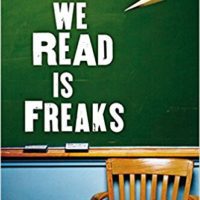
“All that stuff about not going outside, she sounds like another freak,” says Tammy Wood, the perpetually hungover cowgirl. “Seems like all we read in here is freaks.”
“Let’s try to rise above the level of discourse in a Ricki Lake audience,” I say. I can’t tell if what I say next comes across as antagonistic or babying. “What if we examined what could be gained from understanding the perspective of someone who lived as Dickinson did, rather than condemning it?”
“Well, staying in your house for twenty years isn’t normal,” Tammy says.
“Crazy’s what it is,” Chuck Barnes says. Every day Chuck wears a cap with CALCIUM NITRATE printed on it. He’s a tad confrontational, but, in a class that mostly dozes, punchy kids can function like defibrillators.
Teaching Dickinson is such a balancing act. Students are always fascinated by the weird anecdotes of her hiding from guests, but the moment I allow her to be called “crazy,” I’ve opened her up to the Hollywood idea that one’s genius is a function of one’s dysfunction.
So I discuss her family or her year at seminary, or how her poems are filled with the standard range of urges. As much as one tries to make Dickinson more “human,” the class prefers to perceive Dickinson as a cartoonish variation on Psycho’s upper-window silhouette.
“Sounds like Emily Dickinson’d fit in with the crazies around Market Square,” Chuck says. Everyone laughs. Gainesville has a disproportionate number of actual schizophrenics, despite all efforts to sanitize downtown.
Perhaps I shouldn’t have assigned “One need not be a Chamber—to be Haunted—” for the first night. The poem argues that there’s nothing more terrifying than one’s own mind. The speaker would prefer to be stalked by an assassin or ghost than “one’s a’self encounter—/In lonesome Place.”
“Some of this sounds like more of that ‘gothic’ we already studied,” Cliff Lesley booms. “She only wore a spooky white dress, she was death-obsessed, she tiptoed out to graveyards at night, et cetera. I thought you said that was Southern. She’s not Southern. Says here she’s from Massachusetts.”
Here’s a mini-breakthrough. We who elect to live in this soundbite culture have a way of automatically attaching certain words to certain concepts. When I introduced the term gothic, we were looking at three O’Connor stories, and the students said that, for them, the word connoted the Columbine shooters and rock acts like the Cure or Marilyn Manson. This prompted a rant from me about Victorian literature, Gothic architecture, and the North-South-everywhere-and-nowhere gothic of Poe. After we analyzed O’Connor, the students chose to remember gothic as being, as it’s often presented in this country, exclusively Southern.
“Well, the South doesn’t have the market cornered. In fact, the term Southern gothic is probably overused. Who remembers what we said it meant?”
“‘A hybrid offspring of religious hope and rural fear, cultivated in a climate of righteous ignorance,’” Lauren Hendricks says, reading stiffly from her notes. Thank heaven for the obsessiveness of success-minded students. “‘A goulash of physical violence, psychological unrest, spiritual symbolism, and some notion of cultural and individual loss and redemption.’”
“Now that’s some well-and-good high-minded theorizing, but think about what often gets called Southern gothic now. A misspelled word on a sign for a boiled-peanut stand. The mood cued by cheesy Dobros on TV movies. A rusty school bus in someone’s yard.”
“Sounds like those Jeff Foxworthy redneck jokes,” Tammy says.
“Exactly. Kind of safe and silly. Or worse, things get labeled as Southern gothic that are just unspecific nightmares or social problems. The term has been sort of redefined by misuse.”
I continue: “Dickinson’s home turf has a viable gothic, too. The South had Oral Roberts persecuting people for having beards, and communities dressing in sheets, hanging individuals for their skin color. But Massachusetts persecuted accused witches and maintained paranoid, socio-economically driven narratives of sacrifice and possession.” I go on, trying to explain that the North is just as authentically spiritually haunted and spiritually entangled in the dynamics of denial and confession as the South.
“Look at what the Northerner Dickinson wrote from her doorstep,” I say, and read from Poem 1583:
Witchcraft was hung, in History
But History and I
Find all the Witchcraft that we need
Around us, every Day—
Class ends on this note, and I feel like we didn’t get far enough. Examining Dickinson’s poetry is like freeing an ant from a spider’s web with tweezers, which, come to think of it, is something people might be moved to do on their porches on dark evenings in Gainesville.
*
The next few classes go well as we plunge forward and the students get to know Dickinson better. We single out many of her defining traits, crudely reducing her characteristics to a top-ten list. The dashes and randomly capitalized abstractions go down easily for the students, as does Dickinson’s hyper-self-referentiality. One student, who loves to say masturbatory, finds something to say masturbatory about. Another student likens some of Dickinson’s “I-me-my” lines to the braggadocio of rappers, apparent when Dickinson boldly acknowledges how she’ll be remembered after she is dead even though only eleven of her 1,775 poems (fewer than 1 percent) saw publication during her lifetime:
My Splendors, are Menagerie—
But their Completeless Show
Will entertain the Centuries
When I, am long ago,
An Island in dishonored Grass—
Whom none but Beetles—know.
We look at her use of quotation marks, at how postmodernly sassy, mocking, and ironic they can be, often questioning such utopian notions as “Paradise,” “Hope,” “Faith,” and “Heaven.” We joke about a character that the late Chris Farley used to do on Saturday Night Live, who’d overgesticulate creepy quotation fingers as he discussed his “hygiene” and “health.” Our chuckling subsides when I point out that many of the words between Dickinson’s quotations indicate that her reality was the unending night of the depressive; “Tomorrow” and “Morning” are punctuated as if potentially fictitious.
The students get a sense of Dickinson’s rich inconsistency as we examine poems that make aggressively polarized arguments about faith and death and love and nature and sexuality. This slipperiness frustrates them at first, especially the linear Lauren Hendrickses of the class, existing as they do in a world of O’Reilly Factors full of absolute, uncompromising, and often righteous stances on issues. The maintenance of any mental flexibility is supersized to ambivalence or downgraded to waffling, signs of weakness or culpability in their worldview.
*
One afternoon I’m sitting in my office answering the e-mail of a student who disappeared for weeks but now wants to catch up. He’d heard we were doing “something about Angie Dickinson,” so I try to sort out for him the nuanced differences between the solitary poet and the swinging film star. Someone knocks. I minimize the e-mail window, remove my wad of gum, turn down the music, and open the door to welcome a student named Jillian Jenkins.
Jillian had begun the semester with much-appreciated displays of intelligence and energy, which have since dwindled. Often she didn’t even open her book in class. I’d seen this happen to other bright lights. The apathy that surrounds them has a corrosive effect. I ask about her job.
“How are things at KFC?”
“I don’t know,” she shrugs.
“That’s hilarious that they prefer the clunky KFC over the old name. I guess a global food hopeful doesn’t want to have come from a ‘backward’ place like Kentucky, and no one wants to be reminded that what they’re eating is fried, but how do they explain avoiding the fact that it’s chicken?”
“I guess they just want people to think of it as food-blobs.”
“Like it squirted out of a Play-Doh Fun Factory.”
I am trying to resurrect a rapport that Jillian and I used to have. We would discuss how drive-thrus such as KFC’s alienate the consumer from the process of food preparation, or how politically shaky the cartoon image of the Colonel is.
“You know, that’s what Microsoft’s spell-check tries to change Kafka to: KFC.”
“Mr. Bowers, I don’t have much time to talk.”
Yikes. Something has happened to the spirited student who wrote way over the minimum-length requirement on her first essay. She tells me that she came by because she is thinking about dropping out, a victim of Too Much Life. For one thing, she feels she needs more hours at KFC to help make her car payments. Also, her father is very ill. More pressingly, she is being fought over by two young Hispanic men and is afraid for her safety. One of them, a mechanic, was so unchivalric as to remove the nuts from her wheels, causing them to slip off in her driveway. She fears the sabotage will escalate.
I am confronted with these scenarios all the time and am, of course, not qualified as a counselor. Perhaps some students reach a comfort level of revelation in their composition papers that they ascribe to my role as their audience. Am I unrealistic to want to joke with my students but also to want to avoid fielding their sorrows? Students have dropped terminal cancer, drug addiction, parental death, child death, drug trafficking, paralysis, rape, and incest in my lap, and I have floundered, become “professional,” and offered some bland, encouraging phrase, too conscious of the ephemeral nature of these intimate semesters and of the dangers of involvement, as well as of taking their horrors to heart. I am the hero whose job it is to write comma splice in the margin beside, My ex-husband held me down, he put himself inside me.
“I’m just not understanding this Emily Dickinson stuff, and poetry doesn’t seem all that…relevant…right now.”
I reach for the William Carlos Williams line that is an intro-to-lit professor’s life preserver: “It is difficult/to get the news from poems/yet men die miserably every day/for lack/of what is found there,” I say, careful to change men to people.
Jillian says she’ll try to finish the course.
I imagine that I’ve rescued something for the moment. Soon, though, discouraging thoughts prevail. I begin to wonder if my colleagues in this interdisciplinary office—economists, engineers, mathematicians, political scientists, advertising and business instructors—are ever forced to consider whether their instruction is tinged with absurdity. What is the reward of my department’s offering more refined cultural reference points than Jerry Springer or Hulk Hogan to folks who clearly don’t intend to examine them? Will the next edition of Familiar Quotations remove the poetry altogether, since none has been added lately, and just highlight Deepak Chopra, Greenspan, Ford, or Gates? Poetry will have to settle for the fringe, I suppose, and its celebrants will have to get comfortable with being outsiders themselves. The trick is not to become an elitist bastard, a misanthrope—or a hidden, like Dickinson. Maybe I’m having manic delusions. Still, how can people choose to fill their heads solely with jobs, shopping, trouble, and TV? How do those building contractors next door enjoy that same joke—it involves a bikini and a drill and a Doberman—every day?
Theodor Adorno said that there could be no poetry after Nazi propaganda, and was wrong; with such entities as Wal-Mart, MTV, Mortal Kombat, and Chick-Fil-A generating the symptoms, adspeak is the plague that poetry arguably won’t survive.
A friend who teaches at a Northwestern community college telephones. She lovingly calls me a Luddite for making fun of the inevitably popular film course she teaches. Then she tells me a student dropped because “the movies were too hard.”
*
The class continues. We listen to a tape of Robert Pinsky’s hammy, Vincent Price-ish readings of Dickinson. We manage to navigate some of the “omnisexual” poems without resorting to late-night AM radio politics. A student catches allusions to Dickinson in Being John Malkovich. We spend some time with the anti-celebrity, anti-self-promotion essence of Poem 288, which includes the stanza:
How dreary—to be—Somebody!
How public—like a Frog—
To tell one’s name—the livelong June—
To an admiring Bog!
The students catch on, in their own way.
“She’s kind of an anti-diva,” Tammy says.
“But she’s a real diva about it,” Jenny says.
We discuss how the poem views the limits of popular recognition, how one’s name might become nailed to audience expectations.
“Like how Jim Carrey is expected to talk out of his butt,” Cliff says.
“Or how Willie Nelson must feel while people scream, ‘On the Road Again,’ during his new songs,” I find myself saying.
As a brief creative assignment, I ask the students to compose eight lines using Dickinson’s form and meter. Her reliance on the ballad stanza is a classic example of her ambiguity. Despite her battles with religiosity, almost all of her poems take on the structure of the hymns with which she grew up. I ask the students to try to think in rhythm, knowing that hilarity will probably ensue. I remember that when I was a teen I saw a documentary that featured Allen Ginsburg being asked, “Do you think in words or in images or in forms?” His response added a category: rhythm. At the time, that struck me as gargantuan pretense. Ginsberg was right, though. After long nights with Shakespeare or Milton, I am attuned to pentameter variations all day, even on supermarket tabloid headlines, one of which offers the beautiful line MICHAEL JACKSON’S PLASTIC FACE IS MELTING. Some of my students achieve decent approximations of Dickinson’s cadences, using “Because I could not stop for Death” as their model. Chuck Barnes submits the workaday surreality of “I drove my truck around the room,” and Cliff Lesley offers “I microwaved my pubes today.” Lauren Hendricks pens the terrifying “I wish I lived at Disney World.” The students laugh but are impressed with each other, having enjoyed the experiment. I bring down the mood by asking them to imagine thinking in that rhythm for thirty-five years, rarely leaving the house. Then I share with them a personal note: One of my relatives sent me a letter from prison when she was placed in solitary confinement and had lost track of time and reality. It’s written in prose but accidentally in Dickinson’s rhythm, beginning: “I count the bricks by feeling them.”
*
Jillian Jenkins comes by my office again to check her average. She’s afloat in the class, but her problems are unrelenting. One of her suitors has assaulted the other. A KFC manager is harassing her. Plus, she hates her body. Many of my female students have either written or spoken to me about their bulimia, their anorexia, their self-mutilation, or their need for plastic surgery. One heavyset student told me her weight made her “already dead.” Jillian shows me an ad from a free newspaper aimed at college students. The ad is a photo of headless cleavage in a wet swimsuit and asks if the reader is truly prepared for the coming Florida summer. Jillian tells me that artificial breasts would look more natural than what she has. She needs the job at KFC to save the thousands of dollars for the procedure. She does not mention her sick father. No lines of poetry come to my head.
*
The class and I successfully examine a chunk of Dickinson’s religious poems. This procedure is tricky, since some students are either so compartmentalized in their religion that they cannot fathom having a spiritual crisis, or they are so secular that salvation and redemption are concepts limited to the realm of coupon-clipping. At first none of the religious kids admit to remembering anything from Sunday school, but eventually they help the class along. The second group of students mock as fanatical any vehicles sporting Bible verses, crucifixes, and Jesus fish but see nothing odd about their own cars’ Dale Earnhardt numbers, Nike swooshes, or ad slogans.
The class and I note how many of the faith poems are flat-out defiant and then, by contrast, how many sadly emit an unfulfilled desire to access a conventional spirituality, resulting in a kind of theological constipation. We agree that several of the poems seem to expect some response or manifestation from God, as if Dickinson’s belief required proof. I am particularly amped by my morning’s breakfast segment of The Civil War and declared to the class that Emily Dickinson was the General George McClellan of the soul, aligning her arsenal along a spiritual Potomac, where she set up camp and waited.
Waiting and repetition: two chief sources of human dread. And of insanity. My great-great-grandfather made my great-uncle plow, fertilize, or water rows in their fields on foot all day every day throughout his childhood. My great-uncle was sharp and creative, and this repetitive task, it is believed, drove him mad. One morning my great-great-grandmother went to wake him, and he wasn’t in his bed. She opened the front door to find him walking the fields, naked, with no tiller or tool or bucket or can, turning at strong angles like a patrolling guard. He spent the rest of his life in a home for the disturbed.
My father would pace the floors at night when he’d come home from his monotonous factory job. One of my e-mails from a student who left due to mental illness read: “Waiting is the opposite of water.” Was Dickinson, with her capacity for waiting and repetition, a kind of coward, or the opposite?
*
When Jillian Jenkins misses a class, I pay her a visit at KFC. I purchase a sweet tea (students love to misspell it “sweat tea”) and hand her Dickinson’s poem “To undertake is to achieve,” hoping that she’ll read it the self-helpy way, without emphasizing the thin, dark pun on “undertaker.” Then I leave, kind of freaked by my apparent role as a poetry social worker.
*
The students prepare brief analyses of Dickinson poems, with typically bizarre results. One paper is catchily titled “Weirdo Woman.” Another sounds like the banner theme of a neurotic prom: “Antisocial in Amherst.” A student’s paper on Poem 1445, “Death is the supple Suitor,” begins with the statement, “I have not experienced death.” Jenny Prince turns in an anti-analysis of Poem 986, “A narrow Fellow in the Grass.” The poem, a chilling, charged, multivalent work packed with religious allusions, is about an encounter with a serpent that leaves Dickinson “Zero at the Bone.” Jenny argues that “a snake is just a snake.” So much for Aristotle’s notion of metaphor being a measure of intellect. Chuck Barnes ponders whether Poem 465, “I heard a Fly buzz—when I died—” involves a bug zapper. In Cliff Lesley’s appraisal of one of Dickinson’s nature poems, he submits Mountain Dew, SUVs, and subdivision names (Oak Creek, Forest Lake) as modern examples of the pastoral tradition. Lauren Hendricks’s paper is so coldly professional that it reeks of plagiarism or online “research assistance.” I jot down some of the more Latinate words in order to confirm that she knows what they mean. Tammy Wood takes on the beautiful Poem 215, which begins with the lines:
What is—“Paradise”—
Who live there—
Are they “Farmers”—
Do they “hoe”—
Do they know that this is “Amherst”—
And that I—am coming—too—
The speaker doubts Heaven but simultaneously wants to be invited there. Before comparing the poem to a Garth Brooks song, Tammy, in her paper, asks: “So the farmers are lost?”
On my walk home that day, I am alarmed by a narrow, red streak traversing the road in front of me. It’s litter, a plastic straw blowing in the wind. A snake is just a snake, I think.
*
My grandmother dies, and I drive to South Carolina for the funeral. For Dickinson nerds, funerals are infinitely allusive. Graves and tombs abound in her work. One of her few trips beyond her father’s property line was reportedly a moonlit-cemetery expedition. My grandmother’s burial ground, though, is only remotely gothic and romantic, encroached upon as it is by the train tracks.
My father and grandfather are oddly serene, but I know that they must be in distress. Dickinson’s “After great pain, a formal feeling comes—” rushes to mind, perhaps applying also to my tendency to spectate rather than feel. My father—am I in one of Dickinson’s daydreams?—begins a conversation with the driver of the hearse about what a beautiful day it is.
I am named after an uncle who lived only days, my father’s only brother. He is buried next to where they are lowering my grandmother’s casket. So as this is being done, I am forced to behold a grave marker bearing my own name. Perhaps the only thing more Dickinsonian than this confrontation is my father’s comment regarding how far away I live: “No one stays home long enough to die anymore.”
*
Still brittle after the ceremony, I return to Florida for the last day of my class’ Dickinson Unit. Plus, all of the letter reading in The Civil War is blending with the volumes of Dickinson’s letters I’ve been skimming before bed. In my sleep, I am haunted by the bayonet-wielding female who represents America in Dickinson’s sole jingoistic poem (“My country need not change her gown.”) As cannons fired near a Charleston graveyard, Dickinson herself appeared in my dream, lip-synching to Patsy Cline’s “Crazy.” Clearly, I need to switch mental train tracks fast.
The class seems unhinged as well. Chuck Barnes is disheveled and without his CALCIUM NITRATE hat, which strikes me as ominous. I overhear the usually game Michelle Shivers announcing to her neighbor that she is just about tired of talking about a rich white woman. Jillian Jenkins looks zombified, staring past me, past the blackboard, perhaps past the school walls into the abyss she believes her Gainesville life to be. Lauren Hendricks presents to me a request for yet another recommendation letter, one of a series she’s been having me do for organizations whose credentials can’t be found in any nook of the Internet. I am beginning to suspect that her approval-based confidence is getting the best of her and that she is fortifying herself with these vouchers. She specifies that I praise something new each time. She asked me to include a positive assessment of her leadership skills in the last letter; for this one she’d like me to endorse her aura.
“Folks, let’s look at our last chunk of your favorite writer,” I manage to say as I hand back some old quizzes. “These poems are thematically linked, so—”
“My favorite writer is Associated Press,” Chuck Barnes interrupts. Chuck didn’t do so well on the quizzes I’m returning. “I don’t think I’m learning anything in this class.”
“Chuck, I know that I run an informal classroom, but in your academic future”—and here my inner asshole interjects, If you have an academic future—“be respectful, and don’t talk over people.”
“I just feel like I paid for this class and I’m not going to get a good grade in it.”
It’s the instructor-as-service-provider ethos. Teaching-guide prologues flash to memory:
Gone are the days when professors stood in front of a room
passing knowledge on to students; now more power lies with
the students, whose enrollment plays an active role in the
shaping of curricula and….
“Well, Chuck,” I say, “that reduces all the dynamics of a college course to the level of a fast-food transaction and reduces your professors to the level of cashiers. If you need to view your college experience as a long trip to McDonald’s, at least acknowledge that the rules are different. Here, you don’t just pay and therefore bind me to give you your burger, your good grade. Here, you pay, and then you have to earn your burger.”
A frost descends over the students. Many of them are fast-food cashiers by default. I’ve got to say something to thaw their glares. “Excuse me just one moment,” I say.
I walk next door to my department chair’s office. He’s a great guy. Knows his jazz. I am pretty sure he already thinks I’m delirious.
“Hi. Why do we teach poetry?”
“Don’t you have a class now?”
“Why do we teach poetry? Why do I make Michelle Shivers write papers about a rich white woman from the 1800s? Why do we literature instructors spend our lives prepping lectures on an art form that is, next to, say, sitcoms, dead in the gutter? Just remind me quickly. A sound bite, anything.”
This guy could have easily drawn a macho line in the sand and accused me of lacking fundamental belly-fire. Instead, he looks, as if for inspiration, at his poster of Miles Davis, one from Davis’s overtly whitey-resenting days. Then he performs a little drum hit with his fingertips atop a stack of forms requiring his authorization.
“Their world’s a blur, their lives such rushes. Meditative concentration is, is—it’s almost impossible for them. We teach poetry because it forces them to slow down.”
I thank him and run back to class.
All I want is to feel that the class really gets a group of poems, just once. But this day, I feel as if I have no reserves to summon, that I am out of ammunition.
I mutter a question: “What does Dickinson mean by ‘Success is counted sweetest/By those who ne’er succeed’?” If a student says “opposites attract,” I’m going to weep.
Someone in the class volunteers, “If you always lose, winning is more, like, precious or whatever.”
“Yes, loss or hardship makes one appreciative,” I say, though I am irked by the students’ compulsion to disqualify their bold statements with such deadwood endings as “or whatever.” Once, a student condemned a poem about tattoos by asserting, “Your body is a temple of the Lord or whatever.” And everything. And stuff. Basically.
“But what does the poem say about always winning? About how one can become spoiled by constant victory? In sports, the victories of championship teams can become tedious. The souls of rich nations can stagnate. What does Dickinson mean by ‘To comprehend a nectar/Requires sorest need’?”
Silence.
“When is a cold drink best? When are grapes the best? When’s an orange the best?”
These kinds of open-ended questions either get aggressively individualized answers or some kind of fatalistic, apocalyptic overstatement. My students today choose the latter. Someone in the class says, “When you’re thirsting to death.” Someone else says, “When you’re thirsty as hell.” Everything’s to-death-as-hell.
“The line hinges on that word comprehend. What might that mean?” I ask.
“That you are understanding the food instead of just consuming it.” Score one for Cliff Lesley.
“What might that mean, to ‘understand’ it?”
“How it got here, why you have it, its role in existence,” Cliff continues in a grand stroke.
“Instead of the way we take in food at KFC, just snarfing it,” Jillian Jenkins says, triumphantly awake.
“Exactly,” I say. “With no sense of cosmic consequence. But Dickinson may mean much more than food; perhaps the ‘nectar’ stands for all reward, all pleasure. Okay, maybe she just meant all sustenance, but our twenty-first-century palates are so bored that ‘nectar’ connotes decadence. So perhaps, ‘comprehending a nectar’ is a kind of metaphor for the fullness of a more examined life.”
“Yeah, but that fullness ‘requires sorest need.’ Sore need don’t sound too good,” Tammy Wood says.
“So maybe Dickinson’s making an argument against indulgence and in favor of moderation, or perhaps a more extreme kind of self-discipline, rather than gratifying yourself every five minutes. All of these poems for today present doing without as a lifestyle choice,” I say.
“Then Dickinson’s against everything America stands for,” Cliff Lesley says.
I leave that one alone for the moment. “Look in this other poem, where she says that peace is ‘told’ by its battles, and that land is ‘taught, by the Oceans passed.’”
Lauren Hendricks says, “It’s more of that idea of comprehension and appreciation being directly proportionate to how much you had to endure or how much you were denied.” Maybe she does write her own papers.
“Do you guys ever go out drinking?” I ask.
Even the students who never speak say, “Yeah.”
“Have you ever been the designated driver?”
A second, general “yeah.”
“What’s that like? Don’t you see more scientifically and more keenly the nuances of the culture surrounding the consumption of large quantities of a central-nervous-system depressant?”
“Yeah.”
“So on that night that you hang back, that you don’t participate, it’s fair to say that you gain a more profound understanding of the people who are participating?”
“Yeah.” The class offers stories here of doomed couples, of groping, fight-hungry security staffers and apoplectic lighting.
“So here we have Dickinson, who hung back, who was, as a poet, a kind of lifetime designated driver, treating her life as an experiment in negation, pursuing—and enjoying—the clarity that accompanies observation.” I think but do not say anthropological distance.
“So perhaps Cliff is right to suggest that with poems such as ‘Water, is taught by thirst,’ Dickinson has much to tell our McWorld. Perhaps that’s why so many people claim to be so dissatisfied here in the richest, freest country on the planet, where every good thing is available by pressing a button. Dickinson seems to be saying that if our culture of saturation leads to a superficial comprehension of the world—”
You know, teaching is isolated work. You spend a lot of time alone, grading papers or preparing lectures. Most of the people you do encounter don’t want to see you, and certainly don’t want to read your beloved assignments. That isolation becomes unbearable if you freeze while teaching. That’s what happens to me here. I lock up. A total blank in front of thirty scrutinizing, or at least expectant, people.
“If saturation leads to a superficial comprehension of the world—”
Sometimes repeating what I’ve just said helps. Not here. I understand that this happens to all teachers who take risks, who allow spontaneity in their classrooms. I’ve heard it referred to as academentia, a point at which an individual whose job it is to communicate concepts becomes incommunicative. I have simply run out of ways to put things. One wishes for an autopilot.
“If saturation leads to a superficial comprehension of your world—”
One may choose from several forms of pedagogical suicide at this point. Some instructors, in order to fill the silence, have, well, babbled (making it apparent that their professionalism masks a kind of madness). When I was in college, one of my instructors attempted to staple the curtains sun-tight during a severe attack of academentia. One said, “I give up,” and stomped off campus. Some confess things about their parents, children, spouses, or former spouses. How to fill the silence? Do I deliver a soliloquy on fatherlessness? On personal religious unease? Do I confess that the woman I was living with, who had wooed me with bodily confidence and material humility, has gone violently bonkers, bless her heart, with bodily insecurity and material covetousness, symptoms of the image-and-acquisition culture I was discussing with such calm reserve? Do I confess that because I failed her, I’m temporarily boarding in a house behind a funeral home with some rich stoners? That I drink on the porch at night and read Emily Dickinson and bemoan my kerplunked love and watch the undertakers unload folks’ remains from somber SUVs? (The opening lines of Dickinson’s Poem 241 flash to mind: “I like a look of Agony,/Because I know it’s true—”)
“Saturation,” I try once again, “contributes to a superficial comprehension of your world, so, conversely, it could be argued—”
“—that deprivation leads to depth,” Jillian Jenkins perfectly finishes the thought. The line even scans: that deprivation leads to depth. I smile. Jillian smiles. The class smiles. The moment is so satisfying that I wish I weren’t single, young, and energetic; I wish I were married, old, and frumpy. Because I would like to retire.
*
Many of the class’ final Dickinson papers are actually pretty good. I know there’s a greater chance of my dreaming of Chuck Barnes’s hat than of his dreaming of Dickinson, but I still feel like I’ve expanded the students’ entertainment and shopping Youniverse and broadened their Mytopia. After just five years of teaching, I know that every semester will initially seem fraught with limitations, only to erupt with rewards later. Semester after semester, students still say “literally” to modify “raining cats and dogs,” they still think a dark night of the soul involves having a cable outage or a dead modem, and they still want to reduce Dickinson to an obsessive-compulsive Northerner. And some fall through the cracks. I try to talk Cliff Lesley into finishing his studies whenever I spot him bagging groceries, and on a late-night jog, I see a plastered Tammy Wood being carried by her friends out of a rodeo-themed bar. But many students engage the poems and remember what we covered, if only as a fascinating detour from the quotidian, shop-till-you-drop path of Wal-Mart’s (this phrase comes from their panty-hose packaging) Transparent Control. Poetry helps folks cope with their lives’ fat task, which, Dickinson wrote, is “To make Routine a Stimulus.”
*
Dickinson’s portrait is posted on my office door, flanked by some “fun facts” about her life. I cut tiny eyeholes into the picture, which covers a small window. If I hear a student loitering, and peer through to see one squinting to read about the “morbid” poet who lived in awe of death’s absoluteness, I can’t resist exclaiming, “Boo!” from behind the door. Students usually scream or jump back. The good sports even laugh.
It cracks me up every time. Who says that here, in the land of fluorescent signs, football mania, booming bass, and a Mouse with a compulsion to celebrate itself every few hours, a poet can’t still strike a nerve?
***
[1] The names of students, and some details about them, have been changed.
***
“All We Read Is Freaks” originally appeared in the January/February 2003 issue of The Oxford-American.



23 responses
In a time when standardized tests include testing the ability to read an inter-office memo, when such “literacy” is substituted for the honest attempt to engage with a text which does not aim to eradicate ambiguity, I’m glad to see someone take an ice pick to the permafrost which characterizes not only the intellectual but also the “real” lives of their students. It seems fitting that Emily Dickinson, someone who so emphatically grinds against the apathetic “Youniverse,” is your vehicle for this effort. Extremely moving essay: the comma splice line tore my heart out-halting, haunting. I found the idea that the AP could be someone’s favorite writer a tragic and profound observation of a culture where original, distinctively stylistic writing (not just journalistic writing) must be sought out. I’m thankful for places like the Rumpus where pieces like this can be showcased. Homogenization is not limited to fast food and strip malls. It has been exported to our collective rhetorical and stylistic range. Thank you for the freshness, and the open expression of love for a New England freak who used as many dashes as the vacuous words which riddles most writing today.
Surprised there haven’t been more appreciative comments posted here. I don’t have anything clever to add — just wanted to say know how much I enjoyed the essay.
Yes I loved this as well. Beautifully written.
Why doesn’t the world have more of this kind of text? Many thanks to the author, of course, but also to Kyle for the finger-waggling endurance it took to give us this.
Thanks.
Thank you for unearthing this – and for pointing towards more William Bowers at Pitchfork. I am now a rabid fan after having read the following two sentences in his “Puritan Blister” column (#44) about the band Xiu Xiu: “We, the abused, are parent-haunted to the point of never becoming parents. We stay trauma-bonded to folks who mistreat us while dismissing the well-adjusted and kind.”
It takes a long, long time for some stories to get themselves written.
Hey, that was a tremendous essay; I enjoyed it. It is indeed remarkable when someone writes about an extremely traumatic event and a teacher’s response in the margin is: comma splice. 🙂 Hilarious. Mr. Bowers has a tough row to hoe, and I wish him well.
“…some students are either so compartmentalized in their religion that they cannot fathom having a spiritual crisis, or they are so secular that salvation and redemption are concepts limited to the realm of coupon-clipping.”
This is the exact reason why I usually feel like an alien on this planet, and also the exact reason why Emily has helped me cope with life’s “fat task.”
Brilliant essay.
As a colleague in the community-college realm, I laughed out loud (and a couple times with tears of joyful despair).
As a person who thrashes against finding that mental middle way between my gleaming egomaniac and my weepy dowager (even though I know it’s good for me), I sighed with the momentary peace of recognition.
As a reader who values words, ideas, words, and too much thinking about words, I wanted to pet the writer’s face in gratitude before slapping his butt and telling him to get back out there.
Thanks for re-typing this. Well-worth it. I’ll pass it around to a select few (of my fellow CC instructors). It’s long, that’s why there aren’t as many comments as…, and why it took me a week to read… and what can you say but : it’s great, just great!
Thank you, Daily Rumpus. I love the work this publication brings to my attention.
Thanks so much for this. Humor is a great antidote for existential despair. Well, a good antidote. Mr. Bowers, you are a brave man. I am lucky enough to teach literature in a high school where students have to audition to get in – it is an arts school, a public school. There are always some students who really love reading, and the others are smart enough to get it, and do a reasonably good job of pretending to like it. They are also honest about disliking pretty much everything written before 1900. Especially the Scarlet Letter. Some of them like Crime and Punishment. Some of them are addicted to cell phones and popular culture, but many of them appreciate the grand sweep of human history and culture. They write better than William Bowers’ students, but only a few of them risk exposing their thoughts out loud. I’m not sure why.
And thanks, wood s lot, for introducing me to Rumpus!!! (That’s how I got here.) (Here. Hmmm.)
Excellent essay, thank you! Where else can I find your writing?
For a long time I thought William Bowers was kind of a self righteous, cocky English nerd who managed to get published for cleverly shit talking his students, however after reading his actual work I am taken aback. This is a beautiful essay, and also very true to life as far as his students go. I would know, he’s my professor.
At first I was skeptical (a professor writing about his students’ grammatical errors and inadequacies seemed rather cruel and unfair), but this essay took my breath away more than once. I crave a pat, happy epilogue- but doesn’t that just prove your point?
I also came to your writing via your Xiu Xiu odes. As a high school teacher, I thoroughly enjoyed this piece. Keep ’em coming.
Terrific article! -That sounds like marginalia, not my intention. You captured your experience very well and made it glow. -Having trouble getting away from that voice. Well, your writing made me wonder about linguists who reconstruct the sound of Shakespeare’s speech from the phoenetic spelling in his age’s written word, and what those of the future will deduce from ours, in other words you made me think. -Better.
as a long time fan of Emily and a former community college student, who went on to the big time, thank you for writing this. sometimes i think we need an organization called “save the poets”. thanks for doing your part.
Students could use more clever shit-talking and less micro marketing, making them the lowest common demoninator (one) of their own lives. What gifted narration. We all have it; just got to get that rhythm. Bowers has it, and now maybe some of his kids do.
I thoroughly enjoyed this piece. I taught high school and middle school English in Central Florida until I retired two years ago, so I recognize these students and remember both the despair and joy of teaching. Well done.
Greetings. I am a former Remedial English student who was ordered by my tenth-grade English teacher, Barry Buschy, to promise to write every day for the rest of my life. I had a very difficult time understanding what was going on in his Poetry class and did not participate unless under duress, for a fear of sounding like an idiot. But I hung in there. I did not at the time imagine that one could be saved by language and yet I took his advice, which indeed saved me. I went on to a lower-tier state school, transferred to a better one, then on to grad school. I became, you guessed it: a teacher, first at a community college, then at a very rural public school. I am currently in a well-regarded MFA program for Fiction, something for which no one who knew me back then, including myself, could have hoped.
The point of all this is that I suspect Poetry is out there for the overlooked. As a (metaphorical) needle in a haystack, I thank you for your work and for this excellent essay.
As someone who teaches Emily Dickinson in a small college in Ireland, this had surprising resonance. An excoriating and wonderfully wry snapshot of third level poetry teaching. I can’t help but leave this poem by an Irish Poet, Louis MacNeice, to offer some justification for the reading and teaching of poetry:
To Posterity
When books have all seized up like books in graveyards
And reading and even speaking have been replaced
By other, less difficult, media, we wonder if you
Will find in flowers and fruit the same colour and taste
They held for us for whom they were framed in words,
And will your grass be green, your sky be blue,
Or will your birds be always wingless birds?
Teachers like Bowers should be tracked down like dogs, then be made President of the institution where they teach. Triple their salary, and make them continue teaching. God knows our sinking country needs them!
I have read and reread this great Longread article by William Bowers. While I enjoyed the excerpts included from six of the poems by Emily Dickinson, I must admit that my very favorite lines are Padget Powell´s “Life is missing things, NOT getting them” and Bowers´POV on KFC and fast food marketing.
Amazing. Clever. Inspiring. Really well written.
Thank you for pointing me to Pitchfork Magazine.
RAFA
Click here to subscribe today and leave your comment, or log in if you’re already a paid subscriber.