
If you’re like me, you grew up running various scenarios about what you’d do if the world were to end. Would you go nuts and run around in a stadium wearing a woman’s slip like the guy in The Quiet Earth? Would you give yourself that mohawk you always wanted and drive a dunebuggy around the desert like one of the extras in The Road Warrior? Or would you gravitate to Denver, Colorado to follow Mother Abigail, or to Las Vegas to follow the Walking Dude? Choices, choices.
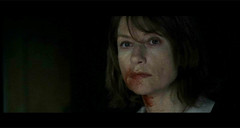
I was prepared to hate John Hillcoat’s adaptation of The Road, having been moved a great deal by the novel by Cormac McCarthy. I’d heard that a back story had been tacked on to allow Charlize Theron to emote. I imagined the worst, that the film would attempt to answer why the end of the world happened in the first place, dumbing down the material with the narrative equivalent of guardrails. I was surprised, then, to find the film sticking more or less faithfully to the spirit of the book, avoiding some big confrontational scene in which Charlize’s character meets her fate, allowing her to simply wander into the darkness. 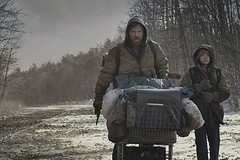
Part of the pleasure of watching post-apocalyptic fare like this is seeing how the auteur renders the physical world. It’s thrilling to see dollar bills strewn on the ground, rapaciously happy billboards standing amid the slag and desolation. The post-apocalyptic genre is a rejoinder to the burdensome noise of consumerism, a glimpse at a future in which the things that we know truly matter–a kind word, a shared meal–will once again regain their currency in our affairs. (McCarthy accomplished this brilliantly in his novel, which Michael Chabon was quick to brand as a work of science fiction. I’d go a step further and suggest that the post-apocalyptic genre no longer be considered a branch of science fiction but a genre unto itself. Imagine if bookstores started shelving The Road alongside The Stand and A Handmaid’s Tale.)
Postscript
My last Eyeball post was sometime in January, and I guess my excuse is that I was finishing a book and had a huge teaching load. I’ll endeavor to post more frequently in the near future. But an interesting thing I’ve observed in the interim has been how my movie-watching habits have changed. When Stephen approached me about doing a column for The Rumpus, I jumped at the chance to write about DVDs. In the past six months I got an iPad and have been using the Netflix app, watching stuff via instant streaming. Little discs that spin in a drive are looking increasingly antiquated to me, and I’m starting to feel a little like those guys in the ’90s who were fiercely devoted to their vinyl collections. We knew this day was coming, but I’m finding it harder to think about films as existing in the discrete realms of the cinema and the home screen. I’d be curious to hear how other people prefer to experience films these days.

4 responses
The movie was very faithful although I wish it had used more of the prose as narration…particularly those gorgeous passages from the end of the book. The locations were perfect. A friend of mine remarked on the relationship of the Road to Children of Men, one of the most affecting movies I have ever seen. I preferred the movie of Children of Men to the original book although it may be as much a question of hope as of merit…Cuaron was kind in putting not only hope but small human moments of humor into that beautiful film. I was sorry it was not seen by more people. I loved it.
Some afterthoughts, with spoiler alert: I’m not sure how they could have used those lovely lines at the end, since the narrator was dead by then…but I was looking for them anyway. The scene reminded me of Night of the Hunter…another well loved movie
Evelyn,
Children of Men, I agree, is a superb film. I squirmed out of my seat during the ambush scene. For some reason I link that film with the excellent The Lives of Others. They felt tonally similar to me, I suppose.
Ryan
dear Ryan,
I was also flinching in my seat throughout that movie. There was great use of the “long shot”– here’s an extraordinary interview with Cuaron:
http://www.npr.org/templates/story/story.php?storyId=6654637
Something about that movie hit home on a level that few do. Went back to see it two more times while it was in the theatres, something I’ve only done once before. Every time I saw something different and was just as moved. It’s incredibly rich– there was so much happening at the margins of the action, allusions to Abu Ghraib– scenes that reminded me of those first days after Sept 11– maybe that is why it feels like The Lives of Others, a movie I still have to see.
But was “Children”‘s incredible humanity that resonated most of all.
Evelyn
Click here to subscribe today and leave your comment, or log in if you’re already a paid subscriber.