
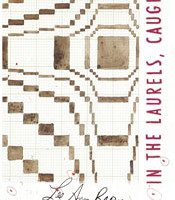
The terrain of Lee Ann Brown’s poetic obsession is greater and more eclectic than local color, norm, tool, parcel. In the Laurels, Caught is a collection which is thistle ‘n petal and intellectual engagement. Yet it is grounded in, if not given over to, the Carolinas, where Brown lived as a girl and which she revisits yearly. From “FREE ADMISSION TO OUR SALE”:
Wood Martin Houses
Drywall Lift
All Terrain Tricycle
NASCAR Calculator
13 Pc. Screwdriver Set
Subsequent lines of this poem follow suit, though it is more than a list poem, because each page in this collection has a literal subtext, a flowery flowing script, an alternative poesy in the lower portions, inviting the reader to explore the counterpoint of text and sub-. The eye is invited to float and bob, rest a while, (friend,) and yet not forget the main attraction. For instance, beneath “FREE ADMISSION TO OUR SALE” is written, in a light, whimsical, musical-as-notes-on-a-staff font, “three churches converge at Ivy River” “not planned that’s just where you go” “hot Sundays 3 denominations”.
In this case, an aspect of a local and sometimes rural culture is delineated through contrast. So, yes, there’s the good old boy-ness of “13 pc. Screwdriver Set.” And also the capacity of the land for said good old boys’ (and women’s) walkabouts and wanderings in the heat, by the river, their joining in with, or not, the general goodness of a Protestant hymn. (Please, sophisticated, anti-religious, South-hating reader: allow yourself a moment of plausible tolerance that not every moment below the Mason-Dixon line or in a church anywhere is a misfortune.)
Brown’s previous collection, Polyverse, was a ripple in a blue sunlit pool, a literate party game, a wisdom of invention. I was directed to read it by a poet-friend about five years ago and soon understood that its difference was the stand-out. And that difference is hard to explain; many poets try to make it new, but the making is self-dependent, relying on individualized vision. In Brown’s case, something is gently and natively askew, like curly hair that never quite obeys, and so the art goes into capturing that askew-ness rather than toiling to try to be different. Polyverse came out in 1991. Brown has published chapbooks and collaborations since then, but clearly hasn’t rushed her singular poetic insight which is, I add, thick-as-thieves with the fact Brown is a woman. (As the Bronte’s visions were so reliant, as Stevie Smith’s, as Gwendolyn Brook’s, etcetera and so on.) In “TRAIN TIME” she specifies the implication of her annual homing in the Carolinas (Brown lives and teaches in New York the rest of the year). “Here nature does seem more attached to culture / more continuous.” And so, I submit, by parallel and perhaps logical extension does her poetry seem particularly female—not a word to be dismissed or used as explanation as to why the glory of manhood was not demonstrated, but a word to use as insight and compliment. Not every woman achieves (or needs to) a femaleness in her writing. One of the tasks and tricks of the artist is to, again, capture, the self. Not easy, at all,¬ to divest the mind of what we think we are so we can see what we are, and also transgressive, when originality is perceived as threatening or dismissed as merely amusing.
In the prose poem “A LETTER OUT,” Brown (the writer specifically, or the writer adapting a persona—I try to be careful about assigning too much autobiography) investigates a cemetery. She thereby fulfills every poet’s duty to speculate about death. “A bumpy road to heaven leaving a rough existence for a straight-arrow afterlife?” The writer spies a college friend who, she realizes, is from the Carolinas. “So THAT’S why I liked his soft lilt so much way back then.” This in defense of the influence of the land on the person. “I struggle with the anti-essentialists who say we cannot identify Appalachia—but yes we are all strange coincidental processes in time and space that somehow (strange attractors) are brought into each others’ orbit yet again.” This ongoing investigation into what makes anyone who she or he is, is one of this collection’s traveling companions.
Brown is a folk musician, also reflected in the work, and sometimes directly so, in poems like “DULCIMER” which is both shaped like the stringed dulcimer (seeing is believing) and describes the instrument “…ye fall down down and / worship Three Feet / Long and made like / a violin they have / 3 strings, / one noted by a / stick.” The poem ends with an aside referencing the wondrous folk singer and dulcimer-player, Jean Ritchie. The end note is set smaller than the previous type, a breathless and secret post script.
Jean Ritchie told me
to make a big
flappy pick
from a
plastic
coffee
can
lid.
The poet’s dreams, a few, are included, some, perhaps distinguishable from the other poems and tidbits. “BROWN’S DREAM” (the title was a clue) confirmed a thought I had about a poem I’m writing, a dream transcription that doesn’t lineate easily—should I prose it? Brown does so. ¬“What is the form of writing down a dream? Should this dream be in line breaks? I must say it was extraordinary finding Alyssa talking about eating apples and honey and the different ways sweetness comes into them . . . I said that poetry could go anywhere, do anything, even practice law.” I wish poetry would practice law, at least now and then, at least in a spin-off, Law & Order: Free Verse.
 There is a compendium feel to In the Laurels, Caught. Prose poems, shaped poems, letters, straight-ahead poems, snippets, bumper stickers, snatches of folk songs—and all supported by the subtext ribbon of comment. So on page 45, there’s the graffiti or bumper sticker or hand-painted road sign as poem. A poem that has been found. I quote in full: “LOTS OF CANDY JOHN 3:16” That New Testament verse (John 3:16) is a wide-eyed argument in favor of God’s (“God’s”) interest in helping us all. I found the following “God’s Word translation” on the web, and use it because it is more charming than the typical verily verily-type interpretation: God loved the world this way: He gave his only Son so that everyone who believes in him will not die but will have eternal life. Brown’s comments/notes from a journal, are the poem: “mythic & Real” “A Birther – Mythology of the South – Abstracted” “or what about”. I’d be interested in the poet’s reactions to the content of the roadside sign, rather than her interpretation of the gestalt. In other words, Brown doesn’t quiet her inner anthropologist, political self, women of analytical abilities. Ah, the other part of having a good mind.
Fence Books rates kudos and then congratulations and then yowza! for this fantastically beautifully produced book. The paperback opens easy yet is sturdy as a New Directions paperback of old. The publisher collaborates with the author’s vision, the sub-scripts essential to the collaboration. In the Laurels, Caught is a surprise ball of a collection, a gift to unwrap and unravel.



4 responses
I think Lee Ann Brown’s previous collection is “The Sleep that Changed Everything,” published in 2003 through Wesleyan University’s Poetry Series. I remember purchasing it shortly after publication in May of that year for a summer poetry course. Its cover is staring at me right now, “What about me?” it asks. “Don’t worry,” I’m telling it, “I got this one.”
Joel, You’re probably right–I have been mistaken more than once in my life. Thanks and best, whichever Joel you are. Sarah
Hi Sarah, I meant my post to be more playful than flippant. I enjoyed your review & wanted to contribute. Respectfully, I do think that Brown’s second collection is important to mention. I once taught a non-credit literature course on “Female Voices in 21st Ce American Poetry” & in one session discussed selections from Brown’s “TSTCE” & Olena Kalytiak Davis’ “Shattered Sonnets […]” both published in 2003. Brown’s work seems to celebrate “language” for “being language.” It stands out amongst early millennial poetry, for me at least, for its ecstatic, generous, and intelligent embrace of what some refer to as an extension of New York School poetry and LANGUAGE poetry, two “schools” that markedly pulsed through the 20th Ce’s “fin de siecle.” I guess this is easy to say since Brown has collaborated with Bernadette Mayer and that Charles Berstein selected “Polyverse” as winner of the NAPS in 1996, published by Sun & Moon Press in 1999. “In the Laurels, Caught” is now my favorite of her work. Some may be tempted to call it “Appalachian LANGUAGE” poetry, or Brown’s version of Williams’ “Paterson,” or some hullabaloo, but to me it’s just vibrant, honest & enjoyable. The combination of lyricism, handwritten scrawl & assemblage of anthropological observations adds up to more than the sum of its parts. “ITL,C” is part of her “NC Ode,” along with “Crowns of Charlotte,” also published this year. I am in no way affiliated with Brown, Fence, or anyone else for that matter. No one knows who I am except for the people who know who I am, which so far is me. I just take poetry seriously.
Again, thanks, Joel. I took your previous comment to be neither flippant nor playful but indicative of interest. Best.
Click here to subscribe today and leave your comment, or log in if you’re already a paid subscriber.