
When people find out I am a writer, and that I attended Syracuse University, they naturally assume I studied under George Saunders.
Dear reader, I wish.
I entered Syracuse intending to study business and left with a degree in art history and my buttocks never once graced the seats of classes in creative writing or English literature. Thanks to AP English, I never even took freshman comp (which I have since been told was taught by a then-unknown Junot Diaz.)
So, I was not introduced to Saunders’ writing until my thirties when a friend recommended I read his essay collection, The Braindead Megaphone (Riverhead, 2007), which I loved. Boy was I thrilled when I found out he also wrote fiction! I read CivilWarLand in Bad Decline (Random House, 2016) and Tenth of December (Random House, 2013) and Lincoln in the Bardo (Random House, 2017), and even his excellent children’s story, The Very Persistent Gappers of Frip (Random House, 2015). Saunders is the best writer since Kurt Vonnegut to lay bare the hilarious cruelties baked into middle-class America, but he does so with such humor, care, and love that you can’t help but warm with hope when you finish one of his books, feeling that you’ve been brought close to something profound.
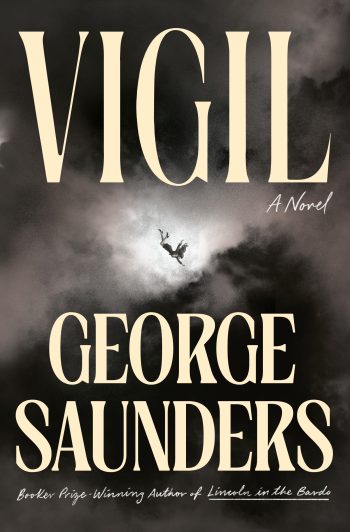
Vigil, his second novel, follows Jill “Doll” Blaine, an angel of sorts, who is sent to earth to comfort oil baron, K.J. Boone, in his final moments of life. But Boone has had quite a hand, it turns out, in pushing climate change denial, and there are certain supernatural forces who would like him to repent for his sins before it’s too late. Told in the witty, playful style Saunders has made his hallmark, Vigil is exactly the kind of hope-giving novel the world needs in 2026.
It was an enormous privilege to speak to Saunders via email about character building, crafting supernatural worlds, and what is currently bringing him joy.
The Rumpus: I’d like to begin by asking what sparked the idea for Vigil. Did it start out as a short story, or did you always see it as a novel?
George Saunders: I had it in mind as a novel—a short one. It just felt like that’s what it wanted to be, from the time the original idea came to me (which was, basically: really bad guy on his death-bed). Usually, I try to make things as brief as I can (my model is one of those wind-up toys and I wind it up and drop it on the floor and it races right under the couch. The end). But with this, and with my other novel, I just had a feeling, once I’d come up with a very simple, two-sentence outline, that it had a differently pace and lifespan than a story.
Rumpus: Your first novel, Lincoln in the Bardo, also focuses on death and the afterlife. What do you think it is that interests you about this topic?
Saunders: I’m not really sure and I’m also not sure that a writer has to know. The main trick, for me, is to recognize a certain flavor of being lit up from inside. It’s a feeling of, “This could be fun,” or “There’s lots of language possibility here.” But also, I like feeling a little daunted at the outset. Like, “Oh, boy, I could really fuck this up.” And I tend to get that feeling if there are some ghosts involved.
One thing I do like about ghosts and the afterlife is that it opens up the temporal axis. You can go back in time easily, by having someone who died decades earlier. It also makes it easy to expand a rhetorical idea outward. You can have the ghost be there to represent some viewpoint that might be hard to express if you just had a couple of living people sitting there.
But really, it’s more like preferring to play the guitar in a certain key, because you can feel more potential in those positions, if that makes sense.
Rumpus: There’s a quote of yours that I share all the time with my own writing students. I’ve heard you say that when you’re working on your own writing you ask yourself, “How can I love this character more?” I’m curious, was it a struggle for you to love K. J. Boone throughout the process of writing Vigil? Do you think that as the world is seemingly becoming more and more divided, it’s incumbent on fiction writers to expend even more love on our characters?
Saunders: Yes, but I’d want to define “love” as “attention,” not necessarily “affection.” You can pay very close attention to someone whose actions you abhor. And that’s a powerful thing for the observer. It’s almost as if you can go from mere judgement (“I hate that stinker”) to a series of objective statements (“He could have shown more courage at this point, but he was too wounded to summon up the needed strength.”) And maybe, by way of that process, you do move toward a kind of “love” and, at any rate, I think that position—less judgement and uncontrolled emotion—is more powerful. It gives you more power, really, to have that view, to change the person in question but also to preserve your own positive qualities.
Rumpus: Empathy is an undercurrent in all of your writing. Jill “Doll” Blaine is a being who is sort of charged with empathy, as her job is to comfort those who are about to pass away. “Comfort,” she is told, “for all else is futility.” Can you say a little more about that line? What did you mean?
Saunders: Well, she thinks (and I kind of agree with her) that when you boil it all down, seen from a certain angle, life is insane and futile. Everything we work for and love eventually dissolves, there’s often an uncertain relation between deeds and outcomes, and chance plays such a huge part in what happens to us. Given that the fact we are all trapped on an endless carnival ride that throws us around and occasionally bashes in somebody’s head (and eventually bashes in everybody’s head), and that all efforts to stop the thing come to nothing, and that all the things we say while we’re on the ride, to make it make sense, turn out to be nonsense—what’s left to do, but turn to the person next to you and say something that communicates, “Yeah, me too. I’m right here with you.”
Now, whether she’s good at being empathetic (to what extent she actually comforts anybody) – that’s another question.
Rumpus: Jill is a really interesting character. On the one hand she wishes to be “elevated,” the full meaning of which is left slightly ambiguous, but which we’re told means she gets to be closer to God. But on the other hand she lusts, bodily, for her former life as a human, so she’s really pulled in two different directions. She’s conflicted and a bit tragic, which seems quite unique if one views her as a guardian angel sort of figure. Angels and spirit guides always seem so stoic and perfectly actualized, so it was interesting to see her character wrestling with these regrets and indignations. Can you speak a little about how you constructed her character?
Saunders: I basically do everything a line at a time. If somebody says or does something that I like draft after draft, it stays in and thus becomes part of her character. In early drafts, I noticed that she had two distinct voices, and I liked them both, and thought, “Well, all right, leave them both in and we’ll figure out later why she’s doing that. That is, we’ll figure out who she is.” And, as you suggest, she’s experienced this thing she calls elevation, which I see as a form of losing the self, and she sees this as a very good thing…and yet. Something having to do with the circumstances of her death has left her longing for more life. It’s sort of like she has one foot in the bliss of being eternal and selfless, and the other foot in the bliss of being finite and full of self. That was all discovered in rewriting and I really kind of fell in love with her for that conundrum which, I imagine, we all have felt from time to time. We’ve been free of self (hooray) and have enjoyed the deep pleasures (at certain times) of having a self (also hooray!).
Rumpus: K. J. Boone is a peach. And he’s a magnificent foil for Jill. How did you decide that oilman would be his profession, and how did you decide that environmental destruction would be his sin?
Saunders: That was really early—one of the only things I knew about the book before I started it. I’d been reading about some of these guys who, in the late 1990s and early 2000s, were really pushing climate change denial, very deliberately. And I just had this image of one of those guys watching the weather report, and his face turning a little red… something like that. And implicit in that was a question, like, “Is there ever a moment where someone like that, in his old age, takes a good honest look at what he did with his life?” What interested me was that I didn’t really know. Or, I thought there must be some people for whom the answer is: No. Or (interestingly): No, unless someone forces them to make that reckoning. And then what? I like when a story makes me ask questions that I sincerely don’t know the answers to.
Rumpus: When you’re writing about the supernatural and especially writing about life after death, you have to devise the rules of the game as it were. You want your story world to make sense and to be logically consistent, but you don’t want to make the mistake of attempting to explain life, the universe, and everything to your poor reader. How do you decide how much information to include? And how do you decide what to withhold?
Saunders: Right, exactly: those last two questions are the whole game. And I can only answer them in revising, line-by-line; by trying to imagine (and re-imagine) where a good reader might be at that point in my book. How much do they know? How much might they assume without me telling them? It’s sort of like cooking without a recipe, by taste. Sometimes I’ll be reading along and feel, “Yikes, too much information. My reader is not an idiot.” Other times: “A good reader would be too lost here, and if she’s lost here, I can’t keep her interested in the pages beyond.”
Another consideration, one that was especially important in this book, is point-of-view: Whose mind are we in, and what would be natural for that person to know? We all know that gut-drop when a character blurts out some world-explanation that seems to be coming directly, for convenience-sake, from the author. Like, if someone writing about 2025, in 2100, were to write: “Bob picked up his cell phone, a small handheld device used to accomplish distant communication.” That is something that 2025-Bob would never think.
In Vigil, another interesting thing happened, which was that I found that the narrative set up made it very hard to be as harsh with Boone as I felt. Turns out, there was nobody in the book, including him, who had a clear moral view of what it was that he’d done. So that was a fun challenge, a little like that old story about the three blind men trying to describe an elephant, but each of them only has hold of one part of the elephant. (The guy holding the tail goes, “An elephant is like a rope!” and so on.)
Rumpus: To stay a moment longer on the supernatural, when you’re writing about life after death, and most especially what happens to not-so-nice people after they die, writers can get into a situation where they not only have to design a moral universe, but will also have to account for all the rules and consequences of said moral universe (and will have to do this with a religious education that’s probably 80% Wikipedia and 20% misremembered catechism), and this can feel daunting. How did you go about deciding what the underpinning moral architecture of Vigil would be? For instance, I believe that this land of the dead is quite different to the bardo through which Willie Lincoln travels, correct?
Saunders: Yes, it’s a much wilder and more irrational place, I think. It’s an afterlife with a lot of raw emotion in it and there seems to be less of a prevailing God, if I can say it that way. These beings…they make a lot of commotion with their energy.
But as far as the implicit morality of such a world… my feeling is, I get no points, if you will, for accurately mirroring some existing religious system. What the reader wants is for my afterlife to make sense within its own context, to be consistent with itself, and then, importantly, to somehow mimic some moral valence she’s felt in her real (living) life. So, in the Lincoln book, I think a person could recognize that these were all people who didn’t know they were dead, just like, in this realm, we tend to forget that we’re alive in the first place (i.e., are on the way to death).
And also, this question of “What sort of afterlife is this?” gets answered (by me) as described above: line-by-line, with the good stuff earning its way in. If something reads well or is convincing or funny—okay, it’s that afterlife. And if two bits contradict, but I want to keep both, I design in some sort of fix, and it’s (also) that afterlife. So the book teaches me what afterlife it wants to be located in, I guess.
Rumpus: Did you feel that Vigil was in conversation with any other novels? This might be way off, but I kept feeling Charles Dickens hovering somewhere off in the distance. The Mels, especially, had a very Jacob Marley vibe for me.
Saunders: Yes, for sure—A Christmas Carol is maybe my favorite book and pretty much everything I write is situated somewhere under its generous umbrella. But also I had in mind two Tolstoy stories, “Master and Man” and “The Death of Ivan Illych,” a Katherine Anne Porter story called “The Jilting of Granny Wetherall,” maybe Flannery O’Connor’s “A Good Man is Hard to Find,” which has that amazing line, “She’d have been a good woman if there’d been someone there to shoot her every minute of her life,” and (why not?) It’s a Wonderful Life. Those (oh, plus the movie Wings of Desire) were floating around in a cloud over my head, for sure.
But what happens for me is not that I decide in advance to write in a certain lineage but rather I look up at some point and feel a cluster of stories I’ve read and loved up there in that cloud over my head, sort of saying, 1) “You seem to be writing in this tradition,” and 2) “Try to do something, even something very small, that will confirm your location in that lineage while advancing it even a little bit.”
Rumpus: In the years since A Swim in a Pond in the Rain (Random House, 2021) was published, has your writing changed? Has immersing yourself in the Russian masters had a significant impact on your writing of late?
Saunders: There’s just one thing I’ve noticed, and it has to do with a Chekhov quote: “A work of art doesn’t have to solve a problem, it just has to formulate it correctly.” Early on, I thought I was going to have to solve a problem in the book: namely, whether Jill’s idea about comforting the dying was correct. There’s another character in the book, who is just called “the Frenchman,” and he has a very different idea from Jill about what should be done about Boone. But, as I was revising, I found that what the book wanted me to do was just strengthen both of those characters’ ideas, present them as rigorously as I could, and then just let them hang in the air over the book, sort of fighting that issue out for all eternity. That was an interesting thing to discover and I think that if I hadn’t had that Chekhov quote (and a few of his stories that proceed by way of that injunction) in my head, I wouldn’t have discovered that approach. It’s sort of like the book makes Proposal A, and then the opposing Proposal B, and when the reader looks at the author, asking, “Is Proposal A right, or Proposal B?” the author goes, “Yes, exactly,” and walks off to write the next book.
Rumpus: “My charge had been born him. But had never chosen to be born him. That had just happened to him… It had all unrolled just as it must. It did not seem strange to me, but inevitable. An inevitable occurrence upon which it would be ludicrous to pass judgement.” I love this passage. You seem to be talking about compatibilism, which is the philosophical principle wherein free will and determinism can sort of coexist with one another, and is something I think about a lot. Were you intending to write about compatibilism explicitly? And regardless, can you say a little more about what you mean in this passage?
Saunders: I have to admit that I’ve never heard that word, “compatibilism” before—thanks for that and I’ll go read about it. And yet, I do believe in it, I think. To me, it seems to be about where you locate your point of view. In the absolute sense, there’s no free will, I don’t think (none of us completed a checklist in the womb, asking for certain traits and so on). And yet, from inside our minds and bodies, the future looks wide open. So if someone asks me if free will exists, I’d ask “When?” and “For whom?”
The idea that a bear is a creature so designed, over millions of years, to subsist on meat—that’s true, in the absolute sense. But when he’s right behind you, and you smell his breath, and he seems intent on eating you—that’s the relative truth.
Rumpus: What’s bringing you joy right now? Either in the writing world or out?
Saunders: Well, I just finished Alice’s Adventures in Wonderland and Through the Looking Glass, and am in the middle of Speak, Memory—definitely joyful. We had two occasions over the holidays to do sing-alongs with some friends, me accompanying on guitar, and Paula and our kids surprised me with tickets to It’s a Wonderful Life on Christmas Eve, at the Aero Theater here in Santa Monica.
And there was one more, complicated source of something like joy, and that was this documentary about the life’s work of Sy Hersh [2025’s Netflix documentary, Cover-Up, about investigative journalist Seymour Hersh]. What was joyful about it—or a source of strange, quiet hope—was the revelation that we Americans have always had dark, violent, secretive, shameful tendencies (My Lai, CIA assassinations, Abu Gharaib, et cetera.) So we are not some perfect country that has recently fallen from grace. We are a deeply flawed country, inside of which, forever, certain people have been trying to drag the whole shebang into the light. That—those individual people, with a hope of something better—is real. What I find joyful is that there’s still time for each one of us to be part of that. This current shitshow is just the latest battle in the long war of dark versus light. Our darkness is now manifesting in a more overt way, but you can see traces of it in these earlier shames that Hersh wrote about.
Then again, it may be an indicator of how bad things are, that my source of “joy” is to say: “Look, we were always kind of shitty!”