I was walking home but I was not at home. For a time, I lived in a country very different from my own: narrow cobblestone streets and brick buildings, windows shuttered by wooden slats painted green, and black, and white. Some slats tilted open just enough to let a little of the outside in. Above, brown window shades slapped against each other. A bird, small and frantic, was caught between the slats. Too far away, I could only watch as the creature struggled against its restraints. When I finally stood right below the window, the struggle ceased: It was not a struggle after all but a set of short ribbons, feather-light strands tangling in a light wind.
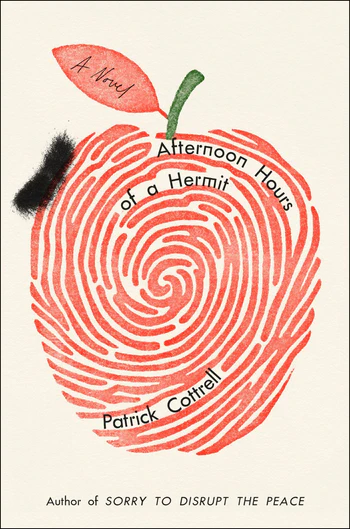
Patrick Cottrell’s newest novel Afternoon Hours of a Hermit offers its own slant way of perceiving: A story nests within a story within a story. A misaddressed envelope arrives with a childhood photo of a dead brother sent to the wrong name—and pulls Dan Moran, a trans fiction professor, back to his family’s table for a memorial dinner he largely ignores in favor of driving around in his deceased brother’s Honda Accord. This is, of course, only the bird caught in the window slats. The closer we draw to Cottrell’s Afternoon Hours, the more the novel reveals its unexpected truths. Yet, meaning is not proximity. Knowledge arrives at an angle. Afternoon Hours is as much a mystery novel as it is a lens that lets us look into the unknowable gap between what we can see and what we can know. So how, then, do we cross the divide? How do we find our way through the moments before understanding arrives? While Afternoon Hours offers no prescriptive answers, what it provides proves far greater and more compelling than mere certainty.
Patrick Cottrell and I spoke by phone for an hour. We talked about the momentum of mystery, the abyss between who we know ourselves to be and who others decide we are, as well as what it takes to live with what we do not yet know or understand.
The Rumpus: In The Paris Review you said, “An investigation ends when someone has exhausted all possibilities.” When did you realize the investigation hadn’t ended for you, and that this was the next book you needed to write?
Patrick Cottrell: Well, by the time Afternoon Hours comes out, it’ll have been nine years since my first book. In those years, I’d started different projects but none of them felt right. I had a lot I needed to do with finding myself in those years and once some of that was clarified, so was the call to this book. I’ve always been drawn to mysteries. So, I was really compelled by the investigation that’s central to the novel. And I was aware when I was writing it that some people would think this is the same as the first book, just with a narrator of a different gender, but I didn’t care. This is what I had to write.
Rumpus: This narrative world does feel utterly unto itself. Investigation and mystery act as portals for all manner of things to enter the story. Did you grow up reading mystery books?
Cottrell: Yes, definitely.
Rumpus: What did you read?
Cottrell: Nancy Drew and all those formulaic series. I even read The Bobbsey Twins and Encyclopedia Brown. Murder, She Wrote was a big show for me too. I like that there’s always something driving the story forward in mystery. And especially in books that are really interior, mystery pushes the narrative forward because if a book like Afternoon Hours doesn’t have that investigative structure, it’s just thoughts. The investigation keeps the pages turning and works in tandem with the interiority.
Rumpus: There’s this structural shape to the novel that resembles origami, the way narratives nest within each other and also speak to each other through proximity. Did this structure of interiority and investigation, the balance between both, arrive early, or did it reveal itself only once you were within it?
Cottrell: It took me numerous drafts to figure out this story. And I had to rewrite the last third of it quite a bit. When I’m writing though, I don’t necessarily think about the structure. I’m more concerned with the content, the voice, and what is happening. I think about the word “momentum” a lot when I’m writing and teaching. It’s an elusive thing that can be hard to instruct—hard to talk about, but it guides me. I follow the question: Does it feel like there’s momentum building or does it feel like there’s nothing here?
Rumpus: Much of the propulsive momentum in the novel derives from Dan’s distinctive voice. Kelly Link has said she’ll follow writers into genres she doesn’t even like, entirely because of voice. When you’re following that momentum what does it feel like? Is it like stepping into a river or current of some kind? Is it a physical sensation?
Cottrell: It’s something I sense as I’m writing, yes. We all know what it is like to read something that feels as if it’s treading water and there’s no sense of what’s pushing it forward. That’s something I don’t like. In this novel, Dan’s particular voice comes from a compulsion of needing to speak the truth to something, needing to describe a very particular experience. You mentioned stepping into a river and it’s something like that. You step into this current and you go with it. You see where it takes you. And like a river, you can’t really control it entirely.
Rumpus: Absolutely. A river is always going to take its course.
Cottrell: I think the voice in the first book was more embroidered but Dan’s voice in Afternoon Hours is more direct and masculine, as a result of the character’s transition and the fact that this book more fully inhabits the detective genre. It’s really a novel that’s trying to work with different noir conventions quite directly.
Rumpus: What particular conventions did you have in mind?
Cottrell: Driving in a car. A detective questioning people. A mysterious woman. Phone calls that hint you’re being followed. The feeling that everybody knows more than you, that there’s something going on underneath the surface that you’re not really sure about. A sense of paranoia. And, I think the main convention of noir is the idea of justice: so, trying to write something that was wrong, making a correction.
Rumpus: As a reader, it’s so delicious to encounter these elements in the novel, particularly the feeling that you’re outside of a secret and the central role of the car.
Cottrell: The car is such a detective convention. Driving a black car through the city. And I find it funny that in the book this is not just a car. This is a site where someone died and chose to die. So, there’s a lot of weight with the car. It felt dark but so right.
Rumpus: There’s so much duality in the novel. The car is a car and it is also, as Dan thinks of it, a “deathmobile.” You’ve said that Afternoon Hours is very much about how people see both themselves and other people and the various blind spots in that seeing. Dan, for one, is repeatedly mis-seen in the novel—deadnamed, misrecognized, cast into roles he has not chosen. And then there is this other narrative of harm that unfolds: a narrative that Dan’s mother tries to overwrite. How were you thinking of this kind of dual (mis)perception as you were writing?
Cottrell: It was a process of moving toward and confronting those moments of harm. With things like deadnaming and misgendering, they’re very easy to depict because they’re things that happen all the time to trans people, especially from people they’ve known a long time. And it’s not always a deliberate thing, mistakes happen. But willfully deadnaming someone—it’s so direct that it’s simple to render. Some of the other moments of harm you’re referencing, those were more buried and were things I didn’t really want to touch upon, but as I was writing, I needed to be honest. It would be easier to not have certain things in the novel but that wouldn’t be truthful for Dan, who is very avoidant in a way but who is seeking the truth. So, at the heart of the book, while there is this deep harm and hurt being depicted, it’s being approached from a digressive angle. And other books might be more direct, but in this novel, it takes Dan awhile to get to certain things, which I think speaks to the nature of investigation. In an investigation, you don’t know everything up front. It’s a process of discovery.
Rumpus: That process of discovery is really bound up in the fact that Dan perceives a great deal in detail but understands very little. Similarly, his family deliberately and clearly chooses to see Dan in one way while choosing to remain blind to other realities as it relates to him. In this way, this kind of clarity bound to blindness is a familial trait that plays out in such different ways across the members of Dan’s family. That’s a complex thing to write, isn’t it?
Cottrell: Yes, it is complex and I don’t think that in this book there are villains, per se. In my experience everybody has major blind spots that they’re not aware of and I wanted to work with that. For myself, I’m very aware of some of my own limitations but not all of them.
Rumpus: There is a moment in the restaurant where Dan eavesdrops on his mother and his brother Matthias speaking about him but he feels unable to confront either of them. It seems that writers often don’t feel powerful in their lives, yet the storyteller—who controls the narrative and the blind spots—holds a different kind of power. What power do you see Dan having? Because Dan is also a writer. Do you feel this tension of power/powerlessness at work in him?
Cottrell: That’s a really great question. I don’t think that was something I was fully aware of as I was writing. Dan is not passive in many ways because he is out in the world actively trying to discover things and ask people questions. But at the same time as a writer himself, I don’t think he’s fully aware or in control of any kind of personal agency or power. And the novel is grappling with that, coming to terms with the idea that writing can affect and even hurt the people we depict. For Dan, I don’t think he has a sense of that fact. I really actually don’t think Dan has any sense of power until towards the very end of the book.
Rumpus: That’s what makes the ending so satisfying, isn’t it? Because Dan does seem to finally realize there’s a narrative power that’s there and is his for the taking.
Cottrell: I’m glad you saw that. I actually had a much different ending when I did the first draft. For this novel, it needed to have a sense of something happening. It couldn’t just fizzle out or neatly resolve everything. I needed something decisive but ambiguous. And I think that’s really hard to do. That’s probably why it took me so long to get it. When I arrived at this ending, I felt sure this was the right way to end the book and I was thankful that I landed on it. There are plenty of things that I don’t necessarily feel perfectly satisfied by in the book but the ending is one of the main things that does feel good.
Rumpus: The ending really landed perfectly, so admittedly, there’s some relief in hearing that it took time. It wasn’t just something that was immediately available to you.
Cottrell: I had to be patient and not try to just do something mechanically. It took months and months. Writing is very mysterious. It really does not get easier the more you do it. Writing is always a struggle to some extent for me.
Rumpus: Writers do seem to like having their shoulders up against a struggle. Otherwise, they might not write.
Cottrell: Totally. There’s something interesting about grappling with something that isn’t working, that you don’t quite understand.
Rumpus: That kind of grappling is also present in Dan, who seems to always be circling parts of his identity in thought. He thinks about his identity as a Korean adoptee as shaping his sense of being in two places at once. He considers how his transition forms a sense of dread. What was it like for you to write about identities that you also share?
Cottrell: I don’t set out to write about identity. I didn’t think, “Oh, I’m going to sit down and write my identity novel.” But at the same time, one writer I was thinking about a lot as I was working on this book was Marie NDiaye, who writes about identity in a very evasive but incredibly compelling and elusive way. She’s someone I look up to because all of her books are about identity, but they rarely articulate any identity markers. In fact, much of her work actively thwarts this kind of naming. I think her books are just so important and beautifully done. And I had her in mind because in terms of transness, this book isn’t about a transition narrative per se. It’s not about a physical transition. The book is more concerned with depicting the disorientation of being perceived in different ways by different people. There is a tension and confusion that can arise from that experience that can be deeply related to identity.
Rumpus: NDiaye’s work is so good and so claustrophobic.
Cottrell: Oh, yes. Her writing is very upsetting and very fascinating. Something else that I love about her books is that they’re very funny. She’s absurd in a Kafkian way and there’s a grim wit that I really enjoy.
Rumpus: Her work requires patience but it really rewards it as well. There’s a tolerance for ambiguity that is challenging but never confusing. For yourself, what questions are you finding you’re turned towards these days? What mysteries still remain open to you?
Cottrell: Well, I do have a lot of questions about my biological family and figuring out who they are and what their lives have been like. I have three older sisters and I’m very intrigued by who they are. And the other question that’s still open to me would be: How will literature and writing survive and persist in this world that is consistently trying to degrade it?
Rumpus: Do you have any particular thoughts towards an answer to your question, if you were going to offer one?
Cottrell: I mean, not really. I think time will tell. People say that more than ever, we need human stories but it’s hard to say what’s coming towards us. So, really, we’re left as people and artists to wonder about all that we don’t yet know.