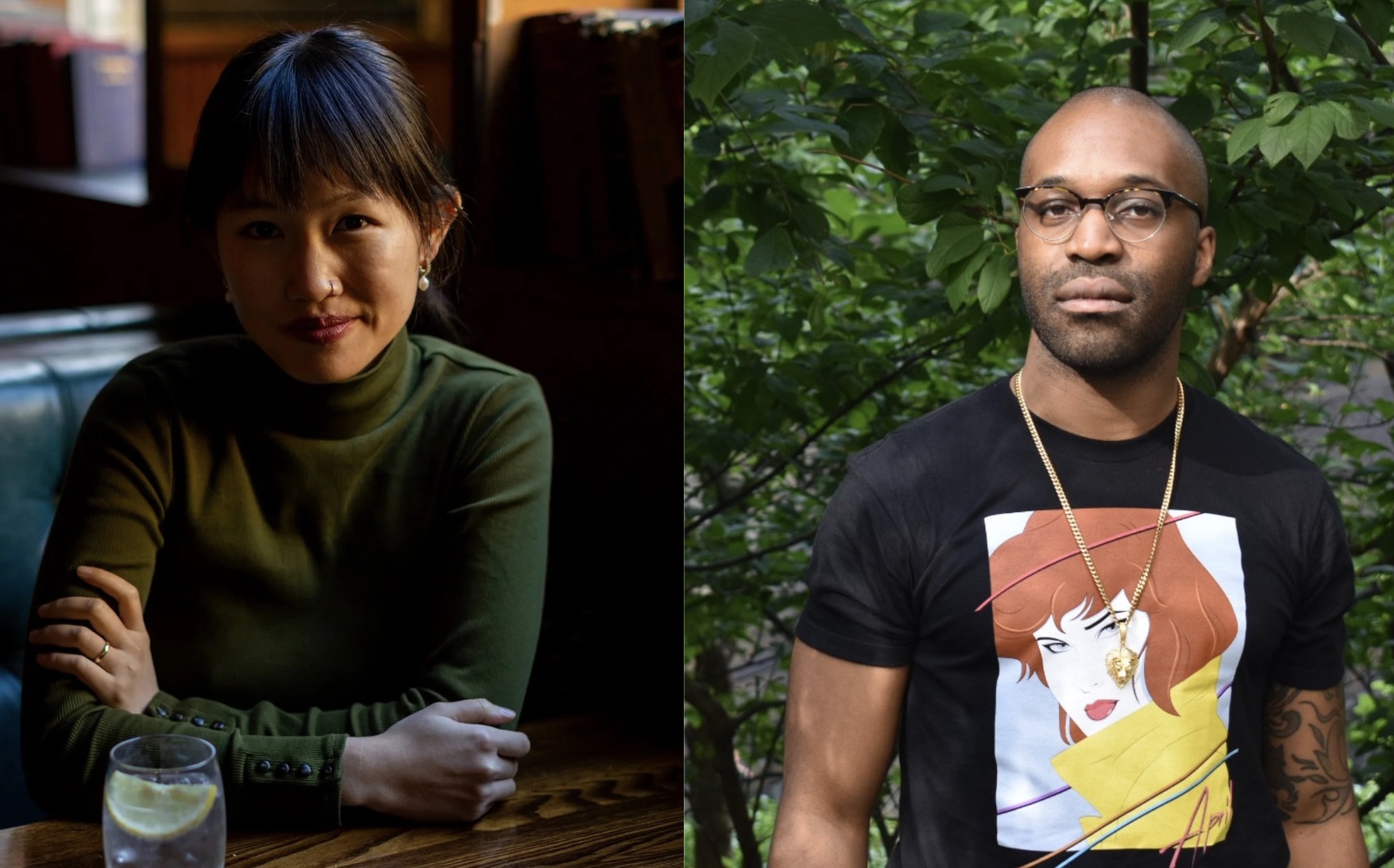
I got to know Tochi Onyebuchi during what felt like the last good years of Twitter: we first became acquainted during the Covid-19 pandemic trading memes about the publishing industry, and those chance “likes” and “retweets” transformed into an in-person, touch-the-grass friendship when I moved to New Haven for graduate school. Our late-night chats over beers and pizzas ranged from our favorite John le Carré novels to Martin McDonagh’s irreverent plays to our favorite moments from last night’s Succession episode. We were out of line (but right), we were not polite company, and we did a little bit more than advocate for the devil. Nothing was off the table. We could throw any idea in the air and trust that the other would receive them in good faith; we were frequently shouting at each other, but we always parted feeling fired up and excited to get back to work. Those evenings felt like a refuge from an Internet that felt increasingly hostile, fragmented, and eager to problematize the most inane cultural opinions.
So I was especially excited when Tochi told me he was putting together an essay collection, Racebook, about the Internet: this frightening, addictive sphere where we both made our careers, and one which we had both grown wary about over time. Tochi is a provocative, hilarious, and broad-minded essayist, and he offers the most vulnerable, nuanced, and surprisingly hopeful perspective on what the Internet is doing to literary culture that I have read in a long time. Interviewing an author about an essay collection feels naughtier than interviewing an author about a piece of fiction. With fiction, you invite the author to get explicit about interpretations and arguments that they haven’t put on the surface. With an essay collection, you just get to force the author to expand on arguments they’ve already laid out, as if they haven’t done enough work already. But he said I could, so here we go.
***
R.F. Kuang: You write about the Internet with an ambivalent nostalgia. Sometimes you long for what it used to be, sometimes you acknowledge that it didn’t used to be all that, and sometimes you wonder if we might ever get it back. I’m less ambivalent: it’s just not like how it once was. What was your personal golden age of being online? Mine was publishing Twitter in the early years of my career right up to the end of the Covid-19 pandemic. It felt like a genuine watercooler back then, a space where you could meet other writers and do the kind of serious networking that could make a career. People were sharing practical and valuable advice and expecting nothing in return. I could ask about craft resources, and my mentions wouldn’t be flooded with people accusing me of not knowing how to write. I can’t pinpoint the moment that all vanished, but I know that one day it felt less like people were talking to one other, and more like everyone was anxiously performing for an audience they didn’t even like. How did we get here? If you could resuscitate one ecosystem of times gone by, what would it be?
Tochi Onyebuchi: For me, it’s gotta be the years coinciding with Seasons 1-6 of Game of Thrones, so that would be, what? 2011-2016? I look back on that time the way I look back at that first Fast and Furious movie as the last bit of pre-9/11 media America was ever gonna get. Simpler times and all that, which is funny, because Racebook spends so much time in ambivalence about precisely that period when offline demographic markers seemed to gain a premium in online life. Where you could suddenly cash in on your marginalization.
But, for me, that GoT run encapsulated a few things. I think Thrones is the last online watercooler television show we’re ever going to have. I don’t think you get that ever again and it’s partly, I think, because of the death of monoculture, partly because the economics of film/TV streaming have changed so much, and partly (and quite obviously) because we’re talking pre-Elon Twitter when it was still a place for jokes and being more clever online than you were in real life, before you could get paid to ragebait. During that period, you had real, honest-to-God subcultures flourishing on social media. (Thrones Sunday nights on Twitter were where you went to see all the Americas existing side-by-side simultaneously. Like a benign version of the OJ verdict.) Like South Africa Twitter or Black Twitter reaching the apex of its powers. It was a heady time too. We’re bouncing from “Meet Me in Temecula” to #IfIDieinPoliceCustody and #OscarsSoWhite to #N*ggerNavy. Anything could happen.
But another reason that time period works for me is because I feel like online media wasn’t quite dead yet. I was reading a metric ton of longform non-fiction online and because of how link sharing worked back then, I was getting exposed to all sorts of topics and publications I wouldn’t have, on my own, discovered. A Leslie Jamison essay in the Virginia Quarterly Review, Scott Sayare on terrorism in French prisons for Harper’s, an Aaron Schuster piece at Cabinet Magazine on tickling. Shit like Anne Helen Petersen writing “The Unbearable Sadness of Ben Affleck” for Buzzfeed (Mar. 2016, I think) and Mina Kimes writing “The Unkillable Demon King” (Jun. 2015) for ESPN, the magazine. It was the type of environment where you could easily come across a resurfaced David Foster Wallace essay on tennis in Esquire. I practically lived on Grantland. RI-freaking-P.
Those two things, the mirth that was so easily available on Twitter and the media environment that allowed for so much educational and gorgeous writing to exist, are why that’s my favorite period of the Internet. Even if your time online didn’t extend past the boundaries of social media, there was that West Wing-ness of the Obama Years that honestly had us believing that, in a contest between our better and lesser angels, the Good would always win out.
The flipside of this is that, at the same time, online platforms were witnessing/fomenting the radicalization of untold numbers of people ranging from jihadists to white supremacists. This is the same Internet that ISIS was able to so deftly exploit. This Internet’s big enough to hold #BlackBoyJoy and YouTube’s alt-right pipeline. What might have the Arab Spring looked like without social media? Would we have even had an Arab Spring?
Kuang: Your golden age is exactly five years before my golden age! But I think we have shared that watercooler show experience together—some of my best memories from New Haven are those Sunday nights when we would gather to watch the latest Succession episode through seasons three and four, and then share the funniest posts about that episode all week long. Those Sunday nights were so sacred that I recall we once checked my husband out of the hospital earlier than recommended to drive down from Boston so we could get that pizza, beer, and couch time. But that was distinctly post-pandemic and during the transition from Twitter to X, and I recall that though we were both lurking, we weren’t posting anymore. What was different for you about that era of decline? For me, it’s that the Internet was still funny, but only anonymously funny,otherwise, that there was no space to slip up.
Onyebuchi: Those Succession nights remind me a lot of the time before online gaming. Back when multiplayer was just the people in the living room with you. I get at this a bit in the “Call of Duty” essay, and I think one thing the pandemic did was it boomeranged a lot of us back to more analog ways of being. I mean, the early pandemic was when the Swifties almost single-handedly shot vinyl sales through the roof. We’re increasingly suspicious of data-extractive convenience and thirsty for human contact so you get these at first almost clandestine meetups (whether they’re book clubs or watch parties or what have you) that maybe calcify once travel and lockdown restrictions are lifted and it’s like, “Wait, are people actually meeting each other in bars again?” This is all the stuff Meta wanted us to be doing in the Metaverse and yet we had all automatically opted to do it the other way. You see so many of the kids these days wanting brick phones because the always-on connectivity is just too much and as many horror stories as we hear of how machine learning and chatbots have run like aggressive bone cancer through the school system, there are still plenty of youth who are like, “No, fuck that, I’m not trying to outsource my neurological development to a fucking clanker.”
There was also a lot of fear regarding being Twitter’s Main Character, but—and maybe I’m victim-blaming here—a lot of those folks seemed like they were being dumb on purpose. By the mid-2010s, Twitter wasn’t the Wild West anymore. It wasn’t Deadwood. Nobody’s having “accidents” while reconnoitering their gold claim by this point. There weren’t laws, but unless you locked your account, you were in mixed company and Outside People could listen in on your Inside Conversations. Still, there was quite a bit of “‘I like pancakes.’ ‘Oh, so you must hate waffles, then, you bigoted homunculus.’ ‘No, that is a completely different sentence!’” And it got increasingly difficult to avoid that energy.
I think for us, too, Twitter (and perhaps the Internet more largely) had lost a certain utility it might have had in the years pre-pandemic when we were much earlier in our careers. I noticed at a certain point in my time on Twitter that my favorite authors who I followed weren’t really posting like that. And it was ‘cause they were BUSY WRITING! Also, it’s so annoying to have to promote your work on social media, and I certainly got braver about putting my foot down and telling publishers, “This is not what I use the Internet for.” I’m 95% certain no tweet I made has moved the needle for me in any meaningful way regarding book sales.
Simultaneously, the “engagement mindset” had also infected me psychologically where I found myself approaching many situations both online and offline in an automatically hostile manner, always in “fight mode.” And I think that’s another reason why I, at least, stopped engaging as actively with social media. I’m basically just a lurker and consumer now. I couldn’t imagine being on X these days. I left shortly after the Purchase. I barely even post on Bluesky anymore. But more widely, I’ve been more intentional about curating my experience online, and I think more and more people in the X Age are doing the same. The AI Sloppification of the Internet, I think, is going to push more and more people into that sort of posture too. Minecraft was one of the biggest movies of 2025 and kinda kicked off that insane Warner Bros run. I’d be curious as to the age breakdown of that box office total. Of the year’s box office totals in general. That in-person experience of a thing crafted by human beings, I see a real hunger for that among the younger generation, despite all the doom-mongering about “The Kids.” But they get it. Why drink Tropicana when the freshly-squeezed orange juice of human-made art is right there? And “right there” might mean “my highly curated online community” or “the homies I watch Succession with on Sunday nights” or “my Letterboxd friends” aka “my Christopher Nolan Support Group.”
Kuang: You describe that curdling moment when you became distinctively Black on the Internet—when your voice, your opinions, and your hot takes gained cultural cache by virtue of your status as a Black man. But I think it’s also fair to admit that that moment benefited us—we were BIPOC authors elbowing our way into the industry at a time when certain corners of the Internet were at least pretending to care about BIPOC spaces. What do you make of the doors that moment opened up for you—if you think it did? Would you have done anything differently?
Onyebuchi: It’s funny. I thought that thinking on this would leave me feeling ambivalent but, especially now that I’m on the other side of Racebook, I feel almost no ambivalence about how all that stuff played out for me. There’s a sort of mercenary “you do what you gotta do” attitude at work, sure. But I was still writing what I wanted to write, you know? I’d written Riot Baby (Tordotcom, 2020) and Goliath (Tor Books, 2023) back in 2015 and that’s where my ambition was located at the time. Excavating the experiences I was encountering both in my legal work during law school and after, as well as in my life-education during those years when BIPOC-ness, and especially Blackness, became such a prominent and litigated feature of life online. If Beasts Made of Night (Razorbill, 2017) was my foot in the door, it’s a debut I’m proud of. Did I imagine introducing myself to the world of published fiction in a different fashion? Of course. Is it at least a little weird that taking advantage of the commoditization of demographic markers played a part in getting me on a shelf in a Barnes & Noble? Super weird. Would I have preferred everything I published through 2019 not be marketed as “Black Panther-inspired?” Abso-freaking-lutely. But it’s like, “So what if the US only gave Black people civil rights to keep them from becoming Communists? We got civil rights!” Which is all perhaps to say that, having arrived at where I am now, I wouldn’t have done anything differently.
Kuang: You write that when you noticed that your career in publishing had revolved around the topic of race, you felt that “a narrowing had occurred,” that you felt “like I had been lessened.” I think anyone who has been reduced to a minority label understands what you mean—I’ve certainly felt that frustration throughout my career, particularly when journalists ask me, apropos of nothing, what I think about the fate of Chinese Americans under this administration. (I have never written a novel on the subject!) But it seems there’s another aesthetic narrowing that’s growing in popularity—one that might be initially resistant to the idea that art has to be clumsily political or representative, but in my view usually boils down to “art is apolitical, so I don’t care about anything, and I can do whatever I want.” How do you walk that line?
Onyebuchi: American letters is so small!!! Oh my goodness, the conversations we’ve had about this. It frustrates me to the point of incoherence. It seems that every book I pick up is small, both in page count and in subject matter. It’s all interpersonal relations—real “Me Generation” type stuff. I’ve been trying to figure out why this topic is such a trigger for me, and I think it comes down to a certain godlessness in American fiction. I watched a docuseries on Scorsese recently and it hit me like a ton of bricks that one big reason—perhaps the biggest reason—why his stuff appeals to me the way it does is because I can watch a Scorsese film, any Scorsese film, and know beyond a shadow of a doubt that I’m watching something made by a man who believes in God. Now, is this God an omnibenevolent bearded man in the sky who loves us beyond measure and has ordered the universe out of affection for us? Not necessarily. But in plunging headlong into questions of good and evil, in depicting his various hells (1970s NYC in Taxi Driver, 1990s corporate America in Wolf of Wall Street, et cetera.), you’re assuming a heaven, even if trying to get there is an asymptotic endeavor. To talk of the Devil is to imply the existence of his opposite. And I see none of that in American literature today. I look at novels today and find myself thinking, “none of these people care where they go when they die, and it shows.” God is shorthand here, and I think you can slot “politics” into that spot and I’d come to much the same conclusions. It’s why something like Andor is such a delicious drink in the desert. As a reader or someone experiencing a work of art, I can’t pick up any book and see it as apolitical. It’s impossible for me. Your choice of topic is a political matter to me. Your characters and the choices you make as an author through them are political matters to me. The absences in your book are political matters to me. Mad Men is an intensely political show. I know people got at its neck early and often about the lack of Black people in it, but I’m of the opinion that that lacuna was an intentional, political matter. It forces you to ask, what does this exclusion mean? How does this exclusion situate all these characters in their place and time? Hell, The Sopranos is literally about the people neoliberalism diminished and how. It’s just that those people are all members of a criminal enterprise. American novelists have ceded scope to TV and non-fiction.
The Chileans get Bolaño and 2666, the Poles get Tokarczuk and The Books of Jacob. I despair that books of that ambition could never grow out of American soil.
I think US writers are also afraid of “getting it wrong,” whatever that means to them. Sometimes, that means being “preachy,” and disobeying whatever tenets of dramatic action they think a story is supposed to be governed by in favor of the didactic. Sometimes, that means erring in your depiction of peoples different from you, like giving someone the wrong hairstyle or assuming a patois where there isn’t one, all that Writing the Other™ stuff. When US writers started being afraid of making generalized statements about humanity, about “Mankind,” we lost something. And so stories get particularized: “Let me write about this small corner of the universe that I’m familiar with.” A writer takes a swing and “gets it wrong,” then the online backlash to the writer and publisher is so bad that the publisher pulls the novel, a warning to the rest of us of what happens when you “assume another’s experience.” So it’s a publisher thing too. But I think writers can and must change before their publishers will. Widen your aperture a bit, assume the Other™ that you’re writing about has an inner life at least as complex as yours, be rigorous. Try your hand at something bigger than 400 pages, like training for a marathon. And maybe get thicker skin. Most importantly, though: be good. I don’t need to agree with your politics. I just need to be impressed by your writing.
Kuang: You brought up God! Now I get to ask you about God. Religion permeates this collection—I was particularly struck by your description of the woman who was able to visit a virtual reality Mecca. We were both raised within the church, and despite some intellectual atheist posturing (and at least on my end, a lot of doubt and handwringing) maintain a not-so-subtle commitment to some kind of higher power in our creative work. We often joke that they don’t make them like they used to because writers don’t believe in God anymore, and I want to push you to elaborate, sincerely, on what you think that means. And bonus question—where do you find God on the Internet?
Onyebuchi: Oh my goodness, where to begin? I mean, it’s easy to believe the Devil exists, right—the thing always nudging us, tempting us, into evil. And oftentimes, the evil thing is just “I’m trying to survive in this hellscape of a country/world.” I mean, of all the things Walter White could’ve done to provide for his family, he started COOKING METH! And we were like, “I get it; the American healthcare system makes me wanna become a drug kingpin too.” But you also look at how much naked greed is valorized, a hypercharged development since the Reagan-Thatcher era, and you look at the environmental degradation and the natural disasters, all the horrible ways we can now witness people online dying or well on their way to it, and, of course, the question is, “If there’s a God, how could He let this happen?” which quickly turns into, “Of course, there must not be a God, it makes no sense that there’s some higher power organizing the universe and it’s allowed both slavery and COVID to happen, like wtf?What God could countenance what’s been done, what’s being done, to the Palestinians?” Right?
But I’ve found every other explanation, both for the cosmic choreography of my individual life and for the majesty and horror of the universe, wildly unsatisfying when measured up against the divine mystery of a God I could never hope to understand but through which I, at least, can find some framework, some superstructure, of both behavioral edicts and explanations. Even if the result of my inquiry (into the nature of human suffering, into the place of the God-fearing citizen in the nation-state, into what circle of hell tech billionaires may eventually occupy, into the question of “are we alone”) is “I don’t know.” There’s a difference to me between “I don’t know,” and, “There is no answer,” and “I don’t know, but in searching for the answer maybe I’ll come to some other understanding of how the universe works; maybe I’ll better myself or be bettered; maybe I’ll be less alone.” The idea that there might be an Author to all of this isn’t just comforting from an emotional perspective but from an intellectual one as well, not because it forestalls questions (“It’s the will of God,” et cetera), but because it gets me asking more interesting ones. If suddenly the state of my soul is at stake, then that’s more money on the betting table. All of a sudden, the stakes have been raised. “How do I survive?” becomes “How do I walk through this life in a way that facilitates closeness with the Divine in both this life and the next?” and that is a much more interesting question for me amidst the backdrop of late-stage capitalism.
It’s not just that it seems like much of modern American literature feels void of moral universes, it feels, also, like there is a stated disinterest in the questions that belief in a higher power (or just belief in general) forces upon us. Who, writing today, could give us anything approaching the “Grand Inquisitor” chapter of The Brothers Karamazov? Mary Doria Russell’s The Sparrow comes closest. That and Gilead by Marilynne Robinson. Lincoln in the Bardo by George Saunders maybe. Faith that “things will eventually work out,” faith in “Something Out There™,” doesn’t mean that all suffering is just some meaningless obstacle to get past on the way to a greater goal; it makes the suffering itself meaningful. “Why am I going through this?” is a non-rhetorical question that I think no American writer under the age of 65 is interested in askingand that diminishes our product.
As for where I find God on the Internet, you might hear my answers and say, “Well, that’s just humanism,” and maybe you wouldn’t be wrong! But I see a bit of the divine spark in many acts of charity (big and small) that occur online. “I Have a Rendezvous with Death” is a dark essay by design, but I also saw, during my time at that company, incredible acts of heroism, people’s lives being saved both by human initiative and by what you might call pure serendipity. It seemed almost that every good thing I witnessed on the Internet had some otherworldly engine given how bituminous the state of the world is. Goodness persists.
There’s a selfish side to this, too. Any time something like the aforementioned comes across my awareness, out of all the chaos and content on the Internet, I can’t help but think, “God put this here for me.” In the early months of the pandemic, the cast of Archer did a live reading of the elevator episode on YouTube. By that point, I couldn’t remember the last time I saw my family, a few members of which were nurses on the frontlines of the pandemic. Every interaction with a loved one wasn’t just characterized by mediation through a screen or through a phone, it was flavored with “Is this the last time either of us will be alive to talk to the other?” If it weren’t for work and my addiction to it, I might have been paralyzed by grief. But, randomly, I came across a tweet talking about the live reading and I went over to YouTube and there they all were, some of whose faces I was seeing for the first time. And they were doing one of my favorite episodes. “You’re not alone,” I was being told. “Even in the midst of all this, I got you.” I couldn’t call that chance or accident or any synonym thereof. It felt way more intentional than that.
At this point, I’m wired to see any unprompted kindness online the same way I saw members of our church fix my mom’s leaky roof for free when they heard offhand that she was having problems. Maybe, “it was the right thing to do,” according to whatever moral universe a person lives in. Maybe it’s Matthew 18:20: “For where two or three are gathered in my name, there am I in the midst of them.” That comforts me and enriches my universe at the same time.
Kuang: It’s hard to pick a favorite in this collection, but mine might be “Stand Alone Complex”; or, “The Great American Internet Novel.” You’re a lot kinder about the Internet than I am. My response to the “enshittification” of online spaces (thank you, Cory Doctorow) has been to try to live offline as much as possible, like an ostrich sticking its head into the sand. But you write: “To take a thing seriously, to take the Internet seriously, is to recognize the parts of it that don’t hurt. The way people talk about the Internet now, it would be easy to forget that it also contains the sublime.” Where are those places now? How do you maintain your access to the sublime without losing your mind?
Onyebuchi: “Select Difficulty” originally appeared in Reactor (then Tor.com) back in 2019. I’d been thinking a lot about violent video games and why we’re drawn to them, and I wanted to write about video games the way Tom Bissell did, which meant, for me, finding a gaming experience of particular poignancy that I could mine for meaning. Anyway, I write about The Last of Us and post-apocalypse and looking for my dead father at the end of the world and Reactor publishes it. I know you’re never supposed to read the comments. That’s like Rule #1 or #2 about living on the Internet. However—and I don’t know why—I broke that rule and there was this woman there who wrote about her son, and her son had lost a father just like I had. And her son had retreated into video games just like I had. And for a time, her son was unreachable. Then she read the essay and felt as though she’d been given some insight into what he’d been going through, as though his experience might be mirrored some way in mine and, in seeing and understanding this, she might better be able to reach him. That’s the greatest moment of my career. I could win a Pulitzer and it wouldn’t come close to the sense of accomplishment I felt reading her comment.
The scary thing about the sublime and the Internet is that it always seems to be something you stumble into. Like it’s a matter of probabilities. You never know who you’re gonna match up with playing Ranked in Mortal Kombat. More often than not, it’s some toxic sweat who teabags you at the end of the match. Sometimes, though, it’s some kid who’s had a rough day and just needs this one win to be able to go to bed and feel like it wasn’t an entirely shit 24 hours, and maybe you give it to him and y’all chat on the mic, then you say your goodbyes and that’s it. The full extent of your relationship, and yet, how beautiful that this can exist in such a cesspool. This island where green things grow.
Not long ago, one of my best friends sent me a TikTok of someone playing Marvel Rivals, and the other person in the lobby (unseen, of course), sneezes into his mic so hard that the sneeze cuts out halfway through. I think he sneezed so hard he literally blew out his mic. Even typing this out, I can’t stop laughing. It sounds like what you’d imagine someone sneezing themselves through an interdimensional wormhole might sound like. It sounds like a sneeze that ripped apart the fabric of time and space—like, this sneeze created a pocket dimension where the laws of thermodynamics no longer apply. Of course, the people in the TikTok are laughing as hard as I am. They’re never going to know me. I’m never going to know them. They’re disembodied voices to me, all those participants, and yet they made my day. They still do.
So I don’t know where I might go looking for the sublime, but I find it’s one of those things I have to be open to. With TikTok, it’s something I can, in halting fashion, even train an algorithm on. But, yeah, how many sunsets have we completely ignored, you know? Just walked past or just spent indoors when we could’ve watched. A sunset, at least a New England sunset in crisp-breeze autumn where the sidewalks are carmine and golden with fallen leaves and you can see through the partially denuded tree branches the purples and reds made of the clouds and the molten gilt over the hills, how many times have I missed out on that? And yet in those times when I leave myself—or force myself—to be open to it, it’s like, “Wow. God really made this thing just for me.”
If I can keep myself from a constantly ironic posture, if I can stick my cynicism back into the tube, if I can approach the world in a spirit of openness, of preparedness, then maybe the beautiful thing will happen and I’ll get to see it.
Kuang: Another point I appreciated in that essay is the provincialism of the better known “Internet Novels.” I laughed at the line: “Hold this trend up to the social upheaval of the 2020s and one gets the picture of a bunch of Peggy Olsons trying to figure out what the stakes are in their life while the Civil Rights Movement rages around them.” Suppose you could conjure a less provincial Internet novel onto shelves tomorrow—not one that you want to write, but one that you want to read. Which slices of the web would that represent?
Onyebuchi: I think I’d be less interested in specific slices than in the fact of a multiplicity of slices. Like, my kingdom for an Internet novel that doesn’t center Twitter! I get the primacy it has in discourse and in people’s lives; nobody got a book deal off of their Google searches or their Reddit posts. But a thriller that captured life in Call of Duty lobbies would absolutely fuck. YouTube is so freaking big and so powerful, and it is just…absent. It’s radicalized a not-insignificant portion of the white supremacist segment of the Right in America, and maybe we’re just still too close to that period in time (say, the mid-2010s) to be able to see it clearly. I wonder if it’s just that the people who write our novels aren’t on the Internet like that and/or we/they can’t be bothered to do the research necessary to ably dramatize life in those spaces. Still, it’s holding us back. Like, we got that one episode of Adolescence that touched on the impenetrability of these online spaces and their esoteric cooptation of emojis to bully and cajole and all that. But, again, that was just social media.
I think a real Internet novel isn’t one whose central motif is that the Internet is driving us apart and decontextualizing us. I think a real Internet novel depicts the hell that is too much connection: like, the body horror of being smushed up against another person so much your souls touch and this is happening over and over from innumerable directions. I think social media is pretty much unavoidable in my conceptions of an Internet novel, but it’s almost like calling a collection of baseball games the World Series when FIFA is the best-selling video game series ever. Most people on the planet don’t care about those nine innings.
Kuang: But seriously, I want to push you on the syntax of Internet writing and where we think you’re headed. At times it seems impossible to write a novel about the Internet without betraying all that a novel is good for—for one, slow, close attention to tiny things. I wrote Yellowface (William Morrow, 2023) during lockdown at a time when I was chronically online, when my thought process had started to mirror the syntax of a viral Tweet—when I look back at that book, I find that I hate those sentences. They are compulsively readable but crude; I never want to write like that again. What literary devices would you reach for to apprehend the Internet?
Onyebuchi: First off, I would banish the impulse to try to mimic Internet syntax or online grammar in a novel. If you read a lot of good crime novels, stuff like The Friends of Eddie Coyle for example, it feels like the characters are talking how people really talk, right? Feels like the dialogue is snatched right out of the mouths of real people, but it’s a trick. The stuff in the book is at least a few steps off from how real people talked at that time. More and more of the sentences one reads on the Internet these days are written by illiterates. I’m not trying to be snobbish; I’m saying a ton of these people are functionally illiterate. And it is exceedingly difficult to textually convey meaning and to depict meaningful experience to someone trained primarily on audiovisual media and cues. All the more reason to lean into the novel and what makes the novel so uniquely it: “If I have to shove literacy down your throat goddamn it, then…” you know? If you try to beat the Internet by becoming it, the abyss swallows you, just like it did Democrats after McGovern, when they decided to become Republicans.
You’re not describing the Internet so much as you’re describing what the Internet feels like. Every story about the Internet is really about the Internet’s effect on people, and I think the Internet novels we have right now have a very blinkered idea of the Internet’s effect on people, and I think that can come from staring so straight at the thing that you’re blinded to everything else. There’s also that “write what you know” provincialism at work too. “What do I, a clever hypomanic wordsmithing white female member of the media class, know about keeping in touch with family members back in the Old Country over WhatsApp? What do I know about clerics radicalizing wayward youth on Telegram and white supremacists growing their ranks on 8chan?”
The Social Network is the greatest artistic artifact we have describing the Internet age and its supreme accomplishment is that it is, above all else, a film. (It’s also, I think, the only artistic artifact made in the 21st century that truly explicates the 21st century.) There’s almost no actual “Facebook-ing” in it. And even that occurs in the grammar of scenes: of film, the eerie, industrial score, the grays and blues, the muted colors; the Sorkin-esque way people talk at each other as much as to each other, film. Halt and Catch Fire is this absolutely glorious excavation of the dawn of the personal computer age, and it’s a TV show about people. It’s not trying to be anything else. If a movie were to splice in TikToks or start to use the filmic grammar of audiovisual social media, I might throw up. So why would we let our literature fall into that trap?
You can have an Internet novel that looks like Ducks, Newburyport. You can do a Modernist novel about the Internet. You can even do an old-fashioned 19th century Russian novel about the Internet. This idea that the Internet novel is somehow supposed to look like the “Internet” is kind of wild to me, because that is not at all why I read novels!
Kuang: Old White Men. You make a passing, eyeroll reference to John le Carré as another Old White Man—here we go again. But tell me if you disagree—it seems like most of the literary heroes you reference in this collection are, in fact, old white men. Part of it is posturing—this resistance against being pigeonholed within a literary canon. We ethnic authors can read Faulker, too! But at least for me, part of it is also wish fulfillment—if certain influences and comparisons weren’t projected onto me, who might I be free to dialogue with? I notice also that the forms of online engagement you write most enthusiastically about involve some obliteration of personal identity. Games, in particular, allow you to slip into another skin, and inhabit another life even if for a little while. When you read and consciously imitate these authors, does it feel like permission to slip into an authorial anonymity? Or does it feel like putting on a mask?
Onyebuchi: THOSE OLD WHITE MEN WERE GOOD!!! Faulkner? Melville?! Freaking William Styron?! Man, they don’t make ‘em like they used to! Where did they all go? It’s like wondering why the sad young white boys stopped forming garage bands and making emo bangers. We used to be a country! But the thing those old/dead white dudes had and that you could feel all the way from the 1800s through maybe mid-century American letters (and maybe with Infinite Jest as a sort of coda) is ambition. It’s like rap, right? Rap in the late-80s through the 90s, you were watching a canon being built in real time. 1998 alone: Scarface’s My Homies; The Lox with Money, Power, Respect; Capital Punishment from Big Pun; Onyx, Snoop, M.O.P.; Vol. 2…Hard Knock Life; fuckin’ The Miseducation of Lauryn Hill; and TWO DMX albums! Looking back through rose-tinted glasses, it feels like that was the type of timing those Old White Dudes were on. Then all that mid-century prosperity kicked in and Gen X had to cast about to find things to feel shitty about and scared of now that Communism was dead and the world was on its way to getting flat or whatever. And it’s been consumerist ennui and character vapor all the way down.
I think the mid-century Black writers, or at least, those novelists publishing before the Fall of the Berlin Wall, had that same ambition bug because what were they reading? They were reading Faulkner and Melville! Like, read the epilogue to Ellison’s Invisible Man and so many of the greats are in that passage! Even when their gaze was community-focused or race-focused, it was simultaneously aimed at the whole country. It was a gaze inflected by the experience of bodies situated in a sociopolitical moment. Maya Angelou was a journalist in Africa and deeply embedded in the Civil Rights Movement all before writing I Know Why the Caged Bird Sings.
Also, Le Carré is a personal touchstone for me because of how he took “spy literature” and turned it into Capital-L Literature. I was doing a lot of genre stuff when I met his novels, and I’ve been learning his lessons ever since. You know what it feels like? In some video games, when you beat a boss—I’m replaying Black Myth Wukong right now, so this is on my mind—you can take one of their abilities. You’re still you, this mute simian warrior, but now you can briefly turn into a dual-flaming-glaive-wielding tiger warrior and just light shit up before turning back.
I’m a very mercenary reader. Everything is homework to me. I’m reading some Mario Vargas Llosa for a project right now and he does a thing that I’d been trying to figure out how to pull off and it is absolutely going into the novel. I’m constantly reading to figure out how various moves are pulled off, like why four parts for The Sound and the Fury and why end with Dilsey; how is Bolaño able to sustain the reading experience in the middle of 2666, things like that. And what I learn passes through me, alchemizes, so that by the time I’m doing it, it’s touched all the other Learnings I’ve done and is specifically me. I never want to be anonymous as a writer. I’m too prideful. I’m also captured by my own subject-matter fascinations. What might some Faulkner techniques look like situated in post-apocalyptic New Haven? What about Ray Chandler in colonial West Africa? Robert Stone and William Styron never wrote a novel set in the Balkans, but what if I—who have read and studied both authors—did?
Kuang: Looping back to your first essay. Suppose: fine. Tomorrow, no one knows a thing about you or your background, and you never have to reveal what you are. What do you write about next? What would it mean to write your way out?
Onyebuchi: I’m actually on submission with the answer to that question at this very moment.