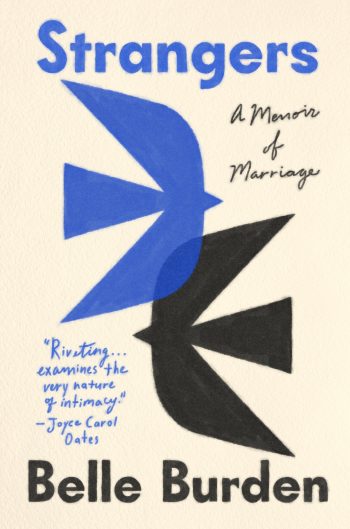
I read Strangers: A Memoir of Marriage, Belle Burden’s memoir in a single day. The book grew out of an essay she had written for The New York Times’ Modern Love column about her twenty-year marriage and her husband’s sudden decision to leave in 2020. When I finished the book, I admired Belle Burden immensely, both for her clear and eloquent writing style and her vulnerable and compassionate storytelling. Strangers chronicles the end of Belle’s marriage, and in sharing it with the world, she created a new beginning for herself.
In mid-January I was very lucky to sit down with her in a cafe in the West Village a week after the book’s release and its instant rise to number one on The New York Times best-seller list. Both Belle and her work are a model of the word grace: being effortlessly lovely and kind while standing confidently in truth, even when others might wish for her to stay silent about bad behavior. In the week after the book was published, she received messages every hour from people who had experienced something similar and felt less alone from reading her story.
The Rumpus: The book has been such an enormous success and especially this week; I’m so happy for you. I was also thinking about how that means you’re spending a lot of time answering questions about a very painful time in your life. How has that experience been, going back there and talking about everything in this new way this past week?
Belle Burden: It doesn’t bring up pain, but it’s easy to get mired in the story—where my ex is now or where the person he had an affair with is or the details of the story. The challenge has been to articulate the themes that I had hoped to get across and to come up from the particular. It’s not painful but it still feels, I don’t know if embarrassing is the right word, but there still is that little bit of shame; here I am talking again about my husband leaving me—a story that will be attached to me forever. But hopefully now other things are attached to me too—that feeling of vulnerability has been getting easier, I think.
Rumpus: I love this quote: “We had all been taught to fill in the hole that men left, to be quiet about men behaving badly, to move on with grace.” By writing a book as brave and honest as strangers, by refusing to be quiet, you took ownership of the narrative, breaking what is expected of women in response to men’s bad behavior. You also talked about listening to Folklore by Taylor Swift in those early days. One of my favorite lines in that album is: “I didn’t have it in myself to go with grace.” How do you think about the word grace now? If, as women, we stop aspiring to grace and quietness when things fall apart, what do you think we can aspire to instead?
Burden: Growing up and watching my mother and grandmother’s example, grace was very important to them. They’re both very graceful women and part of that was never speaking about things like infidelity or about men’s betrayal. I have really wrestled with how to do this, to speak about this, to write about this, and still feel like a graceful person. And I think I have redefined that for myself because I think it is possible, I hope, to speak about these things, to identify them. As women it’s very easy to tip over too much into being perceived as too angry or too upset. My goal was to write in a measured way that was compassionate about my ex as much as I could be, that was factual, and that felt graceful—I told the story in a way that my kids would be able to read one day and be proud of. I think Taylor Swift is someone who has normalized being able to talk about these things and get power from that—and not be criticized or shamed for it.
The Rumpus: One part of the story I found really moving was when you wrote about sitting at your kitchen table feeling the presence of people close to you who had died—your grandmother, your dad and your friend, Lynn. So much has changed since those days at your kitchen table. Have you felt any of their presences since then?
Burden: Yes, my grandmother still is very present for me. Maybe I just choose to believe but that she’s really cheering me on. My father may be a little bit less so, but definitely very conscious of him. Actually on my book’s publication day my stepmother and I went up to the cemetery and brought a book. He loved books and would be excited. And then Lynn, whose real name is Lara—we were very different, she was very outgoing. She would just be just fiercely cheering me on and so I feel that too. I feel all of them. It was really a real thing. Someone asked me if that was a literary device and it really wasn’t, I felt their presence.
Rumpus: In the year after your separation, you wrote about walking: “I felt like I was literally walking through my sadness, the muck of it, day after day. I got to know it. I screamed in the woods. I cried openly on the deserted sidewalks of Vineyard Haven. I laid down on the cold sand of the beach mid-walk in anguish.” Later you began writing the story of your separation and divorce. Both of these coping mechanisms, if you can call them that—walking and writing—seemed to be going right towards the pain rather than trying to distract yourself or move away from it. Was this a conscious choice? Were you ever tempted to distract yourself rather than face things so head on?
Burden: They are similar because it’s this very kind of plotting, regular, routine, revisiting of something. Thinking about my father’s death, it was all distraction: I was in law school and then working for a law firm so it was very much I cannot deal with this. With this, in part because of the pandemic, there was just so much quiet and so much time. Both things felt meditative: the feeling of your foot hitting the pavement again and again and again to just be with that pain and that anguish. Same with the writing, although less anguished, [it was] equally meditative. As a writer I think we write to figure things out and this felt like a way to really stare at it head on. Write down what happened and then get interested again in the art of it and how it works. I’m really glad that I faced it head on because I think sometimes we don’t and it stays in you.
Rumpus: You wrote about how when your husband asked you not to tell the truth about why the marriage was ending you said you couldn’t do that because it felt as though you were bleeding and you had to be able to say “This is why I’m bleeding.”
Burden: Now, I’ve thought about all the reasons why I think it is good to tell the truth and change patterns. But in that moment, if you knew me, you would have expected me to be very private and try to preserve my reputation and not to have a story that was about my husband having left me. But there was a full-bodied feeling of, “No, I’m just going to tell people.” If I did not tell them, I did not think I could survive it.
Rumpus: That’s really brave.
Burden: I hope it encourages more people to do that. It’s amazing that there are things you can feel shame over, even when it wasn’t your decision or your fault—you still feel that shame.
Rumpus: I was surprised when reading that you had been such a private person because being forthcoming seems so natural in the way that you write. Has it felt f like a transformation now that there’s this public version of your story and your life out in the world?
Burden: It does and I haven’t quite caught up to how it’s changing me and my personality. It’s only been nine days. I still feel like a shy person. I still feel, at a party or a big gathering, awkward, if it’s not in my comfort zone. I like one-on-one much better. I will always have my very close friends. I’m more that kind of person than one who has a lot of less close friends. So I think all of that is the same. But there’s something really interesting about having been shy for so long, never really speaking in class, never being comfortable making any kind of public speech, except a little bit in my law practice. It’s interesting to be forced—not forced, I’ve chosen it—into this public platform to talk about myself a lot, which is very unfamiliar. I’m hoping it leads to expansion and more friendships. I’m meeting a lot of new people. I think it’s going to expand my world, which is pretty amazing at fifty-six. I think it feels like expansion: an expansion of my world, an expansion of my connection to humanity, really. And I hope this expansion of my world is going to continue.
Rumpus: In one of the interviews you said about your ex-husband: “I also think the metaphor of playing a role feels accurate. The role of husband and father became unsustainable for him and when he left the stage he couldn’t take off the costume gracefully.” I was struck by this line and it reminded me of a moment in another interview in which you talked about making your husband a sandwich when he came to tell your children about the divorce and you said, “it was toasted bread, I put it on a nice plate, I was performing.” Writing this book feels like refusing to perform the role expected of you. Are there ways in which these different performances or refusals to perform are in conversation with each other in your mind?
Burden: I’ve thought a lot about roles in terms of him playing this role for a long time and believing in it and wanting it. And then, for me, having no real answers is the most accurate understanding of what happened for him when the switch went off and he just could not do it anymore. And it explains the five years after, too. He just could not go back to playing those roles. But for me, I definitely was struggling with my roles in that moment with the turkey sandwich. I think what I’ve struggled with the most is the mother role. What is a good mother in this aftermath and what is the right thing to do at any moment to be that good mother for your kids? Playing the role as a wife, I would say that role was super important to me. I’m a child of divorce. I wanted a family more than anything in the world. I wanted to be a mother, a wife, and to have an intact family, all of that. I still feel proud of that in some way, strangely, but I feel proud of having created that family, even though things clearly changed at some point without me being aware of it, I’m still proud of the wife that I was to him. The loss of that identity and role of his wife was really hard for me. All of a sudden I am a divorcee; I’m a divorced woman. I’m not in a couple, and in the world that I was in, I’m still in, that was really painful to not be that anymore. I’ve started to be able to see my new persona as just as valuable and even more comfortable in some ways. I saw myself as this sort of middle aged woman who was rejected by her husband, who was not part of this world of couples and couple dinner parties, and now I’m matriarch of my family. I’m going to have grandchildren and I’m excited for that. I’m going to have an empty nest in September and I get to decide where I’m going, if I travel—if I go somewhere to write for a while, and that feels really exciting and powerful to me.
Rumpus: It’s a really common thing after heartbreak to feel unable to look at a love story without that story being colored by its ending. You seem to make a really clear choice not to change how you remember or view the good memories before things broke apart. When did you make that choice and what did it feel like to write the beginning of your love story as you were experiencing its ending?
Burden: I can’t remember when I first decided that that would be a part of the book, but it was definitely a motivating factor in writing it. In the aftermath of him leaving, I really felt that both for myself and my kids, that our twenty years, two decades together, are going to be defined by this ending, him leaving. I think that happens to a lot of couples—they’re divorced, and she cheated, or he cheated, or they separated. But there was all this time before. And I really wanted for my kids not to think only of their parents’ marriage in that one way—of its ending. I really wanted to resurrect all of that, and have that still be true. I think both things can be true. You can have that sad ending and still have the love story, and still have the years as a family. And I think you can have, in my specific case, the financial story, which was not a great story for me, that was true from before we got married where he was very financially protective. I can also believe that he really loved me. So I think you can have both things be true. It was really, really important to me to do that. And I hope that for my kids, that they will see the purpose in that, and that they will be happy that I have all of those details. It was really not hard to write about the beginning of the story; it was not painful. It made me miss those times and miss that version of him,but I was glad to resurrect that.
Rumpus: I’m glad you wrote about the financial component, because I think it can so often feel like a taboo subject. But I think it’s so important to talk about women and financial independence. I was interested that there were these different junctures where you made financial decisions that benefited him, and he caused or at least allowed you to do that. In hindsight, what do you make of that?
Burden: I think a lot about it, and I get very happy when young women read the book who are about to get married or are not yet married. Hopefully that will be in their consciousness as they go into the marriage. In the first versions of the book, I really made him a little bit more of the villain. And over time I just kept taking things out and tried to look at my own role in it, which was not to blame myself, but to say, “Okay, I made that decision about the prenup. I agreed to his request to change the prenup.” And I wanted to stay with my kids and be at pick-up and all those things. But in doing that, I really prioritized his career, his dreams, his passions, to the point where it became that everything we did was in service to his career. For reasons of my own childhood, I really wanted to be home. Looking at all of those decisions that I made, [they] put me in the position to be, as we were divorcing, financially vulnerable. And once I started doing that, things shifted for me in terms of being able to look forward. The metaphor that my stepmother gave me of moving the spotlight from him to me was so good. The more I focused on his misdeeds, the more I was mired in it, the more I could kind of see how decisions you make can put you in these vulnerable positions. The more I was able to think I’m going to move forward with this and to really understand it. My decisions were from a place of love. So while I’m taking responsibility for the decisions, I’m also forgiving myself because I did it all out of love. I did have a lot of trust, and that’s nothing to be ashamed of.
Rumpus: I love the detail in the book that when you first got your house in Martha’s Vineyard with your husband, you put the sign in the driveway: Meadow Path. You talked about how this name for the house came to represent everything you two built together. Towards the end of the book, you physically burned that sign. And you mentioned in an interview that writing this book has felt a little like burning it all down, burning down the life that you had before your husband left. Often, we’re given narratives of a woman burning down a house that has haunted her. In your story, we’re given both a burning and a keeping, what you find and create in the ashes. Can you talk about the experience of writing something that was both destroying your old life and helping to create this new one?
Burden: The burning felt apt because I really felt like I was setting flame to not so much the particulars of life, but just the appearance of it and the rules that I was supposed to live by. Staying quiet about what happened to coming out of that lane to actually write about it—felt so dangerous, like I was just jumping off a cliff, but also setting fire to this idea of playing by the rules. And that felt so terrifying and exhilarating that I could just say I’m going for it. I’m going to do this. And the other metaphor I used of letting all the brush and leaves grow into our woods and everything—I think that sticks in my mind as sort of the landscape is still there where it’s some of the same spaces but I’ve let it be—less controlled, less dictated by outside ideas of what I should be, what our family should be. It’s a little more wild. It’s a little more messy, but it feels much more true to who I am.