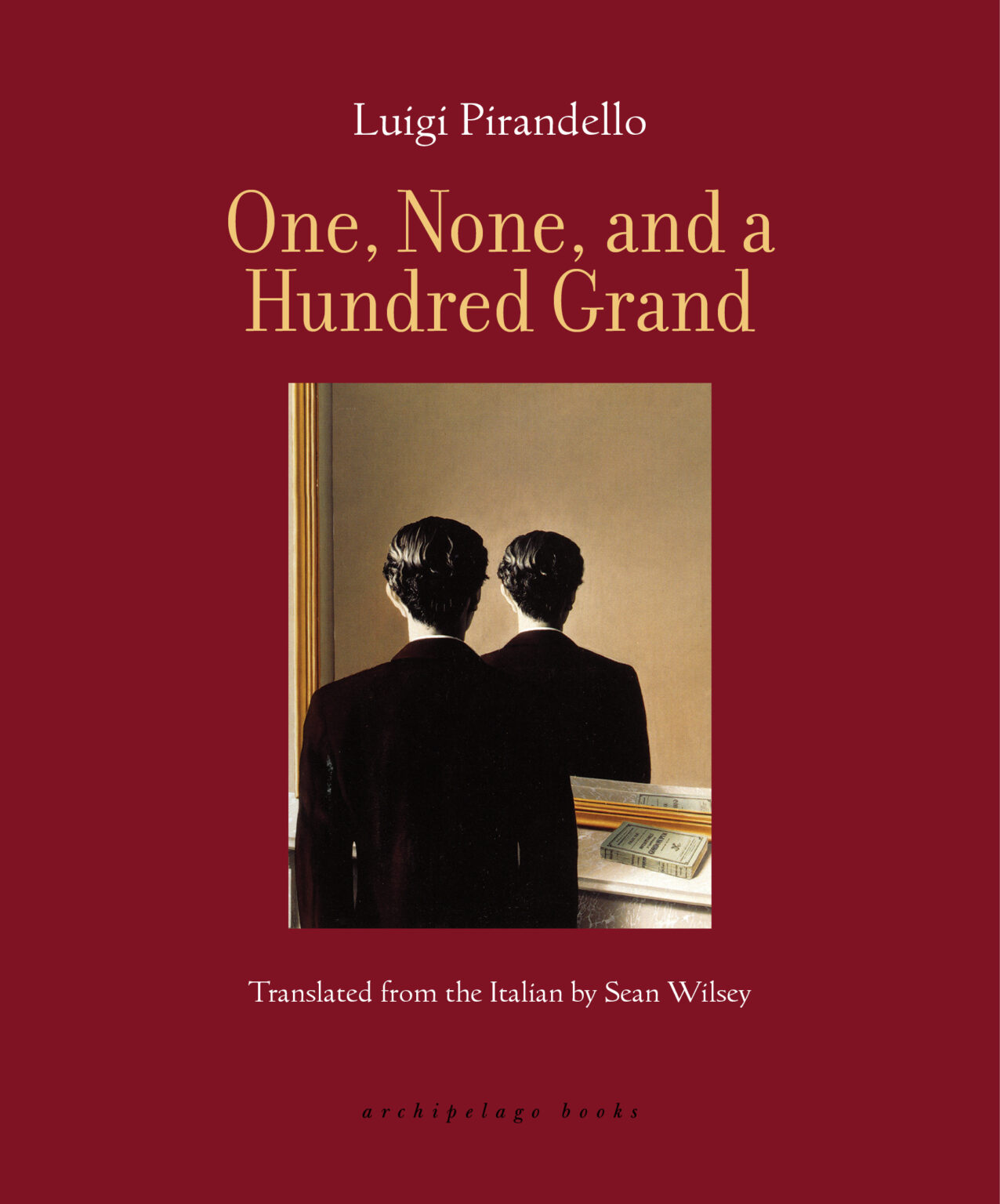
Right at the beginning of Sean Wilsey’s translation of Luigi Pirandello’s One, None, and a Hundred Grand, we’re introduced to what makes our main character Vitangelo Moscarda go mad. Absolutely bonkers. So bonkers, in fact, two hundred-something pages are needed to reckon with what he learns about himself on page one: His nose leans to the right. And now, because Vitangelo, poor Vitangelo, twenty eight years young, has never recognized this physical deformity before, his life as he knows it is fundamentally altered. How could people perceive him in a different way than he’s perceived himself in the last twenty eight years of his life?
“My evil begins here” is how Vitangelo—known to other characters in the book as “Maggot,” or to his wife, Dida, as “Gumdrop”—begins the final paragraph of One, None, and a Hundred Grand’s first chapter. What proceeds is a kind of evil, depending on your definition of evil. Unfortunately, Myers-Briggs personality tests weren’t yet invented in 1926, because Vitangelo might have avoided kicking his wife out of their house so he could make faces in the mirror to see what he really looks like. He also could have admitted his attraction to Anna Rosa, his wife’s friend, and not rejected the life his father had laid out for him. Through immense interiority, Vitangelo’s story nosedives (pun intended) into a journey of understanding himself through the eyes of others.
While the book is fiction, it reads more like a long-winded essay; Vitangelo’s thoughts—which often replace scene or action—return to his central question, “If I wasn’t the man I imagined myself to be in the eyes of others, then who was I?” He takes readers down philosophical, (or pseudo-philosophical) and often neurotic rabbit holes with humor: “I was incapable of consoling myself with philosophy” and self-awareness: “Now, with every word I say, you seem unwell, as if my madness were contagious, and you ask: ‘Come on? What’s this got to do with anything?’”. If there is a narrative thread, it’s pulled through Vitangelo’s mind. Perceptive observation concerning the masses who sleepwalk through life is his specialty, and maybe, so is Pirandello’s. It took him more than fifteen years to write the book— attentiveness takes time.
Yet there is also levity to Vitangelo’s neuroticism, and at certain points, he breaks the fourth wall. “Well, readers, they hadn’t killed me because I had not yet stepped away from myself in order to see myself,” he says, or “You’ve never known this horror, I’m sure,” he recounts after kissing his wife while admitting it wasn’t “him” kissing, but rather another version of himself. The second person can be confounding: Is Vitangelo writing for a purpose? To be on display as if he were writing for Instagram or X? For someone else to tell him how he’s coming off? We can’t bear witness to our own lives, but it’s as if Vitangelo is asking, “What if ourselves were all we needed? We could be everything at once!”
Although the translation is a joyful read of a mind at work, any book packed with as much chatter as One, None, and a Hundred Grand risks fascinating some, while boring to others. Could a book like this, in the time it was originally published, be a privilege afforded to men and men’s issues alone? If this were the story of a woman, who finds her first gray hair at the age of twenty-eight, and feels her sense of self unravel, would it have stood this same test of time? Translated three times in ninety nine years? Inarguably, the book’s premise certainly persisted. The question of self-perception is why Mark Zuckerberg created Facemash, then Facebook, and why, I’d argue, Instagram has steady popularity. Contemporary readers can relate to Vitangelo, as social media seems designed to focus on what others think of us, and in doing so, can drive us to madness.
Vitangelo’s frenzied journey concludes in the opposite spot from where it began. “I don’t look at myself in the mirror anymore,” he tells us in the book’s final chapter. Unable to find someone who can define him, Vitangelo can’t draw closer to understanding himself through the eyes of other people. He cannot resolve his theory, that he is hundreds, if not thousands of different people when seen through the eyes of others. While the book’s central question remains unresolved, it feels true that we may never know how we’re really perceived. Comforting, right?