
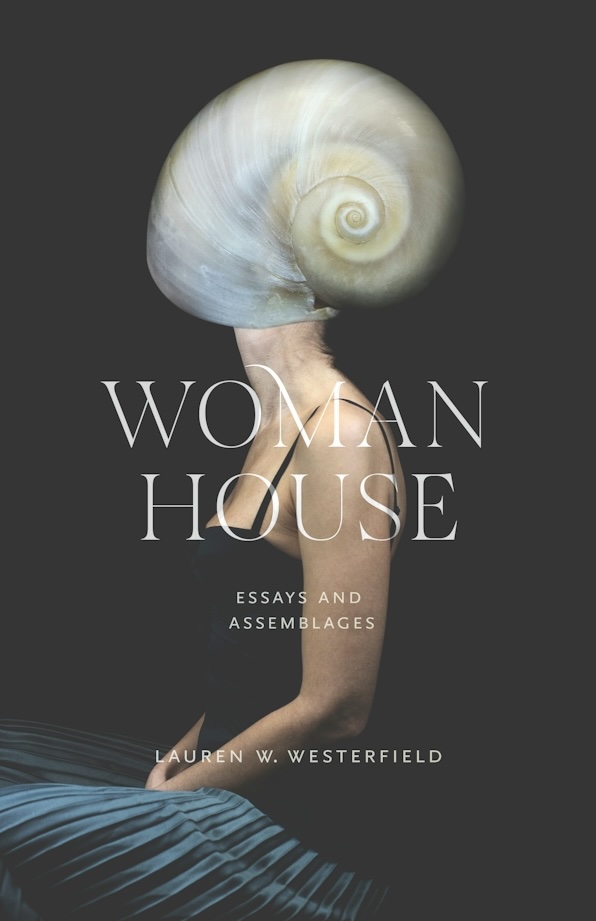
Louise Bourgeois, born in France on Christmas Day, 1911, moved to New York City in 1938, where she lived until her death at the age of ninety-eight. A celebrated visual artist who worked across media, Bourgeois often explored the female form, rendering her as trapped and free, expressive and constrained, monstrous and docile. “Bourgeois’s work is nothing if not a celebration and exploration of the contradictory,” writes Lauren W. Westerfield. “Something playful here, something grotesque there. Innocence and sexuality. Freedom and constraint. The rotund, organic female body and the geometric shapes of the manmade world.” (Westerfield 47) This attentiveness to contradiction, particularly within the female experience, is explored by Westerfield in her new book, Woman House: Essays and Assemblages.
Westerfield’s title pays homage to Bourgeois’s Femme Maison series—a set of ink drawings of female bodies melded with architectural elements. In the titular essay, Westerfield recounts a childhood spent watching classic romantic films with her mother, in a scene that immediately catapulted me into the filmic prose of Madeline McDonnell’s Lonesome Ballroom. Westerfield writes in intimate detail about her own “woman house”: her body, her sexual history, her youthful ignorance of how male desire can blind men to women’s humanity. Recalling her senior year in college, Westerfield writes, “I had not yet developed the conscious awareness that to be seen like this—from a distance, as a vessel for the desire of others, my body a predetermined narrative—was in and of itself a kind of flattening.” (Westerfield 46) She invites the reader to join her in developing a feminist consciousness: first the naive satisfaction in sexual attention before she can identify her own objectification, then the frustration at the inexorability of her status as sex object after she perceives it. “How to neutralize this open secret,” Westerfield ruminates. “How to de-fetishize my body, reclaim some sense of dimension beyond the token identity I’d taken on as the virgin to be claimed (or avoided). How to climb down from that pedestal—that cage—of others’ desire and simply move in the world, freely and without constraint.” (Westerfield 52) These descriptions of discomfort mirror my own frustrations with female embodiment, which I often ascribe to growing up in purity culture, the religious veneration of virginity as the locus of a woman’s worth. Westerfield writes briefly—though not dismissively—of her Lutheran confirmation at the age of seven and her mother’s devotion to the Bible-expounding podcasts of a particular (quietly Trump-aligned) pastor. The cultural ramifications of religious identity aren’t part of Westerfield’s project. Perhaps that’s why I was both startled and gratified by her clear articulation of the inconvenience of virginity, the burden of it: the way virginity becomes larger than itself, something that marks the women who bear it as a kind of prey.
But Westerfield doesn’t neglect the contradictions, the double-binds. What predates her experience of virginity is her mother’s experience. “She has been raped twice—the first time by the man with the knife, and the second time by the man who was her boyfriend, the time she wasn’t sure if she could call a rape until much later.” (Westerfield 17) In an essay titled, “On Becoming”, Westerfield uses a clinical, detached tone to trace which factors of her parents’ lives reappear in her own. Women’s agency around sex is a major theme of the book, accruing complexity and nuance with each recurrence.
Westerfield opens the second essay with the story of her conception: “There was sunshine and a bottle of Andre’s Brut,” she reports. (Westerfield 16) Short essays contain highly sensory descriptions of scenes or snapshots, several from Westerfield’s early childhood. She documents her mother’s frequent drinking along with her own. She writes about her mother’s medical crises, her parents’s subsequent divorce, and the rampant emotions flowing through their house at that time. Westerfield recalls their “cycles—my father’s distance, my mother’s alcohol abuse, the infinity loop of resentments that each behavior engendered in the other.” (Westerfield 103) Even while handling these topics, Westerfield’s prose is clean and propulsive, progressing like a particularly compelling diary or notes from a highly effective therapy session.
I understand, as a critic, that to refer to a text as diaristic or therapeutic is akin to dismissing artistic, literary, or cultural value. Patriarchy dictates that anything associated with femininity—the diaristic, therapeutic, and confessional—is lesser, limited by constraints that don’t apply to “universal” texts, written by men who lavish their free-range considerations on matters of intellect, politics, and globalism. Westerfield herself recalls the implicitly misogynistic injunctions she faced while writing her graduate thesis: to steer away from personal writing in favor of ““the universal” (that is, patriarchal, objective, sanctioned by structures and systems of power)”. (Westerfield 66) On the contrary, Westerfield’s prose maintains a subtle but consistent quality of self-assertion, consciously inhabiting itself, taking ownership of its many possible interpretations and permutations. The particularity she invokes is wielded to ground her point in experience, to substantiate her argument with lived evidence. When she asks about the meaning of power, her question emerges in the political instability of the early pandemic (“This morning, Bernie Sanders ended his 2020 presidential campaign”) while eating “a fancy takeout burger.” (Westerfield 141) Her essays are often self-implicating, which I consider essential in compelling personal nonfiction: she admits where in the past she’s been wrong and invites the reader to access the dual perspectives of then and now. In one scene, Westerfield writes, “I was twenty-three . . . I was tan and taut and self-righteous. I was, in short, a total pain in the ass.” (Westerfield 111) When I read personal narratives, I always want to know: Can the author see through their own bullshit, or are they high on their own supply? To my relief and satisfaction, Westerfield is willing to call out her younger self, quick to assert when her previous understanding was insufficient, and open to her current understanding not necessarily being entirely comprehensive.
Westerfield does this most explicitly and most effectively in “Sequence of Events,” an essay near the center of the book, recounting the events that led to her mother’s near-death medical crisis in 2010 and her parents’s divorce. Westerfield narrates the events themselves as well as her contemporary experience of writing them. “This being 2021, eleven years after . . . I am trying to decide how to tell it; seeking a way in.” (Westerfield 91) In the present timeline of the essay, Westerfield’s mother comes over and the two women reconstruct the story of that traumatic time together. Westerfield recounts her mother’s precipitous decline and ambulance ride to the hospital, and adds, “As we talk, I can see, hear, even smell that Thanksgiving night they took Mom away.” She writes about what she remembers, and also what she has forgotten. Together, the two women toggle back and forth in time, adding layers of emotion and relationship like paint.
As someone who writes personal narrative nonfiction, I have become increasingly interested in this kind of braided essay: not the one that pairs broad cultural history with personal history (the “Steven Hot Dog” essay, for those who subscribe), but essays that consider the experience and the writing of the experience equally worthy of inquiry. In one of her and her mother’s sessions, a minor disagreement leads Westerfield to realize that shrapnel from their erstwhile arguments “lodged in my body in a manner I can’t describe. When I say “can’t,” partially I mean “I’ve forgotten, on purpose.” . . . As a writer, I am disappointed in myself for having blocked the physicality of my hurt so completely that I cannot render it here, now. As a daughter, I think I am relieved.” (Westerfield 98) This attentiveness to her own multiplicity gives the collection its impasto texture.
In Woman House, Westerfield confronts the major questions of life—family, biology, and commitment; virginity, rape, and consent; embodiment, its joys and risks; the contemplation of art, literature, spirituality, philosophy—through a deeply personal, quotidian lens. The significance of her material is balanced by the mundanity of her activities: sitting in waiting rooms, drinking beer in her living room with her mom, cleaning melted candle wax from her cupboards. The collection is a literary parallel to Louise Bourgeois’s Femme Maison ink drawings: The material, of great significance and conveyed with nuance, is rendered in simple lines devoid of fanfare.
If the first half of the book feels like flipping at random through a rich and revelatory emotional scrapbook—more accumulationist than linear—Westerfield narrows her scope for the final third. Starting with “Distance Instructions,” she moors herself in the lockdown of 2020. The final four essays are rooted explicitly between May 2020 and June 2022: two years of isolation, restriction, boundaries, and transformation. Westerfield refers to this period of constraint as “a kind of chrysalis,” and it is from this generative container that the collection ultimately emerges. In the Acknowledgements, Westerfield names what has already been palpable in the subtext: “this book—even though it is not my first—has always been the thing I most needed to write . . . My first attempts at essay and memoir swirled around my mother’s stories and the intersections of our lives, and . . . something about the solitude and silence of the pandemic, years later, forced them back to the surface.” (Westerfield 211) In this way, the book contains both process and outcome, the act of consideration and the conclusions. Like Bourgeois’s drawings, it is a finished project that exudes the intimacy, curiosity, and experimentation of a draft. For these reasons, I suspect that Woman House will find its audience primarily among other women writers: those who recognize and identify with the process captured on Westerfield’s pages. After having spent time with Woman House, I’m eager to return to my own pages and the stories I’ve received from my mother; to plunge into the gaps between oral history and embodied knowledge and to see what I find there.
Click here to subscribe today and leave your comment, or log in if you’re already a paid subscriber.