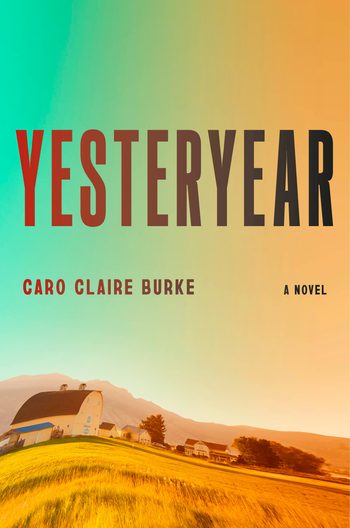
Caro Claire Burke’s debut novel Yesteryear is an acidly funny, satirical take on the rise of tradwife culture, social media influencers, and the pressure on women to perform the perfect life.
At the center of the story is Natalie Heller Mills, an influencer who appears to have it all: beauty, homemaking skills, a devoted family, and a picture-perfect, all-American life at her family’s Yesteryear Ranch. Natalie, her hapless husband Caleb—born into a conservative political dynasty—and their six children embody a hyper-idealized version of the modern Christian family, their carefully curated lives and images optimized, monetized, and streamed to thousands of social media followers. But that flawless image begins to falter as Natalie’s reality breaks down, transporting her to a world that looks a lot like the 1800s. Natalie wonders: is this an elaborate conspiracy, a reality show, or something darker?
Through Natalie’s story, Burke bitingly exposes the impossible standards placed on women, exploring the tradwife influencer phenomenon, the backlash to feminism, the manosphere, right-wing politics, religious fundamentalism, and what the grand performance of womanhood costs us all.
Yesteryear has generated an enthusiastic pre-publication response, sparking a bidding war between fifteen US publishers and selling at auction around the world. Film rights have already been sold to Amazon MGM Studios, with Anne Hathaway slated to star. A former news and culture editor for Katie Couric Media, Burke currently co-hosts the politics and culture podcast Diabolical Lies with Katie Gatti Tassin and can be found on Instagram at @caroclaireburke and TikTok at @caroclaireburkeee. She holds an MFA from the Bennington Writing Seminars.I recently had the chance to speak with Burke by phone about what inspired Yesteryear, her research process, the sociopolitical underpinnings of the tradwife trend, and her writing practice.
The Rumpus: How did this book come to be?
Caro Claire Burke: So around two years ago, in the winter of 2024, I feel like the tradwife discourse was at its peak, and I was very immersed in it. I was talking about it on TikTok, and I was doing research about it for where I was working at the time. It was just something I spent a lot of time thinking about. There’s so much about that conversation that sits at the intersection of things I’m just generally passionate about, like feminism and capitalism and what it means to be a mother and a working woman. Then, because I was thinking about it so much and talking about it so much, it just became something my subconscious was chewing on. So, one morning, I woke up with the elevator pitch idea of a tradwife who wakes up in the 1800s. I emailed my agent and I was like, “I have this weird idea, and it’s different from what I was thinking about, but what do you think?” And she was like, “That’s awesome, go for it.” And so, I was kind of off to the races.
Rumpus: What was your research process like? Did you end up down any interesting internet rabbit holes along the way?
Burke: I think the main focus for me was trying to understand the perspective and interiority of women who live in fundamentalist Christian communities. I did not grow up in one, I grew up Catholic, but I would say I had a secular childhood. So, that was the focus for me, because I realized very quickly that whether it’s Mormonism or evangelicalism or Jehovah’s Witness, it’s really all the same in terms of how women are treated and what the expectations are for them. There are, of course, minor differences, but the more you learn about it, and the more you interview women, and listen to podcasts—I was even lurking on Reddit threads of women who had left these communities—and you hear the same story again and again about what the expectations are. And that really captured my fascination. And again, I am secular, but I also related to that pretty heavily, and so that was the bulk of my focus. Then the external research was, obviously, 1800s homesteading and trying to pay attention to what I wanted to pull from that and what I didn’t and then, just trying to think more about how these fundamentalist communities engage with the secular world, and how that tension could really shine in the book.
I was also already following a bunch of not just tradwives but fashion influencers and beauty influencers. This book is about a certain kind of influencer, but I feel like a lot of the parasocial element of it, a lot of the non-reality, really applies to everything. I became kind of obsessed with the surreality of it all, of how women show up online and how optimized we all are.
Rumpus: What is your perspective on the tradwife phenomenon? Where do you think it comes from?
Burke: I think a lot of people think that this type of vision of womanhood is popular because women simply like that and that’s what they want. But I don’t think that’s true. I think a really, really interesting comparison is the propaganda campaigns of the 1950s housewife. That is such an archetypal image in American history. But what I don’t think most people know is that, number one, that was just television campaigns and advertisements. It wasn’t actually how women operated. Number two, that advertising campaign essentially kicked off after World War II ended, and all these women had entered the workforce in World War II. The men came back, and most of the women didn’t want to leave their jobs and were essentially forced back into the home. So as you have this boom of consumerism and this growth in the economy, you also have a bunch of women essentially shuttled back into homes when they had recently found autonomy and work, and you start seeing this flood of these visuals of these happy women at home who are wearing heels and who have such an important job. And again, that happened after women had been pushed out of the workforce. So there’s this tug and pull where I don’t think any of this is actively intentional, like a bunch of men in suits thinking, “How are we going to screw women?” But I think it is a subconscious implication of, “Well, we need women to feel like they have a lot of power and to kind of make them consumers.”
And I think there are a lot of parallels now with tradwives: 2025 marked one of the steepest drops in the workforce for women in modern history. I think it was four or five hundred thousand women who dropped out of the workforce, and it wasn’t because they wanted to. It’s because they had caregiving responsibilities and the economy is so hard on us right now. So I think you have these visuals surfacing in the same exact way they surfaced in the 1950s where all of a sudden women are being squeezed, or really rather, the American people are being squeezed. And when something has to give, it’s women who give it. So, I think it’s not accidental we’re seeing these visuals that essentially function to operate as a sedative or to comfort us, or to be like, “It’s not so bad if you can’t work.” It’s just this kind of a rudderless propaganda campaign that surfaces every time the economy essentially forces women to make a change with their jobs.
Rumpus: That struggle between societal pressures and personal autonomy really shows up in Natalie. She is such an unforgettable character, so acid and so real. How did you develop her voice and perspective?
Burke: I knew the pitch I wanted for the book, I knew the twist I wanted at the ending, but I really didn’t know who Natalie was going to be. I think I imagined her to be a little bit more pliable. I thought she would be more plucky and just more of a traditional victim. I imagined her to be someone who was acted upon by the world. So I started writing the novel, and the first pages I wrote eventually became the pages that are part one, which is this single day in the life that showcases all of her interactions and shows this pivotal point in her life. As I was writing it—and again, I feel like fiction is kind of a subconscious experience. You’re moving this character around and putting them in different situations and seeing what would happen—so, I kept pushing her into new conversations, and she just essentially kept being awful. And it was a real problem! I emailed my agent just saying, I really like these pages, but number one, I know the book has to move quickly, and this is this long chapter. And number two, this is just a totally different Natalie. She is truly an antihero, if not a villain.
Then, once I accepted that that was the Natalie I was going to be working with, it radically changed the book, because she has a lot of agency, even though, I think, you could also argue that she has no agency. So, it just changed how I had to write the men in the book, how I had to write her interactions with them, because she just had so much more force of will and acid to her than I was planning for. And again, it wasn’t intentional. It was just, no matter how hard I tried to write another woman, this was the person who showed up for me.
Rumpus: How did you decide on the book’s narrative structure—for example, introducing Natalie and Yesteryear Ranch with a long “day in the life” sequence?
Burke: I had never written a book like Yesteryear before, and I knew that what I wanted to be the bulk of the book had to be short chapters, and it had to be very propulsive. Because I knew that I was going to have these two threads of modern day and of Natalie in the 1800s. When I wrote part one, I was like, “Well, this screws everything up because it’s really long and it just doesn’t fit the pacing of the rest of the book.” Then I eventually figured out the structure we have now, which is three parts. It’s essentially the bulk of the story in part two, which is those interweaving narratives, but part one and part three are essentially each one day. So that felt very satisfying to me. It felt like there was a nice moment to have a little bit of a literary muscle stretch of engaging with that type of plot structure within a book that is more commercially driven.
So, I liked the idea of having two days in life, essentially, each of which is a moment of epiphany or a turning point. Those serve as book ends for the rest of the novel, for the mystery in between, and then figuring out that the three parts would be the past, present and future of Natalie’s life. It was just a really satisfying way to keep a structure around a book that, at times when I was writing it, felt very unwieldy, like I was walking in the dark. So having that structure of these two days and then knowing if I could get through the first day, then it’s really going to move quickly. I had also never written chapters that short. Most of the chapters are probably fifteen hundred words or less. So, it was definitely a challenge to tell the story in the way I wanted to, while also holding on to what I hope was a thriller mentality of moving quickly and keeping the action moving forward.
Rumpus: What genre would you say Yesteryear is? Is it a hybrid?
Burke: It’s hard. When I was writing it, I genuinely had no idea how they were going to market it. And my agent was great. She was like, “Yeah, that’s kind of out of your control, so don’t worry about it. You don’t always know how a publisher is going to market something.” But I think the way that I describe Yesteryear is a psychological thriller with social commentary along the lines of an American Psycho or The Stepford Wives or The Handmaid’s Tale, something like that. And again, I don’t pretend to be in the ranks of those books, because those are very classic novels. But I think there is a certain genre of social commentary that blends into horror, and I think Yesteryear fits nicely within that genre.
Rumpus: Who are some writers, or what other works, whether that’s political satire, speculative fiction, thrillers, or another genre, inspired this book?
Burke: I definitely spent a lot of time looking at how Gone Girl functions, because it has such short chapters, and it’s so plot-driven. It just moves like a freight train. I reread it for the first time in a decade, and I was blown away at the speed with which you move. Because it’s also a very long book. I think it’s around a hundred and forty thousand words, but it feels like it’s sixty thousand. It’s a really, really dense book that moves so quickly. I was also looking at All the Light We Cannot See, another really dense book that I think moves very quickly. Then, Leave the World Behind was another comp we used very early on, just as a modern critique of capitalism and suspense. I thought that book was so prescient, but also one that will hold up fifty years from now, which is such a hard needle to thread.
Rumpus: Can you tell us a bit about your writing background?
Burke: I started writing pretty intensively right after college. I did some writing classes through high school and college, but I certainly didn’t think of myself as a fiction writer. And then, for whatever reason, I really became interested in fiction writing after graduation, and I was pretty intensive from then onward. I wrote a manuscript that was kind of a coming-of-age story. Then I went to grad school, to the Bennington Writing Seminars, where I was writing short stories. And I wrote a kind of college manuscript about sexual assault. I don’t know if each of these stories were super quiet—things still happened in them—but they were definitely of the variety of an MFA program and less of a thriller. I had never written humor before. So when I started writing Yesteryear, I had already written novels from start to finish that were at least pulled together enough. I had had an agent before. I had gone on submission before, and I think that gave me a certain kind of confidence. It was like, “I’ve done this before.” I know the feeling of anxiety that comes with writing. A lot of the experience of writing a novel was not unfamiliar to me. And I think, at least for me, so much of writing is just figuring out mental tricks to stick with it, because so much of it is so unpleasant. I had spent a decade figuring out little tricks to not quit, which is essentially, I feel like, the answer to being a writer. So that was my experience up until Yesteryear.
Rumpus: Can you share a few of those tricks you developed over the years?
Burke: Sure, so the first basic one is just setting a schedule and not caring if it feels good or not. So, best-case scenario, when I’m working on a manuscript, if I can write for two hours, that’s like, “Wow, what a day.” And it’s always early in the morning before I’ve gotten distracted by other stuff and just tracking word count. It’s something I learned with Yesteryear that was very helpful that I will definitely take with me.
I was being very unprecious and unfussy about sentences. Each morning, I was trying to write, and I had a very high word count demand. So I would try to write as much of a scene as I could. Some of it would be totally blocked out. I would write half a sentence here, half a sentence there, and then move on. If I couldn’t keep going on that scene, I’d go to the next scene. So I think I was unintentionally doing a lot of blocking and tackling of the plot. And again, I had never written for plot before. I feel like I had written for movement and feeling and beats and sentences, just feeling where things went, and that’s great. I think a lot of people love writing that way. But I think for a novel like Yesteryear, and also just for the speed I was trying to move through, and not letting myself get psyched out by the ambition I had for the novel, I really would be almost writing stream of consciousness. As soon as I got stopped, I would just skip forward to the next part of the plot. So you’re slowly filling things out that way. It’s just the trick of not being precious and trusting that eventually the scene is going to come together. And I had never written like that before.
Rumpus: What’s next for you?
Burke: I’m working on a second novel right now, which is exciting. It took me a while to figure out a concept that would work as a sophomore followup to Yesteryear. So, I’m working on that right now, and fingers crossed that goes in the direction that I want. I’ll also be on tour for eight weeks all over the country, which is super exciting. I’ve released the first set of dates on my Instagram, and I’ll keep releasing them there. But I’m really pumped to have those conversations with people.