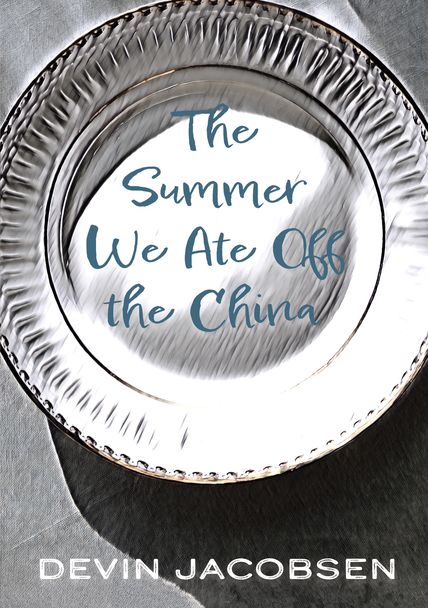
There’s a moment in Devin Jacobson’s story collection, The Summer We Ate Off the China, when violence arrives not as rupture but as continuation. A gun is fired. A man flees. A family stands stunned beneath a roof that has long been making ominous noise. Yet the prose doesn’t elevate this instant into spectacle. Nothing in the text asks us to cordon that moment off, monumentalize it, or explain it away. Instead, this small chaos joins what has been there all along: sexual confusion, economic precarity, familial cruelty, desire misdirected and unmet. Here then, is just another fact of life, absorbed into Jacobson’s domestic atmosphere like heat or smell.
This refusal to treat trauma as singular or sacred, to set it apart from the texture of ordinary life, is among the collection’s quietly bracing achievements. Jacobson’s stories don’t deny suffering. But they do deny it the dignity of exception or theatricality. Pain, here, is neither moral credential nor explanatory master key. It’s just part of the price of living among others from whom we are always alienated.
That’s a narrative choice, but it’s also an ethical posture—one that gives the book its peculiar steadiness. Again and again, The Summer We Ate Off the China returns to families trying, often clumsily, to maintain forms, structures, systems–in a word, order. Eating dinner together, going to church, studying for quiz bowls, using “proper” dishes on special occasions: these are the guardrails that Jacobson is interested in. These rituals rarely succeed at what they promise. They don’t prevent desire from spilling over, nor cruelty from erupting. And Jacobson doesn’t treat them as laughable relics or oppressive norms—millstones from which his characters should free themselves. Instead, they emerge fragile, necessary containers—sentient attempts at holding something together though the contents threaten to leak.
Nowhere is this strategy—and its politics—clearer than in “Possum on the Roof,” a story narrated by a child whose attentiveness to adult life far outstrips her ability to understand it. The family home here is alive and humming with disturbances: the animal scratching overhead, a sister’s sexuality half-glimpsed and half-fantasized, a father’s menacing masculinity, a boyfriend whose confusion seems as dangerous as any malice. The story’s power lies not in revelation but in accumulation. Each scene is modest; together, they create a density of unease making the eventual violence feel less climactic and more like weather.
What’s striking is how much the family insists on maintaining the ordinary forms even as these fail them. They sit at the table. They talk about school. They worry about manners and chores and plates. The china of the title—brought out, implicitly, on special occasions—names not aspiration but conditional permission: the agreement to behave as if things can be held carefully, as if breakage can be postponed. Jacobson doesn’t sneer at this effort. He allows its dignity to coexist with its futility. Sometimes his stories treat the two—futility and dignity— as tautological.
This commitment to form—formality, manners, etiquette, the rules—extends beyond domestic ritual to narrative voice itself. Many of the book’s stories are told by children or by adults whose idiom remains close to childhood: not in sentimentality, but in grammar, rhythm, and ethical reach. In this sense, Jacobson is an exacting ventriloquist. The narrators know more than they should, less than they need to, and exactly enough to keep going. Jacobson’s prose never corrects them, and is neither outside nor beyond them. There’s no superior narrative intelligence hovering above the story to translate or contextualize. We are asked to listen inside constraint rather than escape it.
“Secret Anna,” one of the collection’s most jarring and darkly comic stories, stages this dynamic through an imaginary friend who becomes a problem of adult governance. A mother, initially indulgent, gradually grows alarmed as Secret Anna’s influence crosses boundaries—teaching profanity, committing petty cruelties, pulling out chairs just as the mother is about to sit in them. Is Secret Anna a manifestation of trauma? Loneliness? Childhood fantasy? The answer is unimportant. What matters is the mother’s desire to restore order by naming what is real and what is not, a desire that proves both understandable and destructive.
When Secret Anna is abruptly declared dead—hit by a bus, dispatched with gleeful finality—the relief is not innocent. The story understands something often avoided in contemporary fiction: maturation requires both healing and elimination, not just expression but suppression. Some figures, fantasies, or permissions must be buried—not because they are extraordinary threats, but because they interfere with the maintenance of life among others.
This is where the collection’s political daring resides. In a literary culture that often treats manners, restraint, and social forms as obstacles to authenticity,Jacobson advances a more ambivalent, arguably conservative-adjacent wager. The problem in these stories is not that the rules exist, but that they are insufficient, unevenly enforced, and impossible to live up to. And yet, without them one is left exposed. Importantly, Jacobson does not sentimentalize this position. The structures his characters rely on—marriage, gender roles, religious authority, class aspiration—frequently produce harm. Fathers are cruel. Churches judge. Weddings promise futures that never arrive. But the alternative is not liberation; it is chaos. The stories refuse the fantasy that emancipation alone saves lives.
This refusal is perhaps most evident in the book’s treatment of class. Jacobson’s characters want better dishes, better homes, better futures—not in ironic quotation marks, but sincerely. The desire for refinement, education, and propriety is neither mocked nor celebrated. It is shown as one of the ways people try to civilize their circumstances, though the effort exposes them to disappointment. Eating off china does not redeem anyone, it marks behaving as if redemption were still imaginable.
Some readers may wish for greater stylistic range or formal experimentation. The collection is tight, even narrow, returning repeatedly to familiar family structures, tones, and moral impasses.Yet the repetition feels purposeful. Jacobson is less interested in novelty than in pressure—in what happens when lives are enclosed within the same failing structures again and again.
By the end of The Summer We Ate Off the China, one understands these stories don’t offer diagnosis nor cure. They offer a way of staying with discomfort without converting it to identity or spectacle. Trauma is not the story’s endpoint; it is the ground on which maturity must be built.
Jacobson’s wager, finally, is that containment—narrative, social, moral—is not the enemy of life but its difficult condition. His stories ask what it might mean to honor limits not because they are just, but because without them nothing holds. Reading the collection is like eating carefully from delicate dishes, aware that something may break if attention slips—but equally aware that the imperfect meal being consumed , is the only sustenance one has been offered.