
An undeniable pivot point in U.S. History was the sequence of events needed in order to encourage “Americans” to side with the growing movement to separate from British rule. The most successful tactics often included persuasive writing and oration aimed at the average person, appealing to reason and/or capitalizing on fear. Thomas Paine, considered to be a particularly potent writer of his time, penned a pamphlet called Common Sense, to appeal to the average person, and lay the groundwork for what secession from Britain would mean.
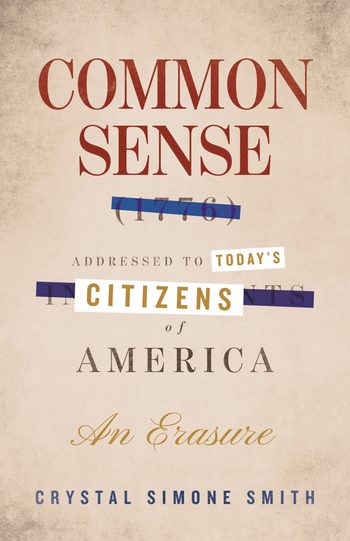
In her new book, Common Sense (1776), Addressed to Today’s Citizens of America, An Erasure, Crystal Simone Smith’s use of redaction highlights the inherently flawed logic Thomas Paine used to guide our country toward a necessary, but just as inherently flawed, document. It serves as a luminous reminder to the reader how timely this work is, both in its context and in the fact that this year marks the 250th anniversary of the pamphlet’s existence and of the Declaration of Independence.
As with Paine in 1776, we find ourselves at a pivotal point, with some pushing away from the current administration, and some, inexplicably, pushing toward it. There are always tactics. When every stance seems polarizing at best and fear-driven at worst, what direction do we follow? We find ourselves, again, in need of a writer, a poet, to appeal to the sensibilities of our country, to reexamine, to course correct—to ensure that “all men people are created equal” and possess unalienable rights to “Life, Liberty and the pursuit of Happiness.”
I recently sat down with Crystal Simone Smith via Zoom to discuss her new book, monarchical ideology, the balance of seeking and silencing, and the craft of revealing through erasure.
The Rumpus: You’ve been familiar with this pamphlet for some time, noting in the foreword that you first encountered it while teaching an American Lit course. So this text has lingered with you for a while. When did the idea and the compulsion to erase/redact it solidify into “now is the time?”
Crystal Simone Smith: As evident with Dark Testament (Henry Holt and Co. [BYR], 2023), I’m drawn to the redaction process and visual poetry to underscore marginalization. The idea to redact Common Sense arose when I was invited to spend a weeklong writing residency in the Great Smoky Mountains. It’s a goal to commence a new project when I’m afforded the benefit of time and the South’s steadfast scenes of natural beauty against, oftentimes, morbid political landscapes offered ideal inspiration for this project. The art center and artists were a literal haven nestled in majestic country views where tourists frequented local moonshine shops and a Trump Store replete with racist merchandise. It was not yet clear, nor improbable, that he was running for a second term, and what that meant for democracy spearheaded my thinking. I finished the first section that week.
Rumpus: Incredible. Did that backdrop create a kind of momentum for you? Did it underscore not only the necessity of the work, but the immediacy it required?
Smith: It was motivating in the strangest way. There were tourists sporting Trump
shirts. It’s a tourist area. Instead of rivers and waterfalls, there’s a commerce strip that
resembles a kind of mall in the mountains. As artists, we looked different, out of place, and
we clashed with the tourists. At times, it felt like them versus us. So, I think that gave me
a lot of momentum in the sense I was immersed in Trump-land and writing with a
purpose that opposed those views. I don’t know if I would have moved as fast with the
project had I not commenced it there.
Rumpus: A lot of powerful work, in my opinion, happens in titles. I’m especially interested in how we enter manuscripts through first lines, first poems, or their titles. In this case the first thing we encounter is “Introduction” erased into “Induction,” which seems fitting. Can you expound on how this sets up the overall work itself, or maybe the dialogue you are hoping to spark?
Smith: Though I like to work with archival materials, I’m not a historian by any means. Notwithstanding, much of the historical documents I engage with often have a performative quality with hidden or overt agendas. I would not dismiss all of these documents as propaganda, but Paine’s Common Sense is far more than an “Introduction” to revolutionary ideals. It was a sort of onboarding. Paine was a virtuoso with words, and the premise was to form the solidarity necessary for a clear separation of the inhabitants from Britain’s monarchical rule. It was a call to action, an “induction” into what we consider today the “American way of life” with its many freedoms and fallacies. I wanted readers to enter the text understanding the full breadth of that agenda; a call for mass support that was, in truth, preferential and mostly beneficial to an elite section of those inhabitants.
Rumpus: Muriel Leung, in her essay Erasure in Three Acts, described erasure as “a subversion of the belief that it is poetry’s job to reveal.” Do you think that rings true, particularly relating to this project?
Smith: I am familiar with Leung’s work and for me “revealing” is a vital aspect of visual poetry. Revolutionary art began with the found poetry of Tzara forming the movement, Dadaism, which introduced collage, sound poetry, and “cut up” poetry as a form of dissent against war violence and nationalism in the 1700s. Censorship on war is less pervasive now, but this approach remains a radical instrument. While the “I” and personal sketches are a way to voice our frustrations, it too often lands routinely. As Leung states, “It happened. That’s all.” As poets there’s the option to reach beyond our internal afflictions and we don’t need to go very far. Historical documents offer us more than what’s rendered. I think of them as a tool to disrupt domination. Certain words illuminate on the page, acting as prominent contradictions. Within those queries, new narratives or new truths emerge.
Rumpus: Speaking of words that illuminate on the page, “We have to enter protest against monarchy in every instance” feels so current, and really there’s no shortage of such examples in this work. As you were erasing these into existence were you ever surprised at how some lines jumped off the page? Any specific lines that come to mind?
Smith: Yes, there’s always the element of surprise and it eases the process. In redaction, the writer is simultaneously seeking and silencing. You are in modes of opposite action and that is challenging in ways that a linear construction of poetry is not. As for specific lines, some high moments in the text were in lines with direct references to “Common Sense.” This term, with considerations to our current political administration and leadership, starkly bridges the two moments (1776 and 2026) and we can see significant shifts away from and back to monarchical ideology. Collectively, many Americans have strayed so far from what we upheld as “common” and “sensible” in our politics: civility, factual truth, integrity, and expert leadership. This is evident in the lines below, the latter particularly seems interchangeable with then and now.
Section III “…the many injuries will examine the principals of common sense, what we trust, and what we are to expect…”
Section III “Common sense will tell us, that the power which endeavored to subdue us may be ourselves,…”
Rumpus: You chose to redact in a way that still allows us to see the original text as well as the resulting poetics, which does create a different experience for the reader. I think the choice to leave a palimpsest of the original text for the reader really pays off. Was that always the plan, or did that evolve as the manuscript evolved?
Smith: Initially, I proceeded by blacking out the text. That approach quickly changed. Each section carries narrative depth, similar to a chapter in a book, and the argument on that topic is sustained throughout, so blackout presents mapping complexities and rendering challenges. In contrast, erasure, with the original text muted with fading, created a fuller work. It allows the reader to experience the original document as written with the illuminated words accomplishing the “reveal” work that reinterprets and transforms the content into a conversation that mirrors our current state of democracy.
Rumpus: We are in a politically charged time where some folks’ first reaction is to dismiss something they think they won’t agree with: “Maybe the poet is overmanipulating the words, or the poet is adding words to guide a political slant.” Because we can see the text, we know what’s there; we get to see Paine’s intention (who was excluded) and where we are today (who is excluded). One could argue that each reader is doing a good deal of the “politicizing” work themselves because, again, it’s all here. With erasure in particular, is there a balance you are looking for between the work the poet exerts on the manuscript and the work the reader is expected to do?
Smith: For me, creating erasure (found poetry), even blackout, are not absent of rules or integrity. The artist does not alter the text by adding to or removing original content. With blackout, the original text is still present. We are concerned with patterns in the language that offer deeper meaning whether it is ironical, or it reinforces a theme we see emerging. The brilliance of the endeavor is that another writer can depict or reveal a distinctly different narrative from the same document. In this way, the process is not driven by messaging, but rather by revelation. As the writer, I was charged with reading the whole document, but the reader is offered an experience in which they interact and interpret on their own terms.
Rumpus: There’s also an evident irony with lines like “a government which cannot preserve the peace is no government at all,” and “oppose not only the tyranny but the tyrant,” which were not altered from their original text. By the time I was halfway through the manuscript I had kind of trained myself to absorb the resulting poetics while also intentionally absorbing the original text. So there’s this additional layer of irony with the lines that are untouched because it’s still applicable today, though maybe not in the way Paine envisioned.
Smith: It’s important to acknowledge the inhabitants had no understanding of democracy, it was a theory in early formation and the founding fathers expounded on their skepticism of its long-term stability. Several deeply believed it would eventually disintegrate into anarchy. What we can discern in this erasure is a vision of freedom and equality that did not exist for all citizens. For so many of us, it was a dead promise from the start, one that required continued work and progress toward that creed, not the reversal of what we are witnessing take place now. I suppose those untouched lines resonate today because our country is still in flux. Two-hundred and fifty years is not long. As I see it, we are still in the continued work of building a nation.
Rumpus: Part of that work (building a nation) must, necessarily, include repair. Did this project at times feel like addition by subtraction—I mean here, highlighting intent along with flaws, creating a reverse blueprint if you will—is that a natural process of working with historical documents in this way?
Smith: Common Sense (1776) is the most cogent argument we have to counter
oppression in this country. It is so very clear that Paine and his constituents at the time
hated monarchy. They hated being oppressed, yet they were willing to continue that
oppression in a newly formed nation anchored in the concept of “freedom for all.” So in
terms of a reverse blueprint, the irony was striking. Our nation finds itself facing an
administration that operates with a similar tyranny, and many of today’s citizens support
that sort of ruling because it threatens equality for all. While historic documents reveal
past events, they also present relationships between fact and fiction. The only legal
identity at that time was white male, so “all” was fictional, and “citizens,” as printed in the
title, was deceptive.
Rumpus: I was just talking to an author yesterday who was describing the kind of fatigue that sometimes comes after completing a work. There certainly seemed to be an abundance of care and effort that went into this project. Do you find yourself now in a space of rejuvenation, or does bringing this project into existence energize you to jump right into the next thing?
Smith: All artists have their creative process. While I let ideas transpire organically, I’m not one to pause for long. I am always transitioning into new work. Publishing can be lengthy and sporadic, so I keep that in mind. The release of Common Sense, 2026 within our semiquincentennial year is fortuitous, but also a result of the steady efforts of many folks at Beacon Press. I’m quite energized by the miraculous meeting of these two works.
Rumpus: What is the next thing? Is there another project lingering in your mind, like this one did, from some lesson or encounter that you’d like to bring into the world? Or maybe another forthcoming project we can anticipate?
Smith: So, my pen stays busy so to speak! A forthcoming book, Ghost Woman, A Rising (Duke Press) is set for release in late fall of this year. It is an autobiographical collection of haiku and haibun that covers my decade-long practice of haiku writing.