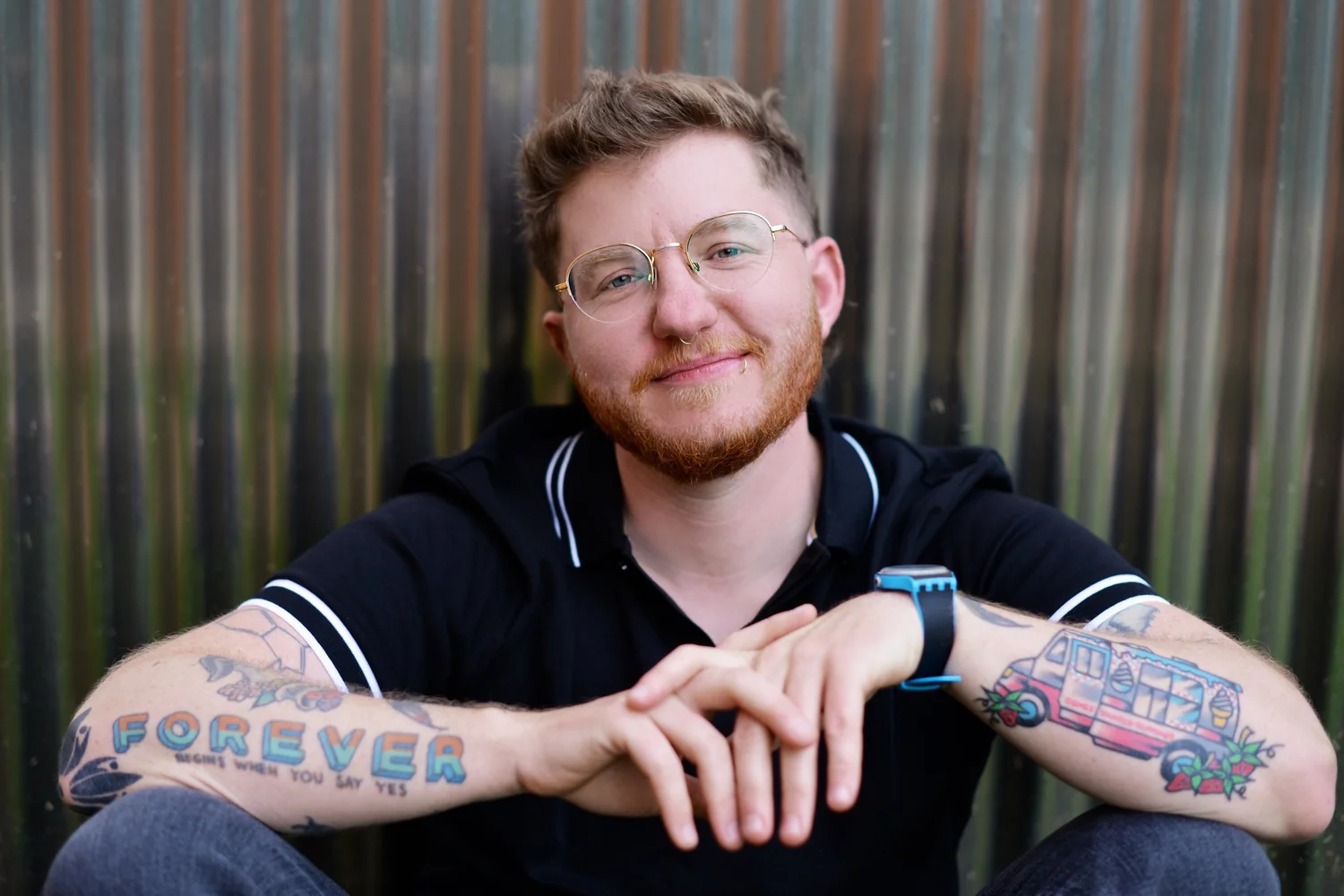
I first encountered Krys Malcolm Belc through his extraordinary debut memoir, The Natural Mother of the Child (Counterpoint, 2021). I was drafting my own debut at the time, and we quickly became online acquaintances, and eventually IRL queer author/parent friends.
One of my all-time favorite CNF writers and teachers (Belc is currently the Edelstein-Keller Writer in Residence at the University of Minnesota), his work can always be found on my highly-anticipated reading lists, and What I Made for Dinner (Catapult, June 9) is no exception. What I didn’t expect was how Belc’s exquisite second memoir, ostensibly about cooking dinner for his wife and children, would have so much to say about isolation, and loneliness, and using the internet to cope and to connect—and about allowing ourselves to be shaken awake to the present moment. While reaching for distraction, dissociation, and numbing has become a habitual and even reflexive form of self-soothing (and/or self-harm) for so many of us, Belc’s startling, honest essays form an antidote–but it’s medicine that tastes and feels like what it is: a lovingly crafted, deliciously original, and impeccably presented nine-course meal.
Belc describes What I Made for Dinner as “a work of memoir and cultural criticism about (his) obsession with celebrity chefs.” We sat down over lunch at AWP 2026 to discuss kids, kitchens, parasocial relationships, the ethics of writing about other people, mental health, and our shared self-diagnosis: Memoir Derangement Syndrome (or MDS)—a particularly intense flavor of pre-publication anxiety.
This interview has been edited for clarity and length.

The Rumpus: I received my galley of What I Made for Dinner in a week when ICE was terrorizing both of our states (Minnesota and Maine), and many of our neighbors and loved ones were sheltering in place. Schools closed or locked down; local businesses were eerily empty or shuttered. Masked men with guns at bus stops and nursery schools, fear and violence in the air. I opened your beautiful book and was dropped into the isolation of early COVID days, and being in our homes with our children 24/7–there was this strange parallel to the present moment. I’m wondering if you’re feeling that parallel as well, in this run-up to publication.
Krys Malcolm Belc: Yes. The weirdest part, for me, is that the tension of the book that made me persevere through finishing it was the fact that cooking and baking calmed me, and it was the only thing that I liked doing in that scenario. And since then, you have an on-and-off relationship with any domestic chore.
The moods change. And I was going through a phase before the (ICE) occupation of the Twin Cities where I was just like: “If I have to cook another dinner I’m gonna cry,” but also, “We can’t afford takeout, so it’s just what I have to do,” and I was doing very repetitive cooking.
I do find that it’s when the stakes are very high and things feel very elevated, it’s: “This is one thing I can do that I enjoy and that my family enjoys and it makes us all feel safe for an hour.”
And similarly to the early pandemic when there was a lot of anxiety but my own family is doing okay, and we have our concerns but I’m really more concerned about all the people who aren’t doing okay…so much of the Twin Cities organizing was around food distribution. Every coffee shop, every school had food drives, and there were overflowing amounts of food everywhere. So food was front of mind again.
It did have resonance for me and I was in the same mindset of: “Being trapped here is actually really nice for me,” in some ways. And I feel weird about that, and uncomfortable and unsettled. But I think a lot of nonfiction writers should write more about the things that they’re uncomfortable with, and around their own privilege.
Rumpus: You write so lucidly and matter-of-factly about your mental health–specifically some pretty terrifying depressive episodes–in this book, in a way that will feel pretty new to your readers, I think.
Belc: I think that people who know me–other than my family–think of me as a ruthlessly and relentlessly optimistic and energetic person. I think it’s very clear to people who know me even moderately that I’m fairly anxious and hyperactive–so writing about that stuff was not a surprise.
But I don’t think I had ever disclosed to anyone how depressed I had been, at multiple points in my life. I think part of using dinner as the structure of the book is that, at some point, I write about how I never didn’t make dinner, even in the darkest time.
Rumpus: Yes, you said: “There wasn’t one day that I couldn’t get out of bed and make dinner,” which to me was….wild. (laughter) But your flavor of depression manifests in a slowing-down. It’s a subtle dip in your energy–in private.
Belc: I think I hadn’t gotten to a lot of the emotional meat of the writing. Then I started taking fertility drugs, and they had a very bad effect on my mood, which I was not expecting, because fertility doctors exist to get you pregnant, not to make you happy. Because the baby is the thing that’s going to make you happy, right?
Rumpus: Of course. The product. The deliverable.
Belc: The deliverable! So they weren’t like, “Hey, this might make you crazy.”
So I was trying to write in a way that was like those weeks of taking Clomid. I wrote this scene about sending my kids away to my parents’, going on dates with my wife, and I was on this medication. And it ends on a regular day where I’m walking into work, and thinking about walking into traffic on just a regular workday. And I realize: “Oh, I’m in danger. I’m not safe.”
And I just have never talked about that at all. So I wondered if people would think I’m not optimistic or hopeful or into beautiful things if I write about this. But actually it is more powerful to have one exist with the other.
Rumpus: And has your relationship to those periods of depression changed, in the writing and recounting of them? From knowing they are part of this conversation now, in this book? Or that they are on the table for discussion of your work in a way they haven’t been before?
Yes. I think that when I started writing the book the way it is, I had the baby and I’d been through depression before, but I started writing about my interest in dinner as a structure thing. I had been writing all these food essays that didn’t (make it into the book). But I hadn’t been through the postpartum depression yet, and I think I assumed I would never be depressed again.
Rumpus: It felt exclusively past-tense.
Belc: Exactly. I write briefly in the book about a depressive episode in college. For the longest time, I thought that was a one-off thing. I was never a depressive child, I’d never been depressed since. And then I took this fertility medication and felt very depressed.
And then again, when I was depressed after having the baby, I had to accept that I may go through these periods, which had never been part of my concept of myself or of what my life would be like. I’d always thought, “Well, sometimes I’ll be really anxious, but then I’ll go to therapy. And I’ll exercise more and then summer will come and I’ll do the summer things–”
Rumpus: —Like, “Oh, I’ll just work harder to not feel this way.” (both laugh)
You and I have spoken about the questions around the responsibility of writing about people who are not us, and to shape a narrative of a dynamic between us and someone else. As I’m reading about your children in ways that do not feel invasive of their privacy at all, and about your wife:in comparison to your first memoir, how has that felt? Your children are older and more aware of your work. How did it feel to write about your family this time around, versus in The Natural Mother of the Child (Counterpoint, 2021)?
Belc: It feels really different now. I think the first book was so much about (one of my children). There was a spotlight on one person. And I was interested in how this one person and the relationship between us shaped my concept of myself, and everyone else was a side character… there’s more of that full cast in this book.
I made the decision early on not to use my kids’ names. And that was actually less about ethics–although it kind of developed into an ethical stance–and more about there being a lot of people to keep track of.
The main relationship in WIMFD is between me and the people who only exist to me in cookbooks or on YouTube. And my family are kind of side characters. So instead of their names, I just used “son,” “daughter,” “wife,” whatever. That was kind of fun. There are things that I think every responsible nonfiction writer will put in a first draft and then realize: “Maybe I shouldn’t say that, and kind of cull details. But I can run it by the kids: ‘Here are generally the things I’m writing about, but nobody would probably be able to figure out (which of my kids) I was talking about’” (because I have two sons and two daughters, which is very convenient).
A lot of the book is concerned with narratives about family—who creates them, who dominates them, who is approaching them from fresh or interesting angles. When somebody makes a tray of lasagna for their family, they’re doing care work and a chore but they’re also communicating with that family, in a sense, about the kind of person they want to be. And if they share a picture of that in a cookbook or a video on the Food Network, then they’re solidifying that narrative for the world.
After my first book came out I was surprised by how many people asked me about writing about my children because in my mind, other than their names, I had disclosed very little about who they are as people, and I was surprised that others felt I had. I felt like I wasn’t done experimenting with disclosure and intimacy. Can a book be even more evasive about details but feel just as, if not more, intimate about the family it’s sharing?
It’s not a mistake that close to the end of the book I write about the way my parents tried to support me but sort of missed the essential essence of what I needed, for somebody to tell me it was okay not to be a girl who grows up to be a woman. I always want to leave very obvious space for my children to point at my writing and say, ”See, he knew he was probably getting some or all of it wrong, not because he’s a bad person, but because he recognizes that even though I was a child, I have always been a full person that he can never fully access.”
Rumpus: And the people you are writing about and describing and naming–everything they have said and done that’s in the book was already on camera or in print, for public consumption.
Belc: Literally. And I was also trying to challenge myself… one of the hardest things there is about writing nonfiction about your friends and family is that just saying what they did or said isn’t enough. You need to lead the reader to make conclusions about them or you or both. Or make the conclusions yourself, right?
I think in my first book, a lot of the writing about other people is kind of scene-based, with really no “here’s-what-I-think-about-this-person” kind of framing or point of view, but it leads people to say: ”Your dad has a temper and your mother-in-law has a strange dynamic with you…” there is a lot of that. And in this second book, I was like: “What if the only conclusions I—or anyone else—drew were about celebrities and people with big public followings?” I don’t know. And that’s actually really scary, because they do have big followings, and I don’t know that they’ll look at it. But, to analyze, frame-by-frame, how Claire Saffitz reacts when a baby comes on the scene, knowing now that she was someone who, at the time, wasn’t a parent—I’m reading into her behavior. That feels like a similar kind of risk to writing about your five-year-old, but not the same risk. It was almost a new craft challenge.
And if you write a cookbook and then do a YouTube series, you’re basically on a book tour on YouTube, right? Someone like Molly Baz, who writes cookbooks that have a very distinctive voice, and then she takes the voice from the writing and employs it in her little abbreviations for things, her lingo that she uses… she created this character in the book that she then enacts on YouTube. That is such an interesting dynamic to me. It feels so memoiristic, even though a cookbook is not a memoir. I wanted to get close to that feeling.
Rumpus: I’m wondering if you can tell me about the choice you made not to contact your subjects, and to refrain from delving into these women’s lives playing out behind-the-scenes, off-camera.
Belc: There was the loneliness of losing in-person socializing at work [during the early days of the pandemic]. And then when I was sent home–because I was not an “essential worker” at my job… there was a screen now, between me and these people. And between these people and everyone else. So I was interested in examining that feeling—that someone is too far away to touch. So I felt like—at some point, a friend told me she knew one of the chefs I was writing about—who didn’t ultimately make her way into the book. She asked, “Do you want me to put you in touch with her?”
And I’m like: “Well, if we were friends, then I couldn’t do this thing.” Because I wouldn’t be taking a video of a friend and then asking, “What does it mean? Why are they wearing a ponytail,” analyzing their behavior. Alison Roman—I kind of quote her in the book, when she said, “I know what people are going to say when they watch this: ‘Why is her shirt like this? Why is she doing that?’” So I wanted to maintain that I was the audience, and not someone who was actually interfacing.
I’m really interested in profiling as a form of writing, especially more creative profiles where there is an eye, like Taffy Brodesser-Akner or Carina del Valle Schorsky, who DO interact with their subjects. But this wasn’t that. The book is about parasocial relationships. It’s about obsession, and it’s about somehow being really at a distance from people.
For a writer I think I have a pretty high need for socialization, and as a prolific texter and emailer, I guess a part of me was surprised by the intense loneliness I felt in 2020 / 2021. I was still in touch with so many people, but it didn’t feel like enough, and when you have an unmet need, you start to feel like there’s something wrong with you, that you are too much. I’m married to a talkative woman; I had three kids; and I was on work calls half of every day. But there was a need for more.
My closest friends were “podd-ing” off in pairs or small groups for virtual school and to have that social connection, but because Anna worked in an emergency room, we couldn’t do that, and we started socializing outdoors months after any of our neighbors. In a sense, there are food content creators who were able to fill that gaping hole because of the way their programming works. I’m not someone who wants to go away for a weekend with friends or even to go out to dinner and catch up about the last four months. I want to sit around chatting at the playground for an hour on Sunday; I want a weekly walk with a friend for twenty minutes after school drop-off; I want to shoot the shit with a coworker as we wait for the microwave. It’s the way the women chefs I was watching narrate dailiness that really made it feel like I was being spoken to directly on a level that felt embarrassing. But that embarrassment also opened up a space for honesty and vulnerability about how dependent I am on other people and how quickly that can fall apart.
Rumpus: Your food writing is so evocative and so real and so beautifully tactile. And I feel like my own instincts might lead me to so many heavy-handed food metaphors, or cooking as parenting, baking as marriage, love as nourishment, pleasure, whatever. I’m curious if there are any instincts you have to work with or against as you’re working on a piece of food writing in particular, which is such a specific little niche.
Belc: I read a lot of food memoirs early in the process, and I think part of the project was learning to write a food memoir that’s doing something different. My first book asked: How can I write a parenting memoir that’s doing something slightly different, saying something new. I’m not a chef. I’m not a trained cook. I’m not the best cook I know. I’m not the best baker I know. So I was like, “The food metaphors only work if you’re really doing an excellent job all the time and the food is perfect and beautiful or the labor of it.” The food is not always the muse, but it is sometimes the muse.
And metaphor is something that I find I reach for when I have lots of time to really think about something, and a lot of the elements of cooking for dinner are like: “I taught till 6 p.m. Now I’m home. I pay the babysitter and then I have to cook dinner and my daughter’s bedtime’s in an hour.”
Belc: What are you thinking about these days? What are you working on now?
I’m thinking about my own coming-of-age as a trans person, and perhaps a golden moment of freedom, now seeing the rights rollbacks. And since I’m interested in the question of how to write about being a person who often struggles, but is oriented towards positivity… I’m writing some fiction and nonfiction that asks what is the specific takeaway from growing up—of growing into adulthood with a sense of freedom, a sense that it was only going to get better, and now dealing with the fact that it’s actually not continuing to get better and is there a way to make art about how people get around that reality?
Because people have always gotten around reality.
So I’m writing more cultural criticism—reading some older trans memoirs, including revisiting ones from the early aughts because I want to see how they capture that moment. I write almost ahistorical work at times, where it’s not really grounded in the time because it’s so interior. So I want to write a little more externally, and that might involve me not being even a character, not only not the main character anymore. I’m hoping to challenge myself to write nonfiction that’s not about me.
And I’m writing fiction, about what we might learn specifically from the ways that people left society in the 70s and 80s to just be queer—to be queer, together.
Rumpus: You always stick the landing, in every piece of yours I’ve ever read, and your endings are so beautiful. I’m a big last-sentence girl, as you know, and I’m going to paraphrase something I remember you saying—one trains their reader toward an ending, or that you’re training them along the way to understand the ending and what it is and why it’s the end. I’m wondering if you could tell me about how you came to understand what this memoir’s ending was going to be, and how you had to then make choices about what the reader would be given in the lead-up to it.
Belc: I didn’t write the ending until I was pretty far into the process, but it was that moment of: “I actually think I know what I’m writing about.”
How do you make a decision to be oriented towards positivity despite many unrelenting reasons not to be? It’s so bleak, but the one thing I control is some orientation towards joy in our day. And I was like, “How can I come back around to that to end the book? I need to steer the whole book towards a return to that, somehow,” which is how I decided to end on Laurie Colwin. I asked: “Who points me towards hope,” which some people see as a negative. Some literary criticism of her work is like, ”She’s too happy. The endings are too happy.” I’m like, “Sure. That’s fine! There’s nothing wrong with that as long as you’re real!” And her characters are always doing bad stuff.
In terms of ending individual essays, I think it all comes from starting as a flash writer. I want to be expeditious,but also I want to earn the right to continue talking on the next page.
Something has to shift for readers every time a section ends: “I wonder what he’ll do next.” Maintaining that element of surprise, even when it’s like: “It’s the same guy. He’s still kind of sad. He still cooks all the time, still likes to watch YouTube videos.” What, in the text, can surprise them?