
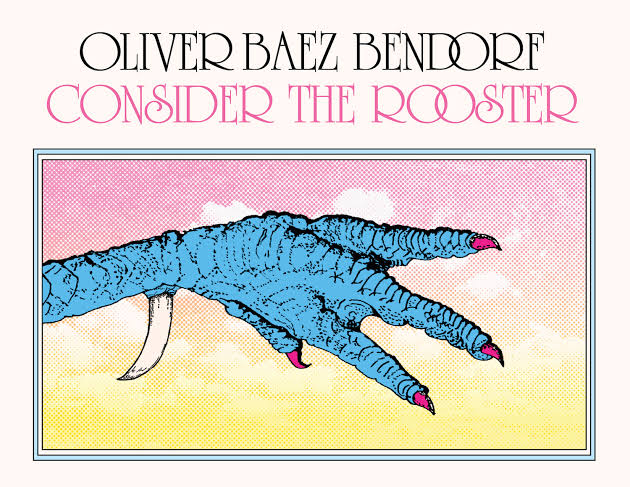
Oliver Baez Bendorf’s latest poetry collection, Consider the Rooster, begins as a visually enticing surprise. We wrestle with a book that asks for two hands to hold it. Thickstock paper, section opening quotes, and a bold, blue claw on the cover prepare readers for something spectacular. There is an unmistakable irony in the more-ness of the text, given the book’s strong themes of sustainability, yet why shouldn’t these important ideas take up some room? Here we witness space, not as a commodity, but as an outpouring, an offering in and of itself. Every poem is center-justified across an eleven inch page. “What Is a Field” is an eight-line poem spread across three pages, with individual lines taking advantage of additional spacing between phrases.
Consider the Rooster invites us into new worlds, both as a viewer and participant. The rooster takes up psychic space and provides not just a metaphor for the personification and projections of humans onto nature, but also asks us to consider what, in fact, is natural. In the titular poem of the collection, as in the book as a whole, there is an ironic intertwining and wandering through religion and the academy:
“God, I won’t be your sacred chicken if it means I have to fight, but I will fight. / I already scan the perimeter. / Testosterone, yes, I take it. Which is not the same as fighting. / The shape you see has nothing to do with me, or the rooster / Who sleeps in a cardboard box in the garage because the philosopher called the police, / Then asked for eggs.”
The narrator will fight for the right reason, reasons known to them (and perhaps to God, but not because of some sanctioned belief), and will stay on high alert to protect his kin because safety can’t be taken for granted, especially not by those targeted and marginalized. The neighbor, a philosopher, threatens and intrudes, and then asks for eggs, oblivious to his own violence and ignorant to the repercussions of his actions. A liberal arts education, although placing importance on the examined life, may or may not increase one’s self awareness, especially for said philosopher, who is unable to recognize the irony of his own actions. In “Yellow is the Color of Happiness,” Bendorf writes a letter to presumably this same man, now named Matt, about a rooster, Walter, and imagines pelting eggs at his door. “I don’t know what I pictured/ Walter was not a metaphor/ You wanted the eggs without the rooster/ You see where I’m going with this/ I’m talking about real birds here.” Metaphors aside, humor does work its way in at times.
Unfortunately, Philosopher Matt is not the only abrasive neighbor that works their way into the narrator’s life. Conflicts with neighbors resurface, reflecting intolerance which feels unchecked and systemic. In “Nebraska,” Bendorf writes:
“Left Michigan without any fanfare no parties still a pandemic/ For six days the neighbors watched us pack the truck arrange and rearrange the belongings/ I’m tired of watching them watch us those neighbors which is one reason I am glad we’re leaving/”
Here we are rooted in time and place through references to the pandemic and state, reminded that microaggressions are still pervasive, as neighbors spy with disingenuous interest and do not lend a hand or kind word. We live together in this world. It is validating to be seen, so this sense of watching feels like a violation of trust, a judgemental intrusion.
In “Michigan,” Bendorf compares the requirement/expectation of keeping a proper lawn with repressing his identity as a queer transgender man.
“Am I the last loser in Michigan still banking/ on silence and pleasantries to protect me/ strangers/neighbors power walk past my ragged lawn/ their yards are dull and starve hummingbirds, monarchs, cardinals, and bees/how is that more beautiful?”
But “Michigan” ends with “I’m done being good!” The rooster that pervades this collection is an activist, daybreaker, cockfighter, protector, defyer. Yet even the powerful rooster falls victim to the status quo and can end up in the pot. Aren’t we complicit if we eat the chicken stew? I can’t help but ask myself this. I want the answer to be no, but the collection points to maybe, even towards yes. We are also complicit as we dig in the garden and plant seeds. But there is goodness here to sow.
These poems wrestle with what is happening around and to us—the Covid-19 Pandemic, police brutality, white supremacy, ecological destruction—but with struggle comes heightened awareness, pause, time for reflection. “Things To Do in Olympia” provides a sample of considerations that, along with specifics on where and what to eat, includes interactions with flora and fauna:
“Roll down your windows on a briny day/ Go look for coyote at Nisqually Refuge/ Walk around before the fog lifts/ Ask the bartender at Brotherhood where to get/ your haircut/ Let Tumwater Falls spray the skin off your face/ remember to breathe/”
Consider the Rooster is for those who read poetry and those who don’t—Bendorf’s writing is accessible, direct, unfettered—he writes openly of his fears, fears for all of us, as we arrive post-pandemic in a world of unrelenting upheaval, yet hoping, probing, offering us poems as a spiritual salve:
“Can poetry keep my mosquito/ population down, or will I need/ to hang a bat house? Can a poem/ ensure my right to non-discrimination/ as I age? Must I trade my tongue for shelter?/ Who is responsible/ for hope? Is anyone in charge of freedom?/ Can a poem hurry the half-life/ of insecticides?” [Rx]
Bendorf describes cultural, social, and historical tensions—nature vs. nurture, invasive vs. naturalized, Indigenous vs. colonized—that leave us in a state of disillusioned flux at times, trying to hold many thoughts concomitantly, not risking setting one aside. It is okay to be confused. “Dizziness defines the center,” Bendorf writes in “Ram’s Head White Hollyhock and Little Hills,” yet we are still safe and purportedly grounded while “propelled by/ love of family and friends,” as we are in “Transit.” The interconnected scenes in the collection feel authentic as old wounds resurface, another coyote is spotted, or the pink light captures a forested scene. We are brought to wonderland, where the ordinary feels extraordinary, while we track deer in fresh snow, and although spells are cast and there are moments of magic, we are generally in the woods in Nebraska or Michigan or Idaho, or some off-the-map place you’ve never heard of but have been before in your travels, as there is always “the woods inside my head.”
Many of the poems explore gender through transience and parenthetical assertion. There is queer visibility and sensibility. In “Who Profits From this Feeling,” gender is described “like a cone of light/ opening outward. Each person has their own cone and sees their own rainbow.” In this poem we visualize how this flow of “solar rays” can be constricted by others through bottlenecks, and that shame can appear as “particulates of wildfire” that one can “Return to sender.” This poem starts with an italicized list of key words, or perhaps ingredients, to visualize such a delightful cone.
Bendorf employs scientific language with some regularity, perhaps as a rebuttal to undermine a more stagnant and deterministic view. He chooses words that are science-associated and familiar, infusing phrases with new connotations. He is able to dismantle artificial constructs and invite us to fully participate in the expansiveness of self, as illustrated in “I Just Chose My Place and Let the Circle Form Around Me”:
“… I stood there squinting/ into the eaves thinking that if “star” can also be “dust cloud” or “nebula”/ or “black hole” then surely gender is far stranger than we’ve imagined/ and much more beautiful, unfurling over decades, a phenomenon./ Exploded from a corn field — that’s me. Will you join this velvet burst?”
We are asked to come along, but will I “join this velvet burst?” As I read, I found myself drawn to the words and the suggestions, often feeling a sense of connection and hope that the language of biology will not always be weaponized. Scientific inquiry can encourage the poet to dive deeper into the mystery, and clarify the expansiveness of ideas, such as gender, instead of restricting it.
Ecological preservation and exploration spills over the page: onto bones, moss, bees, seeds, prairie, coyotes. These references evoke deep appreciation—as readers we are invited to learn “to speak the language of mums,” to be birch trees. We are offered lean-tos, groves, and magic sprouting berries, too-kind beasts. We do not know if first it was the chicken or the egg, if a catalyst forms a community, or a community creates a catalyst, but we are transformed, as we create new connections, not just with each other, but with the other creatures that share this planet with us. The opening poem, “Colony Collapse” sets up this ecopoetic approach as the backdrop of the collapse of bee colonies provides an inroad to explore the essence and importance of community and trying to fit into the world, offering one’s self, one’s talents, one’s love to others. Individual connections are critical to a thriving ecosystem. “No, I didn’t turn away from the witch’s butter…” Bendorf writes, “or the walks… or the briny sea… all the mosses…” Then later, “a witch passed through here in the night,/ so the story goes. (volta breathe.)/ that’s all I’m doing, is moving closer to my life.” To be part of the ever-expanding whole, we must be true to ourselves.
At times there is an admission of naïveté, with new lessons learned. There is a continual return to the cycle of life, a visceral acknowledgement, even a longing, an interrogation of “What the Dead Can Do,” like make lettuce go bad, or even “transmogrify/ their tracks sunk into the snow/ into those of another mammal./ They can make any song/ come on the radio.”
When I finished the book and considered the lessons, the ironies, the forgettings, the discoveries, I found myself wondering how I should feel and what I should do. So I went back to the beginning. Such is the pleasure and power of Bendorf’s complicated collection, offering us plenty of space to settle back in, providing both reprieve and rejuvenation.
Consider the Rooster by Oliver Baez Bendorf
Nightboat Books, 2024