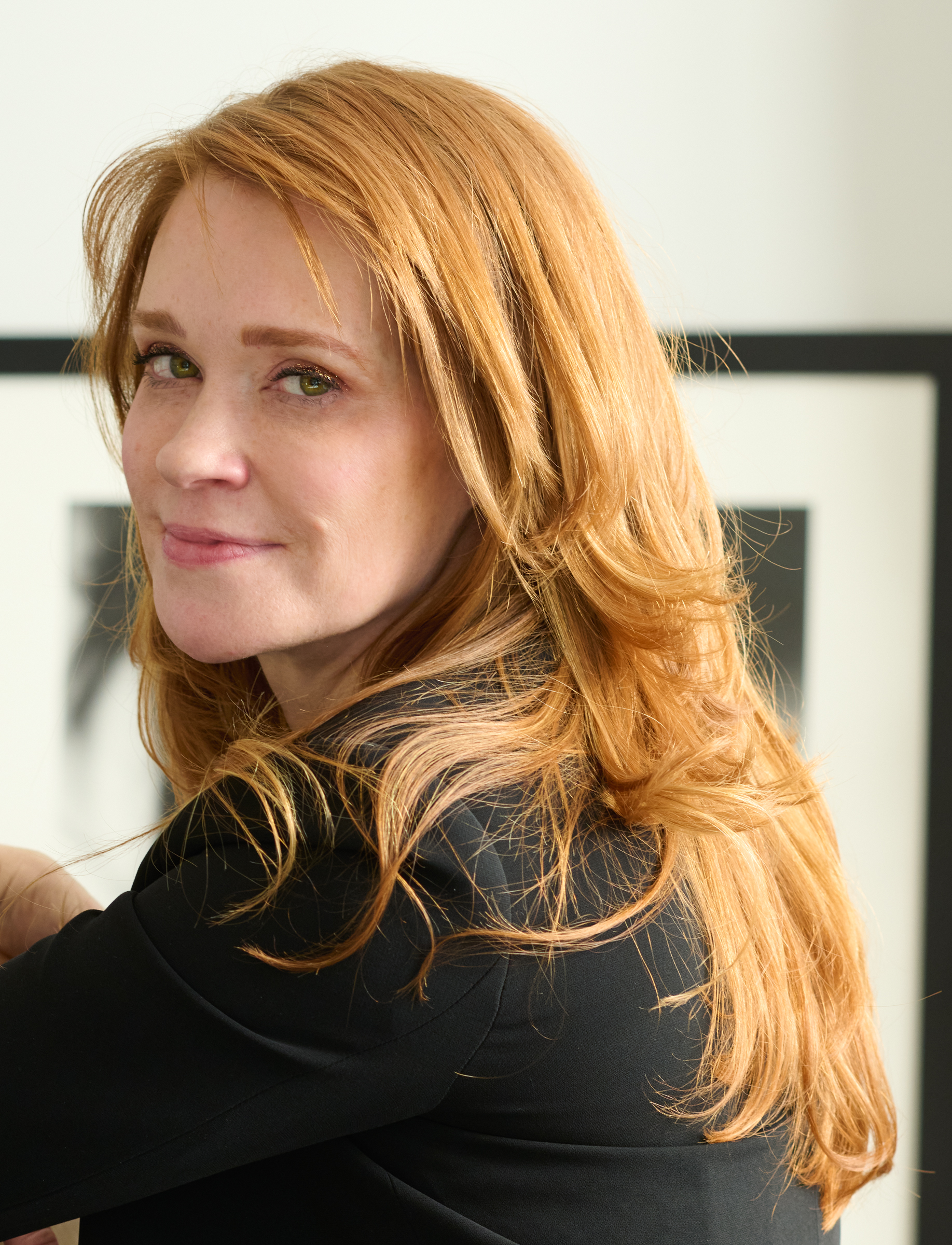
Emily Rapp Black is a writer, a thrifter, a maker, a mama of a boy who died, and a skier with one leg. She is also, as this book makes clear, someone people have told, I would die if I were you. In I Would Die if I Were You: Notes on Art and Truth-telling, she gathers all the pieces—all the big questions we get stuck on, and the little ones too—into a yellow sticky note layer cake that falls apart in the best way into art and faith like gravity.
Rapp Black knows what it is to live the unspeakable. Born with a congenital limb difference, she grew up navigating a world that kept asking what is wrong with you? Her answer, arrived at through embodiment, through liberation theology, and through the ancient texts of a small-town classics education, is: nothing. “I’m not made wrong. I’m made differently.” That recognition—and the secure foundation her parents provided, grounded in community and access—underlies everything in this book. And the title carries even more weight when you know that her son Ronan died of Tay-Sachs disease.
I Would Die if I Were You builds on three pillars of creativity Rapp Black calls “the great conversation:” curiosity, community, and commitment. It moves through craft concepts like Chronos and Kairos time, pattern over plot, and her case for creative joy, while never losing sight of the larger questions: How do we face chaos, loss, and the unknown and still make art? How do we fall into faith rather than being locked inside dogma? How do we belong to a world that tells us we don’t?
Rapp Black is the author of five books, including the acclaimed memoir The Still Point of the Turning World (Penguin Books 2014). She is a professor of creative writing at the University of California Riverside and a graduate of Harvard Divinity School. I Would Die if I Were You is a theology of art: not a system, but an inquiry. It opens with a poem about chaos by Katie Ford, fitting, because this is a book that resists closure and invites the reader deeper into uncertainty, imagination, and wonder.
I was delighted to speak with Emily Rapp Black over Zoom about theology and superheroes, the difference between belief in God and belief in the world, and why your affliction might be your greatest strength.

The Rumpus: The title I Would Die if I Were You works on two levels: the memoir itself, and the visceral experience of being someone others can’t imagine being. Who did you have in mind as your reader?
Emily Rapp Black: I want people to come to the book and know that the title already signals something; if you’ve heard “I would die if I were you” or “I can’t imagine,” which probably everyone has at some stage, that’s a super rude thing to say. It’s the extreme version of “Oh, I can’t imagine.”
I hope people will come and understand that the book signals that there is no story you can’t tell. There’s no gag order on a story, however you want to express it. And my ideal reader is someone who is interested in both the big and small picture, seeing that the world is vast and unknown and unexplainable, and yet there are ways to be in that world that are very specific and craft-focused and really granular, that can be life-giving.
My ideal reader is also someone who has many interests that aren’t necessarily that deep; maybe they know one thing about this thing or one thing about that thing, but when they’re into their art, they’re very focused on that one thing and it matters to them. It’s permission to be a bit of a mess. I like a messy reader. I like readers with messy lives, meaning really everyone. It’s not maybe a beach book, but it’s for everyone.
Rumpus: In the prologue you mention that you carried a Rilke quote with you—“Love and death are the great gifts that are given to us. Mostly they are passed on unopened”—for years before you understood it in your twenties. What made that possible?
Rapp Black: Up until that point, my life had been trying to control chaos, whether through not eating, or overexercise, trying to control the body. Then working as a relief worker knocked me out of that pretty quick, because you see that by accident of nationality or birthplace, your whole life has changed. There’s no control. If you go into areas where there’s so much deep need and no real way to fix it, you realize we’re all meat sacks. There’s no way to point your life like an arrow to some goal.
As a working-class white kid from the Midwest who went on to fancy schools, I had the idea that if I decided I could do something, I could do it. That’s the emotional bootstrap myth. I also had experienced a lot of death at that point. And important to say, much of the way I’m able to live my life and think about these things is because I had a really good family. My parents really loved me. They still really love me. And I feel like that’s a rare thing to be able to say.
Rumpus: Early on you describe learning to answer the question “what happened to your leg”—which really meant “what is wrong with you”—with “nothing is wrong with me.” So many of us never question the narratives we’re given. We live inside them. How did you even begin to question that narrative?
Rapp Black: Probably through sports. When I was growing up, there were two books about people with disabilities that I knew about. One was: the person died. The other was: they become an athlete. I was like, “Okay, door two.” But the thing about any kind of physical activity is that once you do it, you are empowered within your own limitations in a way that feels really great, and then you don’t feel wrong.
For me, growing up, it was skiing, farm work, chopping wood. That labor made me feel like, “Oh, I’m not made wrong. I’m made differently.”
And then my professor in college gave me this beautiful book called The Disabled God by Nancy Eiesland; she talked about disability and liberation theology. Once I hooked onto that, it was like, it’s not just people with different bodies, it’s people who have different colored skin who are told they’re made wrong. This is larger than me. And when something is larger than you, it’s more interesting because you don’t feel so pinpointed.
Rumpus: And the experience of embodiment, of being in your body, told you there’s nothing wrong with you. How did that translate into your understanding of making art?
Rapp Black: My very 1950s-style education in classics, in this little town in Minnesota, reading ancient texts, really helped because it made me trust my brain. It showed me the capacity of brains in general and the power of thinking about something beyond you, but somehow connecting your own experience across time and history with, say, St. Augustine.
Reading makes you feel like you belong because you’re already having a relationship with the writer in your head. Of course I was a reader; I was prone on my back for most of the time and didn’t look like everyone else and wasn’t ever going to. But when you read, the reader is almost neutral. You get to have this curated conversation with another mind. When I saw the possibilities of that with texts thousands of years old, people from all those centuries ago having conversations about the things we’re still having conversations about, I wanted to be a part of that. Because I already was. We all are.
Rumpus: Your pillars of creativity–curiosity, community, and commitment–are grounded in what you call “the great conversation,” which came alive for you at a small liberal arts college in Minnesota. How does a writer outside academia find her way into that conversation?
Rapp Black: Libraries exist, as much as they’re able to in this current administration. It doesn’t have to be academia, and it doesn’t have to be the classics; that was just the program I was in. I always tell my students: “If you don’t want to read the classics, don’t.” It’s about engaging in the flow of narrative, whatever that narrative is. My mom reads magazines; she’s engaging with a narrative. Literally anywhere you step in, kids’ books, graphic novels, comics, horror, sci-fi, prose poems. There are so many modalities.
Rumpus: Community feels like the deepest anchor in the book. What does it mean to you as both a person and a writer?
Rapp Black: Growing up in an intergenerational community—even though it wasn’t diverse except in age—you’re going to visit older people, seeing new kids being born, seeing people who’ve died, going to the weddings, seeing all the cycles of life from a young age. It makes you, hopefully, a little more tolerant.
And once you see that in a community where people just accommodate, before any of those things were legally mandated, if the woman couldn’t come to church, someone would get her and figure out a way to get her into the sanctuary. When you see the cycles of life all the time, you realize people coexist or they perish.
Community takes labor. It’s not work, it’s labor. Remembering things, checking in with people; that’s a learned behavior and it’s not that hard to do once you start, because the rewards are tenfold. Those small moments off the grid are the ones that matter most.
Rumpus: You argue every person has a singular story worth telling, and then describe a New York Times review of one of your books that essentially said your book took readers places they maybe didn’t belong or want to be. What allowed you to double down rather than pull back?
Rapp Black: Rage. Everything I write is rage. I was so mad about that review. It was like, “Your life is too sad to write about.” That’s how I took it. And then I was like, “Oh. Everything I feared was true. I am too much. I’m too sad. I’m cursed.” Then, “But I am alive and I’m okay and I get to write about this stuff. No one has to read it.”
The generation of a thing is separate from the consumption of the thing. As writers we get so tied up in that. I’m not going to force the communion wafer down everyone’s throat. I’m here to offer stories. And an offering means you don’t have to accept it.
When people come in and ask, “Am I a good writer?” what they’re really asking is, “Am I a good person?” You were made good. There’s no right or wrong way to tell the story.
Rumpus: This brings us to the chapter about the joy index, what you call remaking the world again and again; have fun, don’t take yourself so seriously, cut up the text, throw it in the air, enter some chaos.
Rapp Black: Yeah, have fun with it. The sticky note layer cake: I’ve been using that, and people in my live classes are like, “Oh, I already do that.” And I’m like, “See?” Creativity cannot be forced. I one hundred percent believe that.
Rumpus: You talk about pattern over plot, “decorate the rooms before you build them.” This is so against the rules.
Rapp Black: I love it. When you’re writing something, there’s always this effort to ask, “What’s the structure?” But how in the hell are you supposed to know that unless you know what the story is? I have this pink toilet in my garage. Whether I ever get to put it anywhere, I’ve decorated that room. I know the wallpaper I want. I have the marble sink in mind. The point is: what would my dream wallpaper look like? What would my dream character be? What’s the moment in my life that’s the most fairy-like?
You don’t have to have a solid house to live in it. It can be a house of your imagination. It can be magical realism. It can be a tent. Going to Guatemala to see my friend who runs a school there, we arrived in Antigua late at night, driving on the cobblestones, and there were these huge butterflies and parrots and monkeys in the sky. I said, “Are you seeing this? Have I had a psychic break?” She was like, “No, I’m seeing it.” They had redone the town according to García Márquez’s characters, put butterflies in the sky that looked untethered to anything. The parrots were not tethered to the ground. We walked around at night looking up at images from some dead writer’s imagination. Finding the patterns in your story is more interesting than just building the house.
Rumpus: In the chapter on writing through trauma and tragedy, you distinguish between belief in God and belief in the world. What’s the difference for you?
Rapp Black: When my son Ronan died, my dad—an 85-year-old Protestant man—went out into the yard and kept saying, “I don’t understand. I don’t understand.” It cracked his view. He was never really the same after that. He put his faith in people more than in a deity.
I don’t think there is a benevolent or malevolent God anywhere. People are innately good, and they do bad actions because of what happens to them in the world. I still fundamentally believe the world is a good place and that people want to be good in it. I’m much more interested in that than in going to some salvific future where I’ll be reunited with whomever.
I also think we do have relationships with people after they’re dead. The veil is very thin. That person is still inside of us and with us and hasn’t disappeared—because that actually can’t happen. Energy does not disappear. It is only recycled. In that sense I believe in the world because the world and its mechanics—that’s empirical evidence of a certain pattern and strategy. At its core, the world is meant to be a good place for people. I don’t really believe in a God, but I do believe in people.
Rumpus: You write that being an artist is to cultivate a deep faith in the unknown, and essentially you’re telling the reader, “Do the thing.” How do you navigate the line between faith and despair?”
Rapp Black: Just do it. Do the thing. My students always say, ”Don’t make us read St. Augustine’s Confessions; we know it’s about a horny monk.” But that book is basically: this doesn’t make sense, and he keeps trying to make sense of his devotion to a deity that says you can’t have any sexual life or any desire or you’re bad. He doesn’t come to any conclusions. He just thinks about it. And that’s why it’s still appealing to me. You can tip into despair or you can be like, “Well, I don’t know.”
The choice between despair and hope is a fine line; it isn’t always a choice. It’s like a Venn diagram where they come together in this gray area. That’s where most of us are.
I feel more despair now than I did ten years ago; the global uncertainty, mostly. But part of being an artist is to say, “I don’t know what’s going to happen.” To me, that’s the truth of everything. People ask, “What should I do with this?” And I’m like, “I don’t know. Go find out. Take one track and see where it goes.” That sounds too time-consuming? Welcome to making art. It’s not about monetizing your time. It’s about doing the thing, however long it takes.
Rumpus: You arrive at the conclusion that art is faith. Would it be accurate to say this book is a theology of art?
Rapp Black: Yeah, maybe. People used to say you can’t be an artist without ego or ambition or narcissism. But if you’re a person who believes in goodness, that’s the prerequisite. When I write, I’m having faith in something larger than me, connected to me, but hopefully of service to someone else in a way I’ll probably never know. And that’s the part I love. All the things we read written by dead people; they’re not around to tell us how they feel about how we’re interpreting them. But we’re still reading and still thinking about them. How cool is that?
Rumpus: In the “Time Rodeo” chapter you explore two kinds of time—Chronos and Kairos—using the rodeo as a metaphor, with language as the lasso. How do they work in narrative?
Rapp Black: I love that the Greeks had only one word for body, soma. No body/mind separation. But they had two words for time. Chronos is clock time: class starts at 2:00, it takes three hours to get there, it’s marked. Kairos is the time of COVID, the time when my mother was alive, the time when my son Ronan was dying. It’s a more spread-out kind of time.
In narrative, both are always happening. In an essay, you’re writing about a time, and there are scenes within that time that are more timestamped; people are talking and moving, that’s Chronos. And then there’s the larger time you’re underneath, which is Kairos. The memory part is the lasso, picking up memories and categorizing them in those two kinds of time.
Rumpus: “The Exquisite Creatures” chapter connects your disability and Ronan’s Tay-Sachs diagnosis. You watched X-Men: First Class when Ronan was still alive and sobbed through it. The Fantastic Four you saw after. Can you talk about how those two very different experiences shaped the chapter?
Rapp Black: The idea of affliction is biblically rooted, and it has this superhero dimension: if you’re afflicted, you are both special and cursed. You’re a mutant. And what the superhero movies do—and this is true for a lot of people with non-normative bodies—is show that your affliction becomes your greatest strength.
The first time—X-Men: First Class—I was sobbing and making a fool of myself. The second time—The Fantastic Four — I was in the front row with a bag of popcorn and my glasses on. Both deep and completely shallow. But in The Fantastic Four especially, they’re a little family of mutants. They all have inside jokes. They’re also having dinner together. There’s something sweet about it. When you’re on the outside, how deeply attached you become to the people who are like you and not like you; it’s a powerful bond. I feel that all the time in classes, in workshops, in community.
Rumpus: And you identify memoir as your superpower, the gift. You end with, “When you make art, you belong to the world. Not because you proved yourself worthy, but because you don’t need to. You have always belonged.”
Rapp Black: I believe that. I know it sounds naive, but I do. And sometimes it’s not easy to say, because sometimes you don’t want everyone to belong. But in general, when you create art, you’re also saying, “I want to belong to you and you to me. I want to be seen by you.” It’s like Naomi and Ruth [in the Bible]: “I go with you.” Or even: “Here I am. I’m in the world. I’m rooted here.” We all have those moments.
Rumpus: I love that you provided a playlist and bibliography. If you were going to give us one song from the playlist to listen to, which one would it be?
Rapp Black: The Flaming Lips, “Do You Realize?” I can hardly listen to that song. It makes me cry and I’m not an easy stick. It’s sad and joyful.