
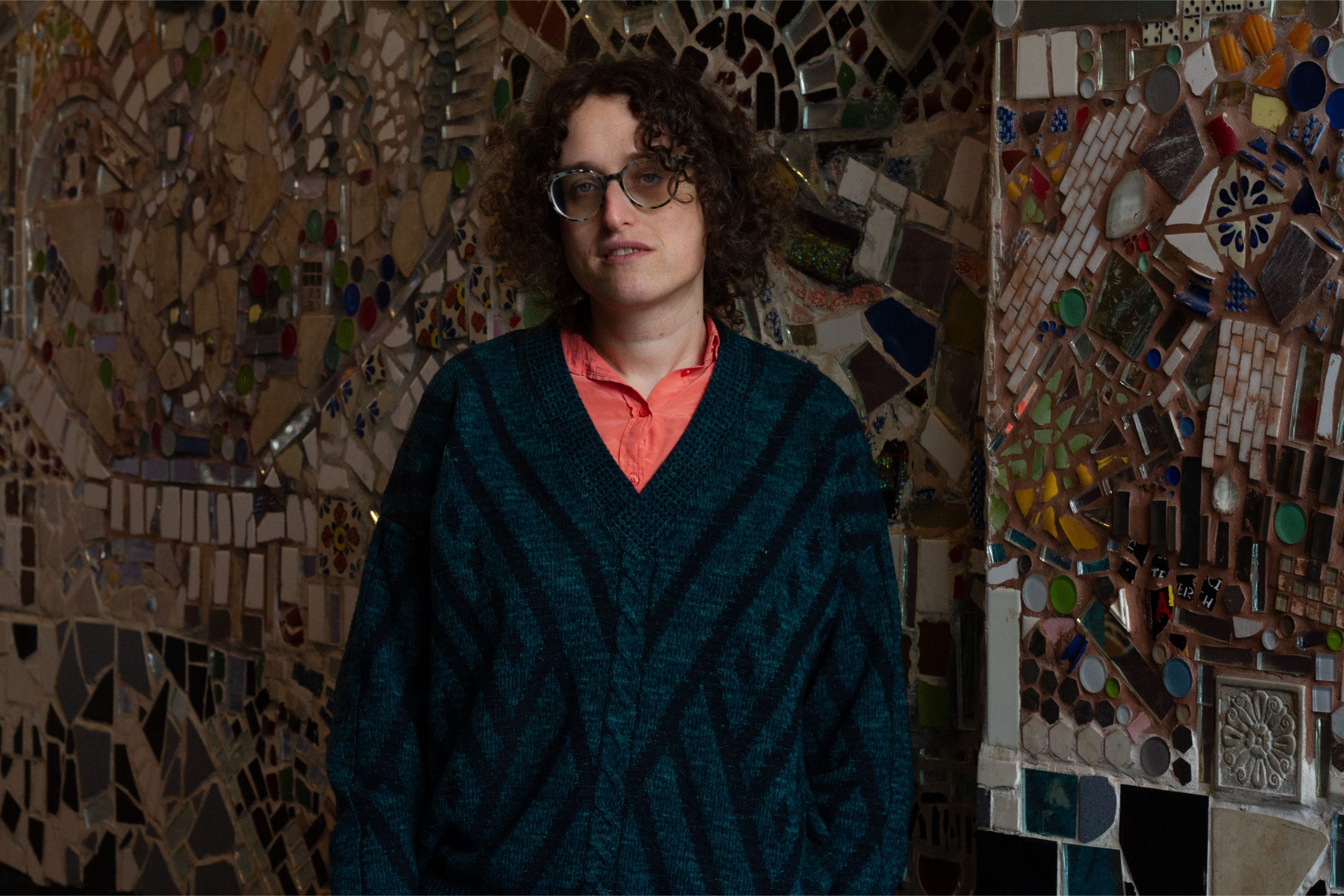
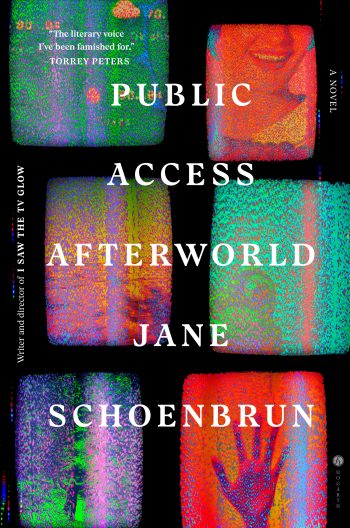
The slippage between reality and on-screen worlds fascinates Jane Schoenbrun, particularly in regards to how queer and trans folks use media as self-discovery and escape. Schoenbrun’s debut novel, Public Access Afterworld (Hogarth, 2026) keeps with themes that the writer, filmmaker, and director explored this summer in the metafictional horror-comedy Teenage Sex and Death at Camp Miasma and 2024’s I Saw the TV Glow. As Homer Simpson said of alcohol, TV is the cause of, and solution to, all of life’s problems—especially when you have gender dysphoria and don’t know it.
The first in a planned trilogy, this ambitious and fast-paced novel of speculative fiction is structured like the opening season of a TV series, with a climax that sets up the next season for higher-stakes drama when the barrier between our world and the world of television is torn. Schoenbrun remixes genres in Public Access Afterworld: cosmic horror, Cold War conspiracy thriller, messy queer coming-of-age story, and dystopian satire of the exploitative gig economy.
The three main storylines all take place at technological inflection points: In each context, the characters become almost deranged from the stress of figuring out what’s real and what isn’t. Willa, the wife of a scientist at the Manhattan Project in the 1940s, suspects she’s the subject of a psychological experiment that has something to do with mysterious transmissions from an underground portal. Teenage friends David and Erin perceive strange messages in the static as they chronicle the moment when television shifts from analog to digital broadcasting in 2009. Skipping ahead to 2026, recently transitioned Bethany seeks financial stability as a content moderator for social media conglomerate GlobalVill, only to wind up running from assassins who’ve been hired to prevent her from breaking the multiverse. Each timeline’s characters eventually intersect. The reader’s mental map might resemble a conspiracy theorist’s “crazy wall” of data points connected by a web of red strings. “I see it all now!” you might say, right before discovering that yet another character’s account of reality is unreliable.
Remarkably, the plot does not confuse but deeply, intentionally unsettles. Clever humor and non-stop adventure seduce you into bingeing a tale that might break your brain—Schoenbrun’s critique of TV in a nutshell.
We spoke over Zoom in October about the politics of content-moderation, what it’s like to tell stories on the page versus the screen, and using the narrative structure of television to critique it. Consider this your spoiler alert for the conversation ahead.
This interview has been edited for length and clarity.
The Rumpus: It was really great to read this novel. Even though it was 600 pages, it just felt like it flew right by. It was very funny and scary and exciting. I hope you also had fun writing it.
Jane Schoenbrun: So much fun. I can’t believe this is a job that you can have, telling stories that are stuck in your brain. It’s what I’ve been doing in my own mind since I was five years old. So writing the novel felt like I was finally doing what I was literally put on earth to do—to tell these long, winding stories, from inside the medium of both prose and television, but not in a straightforward way. I wanted to interrogate that form of the TV series while working halfway within it.
Rumpus: Yes, the novel reads like you have a deep love of broadcast media and an equally deep critique of it. What was it like to pivot to the written word after working in film?
Schoenbrun: This was the first time I’d had a daily creative practice that felt really beautiful. When you make a movie, there’s some of that at the beginning, but once it’s reached a point of being ready to make, it’s more like having a day job for several years. So much of the film medium is about the logistics, getting things actually produced—it’s like running a small business.
Film is very extroverted and business-oriented. You have to first craft the thing that you believe in, and then figure out how to negotiate its existence, which involves a lot of pitching and reframing. “How do I work with the actual resources I have, the reality of all of these people, all of their personalities?” It requires an intense and emotionally exhausting level of interaction with other human beings that you don’t have to do when you write a book!
Obviously there’s so much detail-oriented work that goes into writing a book, too, but this is the happiest version of existence for me—just telling stories and playing in my brain a little bit.
I was always jealous of friends who were painters, or worked in other mediums where they could just sit there every day and do the thing that brought them that feeling of creative excitement—getting to wake up, make coffee, go hang out in this imaginary world every day, and then still be at home and be able to have a life and make dinner afterwards.
Rumpus: The recurring visual motifs in the novel carry over that cinematic feel. All those circular buildings reflected the circularity you pointed to in the creation of broadcast media. I had to keep Googling whether the TV shows mentioned in the book were real, because the tropes were so recognizable. I could imagine those were real shows, even though they were not real shows, like the “HBO prestige drama about werewolves and racism”—I was screaming with laughter. Or the virality of the really dark video clips that the content moderators keep trying to get rid of that keep popping up again. Do you see a kind of self-cannibalizing, constantly repeating quality in the media that you’re portraying?
Schoenbrun: Certainly, there’s a lot of that. Whenever I’m looking right at the screen, or the glow, so to speak, in my work, I feel like there is this almost religious kind of spectacle on display and you want to fall to your knees or something. But there’s also something deeply sinister in it. The thing that’s asking for control is not necessarily to be trusted. It’s taking something from you or pulling you towards it, as much as you’re drawn towards it.
With that image, I liked that central idea as a way of talking about a lot of different things in our world of screens, but also our world of looking for ourselves outside of ourselves, in these various glowing reflections.
I think I’m constantly drawn to it because it has thus far felt like really fertile ground to dig deeper and deeper. It’s part of the structure and mythology of this book, which is the first in a trilogy, so there’s a lot that is intentionally withheld here. The actual mechanisms of what these structures are like, these are things I’ve drawn maps for.
But in the system that I craft by the end of this first book, that you catch a glimpse of when we finally do arrive in the titular space, Public Access Afterworld, you start to see that this facility is the subconscious of the universe where the things that have been moderated go. And what is extracted from them is like the signal under the signal, or the guts, that then gets moderated into digestible episodes and shuffled up towards the surface of our screens.
I’m quite proud of it. I still don’t fully understand it, but it feels intrinsically correct, in that I’ve mapped out something like a parable of what it is that we’re doing when we try to turn our experience of this world into art. Then when you add in the mechanisms of capital and entertainment, it’s something that I find to be holy and awe-inspiring and also deeply sinister.
Rumpus: Your mythology of television suggests something very extractive about how broadcast content gets created, like harvesting human energy in The Matrix. Even the word “content” sounds so much like slop. Public Access Afterworld had a bleak vision of where TV comes from that felt detached from the person “transmitting” it.
What were you thinking when you made the shows seem completely random or irrelevant to the people who were channeling them? Like, some teenage girl would channel a Dragnet knockoff—it didn’t have anything to do with their interiority or their likely cultural reference points.
Schoenbrun: It’s something to do with their unconscious, though—and maybe less of an individual unconscious, and more the ability to sense and be sensitive to the collective unconscious energies that are under the surface or moderated out of polite society. Like Chloe, who’s a 21st-century teenager channeling these 1950s detective shows that she’s never seen—I believe she says it herself, that it’s a mechanism of control. There’s something dissociative in being like, “You know the last thing I could ever be is a hard-boiled detective who solves the case in the middle of the night, least of all because I’m not a man in 1960.” But the dissociation allows some feeling of non-powerlessness or something for her.
And I think the same is true of Erin, who gets stuck reliving this manifestation of trauma and essentially rape through a “very special episode” of a 1980s sitcom [where the main character is in danger from a child-molesting school sports coach]. While not a literal representation of what Erin goes through in the novel, she’s trying to make sense of brutality and a lack of control and power. Something has been taken from her.
It’s like, “What else are we doing in 1980 when we make the real-life episode that that’s based on?” I forget which show it was, but there is a show that has one of these “very special” child molester episodes. We’re taking our individual and communal, normative fears and finding form through which to exorcise our anxiety.
Rumpus: Displacing them onto something completely different so we can process them through this show that on the surface has no relationship to our lives.
Schoenbrun: Right, and then we have Bethany working as a social media content moderator. I am proud of the way in which the book is interested in this idea of content moderation, not as a hot-button contemporary issue, but seeking to think expansively about what we mean when we talk about moderation. The literal job that she is doing is sifting through the septic tank of the internet, and disposing of what she finds, sending it away so that we don’t have to smell it.
We’ve been moderating our cities. We’ve been moderating our population. We’ve been moderating our values and sexualities—what else is America but a deeply moderated place? And that moderation is being done with a very specific image in mind of what the world should be.
Rumpus: Absolutely. It’s like burying the nuclear waste. The portal to Public Access Afterworld is literally located in Los Alamos under the Manhattan Project.
Schoenbrun: Obviously, as a minority figure, you feel this way, right? Even if it’s never said to you out loud, what is a bathroom bill except an attempt to moderate you out of existence?
But then there’s something even more perverse in how we as a culture are also fascinated by that which we’re trying to moderate.
Rumpus: Yeah, the flip side of the repression is always the fascination, like the one makes the other more exciting.
Schoenbrun: Which is why we turn it into these shitty prestige shows about werewolves and racism!
Rumpus: I have a soft spot for Chimotera, the B-movie monster who’s another recurring motif in different characters’ storylines. It’s funny and sad how he’s just another employee who’s being exploited by GlobalVill, the same social media conglomerate that Bethany works for. The blurring of the line between real and imaginary employees was very interesting to me.
In a world where we don’t even know what’s real anymore when we see a video because of AI, and simultaneously we dehumanize real people’s suffering by sharing it as memes, do we owe something to our fictional characters? Should we be treating fictional characters with more dignity? What’s justice for Chimotera?
Schoenbrun: I mean, they’re all fictional characters, right? Chimotera exists just a couple rungs down the fictional ladder in this narrative.
Rumpus: Are we fictional characters?
Schoenbrun: A lot of philosophers have stuff to say about that…!
I am quite proud of Chimotera’s section because I do think it very cleanly articulates something about neoliberalism and its reproduction of itself while draining itself of its joie de vivre. We get to see the character in the horror-movie franchise as the victim of this larger franchisement of the world, in the same way that the general store in the background of his scene becomes the Macy’s, becomes the mall, becomes the multiplex, et cetera.
I really like when he’s having his final argument with [GlobalVill CEO] Fisch, and Fisch tells him, “You’re my IP.” He’s telling him: “You are my property. And you are my intellectual property. I control not only you—I not only own the deed and rights to your likeness—I own the way that you view and experience reality. Get used to your place, buddy. Because it’s this or nothing.”
There’s something cosmic in that that I really enjoy. Without delving too deep into spoiler territory, so much of this first book is just putting the pieces on the chessboard. They all have a lot longer to go, and Chimotera especially—that’s a character that I can’t wait to keep following forever.
Rumpus: Oh, good. I felt so bad for him. I wanted him to break out of franchise hell.
Schoenbrun: Well, I guess, for him, it’ll become a question of, even, when you do break out of franchise hell—when you’ve lived and died over and over again as every possible iteration of yourself—what’s left?
Rumpus: Yes. Now he gets to join the real world in 2026 in America, which we all know is such a wonderful place.
Schoenbrun: He basically goes to AA.
Rumpus: I cannot wait.
Public Access Afterworld follows classic tropes of paranoia: the TV’s talking to me, a big government conspiracy with everyone in on it, all these characters are connected and have secret identities. When I noticed, I started to have a skeptical mindset about the world of the book. Narrators are multiply nested with everything moderated and multiple layers of unreliability:
It’s set up like, “I’m narrating this on behalf of someone else who’s telling me the TV show that they had in their head.” And a mental patient recounts that frame story.
It reminded me of the H.P. Lovecraft era of cosmic horror stories where they would give a false sense of authority by saying, “This is a manuscript that I, a reliable, normal person, found in this crypt. The crazy person who wrote it is not me.” Taking your book’s narrative at face value produces this sense of entering into a paranoid delusion. Was that the effect you wanted to have on the reader, and why?
Schoenbrun: One man’s paranoid delusion is another man’s genre TV series, though.
What you’re picking up on is something that the book is trying to do. I often describe my work as revisionist. Let’s call it revisionist television, or revisionist Spielberg. In the same way that the kids who grew up watching the classical Western being like, “Oh my god, this is my first taste of, like, the world. This is so beautiful, these myths,” are realizing twenty or thirty years later that these myths are built on a lot of really ugly, ugly things. And those things were never that hard to see in it.
I was a kid who just grew up so in love with television, and with the medium of this genre, mythological, episodic storytelling. I think I understand it. I can get under the hood and do it in a way that is gripping in the way that a Buffy or an X-Files or Game of Thrones is gripping—and I’m also deeply suspicious of it.
I’m suspicious of something that is metastasizing in our society and in our culture, this addiction to screens and to narrative. It’s a way of being trapped in an increasingly unstable and nonsensical neoliberal reality. That tension is at the heart of what the book is trying to talk about, but the only way the book knows how to talk about it, to a certain degree, is by being a TV show itself.
Rumpus: A lot of us queer and marginalized people have this really intense relationship with media, and the way that we see ourselves in it. We form these fantasy relationships with it, maybe. David Sawyer’s story arc interested me as a kind of anti-portal-fantasy critique of that. He wishes his life would become a TV show, but then ends up just being this creepy weirdo who won’t grow up.
As someone who both loves and hates media in this way, could you talk about the intense relationship that we have with escaping into fantasy, as trans people in particular. Are you trying to say, at some point, “Stop looking at the screen and start living your life?”
Schoenbrun: Yeah, yeah, I am.
It’s not that simple, obviously—I’m trying to sketch more complex interrogations into these questions which are clearly fascinating to me. David and Bethany very much are mirror characters. And the dividing line between them is that of a pre-transition mentality and a post-transition mentality.
David is doing everything he can not to look at himself. And so he’s literally like a voyeur. He’s looking at the screen and he’s looking at his best friend, Erin, who’s a girl that he can kind of play with like an action figure, and this leads him down a path towards disappearing from any possibility of having a fully embodied life as a person.
When we do find out what happened between him and Erin, this was an incredibly emotionally draining section to write for me, because it’s one of the darkest repercussions of pre-transition life. David being like, “Oh, I like this show, I don’t want to think about myself,” is the way in which he ruins Erin’s life because he can’t find magic in the real world. Through him treating other people like characters, I’m trying to articulate something that to me is a really dark symptom of repression.
I look back at some of the screenplays I was writing before I even knew I was trans and I’m just crying for help: like I’m trying to play with action figures, when I need to be the action.
And then you have Bethany, this kind of idealized hero character who, as we come to learn when she’s in the hospital, has done this really dark work of saying to herself that the thing that feels imaginary has to become real, and it can’t become real on a screen.
So I do think the book, and the series it’s a part of, is about the process of transition too. What Bethany goes through in the novel is figuring out how to be yourself in the newfound precarity and psychosis of post-transition life.
Rumpus: Bethany’s not really idealized, and I mean that in a good way. Transition solved one of her problems, but she still has a lot of other problems, which she’s totally aware of, and she’s living real life in this very messy, almost self-destructive way. But she’s going forward. She’s actually doing something. And that’s the only alternative to being in the loop, being in that endless circle that David is in and that everybody who’s screen-addicted is in.
Schoenbrun: Yeah, transition doesn’t leave her cured. It leaves her now able to confront all of the other problems that she has been avoiding looking at.
But at the same time, this first book in the series does structure her story like a hero’s journey. She is this impossible underdog with superpowers who’s able to topple a system. Part of the complication added by the nesting-doll structure of the book is that I’m very skeptical of the idea, “Oh, look, Bethany became herself and transcended all of the systemic structures that are here to stop her from doing that.” But the book kind of has its cake and eats it too, in this way where television wants her to save herself.
Rumpus: Well, I can think of no one better to save the world than us trans folks with overactive imaginations.
Schoenbrun: Sure, yeah. Let’s get on that.



Click here to subscribe today and leave your comment, or log in if you’re already a paid subscriber.