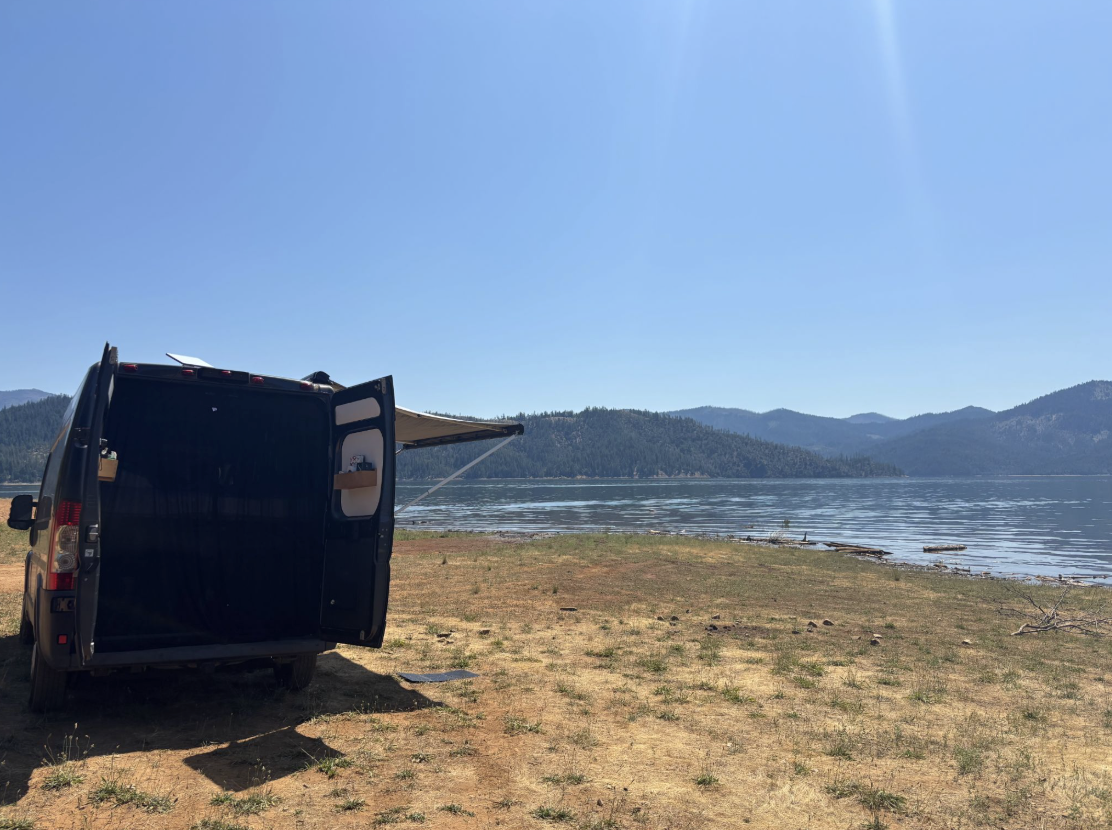
My wife and I considered abandoning our lives for the better part of a decade. We’d go camping and admire the tricked-out RVs, studying each rig’s unique quirks and explaining what we’d do if we could build our own house on wheels. Sometimes we’d eat dinner in front of a laptop so we could watch shaky, first-person YouTube tours of converted passenger vans and imagine what it might feel like to travel indefinitely. We were both college graduates with teaching jobs and a shared mortgage, but the idea of leaving that life behind struck us as both romantic and practical. Videos from the nomad community, the loosely defined cohort of folks rejecting a house and a 9-to-5 for an outfitted vehicle, espoused the benefits of living on the road. Think of all the places you’d go. Think of all the people you’d meet. Think of all the money you’d save!
More than once, the algorithm recommended a video from Bob Wells, whose channel, @CheapRVLiving, has over 850,000 subscribers, making him the closest thing the nomads have to a celebrity. Some of the appeal is thanks to his appearances in Jessica Bruder’s book about the community, Nomadland, which led to his scene-stealing cameo in Chloé Zhao’s fictionalized film adaptation. Some of it is due to his Rubber Tramp Rendezvous, an annual nomad meet-up in Arizona that The New York Times once called “a Burning Man for retirees.” But most of it is due to his commanding presence on iPhone screens: Wells, who is in his early seventies, has an endearing, grandfatherly charisma that can make nearly anything sound interesting, whether it’s explaining how to avoid attracting the attention of local police or the best way to build a $3 toilet.
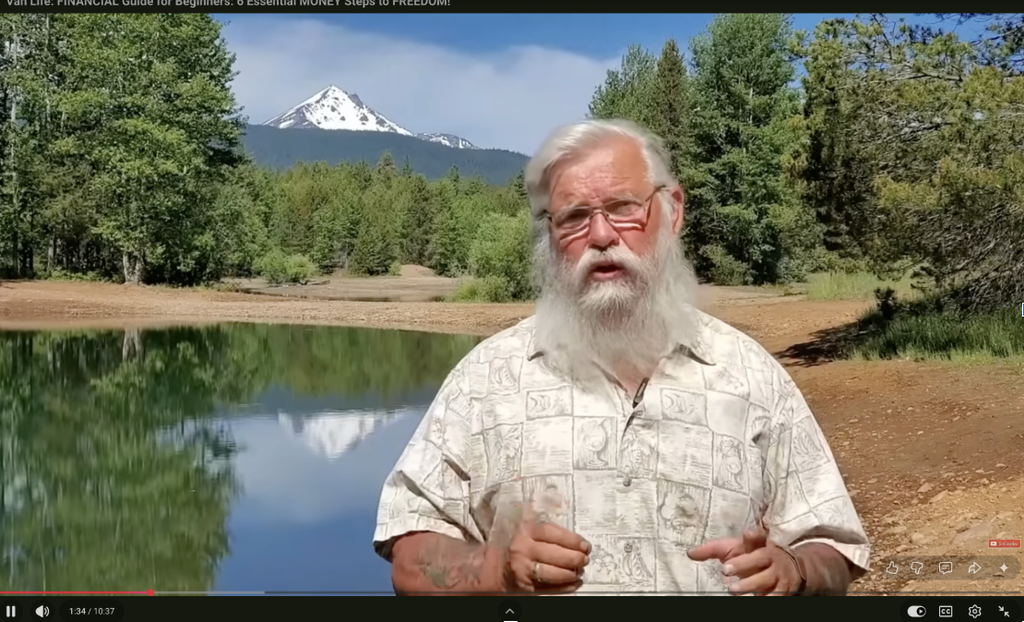
Some in the community jokingly call him “Moses,” a nickname that’s fitting for a guy with a powder-white beard and skin wrinkled from countless hours in the desert sun. But at its core, the name fits because Wells is often proselytizing, especially when addressing prospective nomads. “We can go back to our childhood sense of play and curiosity,” he says in one video in which he asks viewers to reimagine their futures. “You will live it however you want to live it, not the way your landlord or your boss tells you you have to live it.”
For a long time, the videos were a passing fascination. My wife, Sloane, and I took advantage of our teacher summers, road tripping through almost every state, though we always returned to school by the end of August. But, like many teachers, COVID changed things for us, and by the end of 2021 we wanted something else. Rather than going nomadic, we relocated, leaving education and settling in California, thinking life by the beach might be the antidote. Still, we daydreamed. We’d already sold our house and I worked fully remote. We had no children and no plans to have them. What was stopping us?
When a friend forwarded us a listing for a discounted campervan in Phoenix, we pulled the trigger before we could invent the downsides. I hopped on a one-way flight and, grinning, drove back to San Diego the same night.
Even the people confused by our plans were familiar with the model. “Vanlife,” they’d say, then mention that they’d seen it on Instagram or TikTok, that they followed an influencer who’d converted an ambulance into a house or another who’d monetized their life on the road through affiliate links. I would nod, even though I wanted to imagine our trip outside the world of hashtags and brand partnerships, of liking and subscribing. If anything, I told myself, we were hitting the road to escape the noise, not to create more. But “vanlife” was a term that made sense, and—yeah, fine—we were going to be living in a van. Who was I to get semantic?
We took two weeks to tackle the 3,000-plus miles from California to Alaska, one of the few states we’d never visited. Sometimes I wanted a hot shower or a proper desk, but what I’d sacrificed paled in comparison with what I’d gained, namely the feeling that I was getting away with something. On more than one morning, I opened our door to reveal the unencumbered wilderness of a national forest. Every time, I took a deep breath and thought of nothing at all.
Two months into our trip, Sloane had to tend to a family emergency, but I stayed back in Alaska with the van. One night, I was at a roadside bar in Cooper Landing, Alaska, watching a band struggle through a Grateful Dead cover. On my way to the bathroom, I noticed a poster for something called Vanstock, a festival a few hours to the north focused on “Community—Tiny Living—Camping—Sustainability.” The keynote speaker was Bob Wells, the man at least partially responsible for my presence in Alaska. I instantly made plans to be there, eager to hear what else Moses had to say.
***
We pulled up to Vanstock on Friday evening and walked the grounds—a working bison farm—to the sounds of a honky-tonk act kicking off the weekend’s music. I eventually found the dance floor, scattered with 30 strangers tentatively moving their bodies. Most stood on their own islands, awkwardly too far from both the band and other people; several wore air traffic controller headphones. One man jumped up-and-down in place, though it was consistently off-beat, gleeful as his unbuttoned dress shirt waved in the air like a cape. In between songs, he’d prop one of his legs on a nearby fence and stretch his hamstrings, then, when the band started up again, he’d rush back to the center of the dancefloor and hop back onto his invisible pogo stick.
I’m not suggesting I was any less awkward. I was off to the side, taking notes from my camping chair and telling myself that I needed the distance to accurately report. In reality, I was also uneasy, surprised by how any social skills I’d developed over my 37 years seemed to have evaporated on the Alcan Highway. The only reassuring thing was realizing I wasn’t alone. Everyone at Vanstock had emerged from weeks in relative solitude, on long stretches of pavement, aimlessly searching for the next place to hide. Understandably, it took a little time to readjust to the light.
The next morning, I sat in on “Rooted While Roaming: Stress Reduction While Traveling,” the day’s first seminar. The crowd of twenty volunteered the many problems they’d encountered on the road, including sussing out unfamiliar locations, avoiding police and park rangers, and the difficulty in maintaining a healthy diet. One woman said the problems on the road were nothing compared to the day job she’d “escaped;” another detailed the process of removing cat puke from her RV’s carpeting. A thin man in his twenties with platinum blond hair and fingerless gloves explained that he often worked through his anxiety by singing songs from Frozen. “Bob Wells videos help, too,” he added, and people nodded in agreement.
I perused the Free People’s Market for handmade crafts and listened to a seminar on installing solar panels. I had my palm read by a woman who asked if it was all right that she hit her vape to get things started. (“Helps open the channel,” she explained.) I beat the shit out of a bongo in the drum circle and, afterward, thanked the facilitator for such an energizing 45 minutes. “And thank you for your spirit!” she said.
Eventually, I found the Camper Show, where attendees opened the doors of their rigs for curious passersby. At the end of the line was Sherry and Andy Chidwick’s bright yellow overlander, a hulking Mitsubishi Fuso box truck they’d nicknamed Walter. The vehicle was adorned with graphics: silhouettes of evergreens, an outline of a mountain range, and the icons for YouTube, Instagram, and Facebook. The only visible text read “Nomadic MidLife.”
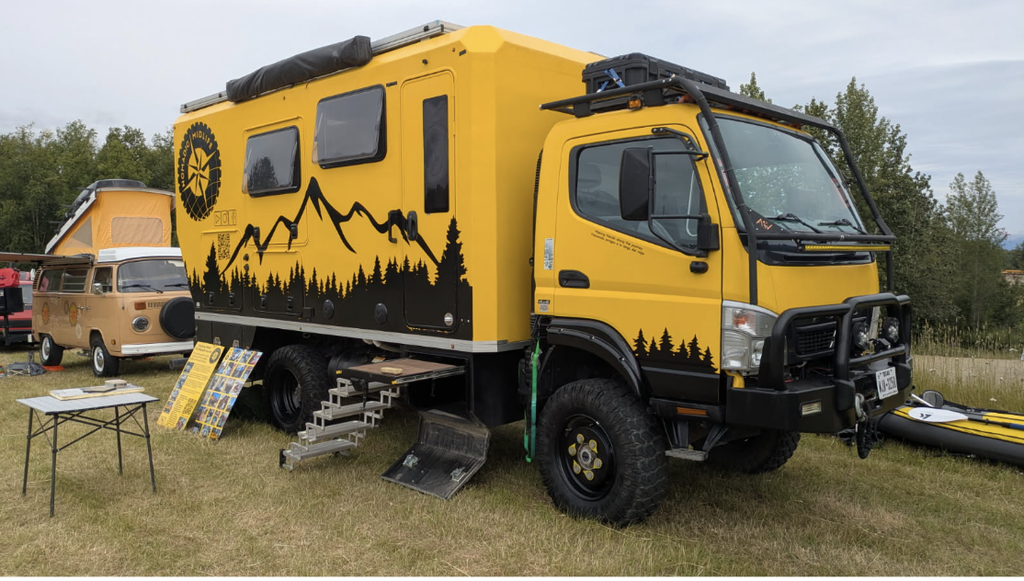
I sat down in their living room/bedroom/kitchen, which could’ve been confused for a chic Airbnb thanks to the bookshelves, potted plants, and ample natural light. The married couple, who are in their mid-fifties but have the wide-eyed enthusiasm of twenty-something backpackers, smiled when I told them I’d been a teacher. “COVID was the great disruptor, right?” Sherry said. It turned out the couple had worked at a school in Oregon before shacking up in the truck. “Teaching became almost untenable, and we began to question, because we learned we can question things. You know, before you don’t question anything, you just keep going, keep going, keep going. We stopped and questioned, Is this what we want to do? Are there any other options?”
Their stress was only compounded by their living situation: residing in Oregon but frequently shuttling back to Montana to care for Andy’s dying father. “That threw us into a season of reactionary chaos,” Andy told me. Ultimately, it also offered perspective: If they wanted the life they’d imagined when they were younger, they needed to do it as soon as possible. They purchased the truck, and Sherry took a job selling dishwashers in Montana. Andy, meanwhile, got to work stripping the truck’s box from its bed and fabricating a custom camper to replace it. After two years of prep work, they hit the road indefinitely. “We can’t go back,” Andy said. “We have broken the ties so much that we are now better off finding alternative paths.” He sounded excited.
Mark Pankey felt similarly liberated. Before going full nomad, he lived in a proper house in Crested Butte, Colorado. He worked as a commercial pilot for Southwest Airlines, so he’d drive into Denver and crash at a hotel between shifts. Eventually, he grew tired of the cost and began sleeping in a van about the size of your local Amazon driver’s. The experience convinced him that his Crested Butte home was excessive, and he began joking with co-workers about selling it and living in one of the airline’s snack trucks. Months later, one went up for auction, and Pankey won it for $3,300, then quickly got to work remodeling. I stared up in awe at the result: a massive mountain home on wheels, with wood siding, a deck with a propane grill, and a pair of antlers hanging above the backdoor. He’d christened it the SnakPak as an homage to its origins.

“I used to fly fighters in the Air Force, so I always had a plan,” the 53-year-old told me. “Always very rigid, to a T. Got to get up, got a time frame, got a plan, got to know what we’re doing, you know, because that was my life.” When he went on medical leave, he decided he should fully embrace the unexpected on the road. “I didn’t even know what I was missing. I wake up every day stoked. I’m like: something cool’s going to happen.”

Danielle Cochran and I shared a picnic table for lunch and talked about our respective drives up from San Diego. The 38-year-old was on a tight budget, but told me she’d gotten a free pass for Vanstock by offering to lead a high-intensity workout on Sunday morning. In her previous life, she ran a fitness studio from her cargo van, leading workouts and coaching clients in parks and public spaces, but managing her own business quickly became all-encompassing; there was a life out there somewhere, one that didn’t require invoices and permits. Nomadland convinced her that life on the road was a way out of that endless grind, and a few Wells tutorials showed her how to turn her work van into a home. The initial plan was just a few months, but by the time we met, the arbitrary deadline had expired. She hadn’t set a new one. “There’s this freedom to it I don’t think I had ever experienced before,” she told me.
*
Wells was the reason most of the festival’s attendees were traveling, so it was no surprise that his keynote was the best attended event by a few hundred people. If you were a total outsider—“a carpet walker,” in the parlance of some nomads—you might’ve been confused why we were waiting to hear from the stout man in Walmart pants holding a dollar store notebook, but everyone there eagerly anticipated his words. “I better not blither on too long,” Wells said as he gathered his notes.
“Please, blither on!” a woman in the back shouted.
I expected Wells to launch into an inspirational speech about the nomadic life, one that—like his many YouTube monologues or his appearance in Nomadland—affirmed our collective decision to abandon the rat race for a more fulfilling life on the road. But the man of the hour didn’t want to talk about the road; he wanted to talk about buying land.
Many issues experienced by nomads, Wells said, could be resolved by the purchase of a tiny plot. The most consequential issue he noted, though, was climate change. “I’m not a crazy prepper, but I am a prepper,” he said. Wells believes living a nomadic life to be one of the best things you could do to combat climate change—in his estimation, people who live in their vehicles emit less carbon than those who live in traditional homes—but he emphasized that they needed to do more to prepare for imminent collapse. The first step? Land. “As things get worse in this slow-motion catastrophe,” he said nonchalantly, “you’ll have a place to go.”
Wells recommended Arizona or Oregon, stressed the importance of water sources, and noted that someone could buy a remote plot for as little as $2,000. Someone across from me laughed at the thought of having that much liquid cash.
Summer 2025 had brought previews of the “slow-motion catastrophe” Wells described. In July, torrential rains flooded the Texas Hill Country, killing 137 people. A few days before Vanstock began, social media was overrun with surreal videos of New York City subway stations under water. And, of course, anyone who’d missed those reports could’ve driven an hour north, up Route 1, to witness the rapidly vanishing Matanuska Glacier for themselves.
But the nomads I spoke with after Wells’s keynote weren’t convinced that the guru had come to the right conclusion. Weren’t we here to celebrate the freedom of the nomadic lifestyle? What did we care about societal collapse—wouldn’t that be a good thing? After decades claiming that a nomadic existence on the road was the only way to be truly free, Wells was now hocking the benefits of land ownership. He didn’t sound like a philosopher; he sounded like a realtor.
Vanstock’s headliner had encouraged attendees to prepare for the end of the world, but the festival still trudged on with its teach-ins and half-hearted freak-outs as if nothing had changed. I met a young couple raising their one-year-old in a school bus and a man who went by “the Tie-Dye Guy.” At one point, I watched the thin man from the stress seminar, the guy who sang Frozen songs to himself, don a rubber monkey mask and begin prowling the fairgrounds on all fours. A friend of the monkey doubled over in laughter.
Lindra Paradise, the 29-year-old organizer of the festival, was grateful that Wells had spoken his mind, but disagreed. In her opinion, dooming about the end of the world was pointless. “If the Earth wants to wipe us out,” she told me, “she’s gonna wipe us out!”
After struggling with mental health issues as a teenager, Paradise left Alaska at 22, driving to San Diego in six days before speeding east to Arizona, where she heard Bob Wells speak at the Rubber Tramp Rendezvous. It was there, for the first time, she realized she was not alone. Since then, she’d spent her life on the road, on her own terms. For her, “climate change” was real, though “climate collapse” still seemed abstract. That is on par with most Americans: According to a 2024 Pew report, only 23 percent expect to make major sacrifices in their daily lives due to climate change.
Paradise believed that the Earth was in a “paradigm shift,” but it wasn’t all bad. “People are waking up to what they need. People are waking up [to the fact] that they don’t want to be unhappy anymore. People are realizing that they can have control over their own reality.” Paradise had already escaped the claustrophobic, fear-based life. Why would she ever choose to live that way again? “I’m personally blissfully happy and completely not concerned.” She chuckled. “And it feels really good.”
*
My wife and I left Alaska in September to outrun the cold, heading south to explore some of the country’s other hideaways. We spent a few weeks in a Montana forest and eventually found ourselves in the West Texas desert, sharing pizza with wide-eyed libertarians building an adobe compound. When friends called to see what we’d gotten up to, I didn’t know where to begin. “It’s been wild,” I’d say.
The more time we spent on the road, though, the more we saw the whole picture. One minute we’d feel light-years away from society, the next we’d be thrust back into its fluorescent lights and recycled air. There was a day spent driving past a herd of bison followed by a night spent sleeping in a Walmart parking lot. An evening studying the Great Sand Dunes, a morning replying to asinine emails. No matter how much I wanted to believe otherwise, I learned that there was no such thing as escape.
“You can’t get away from it,” Wells told me in November. I’d driven to Quartzsite hoping he’d invite me to his prepper plot for our interview, but instead he suggested somewhere a bit fancier: the parking lot of the Carl’s Jr. “When society stops, when they’re no longer paving the roads because all the states are broke—when the machine grinds to a halt—you’re not going to be able to drive anymore anyway.”
Wells’s concerns about climate change aren’t new. He’s been writing about prepping for “TEOTWAWKI” (The End of The World as We Know It) on his blog for well over a decade and, in more recent years, has posted numerous videos that mirrored his Vanstock speech. But he understands why newer nomads might not be willing to hear this aspect of his philosophy, even if they take the rest as gospel. “Everyone just thinks it’s going to be so far away,” he said.
Wells is worried that major catastrophes are likely by 2050, if not sooner. Water and gas will become scarce. Travel, nearly impossible. For him, prepping isn’t paranoid; it’s logical. And, he emphasized, it allows him to help others, especially other nomads, though he’s also more than prepared to protect himself. “If someone comes and asks, then I give,” he said. “Someone comes and demands, then the gun comes out.”
He estimates the setup on his 20-acre plot will keep him comfortable. He’s already erected an insulated shed with solar panels and purchased 12 months’ worth of freeze-dried meals. In the near future, he’ll add a 2,500-gallon water storage, rain catchment, wood stove, and 300-gallon propane tank. If all goes according to plan, someone passing by could easily mistake the structure for a traditional home.
*
By the time winter hit, my wife and I had made our way back to California to look for an apartment. We eventually found a one-bedroom that was small by most people’s standards but, after six months living in 80 square feet, it felt like a mansion. We’d sometimes point to our newly acquired modern conveniences and say their names in amazement: Table! Couch! Microwave!
Still, when I checked in with the other nomads I’d met at Vanstock, I couldn’t help feeling a little jealous. They were still in the thick of it, still trying to duck the pull of modern life. When I spoke with Danielle Cochran in December, she’d been boondocking on federal land in New Mexico for several weeks. At that point, she’d been nomadic for a year and a half and was still unsure when, if ever, she’d quit. Though she’d been intrigued by what Wells had to say at Vanstock, she believed there were other dangers more pressing than climate change. “Just in the last year, things in the U.S. have changed pretty drastically,” she told me. Buying land wasn’t her idea of “prepping”—leaving the country was.
The Chidwicks called me from an airport in Taiwan, where they planned to backpack for the next month before heading to China. Their trusty rig, Walter the Mitsubishi, was temporarily parked back in the States. Somehow, they sounded even more energized than when we’d first met. Wells’s recommendation to buy land, though, was not something they were seriously considering. Climate change was indeed at the top of their minds—Typhoon Kalmaegi had hit the Philippines during their month-long stay there, killing hundreds—but the couple was still going to travel, albeit more slowly, to cut down on their energy usage and more authentically experience the places they were seeing. In their mind, that kind of travel actually made them more agile in an emergency. Unlike Wells, they were not interested in hiding out somewhere in America and had no plans for prepping, at least not in the traditional sense. “Is it actually a prepper mindset in that we’re prepared for anything?” Sherry asked.
Of the nomads I kept in touch with, Mark Pankey was the only one actively pursuing a plot of land, though his decision had nothing to do with Bob Wells—or climate change. Pankey loved the nomadic life so much that he was looking for a way to improve it. There were finite limits for camping on federal land, so the undeveloped wilderness of the United States would always be an imperfect home for him and his compatriots. “You’re always having it in the back of your mind. Well, we can’t stay here forever. We’ve got to move on again and again and again. And I just thought it’d be cool if you had a place where you don’t have to worry about that. You could just hang out.”
That was part of the reason why, after leaving Alaska, he took the SnakPak down to South America. When we caught up in January, he was in Chile, outside the Atacama Desert, almost at the end of the Pan-American Highway, a stretch of 19,000 miles that runs from Alaska to Argentina. The trip was partially a bucket list item, as it is for many nomads, but it was also a scout mission: he was searching for property. He hadn’t found anything yet, but he knew it would be something in nature, something that felt healing, something, he emphasized, that would be far, far away from the cell towers.
As we spoke, he tried to describe his ultimate vision. Maybe it would be a few wooden platforms and some fire pits. Maybe it would be something more professional, something like a proper hostel. Or maybe, he thought, it would look something like a commune, with like-minded nomads contributing their unique skills toward a common purpose. Something, maybe, like a society.