
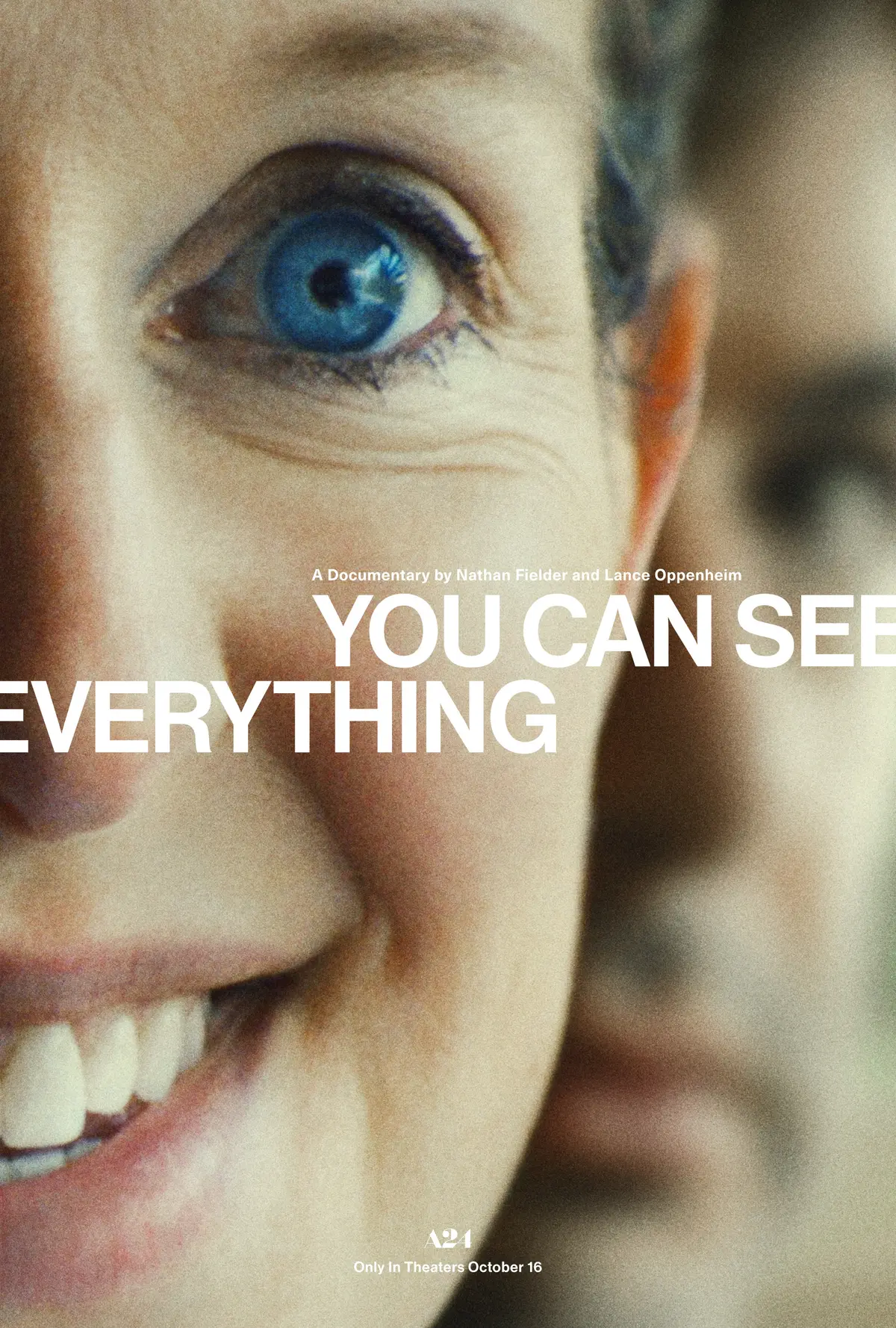
In a rented luxury property, a clean-cut TV host confronts a supposedly nefarious individual, backed by a camera crew and a catalogue of their misdeeds. This is the premise of To Catch a Predator (2004–2007), the pedophile-busting reality TV phenomenon hosted by Chris Hansen—around whose chiseled visage Lance Oppenheim, the wunderkind-ish documentarian, constructs the downward spiral of Primetime, his first narrative feature. It is also the premise, more or less, of You Can See Everything, Oppenheim and Nathan Fielder’s mind-boggling, years-in-the-making documentary portrait of Theranos founder and convicted fraudster Elizabeth Holmes. Released within weeks of one another, You Can See Everything and Primetime, both A24 productions, push up provocatively against the limits of what a camera can, and cannot, do.
Like To Catch a Predator, You Can See Everything, at least initially, takes the form of an intellectual showdown, with Fielder acting as on-screen interlocutor for Holmes and, uncharacteristically for the autistic-coded comedian, the point of identification for audiences—but this is no ambush. Quite the contrary: The disgraced CEO and her odious fiancé, bro-ey hotel scion Billy Evans, invited the filmmakers into their residence, an unpersonalized beachfront rental in the upper-crust enclave of Del Mar, San Diego County, to document their lives in the 34-day period leading up to Holmes’s imprisonment. She commenced her 11-year sentence at the end of May 2023, convicted of defrauding Theranos investors, in cahoots with her odious ex-boyfriend, Ramesh “Sunny” Balwani, to the tune of nearly half a billion dollars.
Holmes and her current beau had approached A24 firm in the belief that putting themselves forward for cinematic scrutiny, an act of “radical transparency,” as Billy terms it, could burnish Holmes’s blackened reputation. (A shower scene in the resultant film showing a post-workout Billy in the buff can only be there to underscore, with a wink, the perverse promise of its title.) Presumably the pair were also looking to get the word out about the diagnostics startup they have, shockingly, been cooking up, this one hinging on laser beam technology. Lest their desire to open their home to a film crew be read as commensurate with “having nothing to hide,” recall that Robert Durst, real estate heir and a murderer three times over, was the one who reached out to Andrew Jarecki, maker of The Jinx (2015), the miniseries that ultimately exposed his crimes. In court and perhaps in their own souls, guilty people have more to prove.
And yet, as the film itself acknowledges, the couple’s choice to involve Fielder of all people in their big-swing crisis PR strategy is next to bonkers. Reportedly, Holmes and Evans were looking specifically for people “who think outside the box”: While the man who pioneered such concepts as poo-flavored froyo unquestionably fits that bill, even the most cursory Google search would identify Fielder as someone whose artistic goals are largely inimical to making people—himself included—look good. He’s practically the Diane Arbus of reality television, not to mention, something of a con artist himself. But what do I know about blue-sky, Silicon Valley thinking? I’ve never been the world’s youngest self-made woman billionaire. And Holmes, unlike the pliable participants in The Rehearsal (2022–) and Nathan for You (2013–2017)—and unlike the chumps ensnared by Chris Hansen’s gotcha journalism—is by all appearances a highly skilled dissembler.
Not since Close-Up (1990), Abbas Kiarostami’s landmark reconstruction of a scam, has a film posed such a philosophically rich puzzle in terms of both its genesis and its form. The setting is aptly purgatorial: The Del Mar property’s windows appear on screen as blown-out rectangles of light, the view effaced, as if the house, and its occupants, existed on another spatiotemporal plane. (When the family does venture outside, down to the water, the weather is uniformly gusty and gray, and there are no other beachgoers in sight.) Draped on the couch in jeans and a cozy, camel-colored sweater, her hair worn loose and unstraightened—the fried blonde bun is no more—is Elizabeth Holmes. This woman is barely recognizable as the Yoda-quoting girlboss of Theranos, whose svelte black turtleneck and red lipstick could never quite neutralize her gawkiness. After seven years out of the public eye, Holmes reemerges thoroughly Goop-ified, as “Liz,” devoted partner and mother of two young children (though evidently not a homemaker: in one scene, she exhibits a memorably ineffective method of scrambling eggs). She is de-glammed, but as a martyr, not penitent.
“I’m always being real,” Liz tells Nathan, her shining blue saucer eyes wide and unblinking, as if by denying herself those imperceptible nanoseconds of private darkness she could have nowhere to conceal any secrets. Often, she’s framed in eerie close-up by cinematographer David Bolen—who also shot Primetime and has worked with Oppenheim since his 2020 debut, Some Kind of Heaven. Through Bolen’s lens, Holmes’s features look artificially augmented, fixed in a dewy mask of virtuous sincerity: a face that has launched a thousand memes and TikTok parodies. She has a tendency to nod along with conversation, like a beatific bobblehead, even after the other person has ceased talking. The combined effect is otherworldly.
Bolen shot the film in the boxy 4:3 ratio, so in close-ups, a face fills the frame, every flickering shift in expression more fodder for analysis: you can see everything. One of the film’s more bizarre scenes finds Holmes encircled by a rig containing 220 cameras: Her arms extended, Christ-like, she is photographed from all angles, nominally so Billy can generate an AI Liz to keep the kids company in her extended absence. But a camera (or hundreds of cameras) cannot recreate a mother, and it cannot capture truth, only light. The film’s title is a tease—Fielder and Oppenheim know it, and are haunted by it.
Midway through You Can See Everything, Holmes goes to prison, her departure inaugurating the film’s second movement. Unfolding over several years, taking audiences nearly up to the present day, it is a self-reflexive interrogation of the first movement—the filmmakers’ attempt to parse what just happened, and why; in effect, an inversion of the premise of The Rehearsal—as well as a continuation of the narrative. To elaborate further would be a disservice to those yet to see the film; suffice it to say, it’s at this point that Billy emerges as not just kind of a jerk but also the villain of the piece. Increasingly, he attempts to hold Nathan at arm’s length (perhaps his most comprehensible move); at the same time, he appears to be remotely exercising a control over Liz that recalls the abusive dynamic of her relationship with Balwani, a toxic mix of gooey, spiritually inflected sentiment and aggressive coercion.
But no one is above suspicion in this Rorschach test of a film, its makers included. While Elizabeth’s face is bathed in warm light, Nathan’s is often occluded by shadow: Sometimes he looks like a noir detective, sometimes a malicious force, awkwardly imposing himself on a family mourning its imminent separation. His investment in the project is something that the film problematizes too: a throughline of Fielder’s non-fictive work. Despite his articulated belief that Holmes is “a liar”—a serious allegation lodged in the most childish of terms—he evidently feels some measure of sympathy for her. To spend time with someone, especially on such intimate terms, is to humanize them. (And presumably Fielder couldn’t help but be a little in thrall to someone whose poker face is even greater than his own.) But how might this sympathy for Liz have colored the film, altered its serpentine course—and, in turn, how might the film, likely Oscars-bound and already breaking box office records for documentary, alter the fortunes of its subjects?
“What would’ve happened if I wasn’t here?” Chris Hansen’s question is rhetorical, a reproach rather than a genuine inquiry. Blindsided, the would-be predators he confronted for the Dateline NBC cameras didn’t typically have anything insightful to say, anyway. But in the case of Bill Conradt, a Texas assistant DA whose chatroom logs revealed sexual desires outside the bounds of the law, a travesty of procedure would expose the ethically clouded flipside of the pat implied answer: On November 5, 2006, with his home surrounded by police, To Catch a Predator personnel and associates, and, for some reason, a SWAT team, Conradt fatally shot himself. In both its methodology and disastrous outcome, this sting operation did not adhere to the TCAP formula. Dateline aired the segment anyway.
The incident was anatomized by Luke Dittrich in a 2007 feature for Esquire, “Tonight on Dateline This Man Will Die,” the basis for Ajon Singh’s Primetime script. Alex Winter, far from the dopey youth of Bill & Ted, plays Conradt; Robert Pattinson is Hansen, rendered as a queasy mix of noble-minded journalist (albeit blinkered) and recognition-hungry showman, flattening his British accent into a canny, nasal caricature of the real man’s. “I will undress you… and you will undress me,” he recites in the opening scene, carefully, repeating it like a mantra. He’s in the bathroom at a sting house in Long Beach, California, rehearsing selections from the transcript of a chat between two adults, one of whom was masquerading as a sexually available minor, with which he will shortly taunt the illicitly lusty party. The combination of the repetition with the “backstage” setting foregrounds the tawdry pageantry of the show and its model of justice.
TCAP justified itself in part as an exercise in understanding the predatorial mind—why do they do it?—without ever really delivering an answer. Primetime is interested in why Chris Hansen did what he did. Like Fielder, albeit working in a different arena, he made his name pulling the rug out from under people via elaborate scenarios staged for television. But Fielder’s work, You Can See Everything included, leans into ethical quandary and discomfort; TCAP, by contrast, presented a black-and-white moral universe, where “predators” are bad and the people who catch them are good. Pattinson’s character is accordingly obsessed with being seen as heroic, and it is precisely for this reason that he comes off as the opposite—not evil, but pathetic.
Where TCAP sensationalized pedophilia, Primetime—made entirely without the cooperation of Hansen and the various people involved (with the curious exception of NBC exec Jeff Zucker, who plays himself)—sensationalizes the show’s host, mocking his pretensions to seriousness. When a vending machine refuses to yield his purchase of a Rice Krispies Treat, the snack still trapped in its coil, he calls the listed number to complain. “Hello, this is Chris Hansen from Dateline NBC,” he says tersely. When a National Enquirer reporter phones and threatens to reveal his extramarital affair, he flounders and hangs up on him. This is a man derailed by any deviation from the path he’s envisioned; unlike Fielder, he struggles going off script. Nevertheless, Chris remains fully committed to the bit: “Nothing I do is acting,” he instructs one of the show’s “decoys,” echoing Holmes. I guess it’s true that people who are always acting also never are: By way of a Baudrillardian maneuver, the persona supplants the self. (Nearly two decades on from the end of TCAP, Hansen persists in his pedo obsession, currently manifesting as Takedown with Chris Hansen, a series hosted on his two-bit streaming service, TruBlu.)
Oppenheim positions his Hansen as representative of a certain ugly tendency in mass media: With a big nod to Billy Wilder’s Ace in the Hole (1951), the film is a cautionary tale about journalistic principle corrupted by the allure of the perfect story—a particularly juicy theme for a documentary filmmaker. Chris’s obsession with bagging the chatroom lurker who turns out to be old Bill Conradt is based on the mistaken assumption that he’s some government bigwig, “a whale,” whose ousting will put a fat spike in the show’s Nielsen ratings. His Moby Dick proves a mythical beast. How could it be otherwise?
When it’s decided that the SWAT team will enter Conradt’s home to arrest him, the TCAP producer frets that she’ll be denied her money shot. The call goes out for “cameras on guns!” This crude weaponization of the cinematic apparatus recalls Michael Powell’s Peeping Tom, in which a serial killer stalks London looking for victims to slay on camera, his weapon of choice, a blade concealed in the leg of his tripod. Reviled at the time of its 1960 release, the film nearly destroyed Powell’s career—a reflection of the fact that people generally do not like being alerted to, let alone made explicitly complicit in, the violence latent in cinematic voyeurism. In Conradt’s case, the real-life district judge who signed the search warrant postulated that, were the cameras not present, the man might still be alive.
A camera has always afforded its user a certain kind of license—not just to solicit the attention of others or enter through otherwise closed doors, but to step outside of the flow of “real life” and so transform it. In Primetime, Oppenheim emphasizes the camera’s destructive-creative power; how its presence can become an excuse to ruthlessly remodel facts in the Platonic image of a scandal. Picking up 17 years later, You Can See Everything dwells in the aftermath of a scandal, in an era when cameras are constantly present, even to the dystopian point of being wearable in glasses form. In this more contemporary context, Oppenheim and Fielder find that the machine can only penetrate skin-deep as its unblinking gaze meets that of another. After all, to be on camera is, in a sense, to be acting—and if we’re always acting, then we never are.




Click here to subscribe today and leave your comment, or log in if you’re already a paid subscriber.