
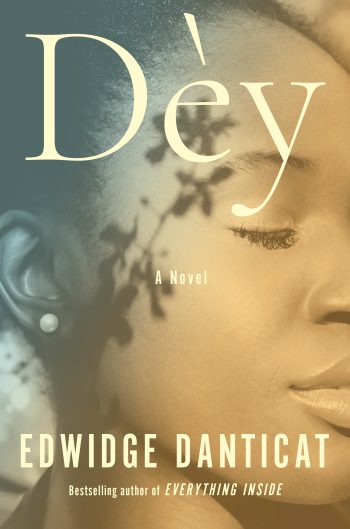
In her newest novel, Dèy (Knopf, 2026) by Edwidge Danticat, she flips the typical novel structure, anchoring readers into heightened tension right away: an unidentified shooter in a Miami mall has shoppers, including the narrator, Magnolia, running and seeking cover. As Magnolia cowers on the floor with a dozen “panicked diners and shoppers” at a restaurant, aptly named Oasis, we want to look away and seek the resolution, but the first-person present-point-of-view forces us to stay inside the tension and witness the realities that many victims of mass violence might endure. We hear the shots fired, the panic in everyone’s voice as they wait to die or be rescued, the police over the speaker system, and the encroaching sirens. This fear grates on our numbness.
When Magnolia leaves the mall, shaken but relieved to be alive, the tension doesn’t dissipate; it’s buried internally, where it crashes against her daily life, threatening everything she knows and loves. How does Magnolia recover? By allowing her community to rescue her. How do readers recover? By dwelling in the complexities of the novel, and not asking for the writer, or the novel’s narrator, Magnolia, for quick solutions.
It was such a pleasure speaking to Edwidge Danticat over Zoom. I have adored Danticat’s writing since college when I read her first novel, Breath, Eyes, Memory (Soho Press, 2015). I remained a steadfast fan of all of her books, her activism, community support, and charity for twenty years.
Murray: In your essay collection, We’re Alone (Graywolf Press, 2025), you wrote about being forced to shelter in place while at a mall in Miami because there was a mass shooting that turned out to be a hoax. In your novel, Dèy, you used this premise to tell another story—what if the mass shooting did happen? Can you talk about moving from nonfiction to fiction and crafting two different realities?
Danticat: In December 2017, when this happened, I was at Aventura Mall in Miami when I suddenly heard what sounded like gunshots. I ran and hid behind a bush near the parking garage. When things calmed down, I called my niece who lived nearby to pick me up, and when I got in the back seat of her car, I started sobbing. Later we found out it wasn’t real, but all the feelings of fright and flight were real. The Marjory Stoneman Douglas High School shooting in Parkland happened a few weeks later, on Valentine’s Day. I started writing an essay about these two incidents to understand both better, especially as my daughters and their friends were doing active shooter drills at school and attending March For Our Lives rallies some weekends. At the same time, there were growing instances of massacres in Haiti by armed groups, which got more intense over time. I was starting to hear more and more of those stories from family members who were moving to different areas in Port-au-Prince, so the precarity and a constant lack of safety were so much on my mind. Going from fiction to nonfiction allowed me to dig deeper into the aftermath of these types of events, not only the loss of a sense of safety but a lingering guilt too, as Magnolia has. In Magnolia’s case, she chooses not to tell her loved ones about her ordeal because she’d rather not deal with it, but I’d like to think that through the magic of fiction she chooses the reader as her confidante. She’s confiding in you, in us.
Murray: In the first scene of your novel, we meet Magnolia. She runs into a restaurant inside the mall to shelter in place with a few people. Unaware of the mass shooter’s location, they are all crouching down, waiting for their potential death or to be rescued. The pain and fear are loud, disheartening, and gripping, but when she leaves that mall alive, the pain becomes subtle and silent.
Danticat: That first scene is a defining moment in Magnolia’s life, so I wanted to open the novel with it. I also like starting my stories in medias res, in the middle of things, because that’s how life is sometimes. Ordinary days can turn into extraordinary ones in a second. I also find it interesting to write about a character like Magnolia, who’s juggling so many things at once that she has to be forced to pause. This incident forces her to pause and pushes her to reflect on many different parts of her life. We’ve all heard stories of people who become mute after tragedies. I think of I Know Why the Caged Bird Sings, a very important book for me, and how young Maya Angelou doesn’t speak for years after she’s sexually abused and her uncles kill her abuser. A kind of selective muteness happens to Magnolia on the subject of the mall shooting as she delays telling those closest to her. She’s slowly realizing how physically close she was to the shooter before he began his rampage, how they might have even brushed past each other at one point. Part of healing is telling your story. In the book, Magnolia’s working through ways of telling her story, which starts with her telling the scariest version to herself.
Murray: Unfortunately, I have become so detached from reading about mass shootings that I could not understand Magnolia’s post-traumatic anxieties and fears, and then I realized I’d become numb to violence. This is one of the novel’s main premises: to go beyond the mass shooting headlines and see how these violent acts affect the individual, their relationship with their friends and family, and to make us less apathetic.
Danticat: With overexposure, we can of course become desensitized. How can even the most sensitive and caring person live in a constant state of grief, every single hour of every single day? I don’t think our bodies or minds could take it. Magnolia guilt-trips herself for reacting so strongly given her luck and relative safety. She’s like, “What’s your problem? You didn’t die. Other people died. Other people are dying in other incidents, in other places.” With social media and people’s ability to narrate and show certain events directly to us, we’ve all been made witnesses to things that might haunt us for the rest of our lives. Some can look away while others don’t have that luxury. I think it’s a kind of revelation to Magnolia that she’s part of the latter group.
Murray: What happens to us as a society when we’re numb from the pain and violence?
Danticat: We’re also seeing that desensitization in the immigration space right now. In 2004, when my 81-year-old uncle died while in DHS custody, it was seen as something that shouldn’t have happened. I wrote about some of this in my memoir Brother, I’m Dying (Vintage, 2008). Soon after he and others died in similar conditions, there was a Department of Homeland Security investigation, a Washington Post investigation, and a House Immigration Subcommittee Hearing on immigration detainee medical care where some family members, including myself, testified. 60 Minutes did a segment on some of those cases, including ours.
Now you hear about people dying in ICE custody all the time, and nothing seems to happen. Often after these deaths, DHS releases statements listing offenses previously committed by that person or declaring that this was an awful person who was, in their words, illegal, as if to imply that these people deserved to die. A few months ago, a Haitian man, Emmanuel Damas, died from an infection after complaining about a toothache for weeks at a detention center in Arizona. I recently read that ICE will soon have electric shock gloves. How can that not be torture?
There’s an overall desensitization to people’s humanity, to declaring them less than human so you can do whatever you want to them. In the context of mass shootings, even as we’re preparing children for them, we’re training them to see mass shootings as ordinary, as part of daily life. My children often had those drills in school, and I was amazed at how they’d come home and casually talk about them at dinner, like just this thing that happened at school today. That routine attitude seemed to almost be encouraged, as it could be an important part of your survival.
Murray: I want to return to your concept that we are all made to be witnesses to things that we can’t unsee. If we are made to be witnesses, that means that we need to tell the truth, and if we are engaging in truth-telling, we owe ourselves and our community more than what we are providing at the moment.
Danticat: I think folks have to decide for themselves what they owe to the community. Truth-telling or fully acknowledging what’s happening is definitely crucial. Some of us have much greater levels of risk than others as consequences to our activities. There’s so much that’s happening in this country right now that I believe folks will look back on and say, “How did we let this happen?” At the same time, it’s not always clear what we can do. I think that’s why it’s important to look to elders and folks on the frontlines.
But also, if we feel powerless, look at the small ways in which we might be able to help. Right now, for example, in the Haitian community, TPS (Temporary Protected Status) has ended, and there are a lot of people who are afraid to leave their homes, to go grocery shopping or take their children to school or even attend church services. At the same time, there are individuals in the community, both Haitian and non-Haitian, who have stepped in to pick up some groceries for their neighbors when they go grocery shopping, taking their kids to school along with theirs. This is an essential part of the novel: how community steps up. Sometimes Magnolia feels like, “I don’t want to be a bother. I don’t want to call on these people who love me.” But it’s so wonderful that a community is there when you need it. Maybe that’s what we owe one another: to be there, to stand in the gap when somebody’s unable to.
Murray: After reading this novel, I could not help but see the parallelism between Haitians, the Rohingya in Bangladesh, Palestinians at home in Gaza or abroad, and many communities who are stateless or landless due to political or state-sponsored violence. Am I overreaching with this idea?
Danticat: I don’t think you’re overreaching at all. I think of all these communities as well, including Sudan and the Democratic Republic of Congo and also the folks in their diaspora who are watching their loved ones’ suffering from afar while their hearts are breaking for their friends and relatives, their land, and their people. The other commonality the novel explores is this idea of home. What is home when, as the poet Warsan Shire writes, “[H]ome won’t let you stay?” While at the same time borders are closing everywhere else. This question is ever present, of course, during wars and state-sponsored violence, but also is bound to become more and more urgent as extreme weather and economic collapse hit the most vulnerable places. Magnolia realizes, both on the micro level in her own neighborhood and with her parents being forced to leave Haiti twice, that a place you call home may become so uninhabitable or so unwelcoming that even if you’re able to find physical shelter elsewhere, you can still be stateless.
Murray: You’ve been doing this for a long time. You’ve been a political and cultural force in your community. You’ve been writing about communities at the margins, showing up for large-scale events to support these communities, and small-scale events where aunties, uncles, and children gather. What keeps you grounded and committed?
Danticat: Love. Love. Love for a place and for a people. I often think of James Baldwin’s words on love. “Love is a battle, love is a war. Love is a growing up.” Haiti has an extraordinary story. Even when you leave at a young age, as I did, that story is imprinted on you. Every person, every region has so many powerful stories. I write in part to pass on what I know of those stories to my children and those who will come after me, just as was done for me when I was growing up.
Murray: In her short story collection, Homemade Love, the writer J. California Cooper showed us that love doesn’t need any materiality. Love is organic, creative, and we need community to sustain this love. All of the characters in Dèy are following this love ethic, and this makes the novel hopeful, even as the characters navigate precarity.
Danticat: I love J. California Cooper. May she forever rest in power. She was, for my generation, part of a group of Black women writers who were ever present with their great variety of books and wisdom, like what you’ve cited here. When I was writing this novel, I was a bit nostalgic because I was leaving Miami and the community there that I’d been part of for over twenty years. I wanted to honor the love that my family and I felt and received there, along with the many changes we saw emerging around us. Magnolia is reluctant to tap into all the love around her because she doesn’t feel that she deserves it, but ultimately, even with all the tragedies, community is essential. As Martin Luther King Jr. said, “Our goal should be to create beloved communities as an essential means to our survival.”
Murray: While Magnolia experiences a mass shooting inside the unnamed mall in Miami, her parents and brother, who are living in Haiti, are simultaneously experiencing similar kinds of violence as their community is being taken over by armed groups. Can you talk more about the parallel between the violence in Haiti and the mass shootings in the United States?
Danticat: I was trying very hard for Dèy’s central message not to be, “So, for the folks who are talking about gun violence in Haiti, you have that here too.” Ultimately that’s not the point, though the abundant availability of guns and ammunition and easy access to people who want to do great harm is a big part of the problem in both places. What I wanted most to do in this novel was to explore how all of these things can merge in one person’s life, as they do in Magnolia’s. She’s connected to so much violence that she has no control over. She’s connected to this out-of-the-blue shooting in a mall that she frequents often, to the rising power of gangs in Haiti that function more like militias and paramilitaries. Her parents live there and are giving her day-to-day accounts. As a Floridian and parent of a school-age child, she’s connected to the Marjory Stoneman Douglas Parkland high school shooting. All while trying to live a normal life as a relatively young woman with a partner, a job, and a child. Sometimes there are things in our lives that converge, but we don’t pay much attention until something drastic and dramatic forces us to, and that is the case with her.
Murray: I found it fascinating that your novel was layered with such major ideas as climate change, political instability, gentrification, and gun violence, and at the same time, it didn’t feel cluttered. Moreover, the structure of the book and the first-person point of view allowed readers to readily access these connections without sacrificing its depth.
Danticat: There’s actually a line in the book where Magnolia declares that she hates clutter, in relation to her home design choices. So thank you for noticing that. One of the things that drew me to writing the novel in the first person present tense is to show Magnolia living through all these things in her daily life, the way so many of us do. Think of all the issues you engage with either superficially or deeply regularly. One of the things I most love in reading or writing first person is the underlying premise that we, the readers, are watching, or rather reading, the narrator struggling with how best to tell multiple aspects of a story.
Murray: In Creole, Dèy means mourning the dead, and while this act happens in the novel, Magnolia is also mourning her mother’s mental health issues, her father being a philanderer, her unsteady relationship with her partner, and the life she has yet to live.
Danticat: That’s another thing I wanted to draw out of this novel, the idea of collective mourning. In most communities you’re not expected to mourn alone, or it’s a great tragedy if you have to. My mother-in-law, who’s 91 years old, often says that it’s better to mourn with someone than to party with them. It took me a long time to realize that she was quoting from the Bible, from Ecclesiastes. “It is better to go to a house of mourning than the house of feasting.” You’re so right, though Magnolia is mourning more than the dead. She’s also mourning the living, and the loss of many things that she never had, like stability with her parents and a deep sense of home, that she’s now trying to give to her daughter while also making her own errors along the way.
Murray: I feel like Dèy is one of your most political novels.
Danticat: I wasn’t aiming for that, but if it is, so be it. The personal is political, and the political is personal, right? Some personal issues are deeply entangled with highly political ones. The novel strongly touches on political events and occurrences—mass shootings, the takeover in certain parts of Haiti by armed groups. As Toni Morrison writes in “Rootedness: The Ancestor as Foundation,” an essay I teach often, the novel should have something in it that opens the door and points the way. The best art, she writes, is “unquestionably political and irrevocably beautiful at the same time.” I truly hope the book achieves something like that.
Murray: By the end of Dèy, I kept thinking about the question of how we build a life when so much around us remains unresolved—politically, historically, personally. How do we learn to thrive, rather than simply survive, when the world around us feels incomplete?
Danticat: Love, family, friends, focusing on the things that count most. Some issues will always remain unresolved. It’s sometimes heartbreaking to come to terms with that. In the novel, Magnolia’s father envisions that some version of what he refers to as a spiritual konbit or communal healing will help heal her mother. So they go back home seeking that and struggle to find that while reminding each other that our ancestors endured greater and more impossible obstacles and survived by relying on one another, so we can be here.
Murray: What should readers take away after reading Dèy?
Danticat: I try not to give readers directives or directions. I hope that they’ll enjoy the book and that it will spark some reflection. If there were a takeaway, it would be that we don’t have to endure everything alone. Beauty, love, art, and stories are gifts that are also meant to help us survive.