
The boy woke to singing, ate his lunch surrounded by the musical voices, and closed his eyes every night to the continuous melodies of the village choir. No instruments interrupted or enhanced the voices. Someone told him there once was a word for that, but like so many other things, it had been lost to time.
On the beach, the boy loved to watch the sunset and the waves, the crescendos of the singing always matching the tides. High tide brought the loudest vocalizations, and the village choir responded with louder songs at night. The night and the high tide, the boy was told, were the most dangerous times for the village.
He had been taught to sing but was not allowed to perform with the choir.
“Why,” he asked the eldest man in the village. “Why teach me to do what I am forbidden to do?” The answer reflected the answer to another question he frequently asked: What is my name?
“It is not safe for you to know these things, child,” said the Elder.
“Your time will come,” the village’s Matron answered.
“It is not for us to share that with you,” the other villagers replied.
And so the boy existed not knowing his name or his purpose, although both were as real as his flesh and voice.
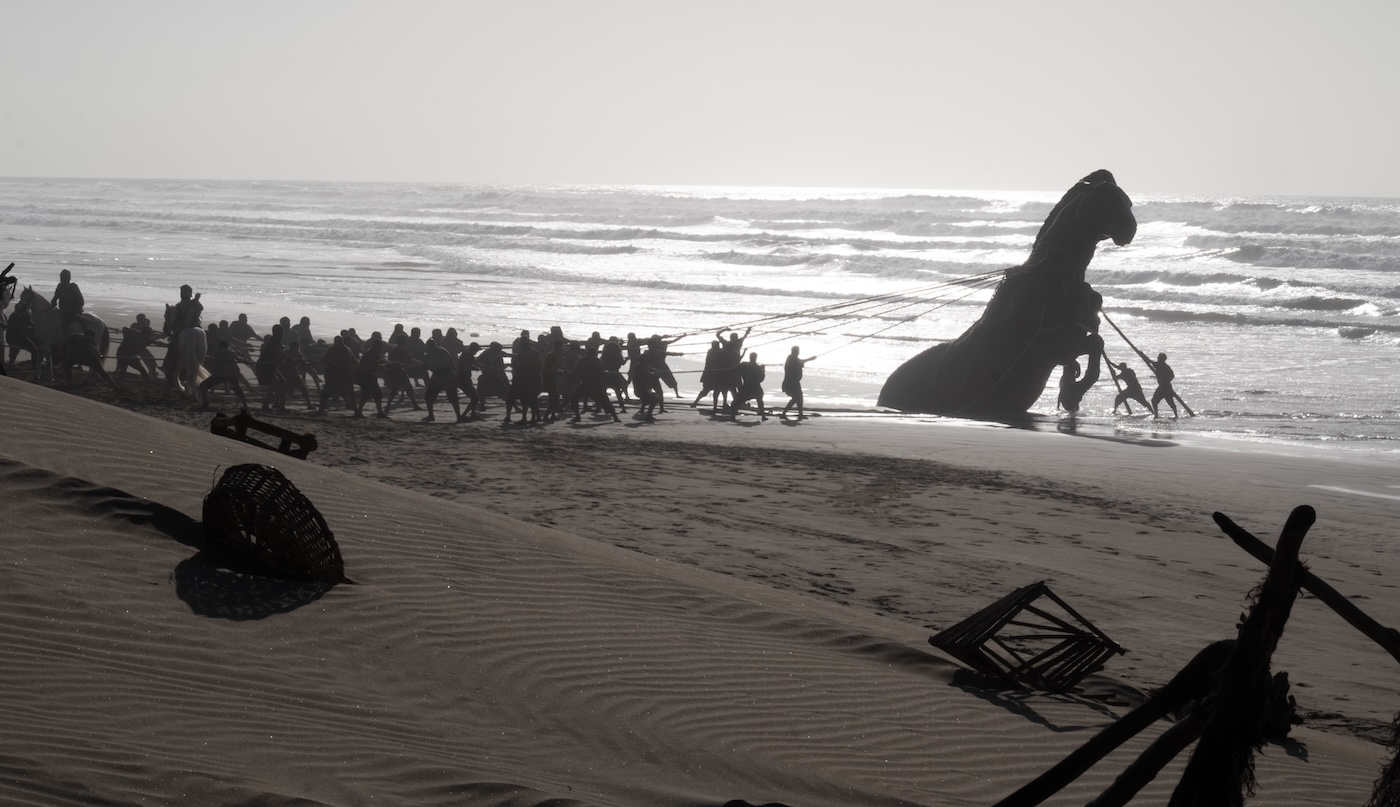
Turning away from the sea, the village came into view. Short wooden buildings surrounded the central structure of the community. The roof rose up to the sky in a point that appeared taller than the peaks in the background if he stood close enough. No one he knew had ever been to the high hills and although he was told the mountain was dangerous, it was not as dangerous as the depths beyond the shore. The doors of the building opened, allowing the choir’s song to carry throughout the village and down to the beach but still keep the chapel protected from the elements. The boy had heard of the cold white rain that sometimes stuck to the ground but he was more accustomed to the regular fall of water the land experienced almost daily. The sea doesn’t stay where it is told, the Elder preached one day. The sea and the things inside it want the land.
Inside the building stood a tall wooden pole with horrible visages carved into it. Similar stakes had stood around the village at some point, but the boy had never seen them. One day he counted seven that had been burned and five cut down to stumps. The bottom faces of the torched masts were barely discernible; the lowest countenances of the severed rods stared out angrily at him when he chose to stare back and with a fatal malice when he caught them from the corners of his eyes. The Elder and the Elder’s elders did not carve or build the poles, he knew. They belonged to the people who lived there before there was a village. Some past time, pale men like him and the Elder found the beach and the people who lived here and decided to take it. The Elder refused to speak more about the ancient people of the land other than to offer condolences to them for the actions of his ancestors. The mast inside the central building was used to prop up the point of the building but then could not be removed. Naturally, the boy wanted to know why and as always the solutions evaded him.
“One might ask why we sing,” the Matron said, “for the answer is the same.”
“Why do we sing?” the boy asked. The Matron, frowning, said he would know someday and then he would wish he had never been told.
“I’ll never forget anything.” The boy spoke aloud, as the midday waves crashed into the shore. As he communed with the air, a black wave poked its way out of the water, then was joined by a toothy head not unlike one of the faces on the burnt poles. A spout of dark water jetted from the top of the thing as the boy saw more of it. He screamed and ran back to the village.
The singing grew louder as he neared the central structure. Before he reached the door, the Elder caught him by the shoulders.
“Boy, where are you off to so quickly?” he asked, despite the boy’s obvious track toward the building. “And so loudly. Calm yourself before harm befalls you.”
“I saw something in the sea,” the boy said, barely whispering the words. “I saw a massive creature that breathed water and looked like the waves. It looked like that.” He pointed to the nearest stump, one with a grinning, toothsome beast at its base and points like sharp waves surrounding it.
“A truly fearsome creature, boy, but not the one to fear. The people from before respected it but did not fear it. As you saw, it is a beast of the black and of the white. Yes, it can cause great hurt, but not to you or the village; to other creatures of the sea. It is a devourer of lesser beasts. To us, it is not the worst thing to see at midday.”
“What is the worst thing we might see, Elder?”
“Ah, that is not yet for you to know.”
And so, again, the boy sought and was denied answers. Words he’d heard floated in his head. They also came without answers. Mother. Father. Family. Heaven and Hell. Words he had heard but did not understand. The village, the villagers—especially those in the choir—and himself. Those were all he knew, and he felt like he knew less about them every day.
Rather than continue into the central building to watch and listen to the choir, the boy retreated to his room behind the sanctuary. Others shared structures for sleeping but he inhabited his own small wooden hut. After seeing the sea beast, he felt more alone than he had on any previous day. He had scratched nearly 3,000 sunrises and sunsets into the floor of his room and knew there were days when he hadn’t the strength or had simply forgotten to do so. In all those days, he had never seen someone like him, only the Elder, the Matron, and the other villagers who shared height and wisdom with them. He’d seen many seasons, but not as many as others and many fewer than the Elder or the Matron. Yet he felt as though his seasons past carried greater weight. That the cycles of the Elder were only meant to prepare the boy’s own way. These thoughts did not come with self-indulgence, no. He was but one member of the community, he felt. But the weight of the sunrises and sunsets carved into the floor meant something more than he knew now.
On the beach, the rough sand between his toes, the boy thought he heard someone whisper from behind. Had a villager walked out to meet him, he would have heard first their legs parting the long reeds then their feet mashing into the wet sand. Most villagers walked oddly on the sand, crunching shells and rocks beneath them and earning small cuts on their soles. They preferred to stay near the chapel, leaving the boy alone here.
The whisper did not belong to the Elder nor the Matron for it sounded much too young. He watched the water, saw the great black and white beast rise and fall with the waves, and repeated the word he thought he’d heard.
“Or…ca,” he spoke, slowly as if trying the two syllables in his mouth. The waves of the sea refused to acknowledge his voice, as did the reeds behind him. The waves crashed, the beast disappeared again, and the cattails whistled to themselves in the breeze.
“The bulrushes alone,” the boy said to no one. “The plants and the sea speak to each other and the forest must speak to the reeds, but no one will tell me anything.” The sounds of his hands brushing shore sand from his behind almost sounds like a voice, too. He shook his head, droplets of ocean dew flying from his hair, leaving miniscule dark spots on the sand. He felt he could see each individual drop just as he could hear every single note sung by the village choir, separating them out before seeing again how they joined together for a whole greater than their parts. The sea in front of him was simply a billion dew drops in one as the choir was two dozen voices in one. No single drop or voice mattered more than the collective whole. Except, that was, for him.
He needed to know why.
Another night. The reflecting orb half concealed and the shining star hidden away again. The Matron brought him dinner, broth with boiled roots and something fatty and tender. The villagers sang songs of hunters past but no one here hunted any longer. He knew this was meat, but not much more.
“Mother,” he said, although every villager knew she was no one’s real mother. “Where does the meat come from? Do we have hunters like in the songs?”
“No, child. We no longer hunt. We do not have the tools nor the knowledge for it,” she said.
“Then where does this meat”–he held the chink of fatty meat in his fingers–“come from?”
“As long as we sing and keep what lives in the ocean beneath the waves and what resides in the forest amongst the trees, we are given provision.”
“Then I want to sing, Mother. I want to sing and help the village,” the boy said.
“No. You know you must never raise your voice to song. To do so would…” She caught her words in her throat, swallowing them like partially chewed roots. “Your voice is not needed for our provision. Now, finish your meal and accept your rest.”
“I want to sing.” His voice ticked up, not yet daring to become a yell. Or a song. “I want to sing for the village and for your health, Mother.”
“Don’t. For you to sing would be the end of me and more. Perhaps you should retire now.” She scooped up the bowl in front of him and ushered him to another room of the chapel. He heard the village’s night singers, now outside the building, their song like a lullaby only for him and the creatures of nature surrounding them. Torches glared through the few windows of the chapel, illuminating the robed figures beyond his walls. Shadows flickered around their frames and a faint odor like the red berries on some of the forest trees wafted through the cracks of the ancient building. The pungent scent, the scant firelight, the remnants of the broth on his tongue, and the hard floor beneath his feet all gave way to the sensory overload of the never-ending song surrounding him. As much as he wished to join his voice with the choir, he also wished for a single moment of silence.
The Matron followed him to his bed at the rear of the sanctuary. Beneath the wooden feet of a god no one in the village remembered, the boy covered his ears with his hands and hummed so low only he perceived it. He purred a tune he’d never heard the choir sing, something at once familiar and new he’d conjured himself. He buzzed so that sleep drew him in and kept it low so no one else might hear.
But of course, someone—or something—always hears what we most wish to keep hidden.
In his dreams, the boy sang day and night. Sometimes, he sang well-known tunes, the same ones the choir repeated when the sun was up and the same intonations for when the darkness covered the village. He knew every word and note of the village’s songs.
His dreaming self knew songs the choir had never sung. Those songs felt as though the village choir hadn’t the skill or the right make up of voices to properly intone the melodies and harmonies heard only in his head. If they tried, they would run out of breath and collapse, leaving him as a soloist, an unaccompanied instrument of the village’s message to the forest and the sea. In this night’s dreaming, the word he had heard while sitting on the shore eked its way into his solitary songs.
Orca, an unknown voice rang out.
Orca, his own fantasy voice responded.
At some point in the dream, the strange voice and his own became one and he heard only himself again, a solitary chorus, singing toward the sea. Around him lay the draped bodies of the night choir, silent as the sun rose. The daytime choir had yet to begin and the boy found himself in the rarest moment of all, even for a dream: pure silence.
He woke first to the echo of something running through the woods behind the chapel and then the dawn’s songs penetrating the air and stilling anything that moved in the forest. His dreams faded and the songs that lived during his sleep dissipated with them.
Rather than gaze out at the water, the boy chose to watch the trees. Sitting at the base of the chapel, he noted the two stumps of the old beast poles the Elder had shown him, one that represented the sea and the other the forest.
“We reside in a land of in-between,” the Elder said. “We are not in the woods nor in the waves. Our homes have been in both, sometimes covered by floods and other times closed in by the groves. The pieces of history we have left also tell us that our village has been both at the same time.” The Elder pointed to large trunks living past the poles that showed dark skin from the bases up many feet until a distinct point in which the skin of the trees lightened. “The water has reached above where your head is now, boy, but it has not risen that high since before we lived here. The forest is old, but the sea is even older. And we—the choir that sings through sunlight and shadow—use our voices to hold them so that we might live.”
How long ago had that speech been? Or, more accurately, how many times had the boy heard it? Not as many times as the song he heard now on the other side of the chapel walls, but often enough to repeat the village’s long story.
There was no one to ask, though. The Elder, the Matron, all the members of the choir knew the story. The forest wants to meet the sea; the sea wants to reclaim the land. In both lived great beasts that the former inhabitants of the village worshipped and feared. And so the village now worshipped and feared the beasts, too, despite not truly knowing what they were.
“I know one,” the boy said aloud, his voice a mere speck in the midst of the choir. “Orca is one. The black and white beast of the waves. That’s Orca.”
He stood, quickly walking to the pole he knew meant the sea, and traced his fingers in the grooves of the remaining beast. Up close, the wooden representation appeared to be dark and light, not exactly black-and-white, but carved in a way that made the two halves obvious. Sitting atop Orca was the remnants of another creature of the sea, one that remained a mystery as it had been lopped off before the current villagers resided here. The monster had unnaturally long limbs with round nodules leading up the arms. What the animal looked like above those squirming extremities the boy didn’t know, nor did anyone in the village.
As he ran his hands along the wood, he thought he heard a rustling from the forest, closer than what he was comfortable with. He glanced behind him, toward the other pole, but neither saw nor heard anything else. Instead, a gust of rotten air slammed into him, as if a weeks old chunk of the broth meat had lost its color and been thrown at him. He did not wait for a second chance to see where it had come from. He fled past the chapel, so near the Elder and the Matron that he almost bowled them over, and did not stop until the waves lapped at his bare feet.
The melodies of the daytime choir bore down on the boy as he stared toward the horizon. The sun arched toward its highest point and the waves had ceased kissing his toes hours ago. The last time a choir had come to the sands, they had been carrying a weight bundled in extra robes so that no part of it showed.
“This was your last brother,” the Elder had told him. “When the daylight singers lose their voices, they are sent out into the sea.” Nighttime singers, similarly, were bundled and taken into the forest. The songs of those times—and it had been many nights and days since the last brother had been swallowed by the sea—only rang out when a choir member has lost their voice. The songs might change, but the singing never stops. Brother, the boy committed to memory. A word not spoken to his knowledge. Not Mother or Father, no, but a new—and old—word.
He had never seen the face of Brother nor anyone else’s face beside the two senior villagers who looked after him. He’d never heard anyone else speak other than the Elder and the Matron. He watched and listened, memorizing the dirge as he had all the other songs and wondering how it differed from the night song when a vocalist was given to the forest. The bundle bounced in the waves and was soon swept out, perhaps encountering Orca or the many-armed creature. Perhaps it floated to the edge of the world. The boy did not know and since he was not allowed to sing, he would never lose his voice and be bundled up and given over to the water or to the forest.
Only after the sun crested and began its return to the depths did the daylight choir return to the chapel. No one acknowledged the boy’s presence nor bade him join their mourning. For being as central to the commune’s survival as the Elder had convinced him he was, he never truly felt he was part of the village. He watched the choir members enter the sanctuary and noticed that despite sending one to the sea, their number had not decreased.
For the remaining light of the day, the boy concentrated on separating individual voices within the choir, getting a count of how many singers there were and how many there should be. He did the same at twilight discerning each voice. Both choirs numbered twenty-six. Where the new daylight singer emerged from confused the boy, and he did not slumber that evening. Not sleeping meant no dreams of singing and he vowed to sleep the next night so that at least his imagined self could release a song.
As expected, he slipped in and out of dreaming throughout the next day, often catching himself the moment before falling into a deeper rest. He walked back and forth from the shore to the edge of the forest, traipsing the between land, living in the between state of wakefulness and dreaming. On one rotation to the forest area, the boy saw a circle of leaves and pine needles rising up from the ground. The mound looked surprisingly soft and so he lay down on it and soon lost himself to his dreams.
He did not feel the ground shake beneath him as he slept. The choir’s songs never ceased as the beast of the forest barreled its way through the thick trees, stopping to sniff its image at the base of the pole, then snuffling toward the boy. Solid pacing. Its fur was matted with dirt from the earth, thicker and darker than the sand of the shore. Clumps of leaves mixed with a dense substance that the boy would have said smelled like the meat in the broth had he been awake to smell it. The creature pushed at the boy with its muzzle, then with a great clawed hand, so like a human’s but still so different.
In his slumber, the boy stirred. His dream self sang to something that looked like a collected ball of his own hair. He sang louder than he had in any dream before and the hairy bundle grew arms and legs but never a face. The arms pushed at him but he continued to sing. He sang in his dream until the hairy thing disintegrated.
The beast, not hearing the song in the boy’s head, licked his face and then let him be.
When the boy woke, his face wet, he thought he heard the voice from the shore again. “Chet-woot,” the voice said, so soft that it might have been a remnant from his dream.
They were never meant to be here. One of the earliest lessons taught by the Elder was that of the people who lived here before the villagers, before the Elder was even as old as the boy was now. A different people inhabited the space between the forest and the sea. They carved and set the poles at the edge of the forest and the one in the center of the chapel. They knew the beasts and how to keep them at bay and how to live beside them when needed. The Elder said one reason the people were destroyed was because of their close relationship with the beasts. The Elder said some believed the people split into two and some went to live in the sea and some to live in the forest. Lovely stuff.
“If that was true,” the boy asked, “then some would still be alive, right? Could they not return and reclaim what was theirs?” He was not afraid of that happening, he found. He thought it would be interesting to meet new people.
“They did go into the sea or the forest,” the Elder said. “I believe that is true. But as we do with ours, those who go out do not go in order to return. They have all passed into whatever existence awaited them.”
“Don’t be such a storyteller,” the Matron interrupted them. “The builders are gone just like those who came before us, those who brought us to this place many days ago. There was once a world deeper than the forest, my Matron told me. One full of people who never had to sing just to live. But the fires from the sky wiped them out just as it did those who built the poles. Those lucky few not to burn gathered on this land. And here we’ve been since I was but a wee warbler. “Before this one,” she kicked out at the Elder, “could even speak, much less sing. Now he never shuts up.”
The Elder stared at her silently, and the boy remembered they both had forlorn smiles on their faces. “Today’s lesson is over, boy,” the Elder finally said and walked away with the Matron.
The boy wondered then and wondered again today if the sea creatures and the forest beasts were not new forms of the old people. He spent the rest of the day meditating on what those old people must have looked like and what their songs sounded like. Somehow, their songs ended and that, he decided, was why they were no longer here.
An apple awaited him at the head of his bed. He knew the word apple because the Elder had told him what one was. He knew this was a red and yellow apple because the Matron knew the names for all the colors: the blue sea, the lighter blue sky; the brown sand of the shore, the darker brown dirt of the forest earth; his hair was red, but not the same red as the apple, and the robes worn by the choir were black.
The apple smelled like it wanted to be eaten. The boy knew the apple did not have thoughts of its own, but if it did, “eat me” would be its lone idea. He ate it and stopped before the harder center and the brown seeds as he had been taught. Instead of leaving the remnants in his room and going to sleep, he walked back through the dark chapel and opened a small door at the side. He heard and saw the moon choir, his lips glistening with the apple’s juices in the scant light, and made to throw the core as far from the building as he could. But as he lowered his head before rearing back, he saw another shiny apple at the base of the door. As he was the only one who ever used this door, he knew the apples had been left for him. He dropped the first core, picked up the second apple, and took one large bite. The crispness cracked through the night, but no one in the choir skipped a note nor twitched. He looked toward the moon as he opened his mouth for another bite and stopped.
Beyond the ring of the night’s singers, he saw a pile of three—no, four!—fresh apples like the ones he had already eaten. A path between singers emerged and he doubted any of them would stop him if he walked by. To stop the boy would mean to stop the song, and that was unforgivable. He ran to the small pile and picked one up, bit into its flesh, and let out a long, pleasurable gasp. He couldn’t stop himself from devouring it like the previous two. The seeds dropped onto the ground at his feet, watered by his saliva. He glanced around, ensuring no one from the choir had moved, then grabbed the three remaining apples and started to turn back.
A sharp sound caught his ear, too slow in returning to be an echo of his bites. And it was only that one sound, farther down the path skirting the edge of the forest. The report intruded upon his senses yet also tantalized him. A new noise could mean delight as much as danger. In the dark, the end of the path remained hidden.
That meant there was only one way to find out who or what waited down it.
Apples in hand, the boy trotted down the path, assuming it was one he’d walked many times before during the day. At night, it felt new, which made walking it an adventure. He walked, munching his apples, stopping to listen in case he’d missed something masked by his chewing, and continued away from the chapel. Away from the choir and away from their songs. Soon the path began to rise and the tree of the forest formed a wall to one side. The other side, hidden in the dark, was the ocean, the wall was a sheer cliff drop down, making the water sound farther away than it was. Keeping his feet on the path prevented him from noticing these developments.
When he finally noticed that he no longer heard the harmonies of the choir, he turned, nearly falling off the cliff. He kept turning and ran into a thick tree, knocking himself out. As he fell, his last apple rolled off the path and into the ocean below. His feet scraped the hard ground of the path as something from the trees dragged him into the forest.
He smelled apples again and something like the roots the Matron served in her broth, but also fire. Fire! That startled him awake and he hoisted himself to his feet and struck his head on something hard and flat.
“Sit,” said a voice that sounded as old as the Elder. “Sit and take heed of thine head.” Something that wasn’t quite a laugh but tried to be followed, disturbing the boy more than bonking his head again had.
“Why can’t I hear the choir? Where am I?” the boy asked, searching for the source of the voice and the fire.
“Yer safe, young one. Safest thou hast ever been, I assure you. Tis I who left the apples thee didst enjoy and twas I that delivered thee from the wrong path in the night.”
The language sounded like some of the oldest songs sung by the choirs, but not even the Elder spoke in such a manner. “How are you called?” the boy asked.
“Dost thou mean, ‘What is thy name?’ And why address such a lowly servant this way? Do thee not know the right words?”
The boy was shocked at being interrogated about his speaking by one who spoke so oddly, but he knew what the speaker meant. He knew enough to try it the way it was spoken to him. “What is your name, then?”
A flash of light and a greater smell of fire flashed before the boy. As his eyes and nose adjusted, he saw a slumped figure tending a fire, poking at it with a thick and blackened rod. “I am he who calls from the land between. Neither of the forest nor the sea, but of both. I am the people who lived here before thee and know the names of all the beasts and men alike.”
“That answered my first question,” the boy said. The sight of the hunched over figure gave him confidence that he was stronger and would be able to roust his way out if this person tried to hold him. “I know what you are called, but what is your name?”
“Thou first. What is your name?”
He had never been asked for his name, not by the Matron nor the Elder. Definitely not by any of the other villagers. He swallowed hard and remembered his momentary but now shaken confidence. “You said you knew the names of all the beasts and men. You should already know mine.”
“Aye, thou art correct. I do know thy name, given at the moment of thy birth. But dost thou know it? What is thy name?”
He shook his head, still groggy from the bumps. “I’m… I am the Boy. I’m called Boy.”
“That is no proper name and not the name thy mother and father graced upon thee. Thou art the one whose song will bridge the worlds, bringing the end and new beginning. Thou art named—”
The enclosure the boy and the speaker were in shook around them. Dirt and twigs fell from above the boy’s head and the figure moved quickly to dash out the fire. The shaking grew more severe and a crack formed near the boy, letting in daylight. The natural light was almost as surprising as the firelight had been. He knew it had been night when he found the apples and began walking. But now it was clearly daytime, although he would not have known it if not for the force that split the enclosure around him. A set of thick arms burst through the crack and grabbed the boy, pulling him out into the forest. Cloaked bodies like those of the choir cloistered in the immediate area although these bodies were larger than those of the choir the boy was used to seeing. Two of them held his arms and were walking him away. Others stood around the opening in the ground, the form of a collapsed mound between them. One held a torch, but only for a moment before throwing it into the gap. The boy heard a scream but was being carried quickly away from the area and soon the only sound in his head was the renewed ringing of the familiar choir.
The snap of a lock startled the boy. Despite never hearing one before, he knew the noise meant he was trapped in his room. Whispering underscored the usual singing. He heard the Elder and the Matron, but another voice whispered beyond his door as well. A gruff voice, filled with malice every time it spoke one word in particular, but the word never solidified in the boy’s mind. Perhaps if he’d not struck his head multiple times that day, his ears would have worked better. If he were not shut away in his room, a captive in a well-known place, he could have listened better. Instead, he inhaled mightily and did the only thing he could think of that might secure his freedom. He sang.