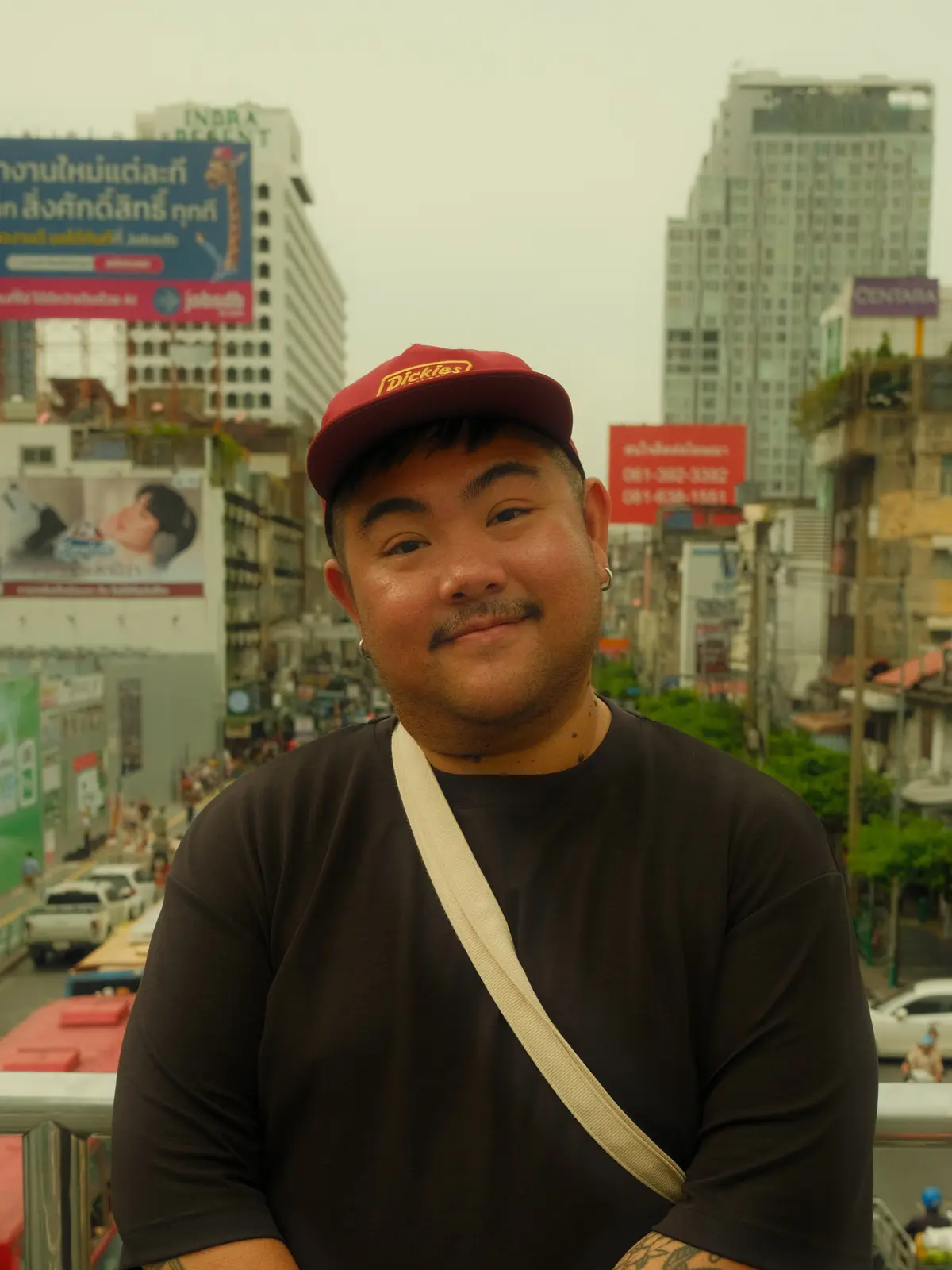
To say we live in fast-moving times is hardly radical, yet our understanding of the self and everything in its orbit seems increasingly elusive as the days go by—a feeling that inevitably raises the question: How do we slow down? And if we can, how do we truly examine that which feels always, impossibly, just out of reach? In his latest poetry collection, Staying Still (Tin House, 2026), Hieu Minh Nguyen seems primed for the task, taking stock of the self through subjects ranging from desire and the erotic to family lineage and legacy, delivering a body of work that ultimately takes pleasure in excavating the enigmatic.
If self-immolation is the moment, then Nguyen’s signature curiosity and irreverence remain deeply in tune with its questions. Indeed, his third installment in an ever-growing oeuvre, Staying Still resists easy answers, finding its truest home in the mode of discovery as it moves readers through various set pieces of the everyday, scenes and moments that often forsake the broad strokes of existential determinism for a more expansive portrait of contemporary life. However, despite its momentous charge forward, the collection remains deeply attuned to the nuances that complicate personal history, the ghosts of family members and lovers past always looming just out of frame. For Nguyen, life is but an accumulation of experience, and this rhythm of push and pull remains the energy we all need to keep moving forward, a sentiment that carries throughout the collection, as in “Three Dollar Bill, Brooklyn,” when the speaker declares, “I want it to be big, the next animal / I make of my living. The next life / I make of my life.”
I had the fortune of speaking with Nguyen on a lovely June afternoon over Zoom, where we chatted about all these questions and more.
This conversation has been edited for length and clarity.

The Rumpus: Many of the poems in Staying Still grapple with a tension between movement and rootedness—a more transitory existence versus one that feels anchored, whether in a physical place or in something less tangible: identity, sexuality, memory, desire. I found myself thinking about stillness not as a state of peace, but as something more complicated. Can you talk about that tension, especially as it relates to the title of the collection?
Hieu Minh Nguyen: That’s a great question. I think the title actually came to me as a question. I didn’t sit down intending to write poems around a particular theme. These were just the concerns and questions I kept returning to while writing. I’ve been working on these poems for almost ten years, and for a long time they didn’t feel connected to one another. They felt transient. I was using the poems as a way to anchor myself inside a question or an inquiry. When I think about stillness now, after spending so much time writing this book and thinking about belonging, I realize that for a long time I carried this longing for a place that I couldn’t really name. It was a feeling of being untethered—not only to place, but also to people. Or maybe it was a fear of being untethered to people, of becoming insignificant to the people you love. Part of that comes from my family history. I grew up as an only child, though I was surrounded by cousins. My family is Vietnamese, and my mother came to the United States as a refugee. I’ve thought a lot about how she also feels untethered to place, and how that feeling became something I inherited. Belonging is complicated. For a long time I thought the answer was rooting myself somewhere. I thought if I could just find the right place, that feeling would disappear. But I’m learning that isn’t the miracle fix. More and more, I’m interested in relinquishing the need to belong. Sometimes the desire to belong asks you to ignore parts of yourself in order to fit somewhere. I’m trying to sit with that tension instead.
Rumpus: One of the things I found so compelling about the collection is that those tensions feel present not only in the themes of the poems, but in their movement. They often move quickly while also asking the reader to stay within a particular moment. That balance between motion and stillness felt really captivating to me.
Nguyen: I appreciate that. I think that’s exactly what I was wrestling with, even if I didn’t fully understand it while I was writing the poems.
Rumpus: One of the aspects of the collection I most admired was your ability to reinvigorate language around intimacy and desire. Certain subjects—like sex, sexuality, and the body—can feel difficult to approach in fresh ways and yet these poems consistently surprised me. I’m thinking in particular of “Staying Quiet,” which directly confronts the limits of language. At one point the speaker interrupts an intimate moment to declare, “I’m running out of ways to describe it.” Can you talk about your approach to writing the erotic? How do you continue surprising yourself on the page when working with subjects that have such a long literary history?
Nguyen: Thank you. I actually think of that line as a moment of frustration. One of my favorite words—and probably a word I overuse—is “body.” I haven’t found a better alternative for it yet. The body has always been a central concern in my life, not just my own body, but the way other people feel entitled to comment on it. The body enters the public. It has to interact with the world. We often think about intimacy as something private, but it’s also a kind of public exchange. Once another person is involved, it no longer belongs entirely to you. Questions of desire are wrapped up in that. For a long time, I connected desire with belonging. I thought that in order to belong somewhere, I needed that place—or the people in it—to find me desirable. As much as I’d like to think I’ve evolved beyond wanting to be considered beautiful, that impulse is still there. Those questions are still with me.
Rumpus: That actually connects to another question I had about drag and performance. Throughout the collection, I found myself thinking about persona and the ways we construct and perform versions of ourselves. I’m curious how drag has influenced your understanding of performance, both on and off the page. Do you see it shaping the voices that emerge in your work or the ways you imagine the self within these poems?
Nguyen: Absolutely. Drag has taught me how to look differently at the world and differently at myself. One thing I love about drag is the opportunity to become someone else. I’ve never been especially good at pouring energy into myself. A lot of my writing comes from the position of a witness or observer. Poetry was my way of participating in the world while still remaining somewhat withdrawn from it. Drag changed that. It pushed me to go out and touch the world. To participate more actively in it. To meet people and be surprised by people. In some ways, putting on a costume gave me permission to become curious again. It’s also taught me that I don’t have to be just one thing.
Rumpus: I could really feel that influence in the collection. One of the things that struck me was the way drag and performance often introduced moments of levity into poems that were otherwise dealing with deeply personal material. The humor throughout the book feels incredibly important. I’m thinking of a poem like “Crisis,” which opens with the unforgettable line, “In the gallery of embarrassments, I get an erection when the doctor touches me.” Do you find yourself naturally drawn to humor in your work? And when you’re writing in that register, are there particular traditions or influences you’re drawing from?
Nguyen: Humor has been one of the primary ways I’ve navigated the world for as long as I can remember—maybe even longer than poetry. It’s been a defense mechanism, a way of building friendships and community. It’s also an offering. Humor creates a point of connection. Sometimes it’s a crutch, too. When things become too earnest or sentimental, humor gives me another route into the conversation. I think humor also helps establish trust between writer and reader. If you can make someone laugh, even briefly, you’ve created a kind of relationship. Many of the poets I’m drawn to are good at balancing emotional intensity with humor. And drag has definitely shaped that sensibility. Humor is inseparable from drag culture. As much turmoil as there is in life, there’s also absurdity. Sometimes the most honest response isn’t laughter, exactly, but simply recognizing how absurd things can be.
Rumpus: I love that idea of absurdity. It feels connected to what you’ve been saying about observation. To notice the world closely is often to notice how strange it is.
Nguyen: Exactly. And humor lets you step back for a moment. When you’re deep inside something difficult, humor creates a little distance. It gives you another perspective. Sometimes it’s a release. Sometimes it’s a survival strategy. And sometimes it’s information. Even when a joke fails, you’ve learned something. You learn something about yourself, about the people around you, about the room you’re standing in. Sometimes you make a joke in front of people you love and immediately realize you’ve misread the mood. Suddenly you understand something about the emotional temperature of that moment. Humor reveals where people are. It reveals what they’re carrying and what they’re willing to engage with.
Rumpus: That’s such an interesting way of thinking about it, especially now, when language itself can feel so politically charged. The way people respond to humor often tells you a great deal about the world they’re inhabiting.
Nguyen: I think so, too. Paying attention to those responses is part of being a writer. You’re always observing how people communicate, where they connect, and where those connections break down. Even when humor fails, it teaches you something.
Rumpus: Speaking of observation and attention, I wanted to ask about form. One of the pieces that stayed with me most was “Come On Over.” It operates differently from many of the other poems in the collection. It’s more prose-forward, sprawling across multiple pages while still retaining a distinctly lyrical quality. Can you talk about how that piece came together and how you see it functioning within the collection?
Nguyen: When I first wrote it, I wasn’t thinking about it as part of a poetry collection at all. Hanif Abdurraqib has a project where writers write about albums they love, and I’d been wanting to write about Shania Twain for a long time. I wanted to write about that period of my life—about my cousins, our mothers, those road trips, and the music that accompanied them. Originally, it was just an essay. When I started assembling the manuscript, though, it felt like something was missing. I had all these different threads running through the collection, but I didn’t quite know how to bring them together. I returned to that essay and realized I had more to say. As I began breaking it apart, adding white space, and letting different threads emerge, I started to see the larger shape of the book. Questions of sisterhood, femininity, masculinity, my relationship to my mother, even drag—all of those concerns were already there. I think a lot of what would eventually become the identity of the collection came out of that process.
Rumpus: That makes a lot of sense. Even though readers immediately notice that it’s operating differently from many of the other poems, it still feels deeply connected to the collection’s larger concerns. What struck me was the amount of space the poem gives itself. Even though the sentences often read more like prose, the white space invites readers to move through it with the attentiveness they might bring to a lyric poem.
Nguyen: That’s exactly what I was hoping for. Breaking it apart allowed me to slow down and spend more time with each thread. It allowed those different concerns to sit in the air a little longer. It also helped me understand the collection better. I hope it does the same thing for readers.
Rumpus: It definitely did for me. It felt like one of the collection’s anchors. I was especially curious because I primarily work in prose, and whenever I’m reading poetry collections, I’m always interested in moments where a poem begins borrowing from the possibilities of prose.
Nguyen: It was definitely my attempt at prose. I learned how to write poetry by writing poetry—just figuring it out as I went along. So in many ways, “Come On Over” was one of my first attempts at writing something more prose-forward.
Rumpus: That actually leads into my next question. You’ve built an impressive body of work as a poet, but you’ve also begun working more seriously in prose. I’ve heard there may even be a novel in progress. How has your relationship to prose evolved? What possibilities does it offer that poetry doesn’t?
Nguyen: I’m still very new to it, which is part of what makes it exciting. Poetry remains my primary home. I call myself a poet. But I don’t necessarily think writing prose is fundamentally different from writing poetry. In both cases, you’re trying to find the right form for the story you’re telling. Some stories want to be poems. Some stories require something else. I think about drag in a similar way. Drag is another form of storytelling. It’s another medium through which you can communicate ideas, emotions, and experiences. Prose feels like another tool I’ve recently discovered, and I’m still learning what it can do.
Rumpus: It’s interesting how often poets make that transition. Some of my favorite recent novels have been written by poets, and there’s often a particular attentiveness to language that carries over into the prose.
Nguyen: I hope so. But I have to admit, prose also terrifies me. A poem can arrive relatively quickly. If it doesn’t work, you can set it aside and begin again. With a larger prose project, you’re committing yourself to something you may spend years working on without knowing exactly what it will become. That requires a different kind of trust.
Rumpus: Looking ahead, are there particular questions, obsessions, or concerns that you find yourself returning to now? You’ve completed Staying Still, you’re working in prose, and you’re entering a new creative phase. What feels most urgent to you at the moment?
Nguyen: That’s a great question. My obsessions tend to remain the same from project to project. What changes is the way I approach them. The questions become a little clearer, or I find a different angle from which to ask them. A lot of the time, when I’m setting out to write something, I don’t actually know what it’s about until afterward. It’s only once the work is finished that I can identify the central question the project has been circling. Right now, I think many of my questions are about curiosity. I was going to say, “How do we live?” but that feels too broad, or maybe too obvious. The question that’s really on my mind is: How do we remain curious in a world that is constantly trying to extract and outsource our imagination? And alongside that, I’m thinking about privacy. How do we afford privacy? How do we protect it? Especially as someone who makes art and shares parts of their life through that work, I’m interested in what it means to maintain an interior life. I value privacy. I like my secrets.
Rumpus: It feels like those concerns are becoming increasingly pressing. We live in a culture that often treats attention, creativity, and even personal experience as resources to be extracted or monetized. Maintaining curiosity—or privacy—can feel like a form of resistance.
Nguyen: I think so. And I think those questions are all connected. Curiosity requires a certain kind of space. Imagination requires space. If everything is constantly being documented, shared, consumed, or transformed into content, it becomes harder to protect the conditions that allow curiosity to flourish. Those are the questions floating around in my head as I work on whatever comes next. Whether it’s poetry, drag, prose, or simply paying attention to other people, I’m always trying to find ways to remain curious. That’s the thing I want to hold on to.