
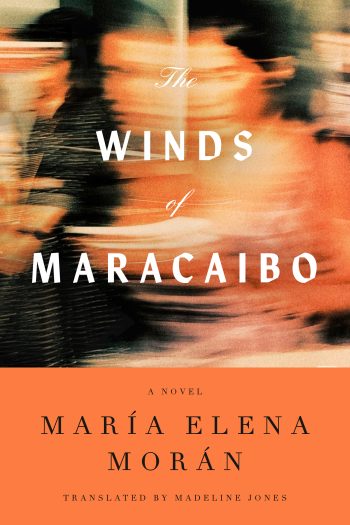
The Winds of Maracaibo by María Elena Morán accomplishes one of fiction’s greatest feats—bridging the gap between the outside and the inside world. The novel hits the right notes of external and internal conflict, becoming intimate and expansive at once. Morán reminds us that our lives exist within the context of larger conversations. Yes, we belong to ourselves, but we also belong to the world, to countries that shift between cycles of decay and resurgence, and that connection to the world, and to those countries, for some of us, remains inextricable.
The novel explores the lives of a family trying to find peace and refuge within themselves amidst the ruins of a post-Chávez Venezuela, diving into the Venezuelan crisis with accuracy, nuance, humanity, and beauty. Morán balances the aftermath of a political crisis with the internal, intimate turmoil of her characters, who, despite their circumstances, remain palpably human.
It is rare to read a novel that can skillfully contain multitudes: one that satisfies both our need for human connection—through the pains and joys of its characters—and our curiosity about the workings of the world those characters inhabit. The Winds of Maracaibo satisfied my readerly needs, both emotional and intellectual. I found myself wrapped in Nina’s world—her desire for safety, love, peace, and stability for herself, her family, and her country. I found myself rooting for her, often in awe of her humanity—her capacity to persist, as a person, mother, and citizen of a fractured country, in the face of obstacles, both within and beyond her control. And most importantly, I found myself enamored with Morán’s words and the palpably fraught and very realistic world she rendered on the page.
We spoke via email about the Chavista identity, political tumult, subverting expectations, and her inspiration for The Winds of Maracaibo.
This interview has been edited for length and clarity.
The Rumpus: What inspired you to write The Winds of Maracaibo?
Morán: The novel emerged from a profound sense of loss. I was trying to make sense of my father’s death, the collapse of my homeland, and the failure of the political project that had shaped my generation in Venezuela. At some point, those different forms of grief became impossible to separate, and fiction became the place where I could begin to explore them.
At the same time, I couldn’t stop thinking about the images coming from Venezuela: overcrowded borders filled with people, my own people, leaving everything behind. Friends and family were suddenly living through extreme vulnerability and uncertainty. There was an overwhelming sense of exposure, as if they had nowhere safe to stand. I wanted to move beyond the headlines and write about the intimate experience of migration, about what exile does to memory, family, identity, and the ways we imagine home.
Rumpus: The Winds of Maracaibo starts with a great deal of immediacy and velocity. Right from the beginning, we see the weight of being a migrant and refugee. Talk to me about beginnings: What’s important to you as a writer? What was particularly important for this novel?
Morán: I think a beginning should create an emotional atmosphere, put the readers in the eye of the storm, no matter how big or visible that storm might be. In The Winds of Maracaibo, I wanted readers to feel the urgency before they fully understood it. Migration rarely unfolds in an orderly way; it throws people into uncertainty from the very first moment. I wanted the novel’s opening to embody that emotional disorientation and immediately place readers inside Nina’s experience.
Rumpus: What role does the Venezuelan crisis play in the development of the plot?
Morán: The political crisis is the condition that shapes every character’s life, but it isn’t the protagonist of the novel. I wasn’t interested in explaining Venezuela or writing a political chronicle, even though I did draw a detailed context. I wanted to show how history enters the private sphere, how it transforms families, friendships, marriages, and even the way people remember themselves. Politics is never abstract in the novel; it is always experienced through intimate lives.
Rumpus: Talk about the “Chavista” identity. How does it manifest in the novel? What were some challenges and rewards of writing about Chavistas?
Morán: One of my goals was to resist caricature. Chavismo is often portrayed in simplistic terms, but millions of people, myself included, genuinely believed in that political project for complex historical reasons. I wanted to portray characters whose political convictions were inseparable from their hopes, contradictions, disappointments, and humanity. I was particularly interested in those who failed to recognize the rise of authoritarianism within the very movement they supported until it was too late, not because they were naïve, but because acknowledging it meant confronting a deeply painful failure.
The kind of literature that moves me is one that allows us to inhabit complexity, that refuses to reduce people to familiar, overused symbols, and instead invites us to encounter them in all their contradictions.
Rumpus: I was struck by the incredible balance you achieve with this novel. In part, it tells a story of political upheaval. But for the most part, it tells the story of a family enduring personal tragedies amidst the chaos of the world they inhabit. The novel is both intimate and expansive. How did you come to strike this balance? What were your goals?
Morán: I wanted to explore big-H History through individual stories, to filter it through the subjectivity of a family and its wounds. I wasn’t interested in separating the political from the intimate because, in reality, they are inseparable. The choices people make, the people they love, and the families they build or lose are all shaped by the historical moment they inhabit. Literature allows us to experience History from the intimacy, from the inside. I think that’s one of fiction’s unique powers. Between the abstraction of history and the singularity of one person’s experience, it is often the triggers of a character’s emotions, the obliquity of their perspective, or the specifics of the situation they face that moves us most deeply. Fiction gives us access to history through emotion and imagination, allowing us to understand it in ways that other forms of knowledge, such as history, sociology, or political analysis, often cannot.
That’s why I tried to embody different dimensions of this collective historical conflict in each character’s individual journey. I wanted each of them to have a distinct psychological dynamic, one that would shape the way they experienced grief, loss, displacement, and hope. Although they all share the same historical catastrophe, none of them lives it in the same way. Their responses are shaped by their family values, their political beliefs, their relationship to class, and even the generation to which they belong. My hope was that, taken together, these different subjectivities would offer a more truthful portrait of a country in crisis than any single perspective ever could.
Rumpus: How do the novel’s characters change in the face of political turmoil?
Morán: The crisis doesn’t simply change what happens to the characters, it changes who they have become by the time the novel begins. They all carry the marks of political displacement and disillusionment, although each has arrived there by a different path.
Many of them once believed deeply in a political project that promised a more just society. The novel takes place after those promises have unraveled, so what we witness is not the moment of disillusionment itself, but its aftermath. Through memory, the characters reflect on the ideals they once embraced, the compromises they accepted, and the painful realization that no political project should demand absolute loyalty or silence dissent.
Exile intensifies that reckoning. It forces the characters to renegotiate their identities, their relationships, and their sense of belonging. Some become more resilient, others more fragile, but none of them remain unchanged.
Rumpus: Though The Winds of Maracaibo centers on Nina and Elisa, it is told from multiple points of view. What influenced this choice?
Morán: I conceived the novel as a polyphonic work from the very beginning. Even before I knew exactly who the characters were, I knew I didn’t want the story to be told through a single voice. In a way, that would have reproduced the very logic of authoritarianism: the idea that there is only one legitimate version of reality. I didn’t want the novel’s form to echo what it was questioning.
The polyphonic structure became both an aesthetic and an ethical choice. I wanted to create a mosaic of perspectives that, by their very nature, are partial, flawed, and incomplete. Rather than offering readers a definitive moral judgment, I wanted to place them in the uncomfortable position of having to constantly reassess their own assumptions.
I often thought of the novel as a relay race. A character tells their version of events, and the reader may begin to sympathize with them or judge them. Then another voice takes over and complicates everything—confirming, challenging, or completely transforming that first impression. That movement between perspectives felt essential to me.
Because the novel is rooted in the Venezuelan experience, where public discourse has so often demanded certainty, unanimity, and ideological loyalty, it was important for me that the novel become the opposite of that. I wanted to make room for doubt, disagreement, self-criticism, and contradiction. I wanted imperfect, fallible, disenchanted, but still hopeful voices asking questions of one another, and of themselves, as they move through a story where it is often impossible to tell where a country ends and a family begins.
Rumpus: Displacement and family separation are overarching themes in the novel. How do you write about these complex themes? What were some of your concerns? What was rewarding?
Morán: I tried to avoid sentimentalizing migration or turning suffering into spectacle. Separation is painful, but it is also full of contradictions, guilt, hope, resilience, and even humor. I wanted to approach these experiences with as much respect and care as possible.
One of my main concerns was the tendency to judge people too quickly, especially in situations of migration, where choices are often made under impossible circumstances. I am interested in questioning those automatic judgments and inviting readers to approach the experience of others with more empathy and curiosity.
What has been most rewarding is seeing readers recognize that complexity. Many have told me that they found themselves identifying with characters they never expected to understand, or even with characters whose choices or political beliefs differ from their own. For me, that is one of literature’s greatest possibilities: expanding our capacity to imagine the lives of others.
Rumpus: Many of the stories centering Venezuelan migration focus on the journey to the United States. The Winds of Maracaibo, however, centers Nina’s experience in Brazil. Can you talk about this choice?
Morán: Brazil has been one of the most gentle and welcoming countries for my people and has received hundreds of thousands of Venezuelans, yet their stories remain relatively invisible internationally. It also happens to be the country where I have been living for the past fourteen years. I wanted to broaden the literary map of Venezuelan migration and remind readers that exile takes many different routes.
Rumpus: Nina leaves Elisa behind, a decision that resonates with many migrants and refugees, who sometimes embark on migratory journeys without their children, leaving them in the care of loved ones until they can be reunited. Can you talk about the complexity of this choice and how it manifests in the novel?
Morán: I wanted readers to understand how incredibly difficult that decision is to make. People often judge these choices from a place of stability, but migration frequently forces parents to choose between two unbearable alternatives. Nina doesn’t leave because she loves her daughter less. She leaves because she hopes that temporary separation might make a better future possible.
I was also interested in the gendered dimension of migration and in what scholars call transnational motherhood. When fathers migrate to provide for their families, they are often seen as courageous or even heroic. Mothers who make the same choice are much more likely to be judged as having abandoned their children. I wanted to explore that double standard and the immense emotional burden it places on women.
In the novel, those judgments are embodied by different characters. Nina internalizes them herself, constantly questioning whether she has failed as a mother. Graciela, who belongs to an older generation, carries many of the cultural expectations and prejudices surrounding motherhood and reinforces them, even while loving her daughter. Elisa hears those judgments too, but more importantly, she is simply too young to understand the reasons behind her mother’s decision. What she feels is abandonment. Having already lost her father, she experiences her mother’s departure as a second orphanhood. That emotional truth is just as important as Nina’s, because in the novel there are no easy villains or heroes, only people trying to survive impossible circumstances.
Rumpus: The migrant experience forces people to reassess and redefine how they interact and rely on others. Nina is an independent, self-sufficient woman who inevitably has to rely on others. Can you talk about this dichotomy of interdependence and reliance?
Morán: For me, one of exile’s deepest transformations is that it dismantles the illusion of self-sufficiency. Migration exposes our dependence on strangers, institutions, friends, and unexpected acts of generosity. Nina struggles with that vulnerability because accepting help also means accepting that she can no longer be the person she used to be. She needs help; she needs to learn how to ask for it.
I think there is great power in knowing our limits, in understanding that asking for help doesn’t mean that we have failed. There is also power in recognizing that, of course, there is evil, selfishness, and prejudice in the world, but that there is also solidarity and generosity in human nature. It just doesn’t make the news that often.
We are constantly being taught that we should need no one but machines and technology and, of course, the money and power that sustain it all. But we have to remember that human history is a collective one. We are more powerful and happier together. Nina’s journey is also about remembering that truth, and that’s probably the most political issue the novel addresses.
Rumpus: What kind of research did you do to write this novel?
Morán: The book grew out of years of conversations with people from my homeland who experienced forced migration, stories shared by family and friends, testimonies I came across in books, articles, and interviews, and my own reading about Venezuela’s recent history. I absorbed all of those voices, mixed them together, and transformed them into fiction. I sometimes think that the novel is biographical; not of one person, but of millions. In that sense, its emotional truth comes from a collective experience rather than an individual one.
The novel also relies on my own experience of migration. I left Venezuela years before the crisis, by choice and for personal reasons, so my story is very different from the one the novel tells. Even so, the experience of leaving your homeland (the ruptures, the longing, the redefinition of identity) carries emotional echoes that I recognize.
Rumpus: What do you want the reader to take away?
Morán: More than anything, I hope readers leave with more questions than certainties. I hope they see migration not as an abstract political issue but as a profoundly human experience, and that they come away with a greater appreciation for nuances.
If readers can feel the impossible weight of Nina’s choices without rushing to judge her, understand Elisa’s sense of abandonment, recognize the love that coexists with Graciela’s prejudices, see the deeper emotional roots of Camilo’s behavior rather than reducing him to his politics, and feel Raúl’s helplessness as he endures the ultimate exile, death itself, then I will feel I have accomplished what I set out to do.
I don’t expect readers to agree with my characters or even to like them. I only hope they will be willing to inhabit their worlds for a while. To me, that’s one of literature’s greatest gifts: it allows us to encounter people in all their contradictions and to leave a story with a little more empathy and a little less certainty.
Rumpus: How did your background as a screenwriter inform your writing of this novel?
Morán: Screenwriting taught me to trust scenes, dialogue, and the intelligence of the reader. It trained me to think in terms of action rather than explanation, and to reveal characters through what they do, what they say, and what they choose not to say. I suspect that background naturally found its way into my fiction. I tend to think of scenes not only through plot, but through sound, space, light, weather, and the sensory experience of a place. Landscape is never just a backdrop for me; it is another way of telling the story and understanding the emotional lives of the characters.
At the same time, writing a novel allowed me to explore territories that cinema can’t reach in the same way. I could spend more time inside my characters’ minds, follow the texture of memory, and linger in contradiction and ambiguity.
I don’t think one form is better than the other. They simply ask different questions of the writer, and I enjoy moving between them.
Rumpus: What was it like to work with a translator?
Morán: Working with Maddie [Madeline Jones] was one of the greatest gifts this book has given me. Translation is a strange and beautiful process because someone else has to inhabit your language from the inside and recreate it in another one. That requires not only technical skill but also deep literary sensitivity.
Throughout the process, we were in constant conversation. Maddie asked incredibly thoughtful questions, especially about rhythm, cultural references, and the emotional undertones of certain passages. Those conversations reminded me that every translation is also a close reading. She approached the novel with remarkable care and generosity, and I always felt she was trying to preserve not just the meaning of the sentences, but the experience of reading them. I couldn’t have hoped for a better companion in bringing the book into English.
Rumpus: What is your writing process like?
Morán: My writing process usually begins with an obsession rather than a story. There is a question, an image, or a moral dilemma that I can’t stop thinking about, and I write because I don’t yet understand it. Fiction is much more a space where I investigate questions than one where I illustrate conclusions I’ve already reached.
Structure is essential for me. Before I start writing, I spend a great deal of time thinking about structure and narrative strategies, because I believe form is never neutral.
As I write, I keep listening to what the story and the characters are asking of me. There are always adjustments along the way, but I rarely feel that I am imposing a preconceived idea on the novel. I’m always asking whether the form is doing justice to the emotional and ethical complexity I’m trying to explore. For me, writing isn’t about certainty. It’s a way of thinking, of listening, and of discovering what I didn’t know before I started.