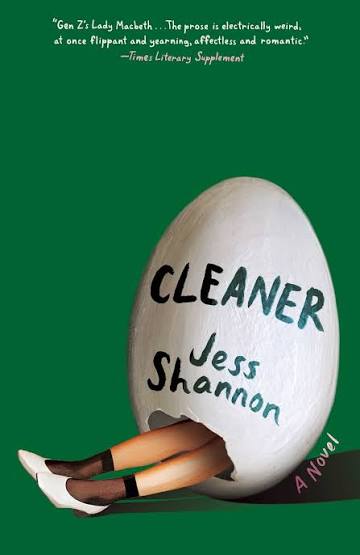
As a late-diagnosed neurodivergent woman, I related to the unnamed narrator in Jess Shannon’s debut novel Cleaner (Scribner, 2026). While the narrator, a highly educated visual artist in her mid-twenties, isn’t explicitly labeled as neurodivergent, her struggles mirrored mine at that age. Like the artist, I went through a period where I hopped from job to job, unable to fit in. I cried from the lack of natural light. I spoke too loudly and interjected at the wrong times. Overwhelmed, I scrambled to appease one client while neglecting the others, and when the day ended, wondered, would this be my life forever? And if the answer were yes, was my life even worth living? At the time, I didn’t know these positions were more difficult because of my neurotype, I only knew that they didn’t fill me with the creatively fueled purpose I desired—a purpose that the narrator also seeks.
After receiving her master’s in fine art and scrapping her PhD pursuits due to financial circumstances, the artist returns to her English hometown to live with her parents; both her and her parents—whose love and approval the artist sought through academic excellence—struggle with the adjustment of cohabitating as adults. The artist, unmoored and with no job prospects in sight, takes to cleaning her parents’ house. Previously, she focused on her work and considered cleaning to be a “nuisance.” “But now,” she says, “it took nothing to put my brains, as it were, into my hands and think about the art of each movement. So simple, and yet I found myself light limbed and coiled with energy.” This hyperfixation leads her to accept a cleaning gig at an art gallery. There, she meets Isabella, a woman attending a life drawing class that she hooks up with in the gallery bathroom, and by night’s end she learns of Isabella’s boyfriend Paul. Undeterred, the artist obsesses over Isabella until a string of events finds her stepping into Isabella’s life, taking over as Paul’s girlfriend in his million-dollar apartment.
Themes of queerness, obsession, and being an artist living in a capitalistic society simmer throughout the story, and Cleaner gives the reader a front-row seat to a one-woman show, where the main character flaunts various costumes, parades through different jobs, all the while holding a limerence for Isabella, whose peripheral existence acts as a beacon of hope for belonging on her own terms. The narrator—who practices conversations before they happen, misses the subtext in them, and is self-reportedly without friends (all experiences that neurodivergent people can relate to)—often feels out of place and is desperate to find where she belongs, to grasp the meaning of her existence.
At one point, the artist wears a costume for a Pride and Prejudice-themed gender-reveal party. She dresses like Mr. Darcy, bucking gender expectations and leaning into the theatrics of the novel. Similarly, upon meeting a kind and consoling nurse during her first smear test, the artist states: “She smiled back without pity and I felt the strangest urge to crawl inside her mouth and live in the gap between her teeth; I wanted to drink the purpose in her.” Afterwards, she dips into a thrift shop to find a “makeshift nurse outfit” and walks home in that “fantasy.”
The costumes aren’t always so obvious, but their symbolism gets to the heart of the novel: Who am I and what is my purpose? One of the longer-lasting roles she “performs” is girlfriend to Paul. The narrator says:
I went through the motions of my traditional housewife parody routine, fondling the fridge door and the breadboard and the butter knife, until the toaster popped and I jumped reluctantly into the realization that if I wasn’t an artist, then I was a kept woman, even if I was doing wifely things, ironically.
Thoughts about making art are fleeting for the narrator, but when she does create, she becomes consumed. An example: “Insatiable, I drew bodies stacked in Jenga piles on Paul’s special printer paper, harvested blood from my period in a beaker, and painted bodily wounds, hearts, organs, orifices. Madly, I even covered the wall with pale red handprints like the Cueva de las Manos.”
As the narrator grapples with who she is if she is not making art, she acknowledges her costumes as her way of trying on different versions of who she could become. In much the same way I went from job to job, trying to find myself outside of myself. She cuts her hair into a shag for a roller rink job, hoping to assimilate (but gets the vibe wrong). She paints children’s faces for a daycare event, and when disappointment coats their expressions from the results not living up to their expectations, the rejection is too much for her to bear.
The narrator herself suggests her performative nature might be exaggerated and possibly parodic, but because she doesn’t know how to fit into the world—“Men are from Mars; women are from Venus, or whatever planet I’m from”—her attempts represent the hope she will figure it out. The character of Isabella, though she is not present for a large portion of the novel, embodies that hope for the narrator. We see the artist continuously obsessing over Isabella’s whereabouts, hoping she will return and help the narrator make sense of her life. The artist says:
Instead of moving on, it seemed as though I’d grown around my longing, storing the way she made me feel safely in my belly. I wasn’t deluded; I knew I didn’t really know her, but I felt sure that she had something to impart, that I was to gain something necessary from her.
All the while, the narrator attempts to format her experiences, quite literally using a traditional story arc. “This story doesn’t have a beginning,” the narrator says, kicking off the novel. At first, this self-reference reads as a clunky start—it even tries to contradict the arc, a rebellion of sorts, or a stubbornness to stay true to the artist—but then the artist continues the meta regard: “Damn right I’m at the end of Act One! That’s what you call an inciting incident!” and “This was the halfway point of my story,” and “This denouement invited further reflections on the art I was custodian of, not all of them welcome,” among other interjections. Its purpose becomes evident—another costume for the narrator to try on, made possible by the narrative distance Shannon creates.
However, the narrator’s inherent self pushes against the visual display of a traditional story arc—paragraphs and chapters that dictate how the white space shows up on the page, how a story determines division and order. Shannon uses stream-of-consciousness storytelling written out in one long paragraph (there are no paragraph breaks in this novel) to serve the narrator. This juxtaposition of character form versus story structure emphasizes the masquerade the narrator attempts while offering glimmers of raw authenticity. For instance, when a man asks the artist to read his erotica at a bar, the artist can’t help herself; she corrects his grammar and leaves editorial notes at the end of the document. Her impulse is unavoidable.
Even when the narrator is in her head about something (which is often), as her thought process unravels on the page, we become privy to what shapes her, the rhythms and beats that inform her storytelling. And through the subconscious of her dreams, the reader finds confirmation of her anxieties and struggles:
The girls from my childhood spoke in chorus: we did a test just then. You’re following so-and-so around all the time and copying everything she does—but she’s not your friend. Why are you crying? You’re so sensitive…
This dream sits closer to the narrator’s awareness and reality, as other nods to this time in her life are made elsewhere in the book, and the reader understands that the narrator has struggled her whole life with her identity and feeling out of place. I empathize. Having emotions bigger than everyone else’s got me labeled as “sensitive,” and I struggled to fit in. What if the artist isn’t “copying everything she does” as part of a mechanism to conform, but as a way to learn, inching closer with each attempt toward an acceptance for who she is.