
Like many Americans, I have recently found myself looking for ways to understand how political transformation reshapes ordinary life. I often turn to fiction in moments like this, not for answers, but for stories that capture what it feels like to live through uncertainty. For years, Emily St. John Mandel’s novels have offered that kind of clarity. From Station Eleven (Knopf, 2014) to Sea of Tranquility (Knopf, 2022), her work has traced how people adapt after familiar systems collapse, often focusing less on catastrophe itself than on the long, strange aftermath.
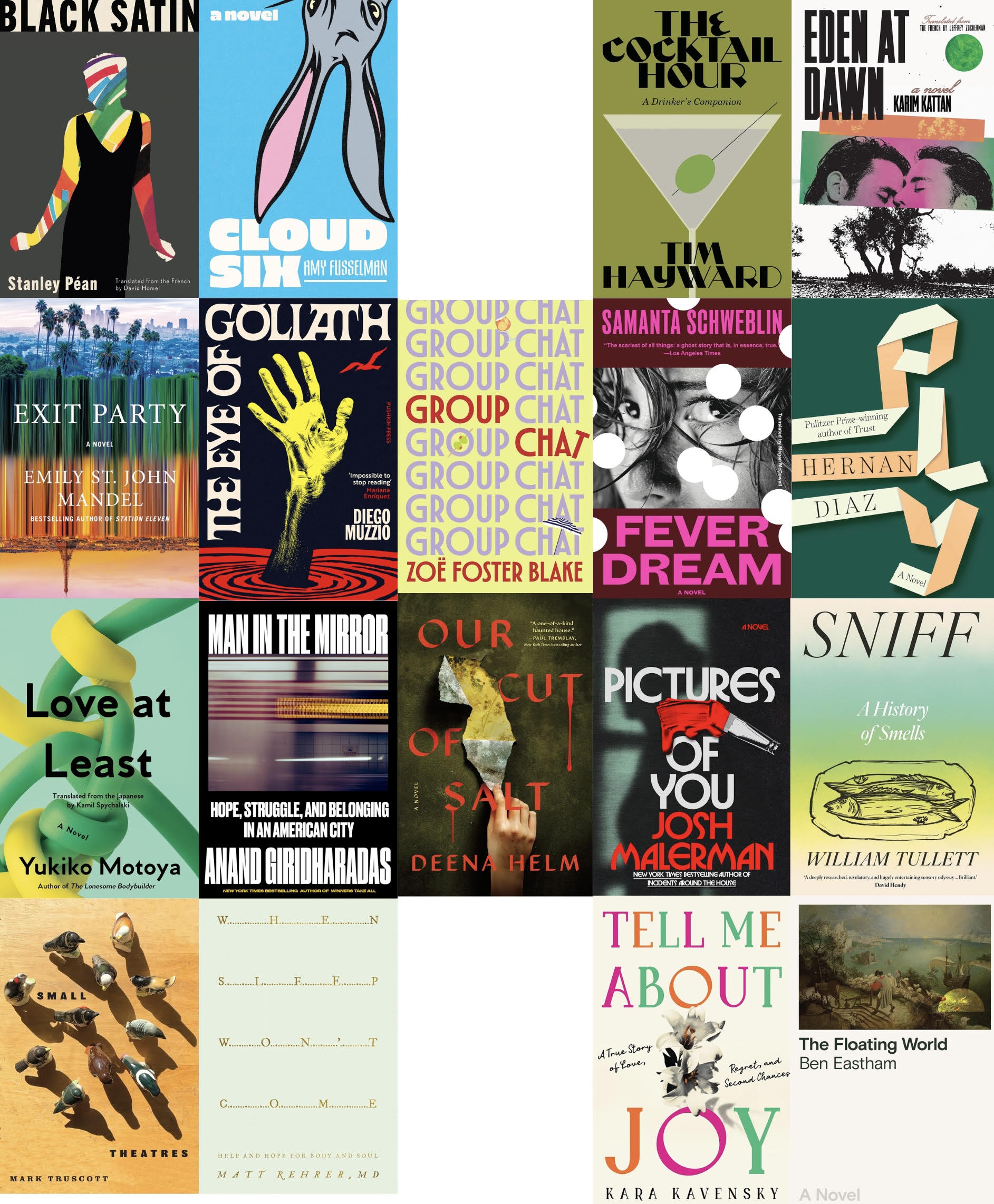
Her new novel, Exit Party, continues that inquiry. Set in 2031, the book imagines a fractured United States divided into republics, city-states, and militia-controlled territories. It opens at a party in Los Angeles during the first spring after national collapse, when the city’s curfew has lifted and peacekeeping troops have withdrawn. That gathering becomes the novel’s gravitational center: a party where something shifts, where a man vanishes, and where reality itself begins to feel unstable.
From there, the novel follows Ari, a woman recently released from prison, as she moves through a landscape shaped by political uncertainty. She remains largely adjacent to power rather than inside it, absorbing the effects of political violence while still needing to find housing, secure work, and form relationships. In Mandel’s near future, ordinary life persists—there is still oat milk and low-paying retail work—even as reality begins to split into parallel versions.
I spoke with Emily St. John Mandel in San Miguel de Allende, Mexico, during the San Miguel Writers’ Conference in February 2026, on her first visit to the country. We talked about disorientation and doubling as well as about writing near-future fiction without trying to predict what comes next.
This interview has been edited for length and clarity.
The Rumpus: You’ve said Exit Party, coming out in September of this year, is the best book you’ve ever written and the hardest. What made it the hardest?
Emily St. John Mandel: Yes, both of those statements are accurate. I feel like I pushed myself very, very hard with this book. Philosophically, I always feel like as writers we should be working at the very outer edge of our talent. Because otherwise, we are not improving and the books aren’t getting better. I feel like I really did that with this one. It was a difficult time in my personal life, which definitely played into that. But it’s also a very complicated book. There are two universes and so imagining not just doubled characters, but a doubled state, was a wild imaginative exercise. It was really fun, but also incredibly difficult.
It was easy to start this book because you don’t have to be a prophet to look at the American news and imagine a civil war. You can just be awake, alive, and consuming media, and find yourself wondering where this kind of extreme hyper-partisanship might potentially lead. So that was not hard to imagine. My inclination is more to look at what comes next, to look at the aftermath the same way I did in Station Eleven. So the book opens in the aftermath of a civil war. It’s also increasingly easy to imagine what life might be like in a totalitarian state, if that’s not an experience that one’s previously had. But figuring out how to pull that whole thing together and how to end it was incredibly difficult. I ended up doing a complete rewrite of the second half of the book, at least twice.
Rumpus: Was that rewrite on your own volition or at the direction of your editors?
Mandel: It was somewhere in between. My experience with editors has been that they are great at identifying problems, and it is kind of up to you as the writer to solve the problem. One of the early notes for the draft I submitted to my editors was, “Could the second half be more of an investigation?” And at first, I was confused by that, because the short answer was no. But I think our job as writers is sometimes to look at the note behind the note. So if someone’s asking for an investigation, do they mean a literal investigation of somebody trying to solve something, or is that another way of saying that section of the book needs more propulsion? Or more surprises and reveals and discovery? So I took the note that way, and that kind of broke open the book for me. That was what finally tied it together.
Rumpus: What was the exact moment for you when you felt like you figured out the arc of the book?
Mandel: It was definitely after that total rewrite of the second half. There’s a character in the second half who is actually fairly sinister. She’s a high-ranking officer, basically in a police-state government apparatus. That character arc was really what landed the plane for me, tracing how someone goes from being afraid of the monsters, so to speak, as a little girl in a totalitarian state and seeing a friend disappear, to becoming the monster, which is not the worst play. If you’re afraid of the monster, you might choose to become the monster. So figuring out how that character, specifically, is influenced by her environment, and how that also tied into the whole first half of the book, which is how people are influenced by living in a more chaotic environment, that was the idea that kind of drew it together for me.
Rumpus: As I was reading, I couldn’t help but think about the way the totalitarian states and contemporary politics impact who we are and the paths that we choose.
Mandel: Yes, absolutely. I had a hard time writing the section of the book with a totalitarian version of the United States because events have moved so quickly since Trump took office. When I started writing it, I was trying to imagine these sort of dark, totalitarian scenarios, and by the time I was done, it was difficult to keep ahead of the news cycle.
Rumpus: What were some of the specific events that influenced the book? Could you pull in some of those threads for us?
Mandel: My personal life was profoundly distracting while I was writing this book. And, I feel like sometimes, in difficult and distracting moments of life, a book can feel like an escape. That was definitely true for me with Sea of Tranquility, which I wrote during the pandemic in New York City. That felt like a magical world I was escaping into. This book didn’t really feel like an escape, except in the way that being immersed in the kind of grand project of a novel is an escape. It is a world over which you have total control, which is something that differentiates it from the work that I’ve done in TV writing, and something I really love about writing fiction.
Rumpus: Were there any political events or political moments that you feel like were influencing you while writing this book?
Mandel: Not really, because I started this book in the spring of 2022 when Trump was certainly on the horizon. What I remember thinking in the years before our most recent election, is that it almost doesn’t matter if Trump wins or loses: It is devastating that it’s even close. Of course, it matters very much that he won, and that has been incredibly damaging to the country. But the thing that I found kind of devastating was how close it was, that there were so many people who supported him. And it was just so easy to imagine where that kind of political environment could go. You just have to read the news. And that was true in the spring of 2022 when I started writing the book.
Rumpus: There’s a lot of mystery in this novel and at times I felt delightfully disoriented. How did you decide how much disorientation is productive for the reader versus potentially confusing?
Mandel: I was influenced by The Leftovers by Tom Perrotta, specifically the television version. I found the first season to be kind of a grind. It was very bleak. But, seasons two and three had these moments of lightness that made it much more watchable. It was people living their lives and trying to survive in this strange time where something inexplicable had happened in the past. It was more about how to move forward than how to solve it. I was thinking about that when I wrote the book. I am drawn to speculative, slightly strange scenarios. They just really interest me. I like the juxtaposition of sci-fi weirdness and characters who I’m really working hard to try to feel real with a speculative, but unfortunately somewhat plausible, political backdrop. It’s such a fine line as a writer when you take a kind of weird path—for lack of a better phrase—to be mysterious, but not maddeningly confusing.
Rumpus: At this stage in your career, do you still have people read your work as you’re drafting? Do you have beta readers or trusted early readers?
Mandel: I do. They’re so helpful. My very first editor had a really good description. He was talking about the phenomenon where you’ve read your manuscript so many times that there could be a typo in the first sentence and you literally wouldn’t notice. He said, “You just get snow blind.” I thought that made sense. You get snow blind. You can’t see the problems anymore.
This is the first book where I’ve ever had anybody read it before I was done. My wife, Laura, read iteration after iteration, and she had helpful notes. She’s not a writer, but she is a reader. She reads a lot and sometimes that’s better. When I had what I thought was a polished draft, I started sending it out to beta readers. I think it was four or five people: two novelists and two or three TV writers. If you want people who understand plot, talk to TV writers. They really understand plot and narrative arc. So yes, I sent it to four or five people whose taste I really respect. I felt I could trust them to point out problems. The last thing you want to hear is: “It’s terrible, put it in a drawer.” But the second to last thing you want to hear is: “It’s perfect; don’t change a thing.” That’s not helpful. There’s always something to improve.
Rumpus: I’d love to talk a little bit about the main character, Ari. Both where she came from, but also how you as the writer feel about her because she’s a bit morally ambiguous.
Mandel: She’s very morally ambiguous. She originated as Aria, the character in The Singer’s Gun (Unbridled, 2010). She’s unambiguously the villain of that story. I found myself thinking about Aria over the years, even after I’d published other books. I wanted to know who she would be after an eighteen-year prison term. She’d be a different person. What if I released her into a country that had fractured and was coming together into city-states? She’s able to survive in part because she’s one of these people that has been through the worst she could possibly imagine, and she didn’t die. That can give people a kind of reckless courage and strength. They’ve lost everything already, and so that’s not scary anymore. So, that’s how I was thinking of her: Someone who is uniquely adapted for survival in a world where you really have to improvise and think on your feet and navigate a very difficult terrain.
Rumpus: While reading, I couldn’t help but think of the way that totalitarianism or political upheaval affects everyday people. Even if it takes three hours on foot, as it does for Ari, people still have to go to the grocery store. Was the realness about what it is like to survive under these kinds of circumstances in your mind or did that just happen as you were writing this world?
Mandel: Well, I was trying to think through what systems start to break down, and the movement of goods is one of them. I remember this one surreal Christmas a few years ago where people at this gathering I attended kept opening up boxes with a photo of the gift they were going to get because of supply chain issues. The fragility of the supply chain is something that I’ve thought a lot about since I wrote The Glass Hotel (Knopf, 2020), which has that whole shipping element. So then I found myself thinking, what begins to break down if a country no longer exists?
Rumpus: Is this the nearest future you’ve ever written in a book?
Mandel: Yes, I think so. I might be forgetting some section of one of my books, but yes I think it is.
Rumpus: And do you have anxiety about doing that? About getting it wrong or getting it right?
Mandel: There’s some anxiety about that, but probably less than I had earlier in my career. You get a little toughened by dozens upon dozens of events where people are like, “This is more of a comment than a question.” You know, people will always point out what they think you got wrong. My first event for Station Eleven was at Greenlight Bookstore in Brooklyn. The first question was from a guy who raised his hand and said, “How is the Traveling Symphony getting their vitamin C?” You know, I didn’t figure out that particular detail. But I didn’t walk them through bathroom construction either. So you know, my feeling is that I don’t have to explain everything. My point is, somebody will always be able to find the “gotcha” moment.
Rumpus: In a way, it shows how engaged they are with what you wrote. But yes, I can imagine it being a little exhausting.
Mandel: So why is it always guys?
Rumpus: Can we talk about that for a minute?
Mandel: Oh yeah, we can talk about that.
Rumpus: You’ve talked a bit about the sexism you experienced on your book tours and the ways that it prompted you to write Sea of Tranquility. Can you talk about what that was like for you? And have those questions changed now?
Mandel: Some things have changed. On the one hand, I am taken seriously as a writer, which might not have been the case in previous times. On the other hand, I do feel that I’m asked questions that male authors are not asked. For example, I’ll sit down for an onstage conversation—I mean, I’m a National Book Award-nominated, international bestseller—and the interviewer will say, “Have you ever thought about writing a book for children?”
Now, there’s nothing wrong with turning your attention to writing children’s literature. Those books can be amazing. But there is nothing obvious about my body of work that would point in the direction of middle grade or YA. It’s not that I mind the question, per se. It’s that I’ve never heard a male author be asked that question.
Rumpus: So how do you deal with that, in the moment?
Mandel: I answer it and let it go. Because the thing is, I don’t think there’s any malice whatsoever on the part of the interviewers. I think we all have unconscious biases. And, you know, I don’t want to mortify somebody and ruin their evening.
Rumpus: And now are there differences in these questions? Or are you always braced for them?
Mandel: I’m always braced for them. But you know what’s really funny—and I didn’t see this coming—when I went out on tour for Sea of Tranquility, every interviewer was like, “I’m kind of scared to interview you.” Now, I swear I didn’t write that book to put interviewers on their best behavior. I told them, “Well, if you don’t say anything crazy, then we’re fine.” And they did not find that reassuring.
Rumpus: I want to make sure and ask you about something that you do that your fans adore. Can you tell me about the connections between past novels and why you bring back characters into new books?
Mandel: I sometimes just become attached to a character. It can be really interesting to take a character further, because novels are so finite. Everything that is in the novel has to serve the novel. So you can’t talk about any character for too long. But how interesting and cool to get to see that same character eighteen or twenty years later when they’re a totally different person? But that past remains as a kind of a deep backstory from the previous books.
Maybe I also have a longing for order in a chaotic universe. None of my books are sequential. There are no sequels. They don’t have to be read in any particular order. But I do really enjoy drawing the pieces of this universe together.