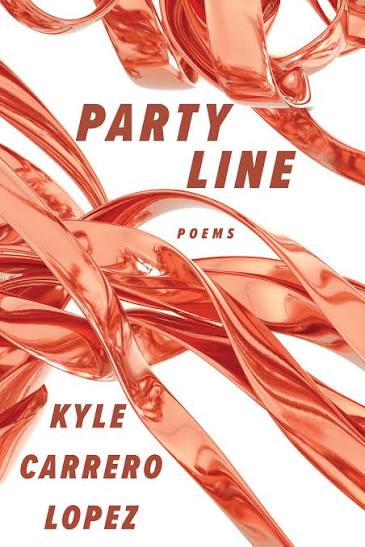
Party Line by Kyle Carrero Lopez invites readers to think critically about the many kinds of parties one is beholden to throughout life. As this poetry collection depicts, political parties and pool parties have more in common than one thought possible.
Both nostalgic and incisive, these poems use modern nightlife as a prism to illuminate devastating truths about the social politics that determine one’s very personhood (and who gets on the guest list for the hottest nightclub in town).
A party promoter is more than just an affable marketer. As the narrator puts it in “I’m Asked a Lot What a ‘Party Host Means,’” it’s a sociological niche in which he becomes “the locus of power” who “empowers patrons to stay, have / another.” The transition between the description and a phrase one often hears in nightlife is smooth, almost flirtatious. This playful register speaks to the amiable nature of one of nightlife’s many foot soldiers—a carefully constructed persona that belies its real interest: capital.
Money—who has it and how it’s acquired—becomes a throughline for many of the poems throughout the book. Behind every drag-queen bouncer and “lengthy manifestos on community care and / the impermissibility of all ‘-isms’ within the space,” declares the same speaker, who is now off the clock and on the dancefloor in the lengthy “Public Policy” poem, lies a microcosm of the capitalist economy to which partygoers subject themselves. Readers can imagine a wry smile on Carrero Lopez’s face as he writes with a sharp frankness that nevertheless remains graceful throughout. He’s not indignant (as so many critics of modern nightlife are labeled); instead, his poems strike a fruitful balance between sardonic and candid as they uncover the hypocrisy inherent in converting nightlife into a political project—with the scruples of an investigative journalist.
Under a system as omnipresent as late-stage capitalism, it becomes easy to abandon hope that one could ever foster meaningful change in any direction and blame forces beyond one’s control. Partying—however passionately it’s been politicized in the last decade—breeds a complacency distinct from that of people who never thought about these things in the first place. But that’s decidedly not what Carrero Lopez embodies with these poems’ narrator. If anything, he’s happy to implicate both the rabblerouser who narrates “Public Policy” and the blithe gays who run amok in “I’m Asked a Lot What a ‘Party Host’ Job Means” in the killing of the cash cow.
In “Phragmites,” the same speaker has left the club and heads east toward Fire Island, a popular gay travel destination notorious for its white-male crowds and prohibitively expensive logistics. He then admits that “[m]yself included, close to everyone here / has a body of one approximate build.” Though he may not share a racial identity with most attendees, the speaker understands himself to be a cog in the machine that manufactures inclusion based on an almost fascistic taste for fitness. The singularity of the phrase “one approximate” echoes the uniformity previously emphasized by the description of the “tall, same-faced” reed plants (and attendees) often associated with this particular summer colony. These compound modifiers work harmoniously to impart the humor, humility, and mathematical precision necessary to deliver a meaningful critique of queer social life’s racial-capitalist trappings. The poem itself is named after the scientific label for the slender and indistinctly beige plant that grows in crowds around Fire Island. Coy? Maybe, and I relish it.
Other poems address entirely distinct aspects of queerness, far from the club’s jubilee, but the consistently (and delightfully) petulant tone implies that they too are narrated by the same speaker. He’s a young man dutifully aware of greater forces always at work even in the most minute of interactions—both outside of the nightclub and in the imperious presence of one’s parents. Thus, this prism also brings familial relationships into focus and shows how these dynamics reflect larger socio-political forces that shape our ability to live up to ideals of the nuclear family. In “Sanctions,” the reader is transported back to the speaker’s childhood when he notes that he’s “at a party where there’s a dance track on that [his] father / used to play in his DJ studio, [their] basement, low / ceiling over checkered black-and-white tile.” He doesn’t dwell on the past for its own sake. He is, however, deeply concerned with the censorship that blots one’s memories as a queer youth, and how he learned his “first sanctions:”
no “girl toys” don’t walk like that stand like that
talk like that sit like that come downstairs like that
Look at men like that like that
like that that that. His anthem, his law
In the same way that global powers like the United States exact brutal economic restrictions on the nations it deems a threat to its hegemony, so too do male caretakers deprive queer children of the self-expression that allows them to achieve full personhood as adults. Call it homophobia or self-preservation, this poem-as-metaphor clarifies how asymmetrical power works within both interpersonal bigotry and imperialism. Further along in the same poem, the speaker smugly remarks that “these old head colds, / pile in on tempo as I dance / on another man.” The unmistakable wit evoked by the double entendre of “old head colds” is a humble but necessary reminder that the narrator is not bound by anyone’s ignorant notion of manhood.
Subjugation (interpersonal or otherwise) is a recurring theme throughout the book. But for Carrero Lopez, to merely state that it exists isn’t enough. Instead, the material conditions that allow people to jeopardize or determine the autonomy of others serve as centerpieces, offering a perspective squarely rooted in this physical world. These poems aren’t against the abstract. But when the thesis is so clearly an analysis of how individual relationships to labor manifest in social and political relationships, linguistic clarity and unrelenting humor become assets.
To enrich the anti-capitalist framework laid out in this collection, Carrero Lopez often invokes his ancestral homeland of Cuba. Despite the richness of the island’s culture, American discourse often flattens Cubans into one of two stereotypes. On one side are fair-skinned conservatives whose families flocked to Miami in the 1960s, ostensibly because the revolution came and took their sugarcane plantations. On the other are Black and brown Castro fanatics who’ve ostensibly been brainwashed by Soviet-era propaganda. The American notion of Cuban people is stuck in the Bay of Pigs as it imagines them split neatly into two groups stuck in a tug of war for Cuba’s political destiny. Nevertheless, it’s a conflict often dwarfed by the true belligerents of the Cold War, “between Kremlin and Pentagon,” as summarized by the speaker in “The Red Telephone.”
Cuba then becomes a symbol of the power struggle between the left and right wings of the Global North, or the “Moscow-DC hotline” as Carrero Lopez aptly puts it. These poems are guided by an ideology that doesn’t pledge allegiance to leftist forces despite their collectivist aspirations. By going beyond optics, one learns how “some sunny, skinny / island could lift so much, // store at least enough power / to spark the giants’ red line.” Emphasizing Cuba’s size relative to the tremendous stature of the United States and Russia clarifies its role as an unwilling stage for one of the most transformative conflicts of the twenty-first century. This is the truth of Cuban society that goes unacknowledged in favor of incendiary headlines that fuel (and are fueled by) reductive political tropes.
The discursive effect of these poems reveals a keen awareness of the colonial machinations that grant societies power over others. But in “Gay Travel, or Music Makes the People Come Together,” Carrero Lopez is at his most critical as his itinerant speaker exposes the invasive tendencies common even among his left-leaning acquaintances. Actually, I do “want to know how B’s trip / to the settler colony went.” To which “[h]e says: What can I say? / It was a lot like the settler colony // where I live.”
The enjambment makes the nature of the speaker’s inquiry surprising—downright delightful, actually. By using a common noun instead of a proper noun (such as Havana, Cuba), the poem implicitly emphasizes the material similarities between societies around the world that were forged through settler colonialism. A nation’s name and tourist districts then become fig leaves obscuring brutal histories of extraction. Even in the throes of the realization that the partiers he rubs elbows with funnel money into neo-colonial systems of travel, the speaker remains observant, further noting that
At the club, B met a twunk
in a harness who would shout things like
We’re so lucky to be alive—meaning: under
the molly under the red lights
Under the ceiling
Under the missile defense system
This poem carefully dramatizes how capitalist reality means that pleasure and safety often come at the expense of others’ well-being. It invites queer people to disentangle the comforts they get to enjoy from their roles within a racial-capitalist economy. Like other poems throughout, it engages mass complicity with a matter-of-fact tone that doesn’t care to insult. Rather, it offers a material analysis that empowers readers to locate themselves within economic systems that dole out safety and danger in accordance with structures of oppression that arch across the globe.
Nowhere else in this collection is capitalism’s omnipotence thrown into greater relief than in “Embargo (ADDENDUM).” It’s a poem that corresponds with other historical moments captured throughout the book. Just as the United States induces strife in Cuba through economic embargos and the father in “Sanctions” coaxes intrapersonal anguish within the narrator, so too does the Israeli state render life utterly inhospitable in Gaza as symbolized in “Surgeon Without Anesthetic.” This final addition to the narrative of manufactured strife reminds onlookers that suffering in a capitalist’s world is never a mistake.
Jumbled into one claustrophobic stanza, the speaker repeats essential questions: “With what syringes? / With what hormones?” They’re queries that invoke the healthcare crises that define modern life. It’s no coincidence that many of these poems’ interrogations relate to physical well-being—a low, and therefore vital, component of the hierarchy of needs. It’s by design that the very course of countless lives is determined while asking something as simple as “[w]ith what gauze?”
Despite the bleakness of the material world articulated in this collection, Party Line isn’t trying to dissuade its readers from living in the world just as its speaker does. In the last poem, “I Saw Assata in Havana” (I read it as “I Saw Assata in Heaven” at first), the speaker leaves the audience with the poignant symbol of a woman who dedicated her life not only to resisting the United States’ carceral apparatus but also to actively risking her life fighting it. Many will finish the collection with the image of Shakur’s “smile / that filled her face and laughs that grew // in strength, upward upward” and a shameless hope that one can rebel and live to tell the tale.
What brings joy—and at what cost—can be frightening questions. At least there are writers like Carrero Lopez to make one wonder why some partygoers get in for free while others have to wait down the block.