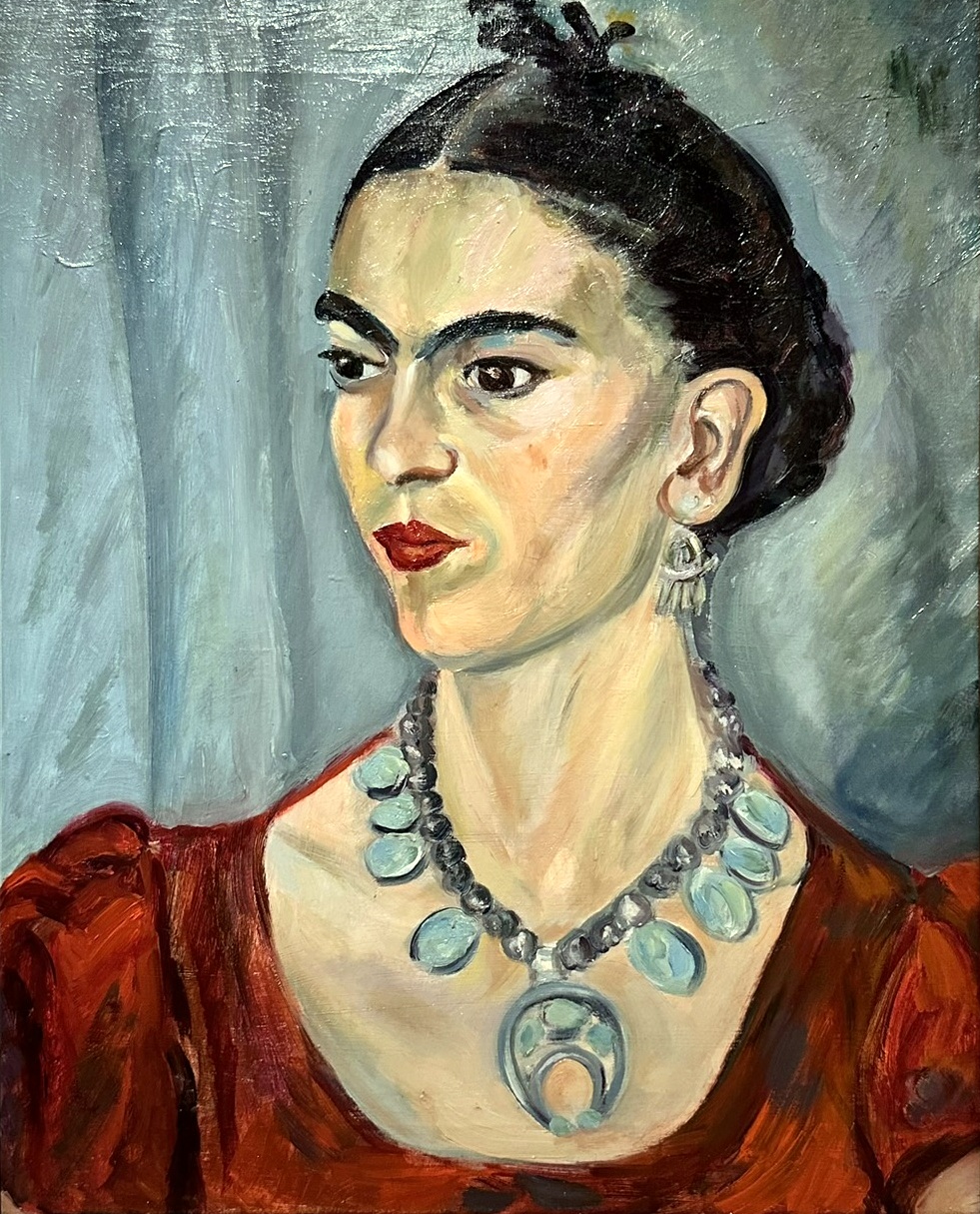
I have a scar that runs from my hip to my knee, and for years I described it the way a doctor would: fracture, plate, six screws. The morning before the surgery, I remember staring at the ceiling of a pre-op room and understanding, in a way I hadn’t let myself understand yet, that whatever leg I woke up with would not be the leg I’d had that morning—that some quiet, permanent negotiation was about to happen to my body without my input. It took me a long time to describe it the way it actually felt, which was less like an injury and more like a language I hadn’t asked to learn. I think about this every time I stand in front of a Frida Kahlo self-portrait, because Kahlo is one of the only painters I know who refused the doctor’s clinical account entirely. She painted the screws.
Kahlo’s The Broken Column (1944) shows her torso split open like a classical ruin, an Ionic column standing in for her spine, nails driven into her skin at odd, almost decorative intervals. Her face is composed, nearly serene, while her body performs the opposite argument. This is the tension that runs through almost everything she made after the 1925 bus accident that shattered her pelvis and spine: a face that has agreed to be quiet and hold still, and a body that keeps testifying anyway. Critics have spent a century calling this style surrealism. Kahlo herself rejected the label. “I never painted dreams,” she said. “I painted my own reality.” That distinction matters more than it’s usually given credit for, because surrealism assumes distance from the body—a dream you wake up out of. Kahlo’s paintings assume the opposite. There is no waking up out of a corset.
I don’t say this to be tidy, to turn Kahlo into a mascot for chronic pain. She has already become that mascot in ways that flatten her: the tote bags, the eyebrow emoji, the Frida of Instagram. That version of her has been fully absorbed into a market that would have found her actual body inconvenient. What interests me is something narrower: the specific grammar she invented for pain that has no good grammar in ordinary language. English gives us a thin vocabulary for chronic conditions. We say flare-up, we say bad day, we say I’m fine in the elevator when someone asks, because the real answer takes longer than an elevator ride. Kahlo painted in a language that could hold the longer answer. Henry Ford Hospital (1932), a canvas the size of a dinner tray, shows her on a hospital bed after a miscarriage, tethered by red umbilical-cord-like ribbons to a fetus, a snail, a pelvis, an orchid, a steel machine—objects that have nothing to do with each other except that grief has decided they belong together. That’s not surrealism. That’s just what it’s like to lie in a bed and have your mind arrange the room into symbols because the room itself has become unbearable to look at.
Critics have a way of writing about Kahlo that treats the pain as backstory—the accident, the thirty-plus surgeries, the corsets, the amputated leg near the end of her life—as if these are footnotes explaining the “real” subject, which is the art. I want to say the opposite: The pain is not the context for the paintings. The pain is the medium. Diego Rivera got the murals, the public commissions, the enormous state-sanctioned walls. Kahlo got a body that would not let her stand at an easel for long stretches, so she painted small, close, mirror-facing self-portraits, often from a bed, often with a mirror mounted above her so she could still work lying down. Scale, in her case, was not a stylistic choice. It was an accommodation. And yet the smallness of the canvases is part of what makes them unbearable to look away from—the viewer has to lean in, the way you lean in to hear someone who’s stopped being able to raise their voice.
I keep returning to a detail that rarely gets its own sentence in the biographies: Kahlo decorated her plaster corsets. She painted a hammer and sickle on one. She painted a fetus on another. The corsets were medical devices, built to keep her spine from doing what it wanted to do, which was collapse. She turned them into paintings anyway, because apparently there was no surface flat enough, no material stiff enough, to keep her from transforming it into testimony. This is the part of her practice I find most instructive, and least discussed: not the iconography, not the unibrow, not the marriage to Rivera that swallows so much of the popular narrative, but the sheer refusal to let a container remain only a container. If the body is going to insist on being visible material, then fine—she’ll paint on the thing that’s holding her together. I think about that refusal every time I remember my own recovery, the way a body under repair will keep insisting on being seen, corset or cast, canvas or discharge folder.
***
When I was relearning to walk after my own surgery, a physical therapist told me, not unkindly, that my leg would probably always know something my other leg didn’t—that it would ache before storms, stiffen on stairs, remember the break in ways language couldn’t quite catch up to. I didn’t have a corset to paint on. I had a discharge folder with exercises stapled to it. But I understood, in a small and probably self-serving way, what Kahlo had figured out decades before any of us had the vocabulary for it: that the body files its own report, in its own tense, whether or not anyone reads it as art. Most of us just don’t have a mirror mounted over the bed.
What I didn’t understand until much later was how radical the mirror itself was as a working method. Self-portraiture gets discussed, in survey classes, as a matter of convenience—an artist without a model paints herself, the same way a writer without a subject writes a diary. But convenience doesn’t explain why Kahlo painted around fifty-five self-portraits over roughly a quarter century of intermittent bedrest, or why so many of them insist on documenting not a mood but a procedure. The mirror above her bed wasn’t a substitute for a model. It was closer to an instrument, the way a stethoscope or an X-ray is an instrument: a device built to let her see a part of the report that the rest of us don’t usually get to see, which is the report as it’s being written, in real time, from the inside.
There’s a temptation, writing about disabled and chronically ill artists, to resolve the essay into inspiration, to end on some version of and despite it all, she made beauty. I don’t think Kahlo’s paintings gesture toward that ending, and I don’t think mine should either. Tree of Hope, Remain Firm (1946), painted after a spinal surgery that left her flat on a hospital gurney, splits her into two figures: one lying on the stretcher, back exposed with two long surgical incisions, and one sitting upright beside it holding a flag, dressed for the outside world. Neither figure is resolved into the other. The healthy Frida doesn’t rescue the wounded one, they just sit in the same yellow desert, at the same time, indefinitely. That refusal to merge the two selves into a single, triumphant narrative is, I think, the most honest thing a chronic illness can be shown to look like. You don’t graduate out of the bed version of yourself. You just get better at sitting next to her.
This is where I think the “confessional” label that gets attached to Kahlo, almost automatically, starts to break down. Confession implies an audience granted access to something previously hidden—a disclosure, a coming-clean. But Kahlo’s paintings don’t read to me as disclosures so much as instruments of measurement, closer in spirit to a patient chart than a diary entry. My Birth (1932) shows a Frida-headed adult figure emerging, already dead-eyed, from between the legs of a shrouded woman whose face is entirely covered, as though grief itself had given birth to grief. There is no vantage point in that painting from which a viewer is meant to feel invited in gently. The painting does not perform vulnerability for an audience the way a memoir sometimes does, angling its most private material toward the reader’s sympathy. It simply records, with the flat, matter-of-fact horror of a clinical illustration, what it felt like to lose a child and to have been, in some sense, delivered into that loss herself. The difference between confession and instrumentation might sound academic, but it changes how I read Kahlo’s whole body of work. Confession asks to be forgiven, or at least understood. Instrumentation just desires to be accurate.
I think this is also why the paintings resist the “inspirational” reading that pop culture keeps trying to force onto them. An instrument doesn’t inspire; it measures and it records. When Kahlo painted herself in a full-length plaster corset in Broken Column, arms tied at the wrists like a martyr in a devotional painting, tears running down an otherwise composed face, she wasn’t asking to be admired for enduring. She was recording the reading on the day of the recording. Some days the reading was worse than others—in 1953, the year before she died, doctors amputated her right leg below the knee due to gangrene, and she drew her own diary entries in that period with a directness that still unsettles me, sketches of feet, of blood, of a wound she refused to euphemize even in private. There’s no arc of triumph in those late drawings. There’s just the next entry.
It’s worth saying plainly that Kahlo’s Mexican identity and her physical pain were never separate projects for her, and criticism that isolates the “disability art” from the “political art” tends to miss how thoroughly she fused them. Her Tehuana dresses, worn in part because their voluminous skirts could hide the corsets and the leg she eventually lost, were also a deliberate political costume, an assertion of an indigenous, matriarchal Mexican identity in defiance of the European fashions Rivera’s circle sometimes favored. The body that needed hiding and the body that needed declaring were the same body, dressed in the same garment, for two reasons at once. That doubling is, I think, the closest thing Kahlo has to a signature move: the column and the ruin, the healthy self and the wounded self, the folk costume and the surgical drapery, always occupying the same frame without canceling each other out.
I don’t know that criticism has fully caught up to how contemporary this doubling feels. Contemporary illness memoir, in particular, is saturated with a certain kind of illness narrative that wants a clean redemptive shape—the diagnosis, the struggle, the hard-won acceptance, the closing image of sunlight on a windowsill. Kahlo’s paintings refuse that shape so consistently that it starts to look less like an artistic quirk and more like a philosophical position: that pain doesn’t organize itself into a plot, and that the demand for it to do so is itself a kind of violence, an insistence that suffering justify its own existence by producing a moral at the end. What Broken Column and Henry Ford Hospital and Tree of Hope offer instead is something closer to weather reporting. Here is the reading today. Here is what the instrument recorded. No forecast, no silver lining, just the data, rendered with an intimacy so severe it becomes, almost against its own will, unforgettable.
***
My scar has faded to something closer to a seam than a wound, the kind of mark you forget about until stairs remind you, or a cold morning, or a doctor’s intake form that asks you to circle where it hurts. I don’t paint. But I keep a mirror image of that first sentence the doctors wrote somewhere close: fracture, plate, six screws, and underneath it, unspoken for years, the sentence that actually mattered, which had nothing to do with hardware and everything to do with what it’s like to become, briefly and without your consent, a piece of evidence about yourself. Kahlo turned that evidence into instruments precise enough to outlast a century of people trying to soften her into a decoration. The least any of us can do, looking at her now, is resist the softening a little longer, and read the reading for what it says, not for what we’d prefer it to mean.
There’s also a version of this essay that could be written entirely through the lens of art history proper—that could trace Kahlo’s relationship to Mexican retablo painting, the small devotional images on tin that Mexican Catholics commissioned to thank saints for surviving accidents or illnesses, usually inscribed along the bottom with a description of the disaster and the miracle. Kahlo collected these obsessively, and it shows: the scale, the flatness, the willingness to combine text and image and to depict violence without apologizing for its ugliness all trace back to that folk tradition rather than to the European surrealists she got grouped with by critics eager for a ready-made category. A retablo doesn’t ask to be beautiful. It asks to be true to the incident, so that the saint being thanked will recognize the debt. I think Kahlo painted herself the way a retablo painter would paint a miracle that hadn’t quite happened yet, a survival that was still, in her case, ongoing, uncertain, and daily. There’s no saint at the top of Broken Column granting mercy. There’s just Frida, tearful, upright, absorbing the credit and the damage in the same gesture, because no one else was going to do it for her.
That lineage matters because it reframes the old “is it surrealism” debate: André Breton called her work surrealist avant la lettre after visiting Mexico in 1938, but surrealism wants access to the unconscious, and retablo logic is testimonial—legalistic, almost, in its insistence on the date, the place, the exact nature of the wound. When Kahlo painted the bus and trolley colliding behind a self-portrait, or the steel handrail that impaled her in 1925, she wasn’t dredging up a symbol. She was filing a report.
That distinction changes what kind of viewer the paintings assume. Surrealism addressed initiates fluent in Freud and dream logic. Retablos address witnesses—people who might themselves need to file a similar report one day. That is a much more democratic assumption about who gets to understand pain, and it is, I think, the reason Kahlo’s paintings have traveled so far past the art-world audience Breton imagined for them, ending up on the walls of hospital rooms and disability support groups and the private laptops of readers looking for a picture that doesn’t ask them to be brave about it.
None of this is to say the paintings are simple, or that their popularity has been an unmixed good. The commodification I mentioned earlier—Kahlo’s face printed on everything from tequila bottles to phone cases—has done real damage to how legible her actual argument remains. A retablo, stripped of its inscription, becomes just a folk-art curiosity. A Kahlo self-portrait, stripped of the specific medical and political history behind it, becomes just a strong, marketable face: the eyebrows, the flowers, the intensity, available for licensing. Part of what criticism can still do, a century on, is put the inscription back. Not to rescue Kahlo from popularity, which she doesn’t need rescuing from, but to make sure that when people bring her image into their homes, on totes or postcards or tattoos, they are carrying the actual x-ray, not just the frame it hangs in.
I think about this, too, in relation to my own scar, which nobody but a doctor or a lover has ever really seen, and which carries no inscription at all beyond the one I’ve just given it here. Most bodies don’t get retablos. Most fractures don’t get filed anywhere except in the private, half-forgotten language of the body itself, the ache before storms, the stiffness on stairs. Kahlo’s genius, if that word still means anything after a century of merchandising, was to insist that this private filing deserved a public form—that the grammar of the body was rigorous enough, specific enough, worth translating precisely enough to count as art rather than as mere complaint. I don’t have her talent, and I don’t have her corset. But because of her, I have something else: a way of reading my scar that is neither clinical detachment nor avoidance. On the days it aches, I let it be its own small retablo—filed for no saint, addressed to no one, asking for no miracle. It simply testifies, in the only language it has ever spoken fluently, that I am still here.