
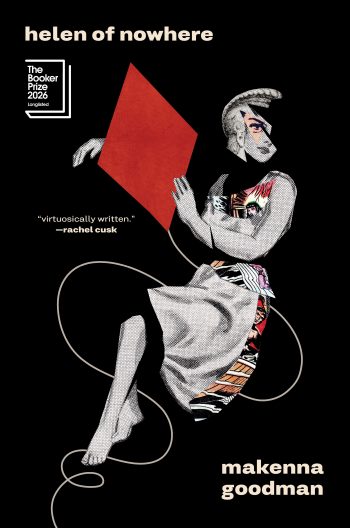
Makenna Goodman’s novel, Helen of Nowhere (Coffee House Press, 2025), begins with a discredited academic bemoaning the downward spiral of his career and blaming the women in his life. When he decides to move to the country and start anew, a Realtor weaves the seductive tale of Helen, the mysterious, shape-shifting, and off-the-grid owner of the house—someone with a very different view of the world, someone who can teach the Man about himself.
Thus, we are launched into a dreamy adventure through the Man’s psyche, in which each character tries on the self of another. Even the novel itself dresses as if it’s something else, a play with acts and character list. The effect is destabilizing and surreal. But the psychological play is purposeful. It’s not a book that seems interested in pinning down characters but in making us sit with the mystery of them—all to reveal something slippery about the mind and the formation of identity, something we can’t get at any other way.
It was lovely to talk with Makenna Goodman through email about these enigmatic characters, the nature of nature, and shifting authorial power.
This interview has been edited for length and clarity.
The Rumpus: Helen of Nowhere opens as if it’s a play, with a list of characters, then a list of acts. Once we get inside, each act is more like a monologue—sometimes interrupted—without other trappings of a play, such as stage directions or traditional dialogue. For me, this positions the book someplace between a novel and a play.
Makenna Goodman: The final form came late in the process. As I was editing, I kept stripping out exposition. I didn’t want any “he said”s. No setting of the stage. No world building. The emotion needed to carry the story completely. I wanted each character’s voice to be the driving factor behind their development. Everything else felt unnecessary.
But it started to feel confusing, and I didn’t want the reader to be entirely lost, just disoriented in a way that helped them feel they were on the Man’s journey, too, that they were in this nowhere space. I was reading the plays of Annie Baker at the time, and I remember thinking I didn’t need to see them performed, as they lived in my mind like any good novel. I realized if I gave the book a character list and titled the chapters as acts, that the reader would know right away they were reading something different from a typical novel. I also wanted it to feel like an experience in the way going to the theater is, the way you suspend disbelief.
Rumpus: The play-like pieces also inform the story. We get a detailed costume description for the Man, but much less for the other characters. The Realtor is only an “attractive hippy type.” Helen is “hardscrabble but aging well.” There’s even less about the Wife. It weights these characters’ importance in a specific way.
Goodman: I wanted the Man to be clearest in the reader’s head. They could be on the ride with him, feel the crease of his notebook in his back pocket. You do learn about the Wife, her age and where she is, not what she looks like. Each definition gives the information necessary for the journey. The rest of the imagining is up to the reader.
Rumpus: A certain suspense builds because the act titles promise that the Wife is coming, but not until the end.
Goodman: It was fun to think that just a word in a list of characters could build suspense and set up tension. Readers know how a story works, that if a name appears, that person will appear, and so we read with that knowing. I wanted her presence to be felt. It’s threatening in a way, as you are waiting for her to weigh in.
Rumpus: I loved that feeling.
It’s different from how Helen emerges. She’s the owner of the house and the only character who gets a name. First, the Realtor talks about her. Then the Realtor becomes her. Finally, Helen herself appears to the Man, in this dreamy sort of way.
Goodman: The progression of Helen as you’re describing it is similar to how we construct our narratives of self. We tell people, “This is who I am,” and then we show them who we think we are, and then our true self appears when we are unconscious.
Helen is a mirror for the Man, in all her forms, and she is a mirror for his transformation. You could see her as a narrative device, or you could see her as a role the Realtor is playing. It depends on your idea of what reality is or should be. Is this a narrative game, a dream, an act of theater? Is Helen constructed in the Man’s mind, or in the Realtor’s mind, or both?
Rumpus: She feels like a personification of the house itself.
Goodman: The house is definitely an embodiment of Helen’s ideas. And it is something tangible that the Man could, in a sense, perform the role of Helen within. It’s far easier to buy a lifestyle than to build it. Buying the house is more accessible than changing your way of thinking—or acting. The Man may not be ready to live Helen’s life, but buying the house is the first step to him becoming good. Or so he thinks.
Rumpus: What you said earlier about not setting the stage or building the world—that struck me because the house itself is so important.
Goodman: The house is a big theme in my work. It’s a psychoanalytic symbol of the psyche and the self. The Realtor is selling the Man a house, but she’s also selling him the story of his self, in a new form.
Rumpus: So Helen is a mirror for the Man and embodiment of the house, which is also representative of the Man. Are there aspects of the house that had to be a certain way because of this? That built-in couch?
Goodman: Built-in couches were a big element in handcrafted houses in the 1960s, and it was important that Helen’s house be summoning the design of that era, which sought to merge furniture directly with architecture. These distinct entities becoming one felt important to the spirit of the book.
Psychoanalytically speaking, the built-in couch could be an invitation to ideas around the self that are so strongly rooted they are literally built-into the psyche. It was most important to create a very elemental room that could contain all the fantasies of the buyer, while inviting a sense of warmth and healing. The house is alive, in a way. It contains the transformation—it is like the body itself. If the built-in couch were a wooden chair, it would make the dialogue like an interrogation. And while it is one, technically, he’s meant to feel safe inside it.
Rumpus: As the Realtor tries to the sell the house, she first pretends to know nothing of the Man, but we slowly learn that she has read his work, read about his work, Googled his every last biographical detail, and maybe knows more than we can explain. There’s a seduction in that. I’m tricked into thinking this Realtor knows about me too, somehow.
Goodman: That would be far-fetched if the Realtor knew about you, but hey, we live in bizarre times, and I love the idea of feeling seen by the book.
There is some playfulness about who is in control of the story’s details, though. The Man is the driver of the story as the book starts, and as every other character emerges, his story comes into a new frame, and he loses his authorial power little by little. But he is the last to know.
Rumpus: Is it still the Man’s story, if he’s not in charge of it? What does authorial power mean here?
Goodman: The Man is only seeing what he is capable of seeing. We as the reader see more than him. I don’t know the technical term for this, whether he is an unreliable narrator, or subjective, or where the omniscience is, but each character takes their turn being the narrator. Each act invites the reader to reconsider the Man’s narrative in a new light. It’s partly modeled off the Socratic method, where a question is asked, then answered, and then re-asked over and over in different ways to complicate the answer. The Man must answer the question of what his story of self is, through various mirrors, until he can finally complicate his answer enough to free himself from it.
Rumpus: He also thinks he’ll find himself through nature. The Man reminisces about taking his students to “wild places” to observe “the divine relationships in nature and the thoughts that were born.” He wants to escape to Helen’s house in the country. Is being in nature about the actual wildlife? Is it about being away from other people? From society? From technology? I’m thinking about someone like Thoreau and his mother and that laundry. What kind of visits with nature has the Man been having? How does Helen’s approach, her self-sufficiency, rub up against that?
Goodman: The definition of nature is fascinating to me, because a definition is all about binaries, right? Everything you said, “Is it this, or is it that,” is about nature being one thing or another thing. The book is asking what if we were to think of nature as all things, altogether, all at once. Nature is the world being the world. So we are all beings existing in nature no matter how we are existing. Of course, plants and animals enrich a certain kind of forest, like jazz clubs and hot dog carts enrich a certain kind of city, but it’s all part of the same thing, the world.
Thoreau was famous for thinking of himself as a man in nature, but he was editing out plenty of stuff, like his mom doing his wash or bringing him sandwiches—same with Helen and Scott Nearing, the pioneering homesteaders living the good life in Vermont in the 1930s. They were famously vegetarian but got doctors to administer B12 shots for extra nutrients. That didn’t make it into the literature, because it didn’t fit in the story.
People are storytellers; we are editors; and nature is its own story. Telling the stories of nature is important. And I love when people do it. And I try to do it, but I also try to complicate it. I try to bring that spirit of editing into the writing about it, so as not to forget that there are other elements at play in “nature.”
Rumpus: There’s so much tension between identity and a person’s interactions with other entities—human and animal and plant; socially, professionally, romantically. Can the Man know himself by looking inward? Or only through his interactions with the larger world?
Goodman: It is definitely playing with the idea of what is the self and what is nature. What is society and what is relationship? What is connection, love—all those things—and it’s about the inner self and the outer self, the face we show others and the face we are too afraid to show. And while it’s easy to say, “Everything is everything,” one can’t live that way all the time. One has to make distinctions in order to get through the day. But one can make distinctions while also knowing that the distinctions are an illusion.
Rumpus: When the Wife finally appears, she pretends to be the Man! We have so many instances of one person talking for or through another. Helen inhabits the Realtor. The Man inhabits the dog. Are these characters finding each other? Or are they finding themselves in each other?
Goodman: Yes, they are finding each other, and finding themselves through each other. But at the same time, they are all acting as representations of aspects of the psyche that can exist in any one person at any one time. We have the sides that long to be loved, and the sides that are accused of tyranny.
This could be a liberating idea, but it can frustrate some readers, because people long for definitiveness. But it’s interesting when a piece of art can activate imagination in the reader, in a way that makes the mind do the work of thinking and of embodying. A psychological dialogue is not just any run of the mill dialogue. That’s what is special to me about books. They can be a tool for people to get closer to their own psyches. But if people don’t want to, it can feel like an imposition.
Rumpus: I like how you’re talking about them as characters and as aspects of the psyche. They can be both—right? Could that be where the frustration is for some readers? Do they feel the need to turn off one understanding to reach the other?
Goodman: They can definitely be both! The best characters in literature are metaphors for larger ideas. I don’t know why some people are so frustrated by a book and others are so excited by it. Everyone is different. We all want different things from books. Disagreeing is part of discourse.
Rumpus: The Man is consistently, but oh-so-casually, sexist in the way he talks about his wife and his colleagues. I gasped at some parts: “My desire was something about her I could control, and ultimately, marrying her was the greatest revenge against her brilliance.” But I was more surprised when Helen herself tells him that women conspired to ruin his life. This is his misogynistic fantasy—why does she enforce it?
Goodman: Helen is casting a spell of sorts on the Man, and this speech about the women who ruined his life is part of that spell. It’s both an incantation of all his fears and a weaponizing of them, but it’s also a cleansing, in the way fire can be cleansing—while also destructive. We are living in a very misogynistic moment so of course we would recognize ourselves in it, as both victims and perpetrators. Women can be misogynist too, of course, as we internalize its violence.
A person at an event of mine raised her hand and said, sort of ashamed, that as a feminist who came of age as an activist in the 1980s, she saw a lot of herself in the Man, in his attachment to old ways of thinking. She looks at contemporary feminists and thinks their arguments are flawed, and they think she is outdated.
I appreciated this take, because it’s too easy to say, “Nah, that isn’t me” and absolve ourselves of so-called bad behavior. To think that my ideas are still legitimate and new ideas that go against my ideas are not as legitimate… Who hasn’t had that thought at least once a day? And how do we decide who gets to be right? I wanted people to think less why they didn’t like the Man, but what they didn’t like about this thinking.
Rumpus: What’s his way of thinking?
Goodman: His worldview is laid out in the first sentence. (“I think it’s okay to tell a woman she’s beautiful once a year.”) He thinks he is being benevolent and feminist, but he’s actually being the opposite. He is not clear on who he is.
The book is about a perspective shift. He is not being fired or canceled, but moved outside of the center, essentially de-prioritized. It’s not actually that awful, but it feels awful to him, because he feels entitled to remaining relevant. I’m less interested in academia and more the necessary shifts in how we teach people to think, and who is in the position to craft those teachings. How does thought evolve?
Rumpus: I’m always interested in the ways we can write about what is wrong in the world, without accidentally reinforcing it. How do you approach these possibilities? Do you write for your best reader? Hedge for your worst?
Goodman: This is a good question, and a hard one to answer, because so much of what we do is unconscious. Do I really have intentions? Do I even know what I’m writing? I certainly don’t want to reinforce what’s wrong with the world. Act 5, when the Wife gets her turn to speak, touches on this. I guess the risk is in being misunderstood. But a lot of the magic is in a lack of a plan. It’s the chaotic landscape of the imagination where things can bubble up and surprise us. And I do believe it is the role of artists to imagine social transformation in our work.
Rumpus: The ending is one more character moving through another—the Man becomes the Wife’s dog. Is it a delight for you to make him a dog? Is it revenge? Is it redemption?
Goodman: Some people think the Man is turned into the Wife’s dog and gets his comeuppance. That interpretation usually means that Helen is some sort of witch, and that she plays this big joke on him. And that becoming a dog is somehow a debasement. Some people think he is embodying the unconditionality of dog energy as a way to express his love for his wife, laying down his sword. This means Helen is some sort of healer, and that dogs are this noble embodiment of loyalty, unconditionality, and presence. Some people think Helen is the Wife, and the whole thing is some sort of role play exercise. Whatever it is, the Man has to give up his ego in order to be happy. Someone asked me recently, “Where did the real dog go?” Their theory was the Man removed the soul of the dog to reach his own happiness, always the taker.
Is the ending a form of punishment, or is it redemption? What is the role of karma in evolution? The fact that it could be either is what interests me, because it depends on our interpretation, and the questions are more important than the answers. Ultimately, the Wife has a nice little companion who follows her lead. But this little companion is bathing in sunlight and being fed and walked and told it’s okay to be naughty. So really, life is good.


Click here to subscribe today and leave your comment, or log in if you’re already a paid subscriber.