
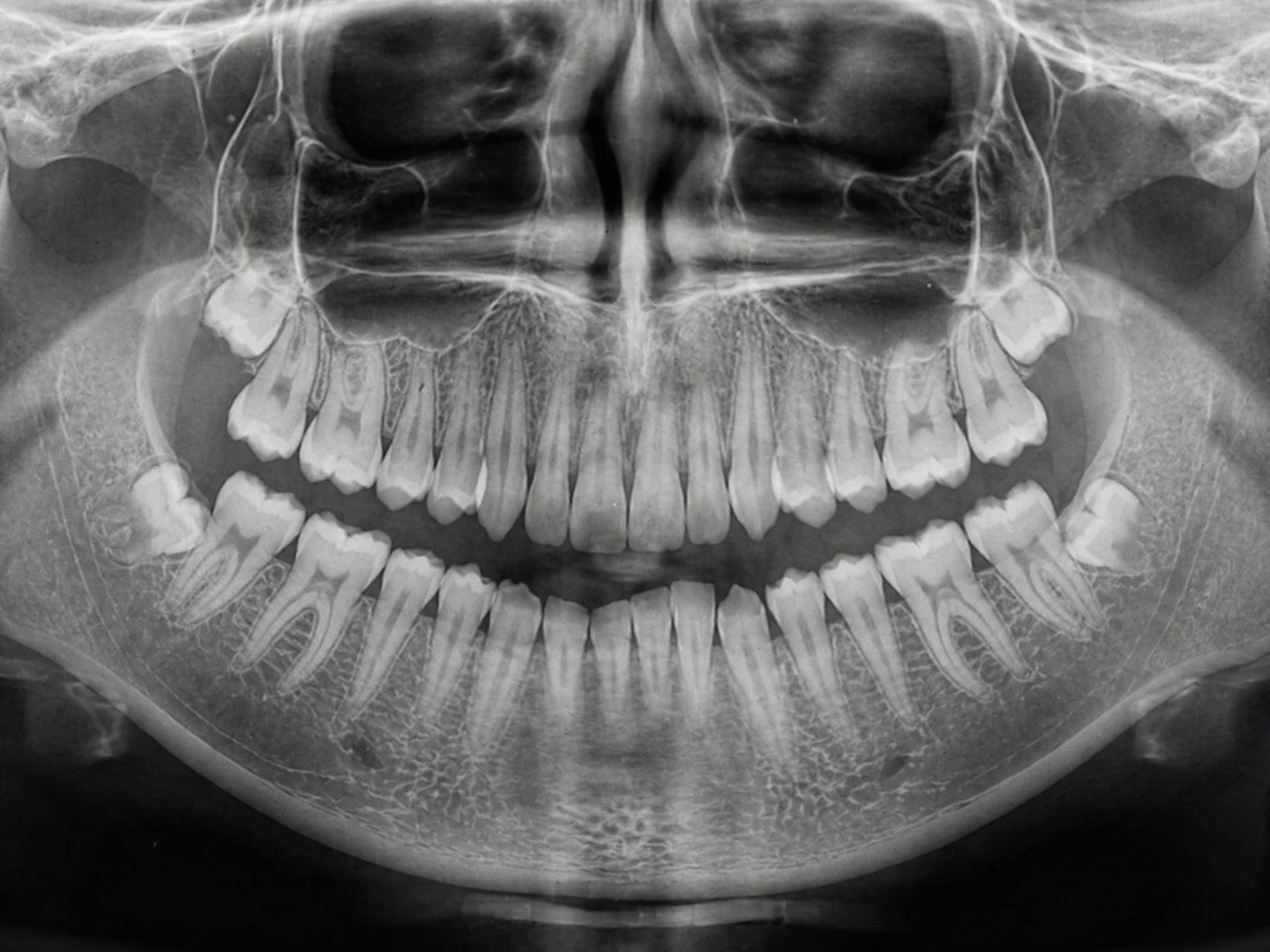
“What the fuck,” I said. “Are those Dad’s teeth?”
I stared at the bracelet on my mother’s arm. At first glance I’d thought it was ugly. Odd stones, rough and discolored. Off-white but not like pearls or opals, more like soiled linen. And it got worse the more I looked at it.
My mother didn’t say anything, only laughed the way you might laugh if someone called you out on a charming eccentricity, not something like this.
“Ma, that’s deranged,” I said, staring at the bracelet. “That’s something a serial killer would have.”
“Just try it,” she said. “It helps me think.”
She slid it off her wrist and onto mine. I recoiled a little as I felt one of the molars scrape my skin. But I let her put it on, as if her hand was an extension of mine. We had gotten like this, one organism, when Dad was sick and after—if one of us got tired, she’d go slack and let the other one take over, so that we could keep going even if one of us could not.
“Why do you even have this?” I asked as she withdrew her hand.
“They said it wasn’t that unusual, at the funeral home,” she told me. “They said sometimes, especially when it’s a premature death, people keep a lock of hair. Only—”
She didn’t have to finish. With the chemo, Dad didn’t have any.
“Yeah, but that’s hair,” I said. “That’s something that would be in one of those medieval poems, you know, of knights and princesses. Courtly love.”
I’d taken a poetry class in college to show the med school admissions committees that I was well-rounded. There was one poem that reminded me of my dad. What do we do with the body, it begins. Apparently what my Ma did was have my dad’s teeth extracted.
“It helps me,” Ma repeated.
So I tried it. I sat with the bracelet and tried to write.
I was working on my personal statements. Four years ago I had thought the hardest thing about getting into an MD/PhD program would be acing my classes and the MCAT, or getting a first-author paper as an undergraduate, or distinguishing myself enough in a cohort of cutthroat pre-med vultures to get strong letters. But I’d done all of those things. It was afterwards, when I sat down to try to write my personal statement, that I drew a blank. Day in and day out that summer in my childhood bedroom, the window unit blasting cold stale air in my face, Ma puttering around the kitchen, I typed words then deleted them, typed then deleted. Describe your motivations. I dug deeper in places like r/mdphd, grasping for grist. You could talk about a formative experience.
That got me thinking about my father. He would have been good at this sort of thing. He was a born storyteller. When I was little I’d crawl into bed between him and Ma, and he’d make up stories about a girl with my name and her many adventures—rescuing a dragon with a broken wing, disguising herself as a pirate, and climbing the tallest mountain in the land to pick the flower that cured every disease.
I tried to channel him while I worked on my applications.
In poems people are always describing teeth as pearls, but Dad’s teeth were as like pearls as the ruthless girls in my pre-med classes were like his doctors. One thing about pearls is you’re supposed to wear them so they don’t lose their luster. The aragonite—calcium carbonate bound with proteins—needs to be hydrated, such as from our skin’s moisture, in order for the light to be reflected evenly off its surface. That’s the reason jewelry experts often recommend wearing pearls when you’re just hanging around the house. And I found myself wearing Dad’s teeth the same way, as if somehow I could transmit something of myself to them to make him less dead. Slowly the words started to come. I wrote about the diagnosis. Late-stage. Inoperable. The chemo that didn’t work, only made him bald and gaunt and tired. How I’d always wanted to be a doctor, but now I needed to be a doctor, a physician-scientist, so I could kill the thing that killed him.
I started to wear the bracelet so much that Ma, even though it had been her idea, checked in.
“It’s helping, okay?” I told her.
When Dad was alive I never thought much about his teeth. Before he got sick, and even after, he would do this thing where he’d say, all serious, “Do I have anything in my teeth?” and then he’d smile real wide and there’d be green gunk all in between them, kale or spinach or whatever. And he’d laugh like it was the funniest bit in the world. I always thought that was so cringe as a kid. It’s funny the things you miss.
When I wasn’t working on my applications, I was shadowing Dr. Banerjee, a medical oncologist. He let me sit in on appointments, even take the patients’ vitals. My favorite patient was Mrs. Chieng. Although we’re white and she’s Chinese-American, something about her reminded me of Ma, the authoritative lift of her chin when she told me I’d be a good doctor. In the afternoons there were tumor boards, and sometimes Dr. Banerjee would have me present a case. That Monday I was up again.
“Fifty-five-year-old man with no significant past medical history,” I began, and suddenly I couldn’t breathe. Sweat beaded on my upper lip. I realized I’d taken the bracelet off to shower that morning and had forgotten to put it back on. I knew it was just back home, sitting on the bathroom sink, but I felt oddly light without it, as if my skin would fly off my bones.
I only lost it for a moment before getting it back together. It was long enough, though. After boards, Dr. Banerjee pulled me aside.
“You can go home early today,” he said. “I know that was a tough case for you.”
“I’m fine,” I told him. “I want to learn.”
As soon as I got home I put the bracelet back on. That night, I started sleeping with it.
The first morning I woke up with marks, I figured I’d just slept weird. The bracelet had slid up my arm from my tossing and turning. Around my wrist were these little indentations, like someone had pinched me. I thought nothing of it and went to the hospital as usual. But then, as I was following Dr. Banerjee around, it was like my mind peeled away from my body. I could observe myself observing patients.
What I saw was a girl in a white coat that was too big for her. And those hands. The isopropanol smell of the hospital sharpened, as if I was about to vomit. My revulsion surprised me. I’ve always liked my hands. They’re small even for my size, and that’s always made me feel dainty. Boyfriends I’d had would compare their fingers with mine and coo, So tiny!
But now, watching my hands hold the stethoscope against a patient’s chest, or follow Dr. Banerjee’s to palpitate a tumor, I hated them. They look too slight, incapable of capability.
Dissociating didn’t stop me from caring for patients. If anything, it made me better at it.
The next week, while we were doffing our coats, Dr. Banerjee lifted my wrist.
“What’s this?”
I mumbled something about scraping it when I tripped over some uneven pavement. How was I supposed to explain that I woke in the middle of the night to the bracelet chewing my skin like a cow chews its cud?
And yeah, it hurt.
But it also felt like remembering.
Brain-dead patients will sometimes raise their arms like mummies in a horror movie. In fact, that’s probably where that trope of mummies doing that comes from. It’s called the Lazarus reflex. No one knows exactly what causes it. I guess that’s why I didn’t tell anyone about the teeth. Like maybe there was some scientific reason teeth could chew after their owner was dead, but I preferred my own reasons.
“It’s ninety degrees out,” Ma said. “What are you doing wearing long sleeves?”
Every day I’d go into the hospital and peel away from my body, come back to myself at random times in a random place. One time in the shower, the water I’d watched running over the body suddenly registering on me, a million hot little pinpricks. Another time sitting in front of the open refrigerator, a pretzel stick dipped in Nutella halfway to my face. The chocolate smell intensifying, that revulsion again as my tongue brushed against the film on my teeth. Rolling up my sleeve to check on my other teeth. They were closed around a nub of skin, kneading it gently.
And then, the worst day. In the too-bright office, Mrs. Chieng’s chin quivered.
“How long do I have? How many years?”
I watched the girl with the puny hands answer in weeks. Didn’t come back to myself when I left the hospital. Didn’t come back to myself when I showered or microwaved the dinner Ma had saved for me. Didn’t even come back to myself when I walked up the stairs to my childhood bedroom.
Maybe I wouldn’t have come back at all.
But pain hooked me like a fish. The bracelet was clamped down on my wrist, a jaw, as if it were trying to bite my hand clean off.
I didn’t scream.
Something snapped. Not my carpal bones.
The bracelet.
Dad’s teeth scattered every which way, rolling like spilled pills. I tried to pick them up, but some had rolled under the radiator, and there on my hands and knees I realized I was crying, and Ma came in and she didn’t say it was stupid, she just got on her hands and knees too, and she was talking to me like I was a baby but somehow I didn’t mind it.
“I know,” she was saying. “I know. But it’s okay. He wants you to live.”
She stroked my wet cheeks, and that’s when I remembered that I have her hands, and I’d never trade them for anything.
We never found all the teeth, not enough to re-make the bracelet. It’s like that sometimes. The string breaks. But I’m okay. Lately I’ve been trying to read more poetry. Not for any admissions committee, just because I like it. Ma likes it too. I read her my favorites when I come home. And sometimes in my childhood bedroom, from those far corners where I lost the teeth, I can hear Dad laughing.

Click here to subscribe today and leave your comment, or log in if you’re already a paid subscriber.