How do you supersize a Rumpus Original Combo? That’s easy—just take a book review and an interview with the author, and add a Rumpus Original Poem to it!
Rebecca Wolff’s most recent collection of poetry, The King, was published in hardback by W.W. Norton in 2009. Her previous collections are Figment, also published by W. W. Norton in 2004, as a winner of the Barnard Women Poets Prize, and Manderley, published in 2001 by the University of Illinois Press after having been selected for the National Poetry Series by Robert Pinsky.
Wolff also launched Fence in 1998, along with Caroline Crumpacker, Jonathan Lethem, Frances Richard, and Matthew Rohrer; Fence Books, a multi-genre literary book publisher, was launched in 2001.
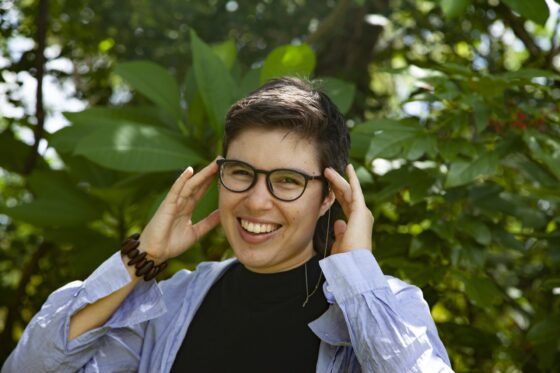
The Rumpus caught up with Wolff in an interview in Cleveland this September, to ask questions about her latest collection, her work at Fence, and her life.
Editor’s note: because of the extraordinary length of this interview, the review of Rebecca Wolff’s The King is available here. You can also read a new poem by Rebecca Wolff, “Stockholder,” in Rumpus Original Poems.
***
Rumpus: What is autumn like in Athens?
RW: Today is the first day of it! It’s dawning here kind of balmy, foggy, with only a whiff of the asphalt distribution plant down by the riverside to interrupt our anticipation of the dropping of leaves.
Rumpus: You were all of 15 when your first poem was published, in Seventeen Magazine, nonetheless. What was the title? What kind of poem was it?
RW: God, I can’t remember the title but I bet my father can—he had it framed as a kind of collage, with sand glued to it, by an art-director friend of his. It may have been called “A Day at the Beach” as it was a perfectly epiphanic, revelatory poem about jumping in the waves with—you guessed it—my father. It was short, maybe fifteen lines, and ended with me wrapped in a warm towel.
Rumpus: In most reviews of The King published to date—and in Norton’s jacket copy to the book—one finds ample description of the “aboutness” of your latest collection, which is, ostensibly, the experience of motherhood. These reviews address—beautifully—how The King invigorates the body of contemporary literature written on the subject of motherhood or parenting. Do you find this focus on your book’s subject matter at all reductive, given the amazing range you show within its pages, from linguistic (re)invention to more theoretic and theological preoccupations?
RW: Oh, orgasm orgasm, I love this question. I just five minutes ago completed a little blog post for the Norton site in which I obliquely suggested that the Publisher might be yet another kind of King in this context, one whose demands must be met and who provides a useful, um, splashguard, if you will. The trope of The King is all about my willingness to be called out by these various kings, if you follow the thread of that, and to accept the limitations they provide.
To quote Led Zeppelin, it’s nobody’s fault but mine, as in the process of trying to politely insist that Norton publish the collection, I did decide to give it this “aboutness” spin, in the hopes that it would make it more palatable for them (and I also have to admit that I wrote my own jacket copy, pretty much, as many poets do). I don’t actually have any reason to believe that this is, in the end, what made them want to publish it, but I have my suspicions that if I hadn’t given this kind of subject-mattery, narrative structure to the book in the first place it might not have been taken seriously at all.
More legitimately, there is a way in which the final section of the book, called “Depth Essay,” is exactly about coming to terms with subject matter, in the form of knowledge. There’s a poem called “It” that ends with the lines “I never thought too much about baking cookies/ Well think about it.” Substitute anything you like for “baking cookies.”
But to answer your question: I wouldn’t say “reductive”—I think I would say that I set a trap, with the jacket copy, and I don’t blame anyone for falling into it, but I do hope that readers as they fall will pay attention to the other kinds of disguises (besides that of baby) the King can take, in this formulation: knowledge, deity, absolute reality.
Rumpus: Do you think subject matter, as such, is more or less considered an anachronism, at least in particular “schools” of poetry (e.g. language poetry?)
RW: I hate to do this but I want to refer you to a recent discussion on Harriet about what a language poet is (or more to the point, was), as I seem to have a very nitpicky but perhaps fruitful kind of literalism about the term (warning, there is a very long comment stream on this one). So I would argue that no one born after say 1950 is a language poet.
For a long time I went happily with the general trend away from “aboutness,” and resented or simply mocked any kind of questions about what this or that poem might be about, or questions that crossed that boundary into talking “about” something that was mentioned in the poem rather than the poem in its wholeness, form and content and everything. I don’t mean that I was simply being trendy, but I had been drinking the same water as other poets in my vague circles. My mockery of and disdain for subject matter had to do with the fact that my compositional process included everything but a desire to write “about” something. I’m often really surprised when I go back to earlier books and see how actually quite cohesive the poems, are, thematically. They are, most of them, “about” this or that, however little I tried to make them so. So I would never say go so far as to say that language has been my subject but rather that my subject has resisted my intelligence with great success. It’s hard to be alive in America right now without some subject matter creeping into your inner psychic discourse.
Rumpus: Fence Books, according to its listing on Poets & Writers, has a mission to publish “challenging writing distinguished by idiosyncrasy and intelligence rather than by allegiance with camps, schools, or cliques”; your many notable authors include Chelsey Minnis, Joyelle McSweeney, Laura Sims, Christopher Janke, and Jibade Khalil Huffman. What trends in literary publishing (for other indie or mainstream publishers) do you see as an impediment to the future of innovative writing?
RW: Here I have to send you over to the Omnivoracious blog for this bit more about how Fence is not a proponent of innovation, per se. I really don’t place any inherent value in innovation in poetry, and the promotion of innovation as a value has never been part of Fence’s mission. So I guess I can’t really answer this question properly without replacing the word “innovative” in it with something more like “idiosyncratic.” And once that’s done I think my answer would be an unfortunately hackneyed one, which is that I don’t really think that publishing is presenting any obstacles right now—there’s tons of adventurous and able small-press publishers; it’s more the trend toward ever more ratification of various modes of writing by the academy. Many many poets make their homes in universities, and this does create a certain kind of same-y-ness of at least vocabularies and referents and objects in the work.
Rumpus: Do you think that any identification with a larger practice is helpful in any way to a poet, particular when he or she begins to seek readership?
RW: The only identification I trust in aesthetic determinations is self-identification, and I haven’t come across any self-identifying poets lately, with the possible exception of “Flarf” poets. Have you? There again I’m fruitfully literal: it’s really hard to accept that any poets besides those who are playing around with script-generated language are being actually “experimental,” given how long Gertrude Stein’s been dead now, lo these many years. The term “innovative” is generally hugely uninteresting to me although, like many subject matters, like a recipe for cookies, I’m sure I would enjoy being inside of it. I taught a poetry workshop last night, the first class meeting, and actually did that dopey thing of mistaking one student’s innovative practice for a corrupted Word doc. Many of his words were interrupted by what looked to me like misplaced letters from other words. It caused me to think for a few seconds about how deeply that student must be reading in the historical material of poetic experiment to come to feel ready to make a go at working up something “new.”
Rumpus: The New Yorker staff editor Jenna Krajeski praised The King for being “resistant to the hunky-dory, the New Agey, and the prescriptive”: similarly, John Kinsella noted that the “deeply private and often tormented spaces” in The King function as “survival tactics, even celebrations of resistance.” Do you think poetry lends itself more to “resistance art” (art that arises in response to conflict) than prose? Have you written any fiction since leaving Houston?
RW: Well, I do think that for many of us, poetic language arises out of certain kinds of collisions (to quote myself, from a poem that talks about language acquisition: “Out of pressure arises concentration/ out of concentration a kind of fission”). Poetic language is responsive to states of, if not crisis, certainly conflictedness, or mental/emotional spaces in which reason is insufficient or is at least silent. There is a kind of sonic exigency created by unthought thought, thought that comes to one as speech already spoken, already verified if you will.
I go to prose for clarity and—there it is again—subject matter and the expediency of sentences. I love sentences! I just read a few pages of this old book by the philosopher Richard Rorty and found him saying that “[t]ruth cannot be out there—cannot exist independently of the human mind—because sentences cannot so exist, or be out there. The world is out there, but descriptions of the world are not.” This is so relevant to The King!
As for my own fiction writing: I’m shocked and delighted to announce that my novel The Beginners will come out sometime in 2011 from Riverhead Books. This is a novel that I’ve worked on for a long while, to the exclusion of any other fiction writing, and it’s super exciting to feel that I’ve now got the go-ahead to begin another.
Rumpus: Did editing the anthology Not for Mothers Only with Catherine Wagner help to create a sense of solidarity between yourself and other contemporary poets who also happen to be raising children? Do you feel your relationship to the women in this anthology as fellow mothers to be incidental to your connection to these women as fellow poets or people?
RW: I’d say more that raising children created for me a sense of solidarity between myself and other women who happen to be raising children, and it was then just bonus to realize that this solidarity would be immeasurably amplified by locating mothers who were also poets. As we spoke of in our introduction, the anthology was directly inspired by our participation in a listserv of “Poet-moms” (mothers of children under ten with at least one book of poems out or a comparable degree of involvement in poetry, career-wise), and that listserv remains active and incredibly sustaining for me as a mother and actually just as a woman, I’d say, now that the critical early years of mothering have passed for me (my children are 5 and 7). I’ve never been a big joiner—more of a hideous solipsist, actually—so the experience of identifying as part of a self-selecting community like this one has been almost embarrassingly important. To answer your question, it is important that these women are poets, and it is important that they are mothers, but it would be very difficult to extricate these importances from each other.
Rumpus: How would you pitch this anthology to a father?
RW: It’s “Not for Mothers Only”!
Seriously: Everyone was at some point born to a mother. These poems should be of great interest to everyone.
Rumpus: Alicia Ostriker’s blurb of The King references Freud’s formulation “His majesty the baby,” but was this connection deliberate on your end? Does Freud or any other so-called authority on women factor at all into the darker aspects of The King?
RW: I wasn’t at all familiar with that formulation when I composed the ms. nor when I titled the book. I was super-pleased to find out about such a happy accident. That’s the kind of accident I rely upon, in my poems. I’m practically an automatic writer.
Rumpus: Your work in The King has been compared to several great writers, contemporary and past: Plath, Sharon Olds, Beth Ann Fennelly and Rachel Zucker, among them. My objections to drawing a parallel between style and “subject matter” aside: do these intertextual references resonate for you? Is it the fate of any writer in whose oeuvre “motherhood” plays a role to walk in the shadow of Plath?
RW: It is so funny to see my own work and the work of Rachel Zucker and the work of Catherine Wagner all get the big P (for “Plath”). I couldn’t revere Sylvia’s poetry more than I do, and I have a terribly complicated relationship with the poems of Sharon Olds (my first book features a loving pastiche of her called “The Sharon Olds Poem” and my next book (god willing) also has a poem in response to her), and have read Beth Ann Fennelly with delight, though I think among this list our work bears the most superficial similarity, and Rachel Zucker made my shortlist for blurbers so you can see that with her I feel no small sympathy.
All that said I see what you’re getting at and concur: It’s annoying and absurd to be painted so broadly with the motherhood brush. It’s surprising to find Plath so brushed as well: Her poems about her children are amazing but they are not the ones I most think of. That she stands as the flagship mother-poet is disturbing given that she offed herself when they were small.
Rumpus: Your poems in The King take place in a wide range of contexts: the speaker’s head, the great outdoors, and in a variety of so-called “domestic” scenes (baking cookies in a kitchen). Manderley’s atmospheric mood is the sepulcher-like setting of Daphne Du Maurier’s novel Rebecca (as alluded to in the epigraph) and Figment inscribes the call to wanderlust (“I make it harder than it has to be./ The perfume of longing for elsewhere”) as well as the vertiginous qualities of terra firma (“instrument to medium in the meantime// stuck out here in the devastation in the forest/ in the middle of fucking nowhere/ between landmass and incontinence/ camp and derangement, the more songlike/ the further we row/ from our figmented shore.”)
Do you think poetry should manifestly take place outside of the mind of the maker? Or is “place” just one more construction?
RW: I think rather that “should” is just one more construction, and not to be applied to much about poetry. One “should” be open to all kinds of modes in writing, and I’d say that poets whose concerns are with the reality of place—Eleni Sikelianos’ The California Book, eg—are doing something super interesting with that. My first book, Manderley, took its title in a heavily ironized fashion: Manderley is a manor house in a film by Alfred Hitchcock called Rebecca (and of course in the novel by Du Maurier) but the place I’m really referencing is the evacuated place created between these referents and my lack of intentionality in referring to them—if you see what I mean.
The fictive place is #1; the metaphorical place conjured in the mind of a reader is #2; the putative intentionality in the referring poet is #3; and the lack of intentionality is #4, “Manderley, we will take each other/ seriously. That which does not kill us/ blah blah blah,” to quote myself. It’s a disturbingly high irony. I actually used to try to write about this disassociative aesthetic action when I was first in college, at Bennington, and called it “The Triple Click.” It was very spacy and self-referential, as a literary-critical position and as an aesthetic philosophy, and didn’t go over well with my professor.
But when you talk about the poem in Depth Essay taking place “in a kitchen,” I think: Never never never, though I can remember the kitchen I was using when I wrote it, in Boise, Idaho. For me that poem takes place inside those 30 words, and their flatness. I would never proscribe or prescribe this to anyone. I can see how “place” as subject matter is political (in its incontrovertibility) but I’m not sure how to articulate anything about that. Perhaps once I really start putting together my next book, which is called Upstate, I’ll start to understand more what I think about “place.”
Rumpus: Can you elaborate on your reference to high irony, for those who easily misconstrue a speech act in the mode of high irony? I’ll be purposefully hyperbolic—who or what is antipathetic to high irony? Or, how might “high literalism” be a necessary bedfellow of high irony?
RW: Well, I’m not sure the two are doing it in anyone’s bed but mine, and I often wonder just exactly where on the autism spectrum I might place myself. Or find myself. A poet friend, Rodney Phillips, the same genius who supplied me with the title Manderley, suggested that my poems (back in that day) were being written by a gay man trapped inside my female body, and I guess I could think about the ways in which campiness fits into Otherness. High camp is full of pain. High irony, arising from the kind of extreme detachment in which one hears one’s self speaking as though one were an audience member, can also be described as “a bad sense of humor,” in that what I find funny, or sayable, through that kind of filter, is often not what others do—my misperception—and the flipside or consequence of a lifetime of disassociative disorder is a desperate attachment to what one perceives as emotional truth—the kind of truth that makes you cry: the truth of the sadness of roadkill, say, or the truth of other people’s romantic attachments, or the truth of other people’s position from which to take offense: phenomena that seem to attest to a much sought after incontrovertibility, and the poignance of that, from a distance.
The enemies of high irony are many and mighty and noble, and include: poverty, injustice, love, and, yes, babies. Children are another thing entirely: Mine show early signs of getting all my jokes! It’s like Rosemary’s Baby, their glowing eyes.
Rumpus: Along with being “about” motherhood The King strikes me as being “about” the very thin (perhaps permeable) threshold between the maker and the made (poems such as “The Lord is Coming: All bets are off,” “In my Jesus year,” and “The Letdown,” specifically.) “You cannot have the body/ until you make me one/ in exchange,” says the speaker of “Where’s the Funeral?” I’m recalling the final chapters of Susan Howe’s My Emily Dickinson—she suggests that in the master/mastered dialectic of Emily’s poetic development, she eventually sought to make the Lord up, in his absence (or, more precisely, to be his Lord or guardian). To what extent is the King/Other/Lord/Man of your collection a byproduct of your own resources, whether material or immaterial?
RW: Well, this is an interesting counter-reading to my own, aforementioned pre-packaged presentation of The King/Other/Lord/Man as representing that-which-is-essentially-too-real-for-me-to-construct. Not exactly a priori Truth-with-a-capital-T such as Rorty refutes above, but at least subjectivity and/or material reality that is equal to my own and which presents an immutability in the face of any whammy-jammy I might try to place upon it with my indefatigable store of Making. The Higher Power that we all must recognize if we are to achieve Nirvana, to completely scramble lexicons of actualization. The irony of all this being that recent reading in philosophy and literary theory is making me realize that for my next trick I’d like to write a memoir, of all things, about this really agonizing, completely authentic existential crisis I endured in my late teens/early twenties, which rendered me absolutely convinced that, in fact, I really did create my own reality. Literally. Does everyone go through this?
I refer again to the short, plainspoken poems in the section called “Depth Essay”: these poems try to express a kind of calm-after-storm pleasure in epistemological inquiry (such as into finding a good recipe for cookies) as anodyne, if not remedy, for that kind of division (see below about Buddhism). Here I feel I’m doing a bit of packaging again, in order to explain, but please trust me when I say that there’s other stuff going on in this section too.
Rumpus: Buddhism is mentioned several times in The King , and several of the poems (“Because He So Loved,” and “Deep Down”) are distinctly aphoristic or haiku-like.
“Because He So Loved”
Short eyes
moral compass
You’re wasting your finest thought
on me
peaceable kingdom.
What about the Buddhist sensibility do you find most appealing (in terms of philosophy or when structuring a poem)?
RW: I think you’re more right on with the aphoristic or epigrammatic tag: I’m actually not familiar with Buddhist philosophy or sensibility, except in a very glossy, undergraduate kind of way. I have been friendly with several Buddhists (impossible not to be when one lives in college towns); I once almost got a job at Tricycle (a Buddhist periodical); I took a really fabulous course in college (while still pretty deeply in the throes of the hysterically Western existential crisis) on East/West dualism that helped me reconcile myself to some pressing irreconcilabilities concerning spontaneous speech vs. silence. It’s more the American-Buddhist lifestyle I grok than anything deeply real about Buddhist practice. I can’t meditate for the life of me and honestly don’t, at a deep level, understand why anyone wants to. (I’m sure meditators are going to have a field day with that one. I actually DO really understand why people meditate.)
Rumpus: I’d like you to have a chance to respond to Stephen Burt’s essay in the May/June issue of the Boston Review, in which he cites Fence as the emblematic magazine of the most-imitated (elliptical) new American poets, a movement he describes as predating the latest wave of poetics, described loosely by Burt as “The New Thing.”
(A brief excerpt: “These poets were what I, eleven years ago, called “elliptical,” what other (sometimes hostile) observers called “New Lyric,” or “post-avant,” or “Third Way.” Their emblematic first book was Mark Levine’s Debt (1993), their emblematic magazine probably Fence”). Burt characterizes elliptical poetry as “full of illogic, of associative leaps,” and these poems to resemble “dreams, performances, speeches, or pieces of music,” while citing a wide range of predecessors, from Rae Armantrout, to Ashbery and Jorie Graham. “The new poets pursue compression, compact description, humility, restricted diction, and—despite their frequent skepticism—fidelity to a material and social world,” says Burt, and, in the wake of William Carlos Williams’ dictum about the inextricability of ideas and things: “They are so bound up with ideas of durable thinghood that we can name the tendency simply by capitalizing: the New Thing.”
I won’t attempt to do justice to the breadth of Burt’s essay, but do you have anything you’d like to say in response to Burt’s association of Fence with the elliptical school of poetics or his alternate ways of describing the “New Thing” poets (“friendly to nature, but not always averse to the supernatural”)? I do feel the rhetorical questions with which Burt ends his essay (“Is the New Thing—with its documentary cousins—related to 9/11? To the rise of the Web, where most texts seem ephemeral . . . to the depredations of the Bush administration, which cast as irresponsible a Clinton-era poetry of free play? Or simply to the exhaustion of the effusive, associative, neo-Baroque mode that came just before?”) beg an answer, and I cannot think of anyone better suited to answer than you.
RW: My shoes feel too big today.
I will confess to a bit of irritation at Fence’s being consigned by Burt to a dustbin of Burt’s own making, at first reading this piece a few months ago. Steve has a habit of being merely, and somewhat demurely, descriptive but in the process, perhaps because there just aren’t other critics around as visible, kind of corraling or shepherding whole mini-generations of poets into adopting his terms. For lack of better terms, I guess, though it seems with his “New Thing” that he’s preemptively landed on something no one will feel comfortable saying, certainly not about their friends or relatives. The essay on Ellipticism in 1998 or 99 was roundly abused by many for thusly reifying a motion in poetry (some of which, yes, Fence definitely put into print) in the late 90s that was a bit unmoored, a bit superficial. This was an interesting moment for me as an editor, a teachable one: Some poets thought that poetry had political efficacy, and felt that poetry that adopted, magpie-fashion, the attributes of that poetry, without its convictions, was deeply problematic.
I think time has shown that, if not politically dangerous, the most derivative or trivial or unfelt examples of that poetry have proved to be, as Burt says, easily exhausted, style not a conviction in itself. It took the Fence poetry editors a few issues to identify the trendiness and formally move away from it, but move away they did, and I guess what’s really annoying to me about the first paragraph of that essay is that it is a narrow reading of what Fence actually published during that time and continues to publish, which is a truly various collection of different kinds of poetries.
The lasting question for me is what “should” poetry be moored to? There’s that should thing again. Some poets and critics have the strength of their convictions, and some have the strength of action, and some rely on cosmic vibes. I am curious about how this New Thing seems more than anything to resemble a New Quietude.
Rumpus: You’ve previously mentioned in an online forum your attraction to the work of Clark Coolidge and Marjorie Welish; what about these poets, or other contemporary poets, challenges or expands your horizon of possibility for what a poem can do?
RW: I’ve always held these two poets (who are hugely dissimilar from each other) up as shining lights of what I think of as music in poetry. For me music means that the words have a kind of definition to them in relation to one another on the line or in the stanza, akin to what I believe Emily Dickinson spoke of as the words’ having an “aura.” I also think of it as texture, and there’s nothing more useless to me than a poem whose texture is completely indistinct.
Rumpus: Do you anticipate publishing a predominance of poetry in the future at Fence Books and/or more fiction?
RW: More fiction! We’ve published two novels: Joyelle McSweeney’s Flet and The Mandarin, by Aaron Kunin. Next year we’re publishing our first story collection, by Paul Maliszewski, called Prayer & Parable, and I hope to add a fiction title per year. Also some nonfiction. Also a few children’s books. As I go on I get more and more interested in the non-poetry out there in the world.
Rumpus: You’ve worked at several health food stores throughout your life. Do Asher and Margot have favorite kinds of junk food?
RW: Asher and Margot are relentlessly well fed. I’m a total food snob and won’t allow anything with preservatives, high-fructose corn syrup, etc. into their gobbets. Their idea of a huge treat is coconut milk ice cream (it’s delicious), or the occasional gluten-free gingersnap (Asher is on the gluten-free/dairy-free diet for autism, which works REALLY WELL for some kids. I highly recommend it.).
Rumpus: Antepenultimately, a little bit about your background: you grew up in NYC and received your BA from U. Mass, and your MFA in Poetry from Iowa, holding a variety of editorial positions before founding Fence in 1998 and publishing your first collection. Has a peripatetic existence been generative for your poetry? Do find the difference between the verse of poets who never leave academia and poets who have made their home outside the Ivory Tower discernable?
RW: That poet you describe, the one who never leaves academia, is kind of a new breed, I think, and so it remains to be seen what that poetry looks like, in its matured form. I think my generation (I’m 42, almost) may be the last (for now) to contain lots of poets who don’t go the whole hog and get stuck in, in the British sense, to academia, but it’s such a mixed bag of influences/affects, as a culture, the poetry culture. I don’t think there’s any identifiable traits of my poems that tag them as non-academic . . . except, actually, that I have so far resisted and probably will always successfully resist that tendency toward “the sustained project,” as I spoofed in Figment (there’s a section called that which is anything but sustained). Many poets in academia need to have a certain number of books out by a certain time etc. and sometimes they sort of come up with projects that may not be wholly inspired but are at least fruitful and interesting to work on and read.
As for my peripateticness: I wouldn’t have done it any other way but again I wouldn’t think to prescribe it. From the age of 18 till 30 I moved every two years (and got a tattoo every two years). Actually I do prescribe this. One can be a sensation-junkie in those years, and if one’s poetry depends, as mine has certainly, on an impulse to re-create for a reader a sense of atmospherics, then it is more interesting to keep the stimuli changing.
Rumpus: One of the arguments in The King seems to be for the privileging of “feeling” (intuition/sensory knowledge) over “thought” (“It’s better to have a feeling/ than a thought—” the speaker of “The Good-Enough Mother” declares). Elsewhere (in one of my absolute favorite poems, “I live in the rectory”) the speaker sets forth a very compelling case for the rawness of lived experience (versus monastic austerity). Do you feel (think) as Stevens did, that, among other criteria, a good poem should give pleasure?
RW: I absolutely do. This was one of my earliest criteria for work for Fence, actually. I don’t think, though, that pleasure is a felt thing rather than a thought thing. I would argue that pleasure is highly cerebral, and that the highest pleasures of the poem might have to do with moments at which aural or tonal sensation and intellectation coincide, or collide, and are inextricable. I feel extreme pleasure when I am writing lines of poetry. That said, don’t you think there’s a kind of pathos in all that talk about feeling? All talk, no action.
Rumpus: Can you please describe your ideal reader in three words?
RW: Kind of lazy.
***
Read Virginia Konchan’s review of The King and “Stockholder”, a new poem by Rebecca Wolff, in Rumpus Original Poems.