

In some ways, I think my son was ready to say goodbye to his childhood. For a long time, during those awkward ages of thirteen to eighteen, he hung onto the artifacts of his younger days—in the back of his closet, in the basement, at his mom’s house.
His mother and I split up when he was almost three. I got married six months later, and that lasted about five years. Shortly after that, I started another relationship that has become my current marriage. I guess his childhood hasn’t been the smoothest or most predictable one.
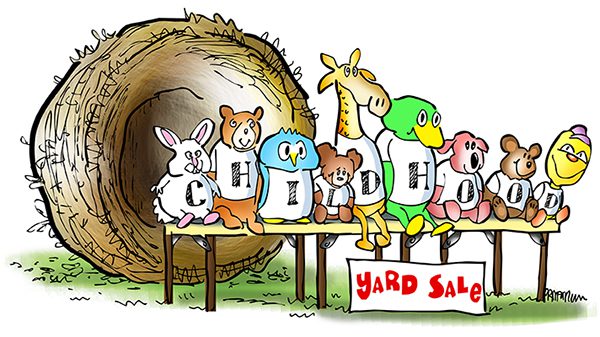
Last summer, he turned eighteen. And what did he want to do on his birthday? Have a yard sale.
Before that, for a few years, I had thought that maybe my son was a hoarder. I wasn’t sure if it was nostalgia or just a mine-mine-mine kid mentality. Kids love writing their names on their things.
When my son started accumulating too many stuffed animals on his bed, I secretly moved some to a box in the basement, so he wouldn’t be swallowed alive. If I dared to ask him before I did this, he would hem and haw and act like he didn’t want to get rid of any of them. When he was a sweet little pre-teen, we would go out somewhere—Oaks Amusement Park, or someplace where he would win a new stuffed animal. He would bring it home and introduce it to the rest of the “family” of animals on his bed. I would stand outside his door and listen to him do this. One plump little bear was called Fifty Cent because it only took me two quarters to win him out of one of those machines where you aim a small plunger thing at a tight little circle and hope it pushes out your prize.
Even if you think your kid seems like a hoarder, though, it’s likely they won’t be for long, and that’s part of the unpredictable sadness of parenthood. Those books I read to him so many nights—everything from Little Critter books to Captain Underpants—are now gone (sold at the yard sale). The Disney movies I sometimes thought I would never erase from my brain—when they stopped being played in our living room, they stopped for good. The tapes or discs had been inserted and ejected so many times, you could barely read the titles on them anymore. So if anyone is hoarding anything, it’s me with his old elementary school papers, art projects, and homemade Father’s Day cards.
Instead of these childhood objects, my son—we’ll call him Ben—now embraces things like violent video games, European goth-metal, bad movies, and Facebook. It pains me to write that, because those are not the things I’m into (except Facebook). He’s a great kid and I am proud that he has worked as a Search and Rescue volunteer since he was fourteen, a counselor at an Audubon camp, and spent the past two summers working for Youth Corps. He’s handsome and slender and prefers manga comics to novels. He—like me—is a picky eater who doesn’t like spicy foods. He’s lived the past couple of years with Crohn’s disease and has to take various medications every day for it. For a while, the meds made him break out and then he started taking pills for his acne. But he’s a tough kid, physically and emotionally, and I don’t recall ever hearing him complain about these problems.
I’ve always loved him. But we’ve grown apart. We barely talk anymore, even though he spends every other week with my wife and I at our place, which is a ten-minute walk from his mom’s house.
***
I often think of parallels between my youth and my son’s. Most parents probably do that. I know that in many ways, Ben is a more balanced kid than I was. I was prone to dramatics and worrying. I would pretend like I was sick and skip school often. I rarely did homework. I barely talked to adults. Ben goes to parties and readings with us sometimes, and he goes off on his own, socializing and making friends with people ten or twenty years older than him. He doesn’t miss school often, and he rarely seems worried.
One of the main differences between him as a teenager and me as a teenager is this: My parents were old and worn out from five previous children, and Ben’s parents (my wife and I at least) are still relatively young—and we’re cool. Is that weird to say? I mean, I’ve seen a lot of parents in my day, and I think my wife and I are a pretty sweet deal as far as parents are concerned. I tell my son I love him and give him as many hugs as I can. I know people usually lean one way or the other—a strict, stoic style or laid-back parenting. But no matter what direction you go as a parent, you always second-guess your skills. You always look back and think, I should have done that a little different or I should have addressed this issue sooner. In the past couple of years, I’ve second-guessed a lot.
I tell myself that this happens with all teenagers: they start to disconnect from you (their parent) right when they start feeling equal to you (equal in height, at least). As Ben becomes an adult, I still want to parent him, but I also want to share more adult moments with him. Like talking about politics, art, and Breaking Bad. But Ben shuts me out most of the time now. He goes into his room when he gets home and only comes out for dinner. It reminds me a little of the Japanese phenomenon called “hikikomori,” where teens stay in their bedrooms all day, playing video games and getting their food delivered to them by their parents.
It so frustrating that sometimes I want to make him talk to me. But then I realize how crazy that might look to him—his dad pleading to him, almost in tears.
***
It always looks easier on television. One of my favorite TV shows is Parenthood, and one of the things I like about it is how the parents speak to their children (whether they be bratty kids, a boy with Asperger’s, sullen teens, or even adults) so calmly and intelligently. It shows, pretty accurately, just how tough and messy parenting can be. Watching that show gives me a vicarious emotional release that makes me cry every episode.
A couple of months ago, after getting a bad midterm report, I had a talk with Ben. Maybe my fear of talking with him stems from the fact that I lack experience on both sides. I don’t remember a time when my parents sat me down for a serious talk. I thought about writing down what I wanted to say, maybe practicing in front of a mirror. Talking to your kid can be as nerve-wracking as going in for a big job interview. And it’s also like interviewing a temperamental actor or rock star—you’re afraid if you ask the wrong thing, they’ll tear off their lapel mic and say, “This interview is over!”
I went in and sat on his bed and asked him about his grades and why they’ve been plummeting the past two years. His first two years of high school, he’d done pretty well—mostly As and Bs and an occasional C. His teachers used to put comments on his report cards like: A pleasure to have in class. Those comments have changed to Missing assignments and Should see teacher periodically for help with studying.
 Confession: About five years ago, while at a friend’s house for a party, I saw her son’s high school report card and I snuck a peek at it. It was full of Ds and Fs. I put it down quickly and felt bummed out the rest of the night. How could this woman, in this nice house full of books, have a kid who was floundering so much? Of course, this was a dumb thing to wonder and my reaction was too judgmental. I see that clearly now.
So Ben and I sat on his bed, and he squirmed a little, like he really didn’t want to be there. I could see his defensive barriers going up. After talking about his grades, I reiterated the advice I’d given him before: If you’re having problems, ask your teacher for help; smart people ask questions; and, don’t just do enough to get by—take pride in your work and make it the best you can make it.
He seemed to feel a little more at ease. I did too, so I grabbed the chance to ask him blunt questions: Are you smoking? Are you doing drugs? Are you drinking? Are you having sex?
He answered no to all of them, and I believed him. I felt like I was in an episode of Parenthood.
***
The slow separation between Ben and me started when he was in middle school. He’d push me away when I’d try to put my arm around him. The first time it happened was a shock. He still took my hugs when we were at home—before school, before going to bed—but I learned not to act so parental, so cuddly, to him in public.
On most Saturdays, Ben and my wife and I walk from our house to a gelato place that makes doughnuts on the weekends. It’s something we’ve done for years. We take advantage of this time to talk to Ben, even if we just get a few bored words from him, while we walk briskly to keep up. When we get there, Ben orders a doughnut and two small scoops of gelato. He eats them quickly, while looking through a magazine (he usually ignores the kid stuff there and picks up the Vanity Fair). Then we’re on our way back home.
It’s strange to look at your kid and remember what you were going through at their age. You think your experience might hold the answers. I was so insecure at his age. I felt so unloved, so desperate. I was a dreamer but also a realist. I didn’t expect big things for myself. I don’t think I took any SAT or college prep tests. I didn’t apply to colleges. I got mediocre grades. I don’t remember being jealous of any of my friends who were leaving our dusty eastern Washington town to experience college somewhere. But I was jealous of my friends who were close to their parents. I didn’t have that. I didn’t have a parent who would try to put their arm around me in public, or wonder about my grades or how I was doing. If you asked me if my parents were strict or cool, I would say neither. I’m not sure what Ben would say about me.
Is it too late to become one or the other?
***
Earlier this year, Ben and I drove to Monmouth, Oregon, just over an hour south of Portland, to visit Western Oregon University. With his grades sinking, his hopes of going to a big school like University of Washington began to fade. After our day at Western Oregon, we were driving back to Portland, and I asked him about his list of options. He and his mom had previously visited a school in Vancouver, British Columbia, and he said he was applying there.
I thought that it would be too far away and I wouldn’t get to see him very much. When I told him about this concern and said I’d like to cross that option off, he became agitated and said, “I want to apply for school there, and that’s what I’m going to do.”
I did not keep my cool. Instead, I said something about his “shitty grades” and that it would be a waste of money to even apply. We didn’t speak for the rest of the drive. When we got back to Portland, he got out of the car at a stoplight and said he would walk home to his mom’s.
I drove the rest of the way home with a mix of shame and anger broiling inside me. I called his mom when I got home and told her about what happened and restated my concerns about his college options. We spoke on speakerphone, my wife was within earshot and sensed my tension. I was flustered and stumbling over words, while I tried to articulate my reasons. I admitted that I didn’t like the idea of Ben being a five-hour drive away, across another country’s border. “My mom only lives two hours away and I barely even get to see her,” I said.
Ben’s mom replied in a tone that sounded flippant, like it was too late to make any choices for him. He was eighteen after all.
What happened next doesn’t happen often. My frustration and worry and escalating sadness boiled over into anger and I lashed out. “You’re not listening to me!” I yelled into the phone.
There was a stunned moment of silence. My wife, sitting at her desk in the same room, shrunk in fear, jolted by my outburst. Ben’s mom said, “Whoa. Whoa, Kevin, calm down.”
But I couldn’t. I was hyperventilating and my voice was sticky with tears. It happens like this with me—I bottle up my fears and concerns, and then I eventually implode. Ben’s mom and I have different viewpoints of parenting. It’s been happening the past two years especially. “He needs to make his own mistakes and learn from them,” she said. “But I think we need to set up some rules or restrictions,” I said. It probably is too late for that, though. Maybe he’s already learning from his mistakes and having his parents come down hard on him would be too much of a double-whammy. But if I don’t try to enforce rules, won’t I just encourage more screwing up? Does trying to enforce rules at least show him I’m looking out for him, that I care?
When I get off the phone twenty minutes later, I am spent. I toss my phone on the couch and then fall face first into a pillow. I’m weeping and wailing, both from the fallout of the phone call and because I know that Ben’s mom is probably right about some things: I need to let him go more, there were times when I could have been more involved, and I have to start seriously thinking about the financial side of his post-graduation life.
Maybe I’m still stuck in that carefree state of mind like when he was in fifth or sixth grade and college was barely something to think about. The transitions in my kid’s life have been jarring at times. I remember walking around a Target and looking at their boys’ clothes and realizing that Ben was too big for them now. We had to go to a whole other area of the store and shop in the men’s clothes. Now, whenever I walk through the boys’ clothing section, I feel a tug of nostalgia. He’s nearly the same size as me these days.
***
I watched him closely as he sold his things at the yard sale. I observed him, studied him, acting like an adult. The first day of his adulthood, under my microscope. Some of the customers were parents, buying stuff for their kids. Ben asked them how old they are and when they said ten or twelve or fourteen, Ben said, “I really loved this when I was their age.”
That night, we had a barbecue party in our back yard with a bunch of our friends. Some of our friends brought their kids. Ben was nice enough to entertain some of the smaller boys in his room, playing games and showing them some of his old leftover Magic cards. I was outside shooting baskets with some friends. The daughter of an old friend watched us intently and I started softly bounce-passing the ball to her and having her pass it back. We did this several times, and I cheered her on with each pass, before turning and swishing an outside shot. It’s funny how, when hanging out with someone else’s children, you can recapture an unadulterated joy in acting like a teacher, a role model, a fun adult. The admiration of a kid looking up to you is larger than life. I’ve had these moments with my son too—teaching him how to drive, how to hit a baseball, how to skip a rock across a river. I hope he will remember those times as long as I do—at least until he has his own child.
A couple of days later, I saw this particular friend and she told me that her daughter was suddenly obsessed with basketball.

I don’t remember my dad showing me how to do very many things at all, so I have always tried to be the opposite way with Ben. The other day, I showed him how to poach eggs. While we waited the few minutes for the water to boil, I asked him, like I often do, how things were going at school, and if there was anything happening soon that he would be going to. This is one difference in us too—I used to go to high school sports games and even went to proms and school dances a couple of times. But he never has.
“I’m thinking about going to prom,” he said.
I was a little surprised about this. Other times, when I asked him about school dances, he scoffed at the idea, as if going to a school function was embarrassing. I secretly hoped that he would go to his prom or homecoming dance this year. I asked if he had anyone to go with him and he seemed to fill with doubt, and said he might have some ideas about that soon. I wanted to say he should ask someone soon and that he might have to rent a suit or tux, but I didn’t say anything because I didn’t want to discourage him.
When the water started to boil, we put two eggs in to poach. We turned down the heat and covered the pan and set the timer for five minutes. I almost turned the TV on, but then I thought I’d see if I could keep Ben going in a conversation. Five minutes with an eighteen-year-old can seem like a miracle, like holding your breath underwater, like staring into one of those optical illusions for a long time until something totally different makes itself seen. He turned to walk back to his bedroom and get ready for school, but I stopped him. “Hold on,” I said. “Talk to me more.” He looked at the timer on the oven. Then he told me about some assignments he had to do in school and some of the tests he had to take. Frankly, I hardly understood any of it.
If I had to go back to high school, I’d probably get bad grades too.
We talked about how he decided to go to community college in the fall, after he does another summer of Youth Corps work. I told him that was probably a smart move.
When the timer went off, he kept talking, and we delicately took the eggs out of the water. We each buttered our toast and put our egg in the middle of one slice. Ben took his butter knife and slowly, dramatically, stabbed right in the middle of the egg’s yolk and watched the yellow spill out. I took the knife from him and did the same thing.
***
Listen to Kevin read his essay:
Rumpus original art by Mark Armstrong.




8 responses
Hikikomori: my new word for the day. Although Matt does come out when I invite him. He watched Platoon for the first time (an assignment of my History of Vietnam class) and we spent an hour discussing the bbasis of the Ameircan engagement in Vietnam. He’s such a bright kid. Of course, at the Fortress of Squalitude, he can’t go into his room and close the door. It’s a walkthrough. There’s a curtain between our room. I offered to switch rooms with him, or even to move him into the front room and make the back door the entrance, but he said, no, it’s ok. I think that’s good as he’ll be in dorm life soon. But yes my bookshelves have entirely too many X-Wing trash novels. His mother just packs all of their kid art, anything she didn’t scrap book, and sends it to my 750 sq ft apartment, and I don’t know where to put it. I hate to part with some of it. And once he’s in the dorm, I’ll miss when we sit down and get into a two hour, adult conversation. He’ll probably go to his mom’s on the weekend since she has a washing machine and dryer, but I’ll gladly haul his stuff to the laundromat for him. Bring him with in fact and teach him how to do his own damn laundry and have another two hour chance to discuss Life, the Universe and Everything,
I have to resort to a cliché, but my heart is in my throat. My fourteen year old boy is bigger than his dad and lately I have been thinking I would do anything, anything, anything I could for a few extra minutes of childhood with him. I cry about it a lot. I am crying now. I am going to print this essay out and keep it with me. Thank you. Best of luck to Ben. He’s lucky to have such a thoughtful daddy –
Throughout this entire essay I saw my own situation and reading it made me weepy. My son is 17 and over the past few years has become less interested in conversation and hugs/kisses from me. I guess this is how it goes. Makes me sad too. It FEELS like I’m losing a close relations but deep down I keep reminding myself that the relationship isn’t lost, it’s evolving. One day, in the future, I suspect he too will go through this with his own children.
A lovely, heartfelt piece. I’m 22 so I completely relate to Ben’s disengagement from his father. As a teenager everything is always wrong, school is hard, and life doesn’t seem so amazing, so it’s infinitely preferable to be in your room, doing your own thing, instead of talking to your parents about school, which is usually the first and only thing they tend to ask you about. But it’s impossible to see things from your parents’ point of view until you’re much older. I think this piece should be read by teenagers for a taste of what it’s like to be on the receiving end of this kind of typical teenager treatment.
Thanks for your comments. Especially you, Maria. It’s nice to hear someone your age feeling a connection to this essay. I think if parents are supportive and maintain an unconditional love, the “kids” will eventually realize it and be thankful. I hope so anyway.
I cried while I read this. Is it something every parent endures? Probably. Even still, I beg you not to give up trying to (re)connect.
I managed to get my son talking to me again when I reversed roles. I had a problem and was desperate to vent. I vented to him. And you know what? This kid who can’t keep his room clean and never remembers to take out the trash suddenly was wise, wiser than I, and listened. And gave me great advice.
Maybe this disconnect is what happens when we, in our zeal to grow a responsible adult, pick on the little flaws like bad grades and sloppy rooms and video game addiction instead of complimenting and encouraging the things they don’t even know they like (like basketball).
When I expressed an adult problem and shared my fears and anxiety, my son rose to the occasion. He didn’t throw crap in my face like my room was a mess and I never take out the trash (things I’m ashamed to admit I’ve done). He listened. He made suggestions. I treated him like a grown-up.
He became one.
I have a 15 year old son. We also have three additional boys! Our house is loud and messy, but you know what connects my 15 year old to our family best? His youngest brother. The 15 year old went away for three weeks this summer. We used FaceTime to connect 3 or 4 times during the duration. The first thing he asked was to see his littlest brother, talk to him, see what he was up to.
I’ve never been so convinced that siblings (and big families) are a gift.
When I think back to the hell I put my single mom through as a teenager, I want to smother myself in my sleep. Why she never did so remains a mystery to me to this day. Thank you for sharing your story in such an accessible way, Kevin.
Click here to subscribe today and leave your comment, or log in if you’re already a paid subscriber.