
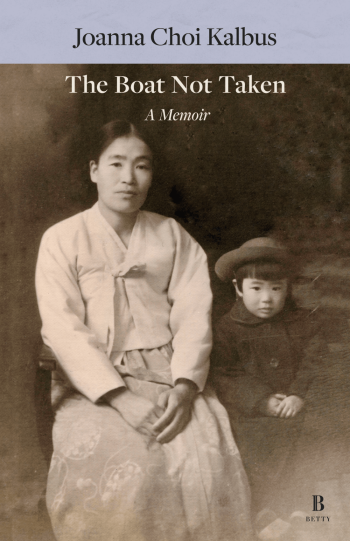
In her memoir, The Boat Not Taken (Betty, 2025), Joanna Choi Kalbus describes how her family was uprooted from war-torn North and South Korea after World War II. Kalbus narrates a journey from North Korea to North America where the wonder of a child confronts the fortitude of a mother with a question—“What now?” A close-knit mother and daughter duo emerges from adversity. Across travel over land, air and water, they build a new life together which spans almost the entire twentieth century. When Kalbus unearths a family secret after her mother’s death, she reflects anew on her life and returns to Korea.
I first heard Joanna Choi Kalbus share about her experience of fleeing North Korea with her mother in May 2016. We were at a weekend conference for women writers (VORTEXT) sponsored by Hedgebrook on Whidbey Island about to listen to participants read some of their work. Despite being five foot two, Joanna stepped up to the podium and projected herself like a statuesque hologram before the audience. She read about how a grandfather clock played a role in their risky escape. I was left awestruck by the presence of this formidable woman. Later that evening, as we socialized among attendees, I was humbled by her candor, compassion and wit.
I had the privilege of catching up with Joanna to discuss her memoir through a series of exchanges via email and video calls.
The Rumpus: When you read at Hedgebrook, I noticed how the audience was mesmerized by your presence. Your voice emanated like a roar. Do you believe that lioness roar comes from your lived experience?
Joanna Choi Kalbus: Yes, I was a roaring lioness. I think of myself as a tall person, which makes me feel and lets others understand that I can be a formidable person. I needed to be perceived that way because I didn’t want to be invisible. I had to create myself—to say, “You are a tall and important person.” There is a saying about how you have to love yourself first. That is what I did. I created my own version of what I want to be.
Rumpus: In your book, you mentioned how you would emulate your mom. How much of your mom do you see in yourself?
Kalbus: A lot. On the cover of my book, my Omai was forty, and I was about four years old. I folded my hands just like she did it. She was my world. It was just my Omai and me throughout my life with her. I gained confidence because she had confidence in me and demonstrated her unconditional love—that doesn’t mean everything was smooth between us. There are many things to emulate, such as grit and resilience. Now that I am old, I look just like her. I look in the mirror and say that’s my Omai. What is she doing in the mirror?
Rumpus: After reading your memoir, I was awestruck by the parent-child dynamic between you and your mom. What reflections stand out about the relationship between you and your mom?
Kalbus: We were very close—so close that everybody in our whole village called me “Gong-dae.” I was Omai’s tail, meaning an extension of Omai. She was the head, and I was the tail. I was also the last child. She nursed me until I rebelled that I didn’t want to be breast fed at the age of four. I realize now she wanted to prolong my babyhood. We shared the same bed until the day before my wedding. The two of us could read each other. My memoir chronicles our adversities as well as our achievements. She wanted me to attend a university and become a teacher. She cried at every one of my graduations and achievements. I know now life is fragile and fleeting, and I take every celebration at heart. She cried at every one of my successes.
Rumpus: Your mom referred to sailing to America as going to a beautiful land. What was your impression of this beautiful land?
Kalbus: Yes, “Mi Gook.” “Mi” means beautiful, and “Gook” means land. After about two weeks of shipboard experience, my mother and I were standing on the deck of the ship when we saw the golden gate bridge, sparkling and orange-red. With the blue sky and turquoise ocean, it was a vision of paradise. Beautiful land. Beautiful bridge. Back in Korea, we heard that the pavements were not cement, but rather paved with gold—that is how wonderful we perceived America to be.
Rumpus: You shared the difficult decisions your mom made to keep you safe and her hard work to provide for you. Did your mom and you talk about the challenges you faced?
Kalbus: We never talked about the bad times because they were painful. Like many immigrants who didn’t speak English, she worked at menial jobs until I graduated from college and was able to take care of her. She led by example. She worked so hard. She worked during the day, then continued to work at night. She would make bow ties and the little boxes that rings are encased in. Even now, I have cartons upon cartons of jewelry boxes because I can not throw them away because they are handmade by someone who could be like my Omai, working hard for their children.
Rumpus: How did your experience of being immersed in both Korean and English influence your appreciation for words and language, spoken and unspoken?
Kalbus: Between Omai and me, it was natural that we’d communicate without words. Her face and body language told me everything. There is a Korean word I like: “nunchi,” which translates to eye perceptiveness. Also, I did not realize how my Omai and I invented our own language. I had heard of Spanglish—ours was Koreanglish. We sprinkled English words in our Korean sentences. I feel like we were pioneers.
It wasn’t until I started writing my memoir that I was cognizant of linguistics. I have a great appreciation of erudite Korean words. In a chapter titled “Jeong,” during my visit to Seoul, Korea, my cousin asked me if I knew that word. I guessed the answer by saying, “Love?” Since my education ended at third grade with the start of the war, I did not learn how to write Chinese characters. My cousin drew ink strokes as he explained, “These strokes mean heart and these strokes mean blue.” I learned that Jeong can have many meanings. Jeong encompasses love, affection, sentiment and endearment.
Rumpus: Your memoir recounts your journey to Korea after your mom died. What impact did returning to South Korea have on you as an adult?
Kalbus: Speaking with other immigrants from various countries, we agree that immigrants straddle between two countries. I went back to South Korea to deliver my mother’s clothes to my aunt. Confucian funeral rites call for the burning of a deceased person’s clothes to ensure the deceased have clothes to wear in the afterlife. Because my Korean was stunted at age ten, after the passing of my mother, I didn’t have anyone with whom to speak Korean. Besides having a northern accent, my Korean was very rusty and ancient. I felt like a stranger in my native country.
Rumpus: After a lifetime in America, how do you view this beautiful land?
Kalbus: It is still the most beautiful land and wonderful country. I became a naturalized U.S. citizen. I am an American. I am grateful to the United States for the opportunity to pursue the American dream.
Rumpus: What do you want readers to take away from your book?
Kalbus: To write my book, I researched the world events that affected my family. As a writer, I had to metaphorically journey to Korean history. Through the process of writing, I had to process the secret my Omai took to her grave. It took soul searching. I had to really think and reflect on my Omai’s story in order to tell my story. I want readers to experience how the most valuable word in the lexicon is empathy. I had been my mother’s tail her whole life. To write this memoir, I had to come to understand what it had been like for my Omai to have been the head and the heart.