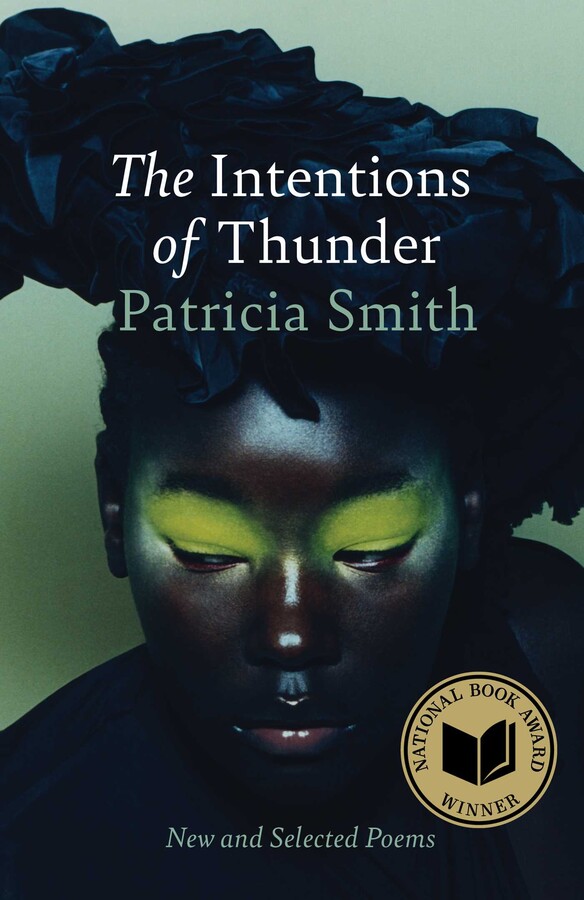
How can a poet chronicle her life outside the expected formats of memoir, autobiography, and autofiction? Who can someone become when they build a life with stanzas? Patricia Smith poses these questions to her readers—while summoning the answers with a carefully crafted and edited anthology of her work—in her most recent The Intentions of Thunder (Scribner Poetry, September 2025). Anthologies are important, especially in these times. With an American culture hell-bent on erasing history—in large sloppy swaths. They cannot erase a history, even when the powers that be try their damnedest to erase a people—the people and their lore remain. Black people remain. Black women exist. Black poets tell stories, no matter what.
Ten chapters, if you will, demarcate a full life of writing, storytelling, and keeping history. Each section opens with a prelude—an interface with the interior of a poet reviewing the lens through which the work was made then and how she is responding to it now. These self-referential interstitials break each section, referring to works’ motifs that she has either resolved or that will never die. What happens throughout this collection—that gnawing specter of death circling the reader and her psyche —is what might happen when you open a time capsule only to discover it is a sepulcher.
In Life According to Motown (1991), we meet the poet as both a girl and a young poet—ripe with something akin to promise. A ghost, or a right-sized giant angel, Gwendolyn Brooks anchors the center of a prose poem, and then we’re off! We see the life of a child in Chicago—rather we enter into “What It’s Like to Be a Black Girl (for Those of You Who Aren’t),” and since I was one, I recognize the harmony in the telling of the modern experience of some of us descendants of the Great Migration. But it also sets the tone for the reader to recognize that perhaps not only is the poet writing for herself, but for an audience of people who will never be Black girls.
First of all, it's being 9 years old
and feeling like you're not finished, like
your edges are wild, like there's something—
everything—wrong.

She engineers a self-portrait of a woman in her sexual beginnings, the mirror being a man’s gaze –the subject finds herself entangled in a tawdry relationship.  Like many R&B tunes, we see a woman boast of her prowess through the lips of another woman’s lover:


…Your man hurls light against my skin
and forgets your name if that's what I need.

Yeah, your man is your man,
 but he visits me sometimes
he rocks the house sometimes
he shakes it up sometimes
he makes it right.
All the time.
Sometimes.

We don’t think enough about people’s sexuality – said not a single American. A part of the American gaze is working in subterfuge, a conservative mouthpiece with depraved imagination - this sharp binary dictates many of our obsessions with carnal desires while shaming that impulse to know with brutality.  So when the erotic life of a poet comes onto the page, it becomes a reason to pay attention. Smith is telling us something about how she thinks about intentions, boldly defying the expectations of purity that are assigned to respectability; a major invention by a Black woman performer and writer of the early 1990s. In the 1990s, we tracked an emergence, a bud aching to bloom between the cracks in the sidewalk, with boots all around threatening the tender green. Big Towns, Big Talk, 1992, is a swaggering between picture making and autobiography as self-song.  The lyrics climb off these pages and into an attitude a reader can’t shake, but maybe one that can be shimmied to. Dancing with a sensibility that maybe senses itself is the excruciating toll of living. The stories of the American South are told through her parents, who are named but not identified as such in these early works.

After all, it was 1969, year plump with deceit.

… A woman reduced to juices, sensation and ritual,
my mother saw the stars only as a signal for sleep.
She had already been promised the moon
and heaven too…

My father told me how she whispered in tongues,
aching for a sign she wouldn't have to die to believe,

In "Annie Pearl Smith Discovers Moonlight," which is not quite an ode to her mother—we get there just later in Smith's oeuvre. Smith knows how to put the reader to work.  At points, I am inhabited by the weight of her words and want to work them out with my own tongue. Friends, family, and famous figures occupy her imagination.  And right after we meet the legendary figures, we’re reminded of the homegrown American violence that a particular section of the public wants us to ignore.  But we cannot. In "Skinhead"

I was born
and raised
right here.

Here we have a portrait of a homegrown terrorist; we don’t even call them skinheads anymore—they don’t even try to “have a look.” They are now just boys and men, some with male pattern baldness. Some are not even white anymore. In "Poems Are Really For People Who Don’t Read Them," Smith declares in her opening to Close to Death, 1993. Smith reports on the casualties of cruel capitalism. The men who die. The men who abandon the dying. The dead who haunt the living, and the women we ignored in the post-Rodney King—pre-Million Man March rubble of Black political discourse of the 1990s. Urban urbane reportage.


…forget that I'm telling you it's the first thing
I ever cooked, that my daddy was laughing
and breathing and no bullet in his head
when he taught me

…and he is laughing and breathing and no bullet in his head

"When the Burning Begins" is a tribute to the poet's father, who was murdered when Smith was a young woman.  In these lines, there is no living without dying. Emotional reenactments are vignetted between sharp, serious, and shocking lyrics. It can be tough to read about the 1990s. Not that so much has changed about the spectacle of Black death, just how we talk about it. One way makes me cringe. —and the other ways through rampant portrayals of negrocide have turned me numb, as if I have been shot in my spine.

The editing of this work is remarkable. The precision of placement of these poems’ protagonists and environments readies you for the next, even when you least expect it. "In Teahouse of The Almighty, 2006," dedications become themes that invite curiosity,  often operating as lyrical riddles meant to be solved or misinterpreted.

The section that took me the longest to finish was the work on Hurricane Katrina. Conjuring weighted visceral images, these poems forced me to stop reading, put the book down, and take time to process.  More than just the haunting retelling of the environmental catastrophe,  it is the calamity of the disorganized and compassionless response by the federal government. As a population of Black people facing regional crises, the poems work as a record of how that grief, 20 years in the making, has not been addressed culturally.  Infrastructurally, much of the work that has been done has removed any trace of what once made that place special. I worry about the compounded impact that era has had on the psyche of the American South and those who look, live, and experience their racialized lives in ways that mirror the survivors of the aftermath of Katrina.

Smith forces you to bear witness, and there is no looking away if you intend to make it through the volume. She has a way of showing you the locale, telling you through her poetic signals what you need to pay attention to.   The suite of poems recollecting trauma travels the distance from narrative to forms framed by archival emails and then into abstraction. It then moves to a motif that reckons with the chorus of grief. A testimony to loss, and to the complications of remaining.

October (the month in which I’m crafting this review) is becoming known as Hoodoo Heritage Month, a socio-cultural designation coined by Mama Rue and the Walking the Dikenga Collective of Chicago, Illinois. An element of this syncretized African diasporic spiritual practice is the recognition of the thin veil between the here and now and the afterlife.  It honors the work, joy, embodiment, and sacrifices of the Africans who came before us.  What Smith has done with this grimoire text is beyond piercing that veil—she lifts it up and forces us to face our mate at the altar and become one with it. Those stanzas live with me—viscous combinations of texts like this in "34:"

The walls are slithering with Bayou spit,
Tears, and the badness that muddies rivers.
We flail in that sin,
alive and bended beneath a wretched Southern rain.
We sip our breath from that filthy ocean.
Only some things float

The 18th of 34 entries that function as a memorial to the 34 souls left to die 20 minutes south of downtown New Orleans on the day Hurricane Katrina’s floodwaters turned their home into a tomb of water.  With each stanza, it is as if you see their faces and feel their frail loneliness, their anger, and the guilt of all the abandonments they endured.  On a sensory level, the descriptions throughout this volume move from formulated allegory towards synesthesia and prose-verse.  Smith is a master of her languages, composing at the will of her impulses. The motif of death, decay, dying, heartbreak, and the tragedies found at home populate every iteration of the poet’s works.  Across works spanning from the 1990s to the present day, we see the writer grappling with her fixations, and perhaps many readers will find they cannot look away, yet as I experienced it, even when I did look away, I was left haunted.

The second half of the book begins with "Should have been Jimi Savannah, 2012," and demands that we, as her students, locate the “I” with word play that traverses the space-time continuum.  This memoir-in-verse opens with a section that functions as its own book, with Smith announcing the tenor in the prologue before we get down to the work.  These pages take us from down South to up North, walking us through her mother’s childhood origins and her father’s early losses.

We see the making of lives primed for escape. The journey up to the North “liberated” Southern folks into urban traps with new pests and forced them to raise foreign children. Then emerges a generation that belonged more to the outside, creating a new facet of  Black culture that became popular: Motown.  In "Tavern. Tavern. Church. Shuttered Tavern," a map of a city is drawn around its exploits and fleeting sites of respite. Raggedy and precarious, a Chi-town girlhood comes into focus after walking the streets from winter through summer. A city becomes a mind, its inhabitants the neurons transmitting information.

They are trying to ignore, the great promise of a government, twenty-five floors
of lying windows, of peeling grates called balconies, of yellow panties
and shredded diapers fluttering from open windows of them nasty girls

With wide avenue hips stomping doubledutch in the concrete courtyard,
spewing their woman verses, too fueled and irreversible to be not
 listened to and wiggled against and the Madison street. bus...

The music of Motown closes out the section dedicated to the Baby Boomers born of southern migrants. The poet bears witness to the chilly northern life and the desperate attempts at assimilation in "Thief of Tongues:"

 My mother is learning English.
… then she's stiffly seated at a scarred oak table
across from a white, government sanctioned savior
who has dedicated eight hours a week to straightening
afflicted black tongues. She guides my mother…

Repetition in the verse is reminiscent of the melodies of a mid-20th-century youth and the music factory that tricked, lulled, romanced, and danced with the generation negotiating freedom and precarity.  I wonder so much about the poet's relationship with her mother.  We learned why her mother haunts her in 2012, while she remains hardly visible, barely rendered on to the page: she remains alive on the poet’s skin. "An All-Purpose Product," a poem hidden behind advertorial language for the usage of the famous disinfectant cleaner Lysol, reveals the harsh ways the young poet’s mother confronted colorism:

Mama, can’t you read it? You want me to read it to you? I can't help being
my color! I am black, I am not dirty. I am black, I am not dirty, I am black,
I am. Not. Dirty. What you have birthed upon me will not come off.

You convince me that I am what is wrong with the world.

Scrub me right.
Bleed me lighter

In "Incendiary Art," poems ignite under the crux of fire: the burning of American landscapes in the wake of its violence. The collection ends with her most recent works, Unshuttered, published in 2023, and a robust assortment of poems that do not appear in any of the poet's other books. In Unshuttered, Smith visits the photographic archive, fabulating her way from images of dignified Black people to others showing Black people struggling to maintain their dignity despite being presented as property. The collection of works bannered under Uncollected 2010-2024, collates the digital landscapes of racialized and gendered discourse—offering the poet more news and archival material to ponder and plot.

Gwendolyn Brooks, who welcomed the entrée of this book, marks the final prologue with a quote from her canonical Maud Martha, centering the page and preparing readers for the last poems, simply entitled "70," the age Patricia Smith is now. But she was learning to love movements. To love movements for themselves. Indeed, Smith must love movement: she knows gestures so well and has been deeply informed by the ways life moves, is unstoppable, and somehow unchanging.  The Intentions of Thunder capture her witness.